Capabilities
RAG Development Grounded in Approved Business Knowledge
A retrieval demo that reads well and a retrieval system that is safe in front of staff or customers are two different builds. Our RAG development services are organized around the two failures that end most internal assistant pilots: surfacing content a user is not cleared to see, and answering confidently when no approved source exists.

Choose the questions worth answering
Scoping starts with people, not models. Which roles will use this: intake coordinators, compliance reviewers, regional operations managers, contract administrators, clinicians checking a protocol between appointments? Which decisions does each one make, and which document is authoritative for that decision when two versions exist?
That mapping produces three lists: question types the system should answer, question types it should route to a human, and question types it should refuse outright.
Retrieval augmented generation pairs a language model with a searchable external source instead of relying only on what the model absorbed during training, an approach described in the original 2020 research combining parametric and non-parametric memory (Lewis et al., Retrieval-Augmented Generation for Knowledge-Intensive NLP Tasks).
The external source is the part you control, so defining it precisely is the first engineering decision, not a formality.

Prepare and index approved content
Most content arrives messy: scanned policy PDFs, exported handbooks, contract repositories, product sheets with three live revisions, CRM notes that mix fact with opinion. Preparation handles extraction quality first, because a table that flattens into nonsense during parsing will retrieve as nonsense later.
From there the work is structural. Chunking that respects headings and clause boundaries rather than arbitrary character counts. Metadata on every chunk: document owner, effective date, superseded version, jurisdiction or location, and access class. An update cadence that says who republishes what, and how quickly a corrected policy reaches the index. This indexing layer is where a general architecture becomes a specific system, and it follows the same scoping discipline described in how configurable AI workflows are scoped.
Retrieve with identity controls
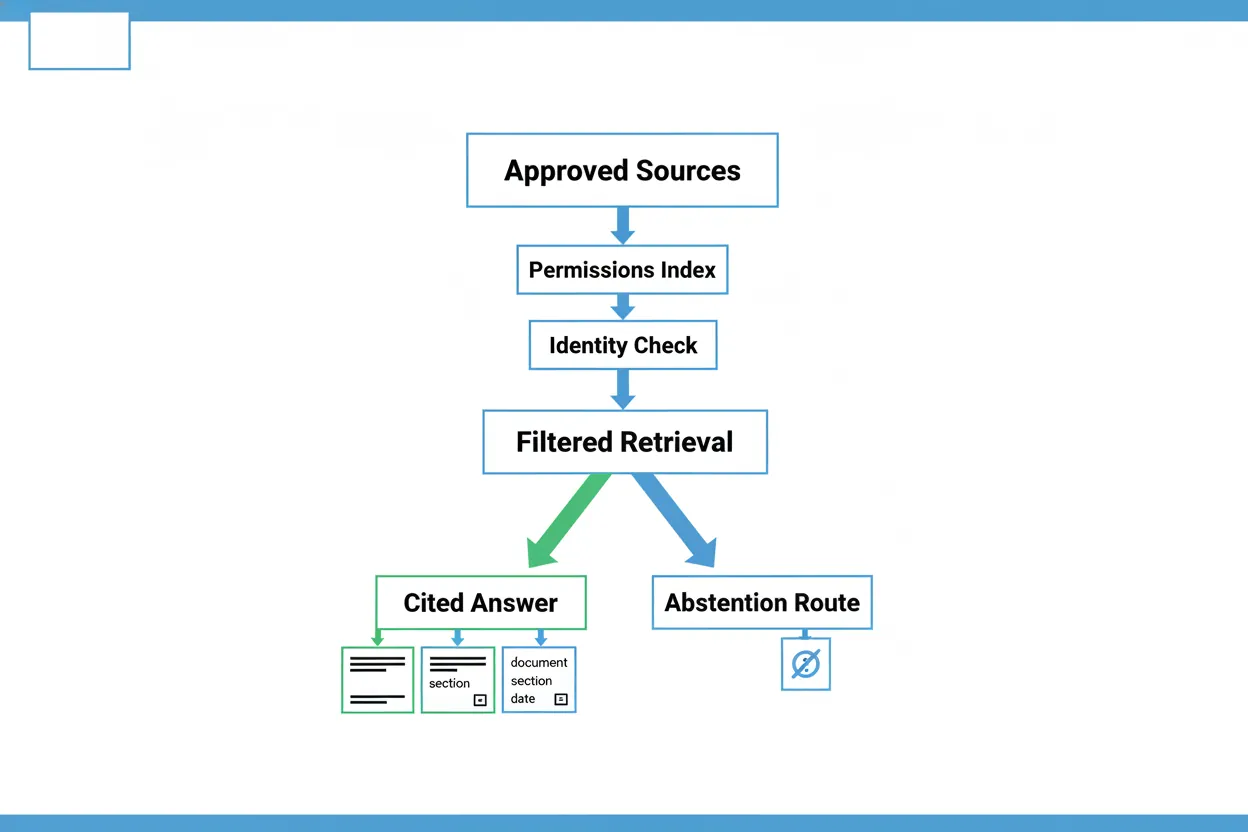
Permission belongs in the retrieval step, before any content reaches the model. A prompt instruction telling a model to withhold restricted material is a request, not a control. The durable pattern is to attach access classes to content during indexing, pass the requesting user's identity from your existing directory or application, and filter candidate documents at query time so unauthorized material is never assembled into context.
For healthcare organizations this maps onto an existing obligation rather than a new one. The HIPAA Privacy Rule generally requires covered entities to limit uses, disclosures and requests for protected health information to the minimum necessary for the intended purpose, and to define in policy which classes of workforce members need access to which categories of information (HHS, Minimum Necessary Requirement).
A retrieval filter is one implementation of that policy, and it only works if the permission data in your source systems is accurate and exportable. This is internal knowledge retrieval, distinct from campaign execution work covered in our AI Agents for Marketing Agency Selection: Executive Guide.
Free Audit
Want a straight read on where your budget is leaking?
Generate answers with evidence
A grounded answer has three visible parts: the response, the citations behind it, and the boundary of what the sources actually support. Citations name the document, the section and the effective date, so a reviewer can open the source and confirm it in seconds rather than trusting a summary.
Abstention is a designed output. When retrieval returns nothing above the relevance threshold, or returns only expired material, the system says no approved source was found and offers the owner or channel to ask instead.
When two current, authorized sources disagree, the better behavior is to present both with citations and escalate, rather than silently selecting one. Deployment shape matters here too, including which models run where and what leaves your environment, a topic covered in owned AI systems and deployment boundaries.
Marketing Powered has been AI-native since 2022 and operates owned, local AI infrastructure for HIPAA-aware inference.
Evaluate the entire pipeline
One accuracy score hides the failures you need to find. Evaluation separates four questions. Retrieval recall: did the correct passage appear in the candidate set at all? Grounding: does every claim in the answer trace to a retrieved passage, with correct citations? Usefulness: would the intended role act on this answer without rewriting it? Leakage: when a restricted query runs under a lower-privilege identity, does the system withhold the content and the fact of its existence?
Each one needs its own labeled set, built from real questions your teams ask. Those sets then run as regression tests after model changes, index rebuilds and permission updates. Reviewing what a permission-aware evaluation set contains is a reasonable first conversation before anyone commits to a build.
Maintain knowledge over time
A knowledge system decays quietly. Policies get amended, a location closes, an employee changes departments, a contract clause is replaced. Maintenance assigns named owners for each content domain, defines how deletions propagate from the source system through the index, and specifies how access changes take effect. Re-index triggers are explicit, and the regression suite runs after every meaningful content change rather than annually.
Questions, Answered.
Fine-tuning changes model weights, which makes individual facts hard to attribute and harder to remove. Retrieval keeps your documents in a searchable store the model reads at answer time, so responses can cite a specific source, permissions can be applied per request, and deleting a document removes it from answers at the next index run.
That is the design target, and it depends on your upstream systems. Each indexed chunk carries an access class derived from the source repository, and the requesting identity filters candidates before context is assembled. The limiting factor is whether your existing permission model is accurate, current and readable by the retrieval layer, which is one of the first things scoping examines.
Effective dates and supersede relationships are stored as metadata, so expired versions can be excluded or flagged. When two authorized current documents conflict, the appropriate behavior is to return both with citations and route the question to the assigned content owner. Silent resolution by the model is the outcome to avoid.
A representative list of real questions and the roles asking them, an inventory of systems holding the content, your permission model and how it exports, content update frequency and approval chain, deployment constraints, and any regulatory conditions that apply to the data involved.
Ownership, retention, hosting, access and approved data flows are documented in writing before a build begins. Your source content and your data remain yours.
Access to our services does not transfer our proprietary tooling or configurations, so the agreement states explicitly which artifacts, such as the chunking and metadata schema and the evaluation set, are delivered to you.
Bring a narrow, real use case and the documents behind it, and we will work through scope, permission dependencies and evaluation design together. Scope a RAG pilot
More Services
Ready to see where your marketing can improve?
Request a free audit of your paid media, landing pages, attribution, and measurement setup. You'll get a straight assessment of where the opportunities are.
or email us at info@marketingpowered.ai