Capabilities
AI Data Preparation for Search, RAG and Evaluation
Most internal AI pilots stall for an unglamorous reason: nobody decided what the system was supposed to know, who owned that knowledge, or how anyone would prove an answer was correct. AI data preparation services close that gap by turning scattered documents into an approved, versioned corpus and a matching evaluation set for one defined use case. It is a different job from warehouse cleanup, from historical data migration, and from training a model.

Define the intended AI task before any data work
The first working session is not technical. It puts the people who actually own the content in one room: the operations or clinical ops lead who will be blamed for a wrong answer, the privacy or compliance reviewer, the IT owner of each repository, and the person who currently answers these questions by hand.
Together they write down the questions the assistant must handle, the answer quality bar, who is allowed to ask, and the business cost of a wrong or unauthorized response. That written task definition decides which documents enter the corpus and which stay out. Preparation without it produces a large, generic index that performs convincingly in a demo and poorly in daily use.

Inventory ownership, rights and authority
Before anything is indexed, each candidate source needs a named owner, a stated authority level, and a decision about whether it may be exposed to the system at all.
This surfaces the things that break retrieval later: three versions of the same policy, a superseded price sheet nobody retired, a shared drive that mixes public material with restricted records, and content the organization uses but does not have the rights to reuse.
Enterprise knowledge normally spans multiple platforms, and building a unified search corpus without disrupting existing data operations is a recognized challenge in RAG design, not an edge case (Microsoft Learn).
Deployment choices follow from this inventory, which is why the cost and control trade-offs in AI Infrastructure: Owned vs Rented AI Economics belong in the same conversation.
Extract and structure content without losing provenance
Extraction is where most quality is quietly lost. A PDF flattened into raw text destroys the table that held the actual answer, strips the heading that gave a paragraph its scope, and separates a figure from its effective date.
Preparation keeps tables as tables, preserves heading hierarchy, retains identifiers such as policy numbers and document versions, and attaches provenance so every passage can be traced back to a source file and a revision. This matters because language models accept limited token inputs, so retrieval must return concise, highly relevant results rather than document dumps (Microsoft Learn).
Extraction rules are set per source type and per task, in line with how configurable AI workflows are scoped.
Free Audit
Want a straight read on where your budget is leaking?
Prepare metadata, chunk boundaries and permissions
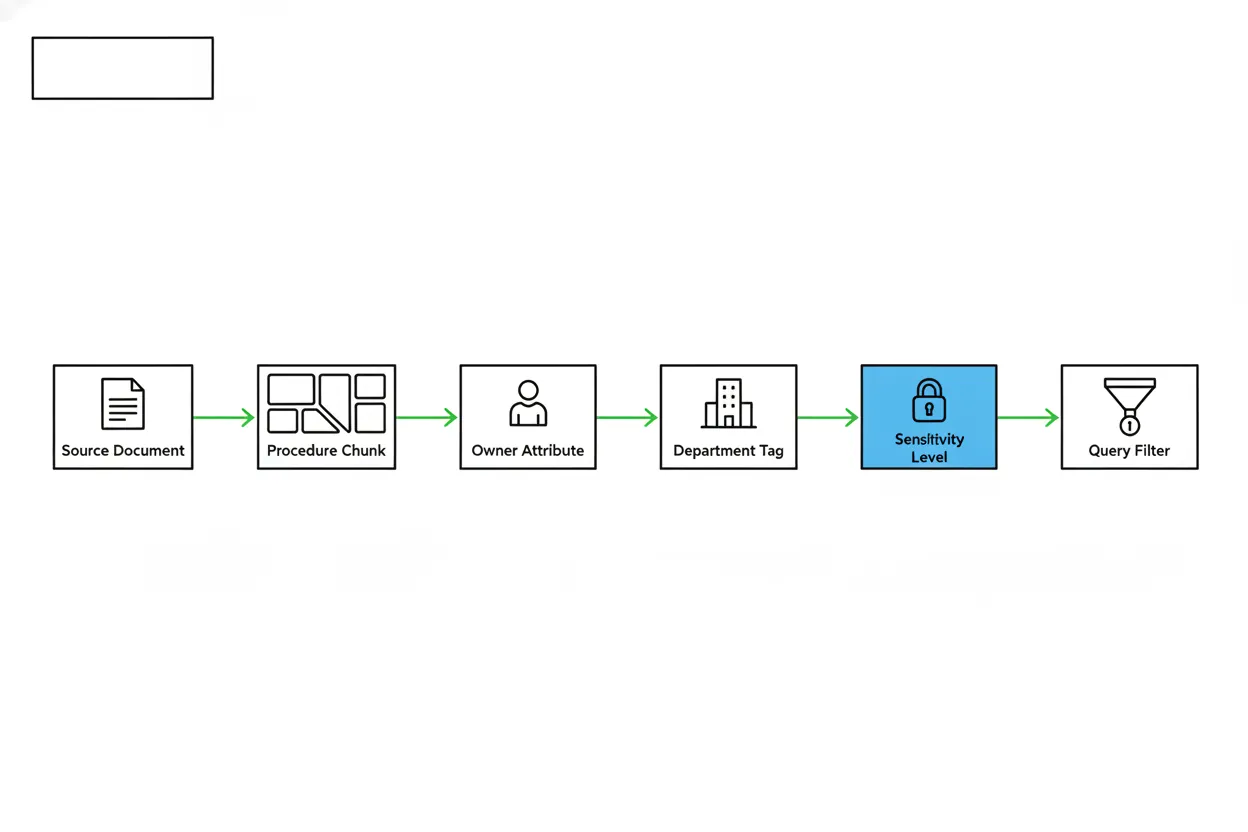
This is the stage that decides what a user can see. Content is split along meaningful boundaries, a clause or a procedure step rather than an arbitrary character count, and each chunk carries attributes: source system, owner, effective date, jurisdiction or location, department, and sensitivity.
Those attributes become the filters applied at query time, so a question from a front desk coordinator and the same question from a finance director return different authorized material.
Opening private content to a language model requires granular access control, and common patterns include document-level security trimming, inherited permission metadata and filter-based security at query time (Microsoft Learn). Update rules are defined here too, including how a revised document retires its predecessor. See owned AI systems and deployment boundaries for where this runs.
Build evaluation examples, including refusal cases
An evaluation set is what separates a demo from a system you can defend. It pairs representative questions with the specific source passage that should answer each one, so correctness is checked against evidence rather than impressions.
It also includes negative and refusal scenarios: questions the system should decline, requests from roles without authorization, and questions whose answer is genuinely absent from the corpus. A model that invents a plausible answer in those cases is the failure mode most organizations fear, and it is only visible if someone tested for it.
Where the material is sensitive, evaluation can run against supported local processing rather than a third-party endpoint.
Deliver a maintained data product, not a one-time cleanup
A corpus is a living asset. Preparation work therefore specifies versioning, a deletion and retraction path, freshness checks that flag stale documents, re-indexing triggers, and named owners for each source after handoff.
Data modernization practice generally treats operating processes, data quality and downstream AI use cases as connected work rather than a single cleanup pass, because content that is scattered or stale degrades every system built on it (Thoughtworks). Without those controls, accuracy decays silently and trust is lost faster than it was earned.

Email Us
Prefer to send the context directly?
Where this fits beside warehouse work and model training
Three jobs are routinely confused. Warehouse and data-quality work makes structured records consistent for reporting. Model training changes a model's weights using large volumes of examples. Corpus preparation does neither: it assembles a bounded, permission-aware body of documents plus the metadata and test cases one retrieval task needs, and leaves the model unchanged.
Readiness and governance assessment is also treated in the market as its own phase, separate from implementation and ongoing operations (HatchWorks). Marketing Powered focuses on the use-case-specific layer: knowledge base preparation, retrieval corpus engineering, metadata and evaluation inputs. Broader warehouse quality work and historical data conversion remain separate engagements.
More Services
Ready to see where your marketing can improve?
Request a free audit of your paid media, landing pages, attribution, and measurement setup. You'll get a straight assessment of where the opportunities are.
or email us at info@marketingpowered.ai