Resources
AI Infrastructure: The Economics of Subscriptions, APIs, and Owned Systems
Mid-market marketing teams face compounding generative software expenses across seat licenses and unbudgeted model usage fees. While enterprise software vendors frame this as an inevitable choice between competing cloud ecosystems, operating dedicated ai infrastructure provides a predictable third alternative. For marketing leaders managing high-volume campaigns, multi-location intake, and sensitive customer records, owning local compute delivers lower unit costs and stronger operational control.
By Mike Hulick, Founder, Marketing Powered

The Three Layers of Marketing AI: Subscriptions, APIs, Owned Infrastructure
Convenience is an expensive permanent operating model. When marketing departments began adopting generative models, the path of least resistance was simple: enter a corporate credit card into a web portal and distribute logins across the team. Over time, that initial convenience solidifies into three distinct operational layers, each carrying radically different cost trajectories and technical trade-offs.
The first layer consists of off-the-shelf software subscriptions. These per-seat tools package underlying foundation models behind clean graphical interfaces. They require zero technical setup, but they isolate work inside proprietary vendor environments where your team cannot inspect the underlying prompt mechanics, retrieve structured weights, or prevent unexpected interface changes.
The second layer consists of commercial application programming interfaces (APIs). Instead of paying per seat, your engineers or technical marketers pay per token consumed, submitting prompts directly to models hosted by vendors such as OpenAI, Anthropic, or Google. APIs allow dynamic integration into internal customer relationship management (CRM) systems, automated reporting pipelines, and content management workflows. However, this model turns marketing production into a variable metered utility where higher volume generates higher monthly vendor invoices.
The third layer is owned ai infrastructure. In this architecture, an organization invests in dedicated local workstations or private collocated hardware running an open-weight foundation model. The physical machines sit within the company's direct perimeter, whether in a secure on-site server closet or a private rack. Operational commands run locally through terminal pipelines, processing batch tasks without sending data across external networks. The workflow does not require recurring per-token fees to third parties.
Choosing among these layers determines how much equity your marketing department builds. When you rely exclusively on rented interfaces, you build zero transferable intellectual property. When you build workflows on owned hardware, your investment yields reusable local assets, customized models, and predictable balance-sheet capital rather than volatile operating expenses.

AI Subscription Costs and the Friction of Seat License Sprawl
Marketing executives frequently discover generative tool expenses only after software-as-a-service (SaaS) license creep has already taken root across multiple departments. Content writers request one set of tools, performance media buyers subscribe to ad-copy generators, and creative teams purchase separate image platforms. The monthly cost of individual seat licenses appears negligible on expense reports, but the cumulative financial footprint expands rapidly.
Consider a marketing department with 25 employees across copywriting, search engine optimization, paid acquisition, and analytics. Equipping those team members with premium generative chat tools at standard tiers of $30 to $100 per seat per month generates between $9,000 and $30,000 in direct annual subscription fees. If specialized point solutions for automated ad creative or search optimization are added at an estimated $150 per seat, annual ai subscription costs can easily exceed $50,000.
Beyond the raw dollar outlay, seat license sprawl introduces severe operational liabilities:
- Siloed Context: Work produced inside disconnected browser sessions remains trapped in individual accounts, preventing the organization from capturing prompt libraries or workflow logic systematically.
- Model Instability: Commercial SaaS platforms routinely alter default system prompts, safety guardrails, and model backends without warning, degrading the quality of established content routines overnight.
- Data Transmission Exposure: Consumer and low-tier commercial accounts frequently retain data rights unless organizations negotiate custom enterprise contracts with explicit non-training clauses at substantial price markups.
- Zero Programmatic Integration: Web-based chat interfaces cannot natively ingest multi-location CRM lead feeds, parse daily call center transcripts, or update thousands of local directory landing pages automatically.
Renting seats makes sense for occasional ideation and unstructured exploratory research. For repetitive, high-frequency marketing production, seat licenses function as an expensive toll bridge that separates your team from the underlying technology.
API Token Unit Economics and Unpredictable Metered Expenses
To overcome the integration barriers of browser-based tools, technical marketing teams turn to developer APIs. APIs allow programmatic execution: an automated script can fetch ad performance data, send it to a hosted model endpoint, receive structured recommendations, and write updates back to an analytics dashboard.
The economic model shifts from fixed monthly seats to variable consumption measured in tokens (roughly four characters or 0.75 words of text). As documented on the OpenAI API Pricing index, hosted model endpoints charge separate rates for input tokens submitted and output tokens generated, with advanced frontier models costing significantly more than compact models.
While API unit costs appear tiny at a fraction of a cent per thousand tokens, high-volume automated marketing operations consume tokens at staggering rates. Consider a multi-location healthcare network or regional service business executing three routine programmatic tasks daily:
- Intake Call Scoring: Transcribing and evaluating 200 incoming patient inquiry calls daily for booking intent and compliance (averaging 2,500 words or 3,300 tokens per call).
- Local Content Customization: Refreshing localized landing pages, review responses, and metadata across 40 locations daily (processing 50,000 words of input and output context).
- Paid Search Optimization: Parsing search query reports across high-volume Google Ads campaigns to identify negative keywords and ad copy discrepancies.
In this operational scenario, the system processes an estimated 1.5 to 2 million tokens daily. On mid-tier hosted model endpoints, daily API consumption costs range from $15 to $40, accumulating to $5,400 to $14,600 annually. When teams deploy advanced reasoning models or run iterative multi-step agent pipelines, monthly token usage can spike without warning, turning an efficient automation pipeline into an unbudgeted corporate expense.
Furthermore, API access remains vulnerable to latency fluctuations, vendor rate limits, service outages, and breaking changes in model endpoints. Your mission-critical marketing intake and evaluation workflows remain entirely dependent on third-party cloud infrastructure.
Free Audit
Want a straight read on where your budget is leaking?
AI Total Cost of Ownership: A Three-Year Financial Model
Evaluating whether to maintain commercial cloud access or deploy local systems requires a thorough ai total cost of ownership analysis over a multi-year horizon. While rented options present zero initial capital cost, owned hardware shifts spending from continuous operational expense into amortizable capital assets.
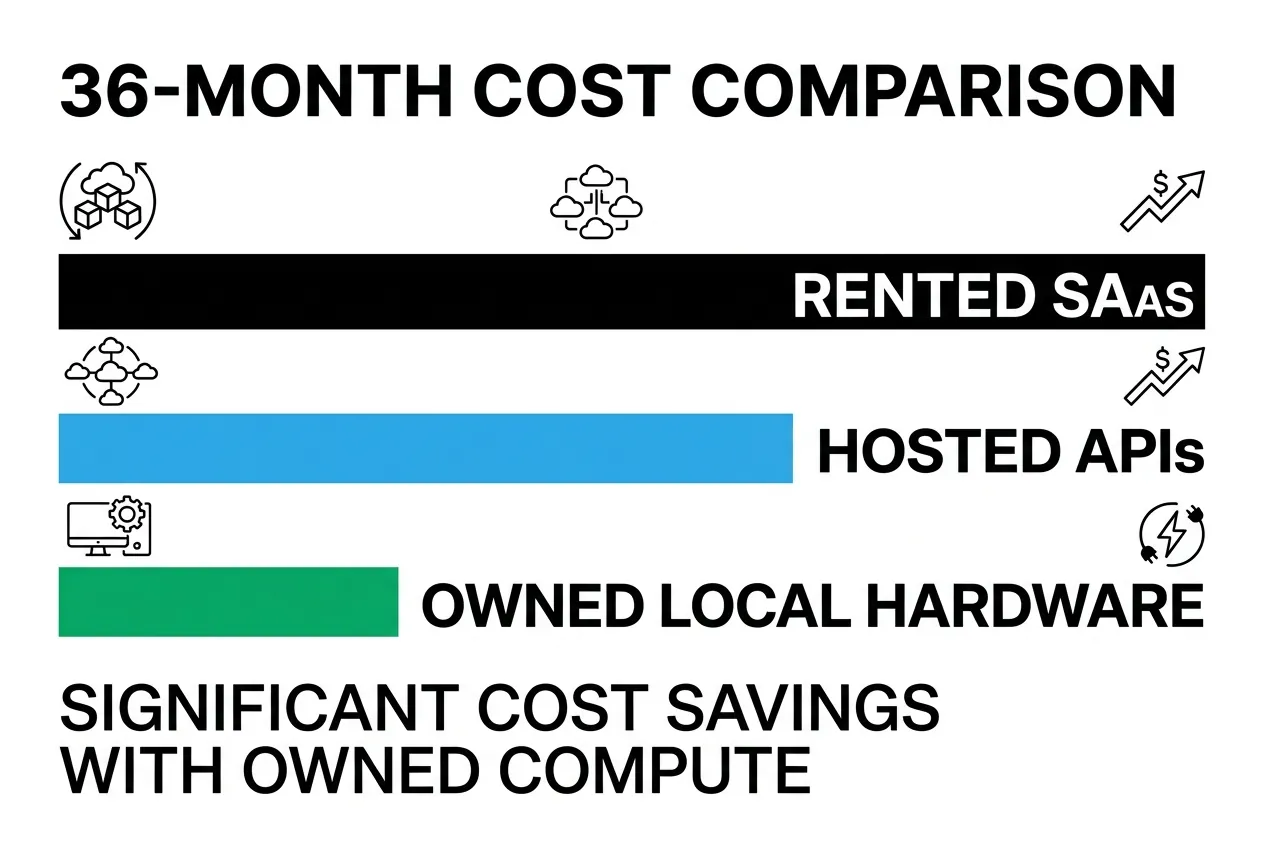
The following model compares three operational paths for a mid-sized marketing organization over a 36-month period: renting 20 commercial SaaS seats, processing programmatic tasks via hosted APIs, and operating dedicated local workstation hardware running an open-source model.
- Initial Hardware & Setup. Rented SaaS Seats (20 Seats): $0. Commercial Hosted APIs (1.5M Tokens/Day): $0. Owned Local Hardware (Dedicated Workstation): $6,500 (estimated workstation tier).
- Annual Software / Token Fees. Rented SaaS Seats (20 Seats): $18,000 ($1,500/month). Commercial Hosted APIs (1.5M Tokens/Day): $9,600 ($800/month average). Owned Local Hardware (Dedicated Workstation): $0.
- Three-Year Subscription / API Cost. Rented SaaS Seats (20 Seats): $54,000. Commercial Hosted APIs (1.5M Tokens/Day): $28,800. Owned Local Hardware (Dedicated Workstation): $0.
- Three-Year Electrical Power. Rented SaaS Seats (20 Seats): $0. Commercial Hosted APIs (1.5M Tokens/Day): $0. Owned Local Hardware (Dedicated Workstation): $590 (estimated at 300W, $0.15/kWh).
- System Maintenance & Administration. Rented SaaS Seats (20 Seats): $0 (vendor managed). Commercial Hosted APIs (1.5M Tokens/Day): $4,500 (internal developer time). Owned Local Hardware (Dedicated Workstation): $6,000 (part-time internal admin).
- Total 36-Month Cost of Ownership. Rented SaaS Seats (20 Seats): $54,000. Commercial Hosted APIs (1.5M Tokens/Day): $33,300. Owned Local Hardware (Dedicated Workstation): $13,090.
Note: Hardware pricing represents estimated enterprise workstation costs; electricity rates reflect operational estimates based on average commercial utility costs tracked by the U.S. Energy Information Administration.
The capital requirement for owned compute amortizes quickly against heavy operational volume. A dedicated desktop inference system equipped with high unified memory can run quantized 70-billion-parameter open models continuously. Once the physical hardware is procured and deployed, the marginal cost of processing the next one million tokens drops to the raw cost of electricity.
The economic break-even point typically occurs between months 9 and 14 for organizations running continuous marketing workflows. Beyond that point, the owned system generates ongoing operational savings, freeing capital for paid media acquisition or creative talent.
Why an Open Source LLM Delivers Defensible Marketing IP
The economic case for owned infrastructure depends entirely on model quality. Two years ago, open-weight models trailed proprietary cloud models by a wide performance margin. Today, that gap has closed for the vast majority of practical marketing applications.
As demonstrated in technical evaluations such as the Meta Llama 3 Technical Overview, modern open-source models ranging from 8 billion to 70 billion parameters match or exceed the performance of older frontier models on structured tasks. Highly specialized marketing tasks do not require broad philosophical reasoning; they require precision, consistency, brand adherence, and structured output formatting.
Deploying an open source llm on owned hardware yields distinct strategic advantages:
Domain-Specific Fine-Tuning
When you own the model weights, you can fine-tune them on your historical campaign data, top-performing ad copy, closed-won CRM transcripts, and internal brand guidelines. The model becomes a specialized company asset that reflects your voice, rather than a generic public model that sounds identical to your competitors.
Deterministic Reliability
Commercial model providers routinely adjust temperature parameters and safety filters, resulting in varying responses across identical prompts. When you run open weights locally, you lock the model version, temperature, and quantization parameters. A workflow built today will generate consistent outputs two years from now.
Zero Rate Limiting
Public API providers enforce strict rate limits based on account tiers, throttling token throughput during peak enterprise traffic windows. Owned hardware processes batch jobs at full local capacity. If your marketing ops team needs to re-index 10,000 blog posts or score 5,000 historical customer reviews overnight, the local pipeline executes without queue delays or vendor throttling.
Build vs Buy AI in Regulated and Multi-Location Marketing
The decision framework for build vs buy ai shifts dramatically when marketing in regulated sectors such as healthcare, addiction treatment, legal services, and financial advisory. In these environments, data governance is an operational prerequisite.
Organizations operating in sensitive healthcare spaces must comply with strict platform and federal rules. Under the Google Ads Healthcare and Medicines Policy, treatment providers require rigorous verification, including LegitScript certification, to market behavioral health services. Furthermore, the Google Ads Policies on Personalized Advertising explicitly prohibit retargeting, remarketing lists, and custom audience profiling based on sensitive health conditions.
When healthcare marketers route patient inquiries, call recordings, or chat transcripts through third-party commercial APIs, they create immediate compliance friction. Transmitting unencrypted patient identifiers or sensitive clinical keywords across external commercial endpoints introduces severe regulatory exposure under HIPAA.
Owned, local infrastructure solves this structural problem. Intake calls, lead notes, and patient communication logs can be analyzed entirely within an isolated local network. The data never leaves the building, no third-party cloud vendor inspects the transmission, and zero records are exposed to public model training sets.
For multi-location operators running regional hospitals or specialized clinic networks, owned infrastructure provides unified operational governance:
- Centralized Intake Scoring: Process inquiries across dozens of physical clinic locations through a single localized model, evaluating lead qualification standards uniformly.
- Localized Campaign Generation: Create thousands of location-specific service pages, ad variations, and directory updates tailored to regional demographics without incurring metered API penalties.
- Full Data Sovereignty: Retain complete ownership of historical conversion patterns and customer response profiles, protecting proprietary marketing intelligence from vendor capture.
In our broader strategic analysis of AI marketing: what it changes for strategy, teams and budgets, we examine how marketing leadership must allocate capital across talent, software, and owned technical assets. When evaluating external partners, our guidance on selecting an AI marketing agency: how to evaluate one beyond the label emphasizes looking past agency software resale toward verified technical capability. Similarly, organizations evaluating search visibility can explore how a generative engine optimization agency: what a specialist partner delivers and how to vet one operates within evolving search ecosystems.

Email Us
Prefer to send the context directly?
How Marketing Powered Operates Owned AI Infrastructure
Marketing Powered does not approach marketing technology as a software reseller or an agency repackaging public API wrappers. We are an operator-led growth firm with deep roots in high-stakes marketing execution.
Our founder is a former healthcare Chief Marketing Officer who directed marketing operations for a treatment network that expanded from 3 to 24 locations. Across that career, our founder managed $1.5 to $2M per month in Google Ads across 11+ behavioral and mental health accounts and serves as a court-certified expert witness in advertising strategy. We have been AI-native since 2022, building technical systems specifically designed to navigate sensitive, highly regulated customer acquisition verticals where conventional retargeting is strictly barred.
To support those demanding operating environments, Marketing Powered invests in and operates its own dedicated, local AI infrastructure for HIPAA-aware inference. We do not claim that every single campaign integration runs completely offline, nor do we promise that hardware alone fulfills legal compliance. Instead, we provide our partners with a proven, accountable operating alternative:
- Closed-Loop Attribution: We connect media investment directly to verified admissions and revenue outcomes, moving far beyond superficial top-of-funnel lead counts.
- Proprietary Workload Isolation: We process sensitive intake evaluations, keyword extraction, and creative intelligence on local infrastructure we own and maintain.
- Operational Moats: We help clients transition away from fragile per-seat SaaS tool sprawl, building custom marketing workflows and fine-tuned open-source models that remain their exclusive intellectual property.
By pairing executive acquisition experience with owned computing infrastructure, we deliver marketing operations that are economically defensible, technically resilient, and built for measurable commercial scale.
Questions, Answered.
Rented AI relies on third-party cloud subscriptions or metered API endpoints where you pay recurring monthly fees or per-token usage costs to access external models. Owned AI infrastructure involves purchasing dedicated physical hardware to run open-weight foundation models locally, establishing fixed computing costs, total data sovereignty, and custom operational workflows.
Deploying local models historically required specialized engineering teams, but modern open-source tooling, unified-memory workstations, and containerized local inference software have streamlined deployment. Non-technical marketers do not need to manage bare metal; instead, forward-looking marketing operations leaders collaborate with technical partners to deploy turn-key local systems that integrate directly into existing CRM and publishing stacks.
For specialized marketing functions, yes. While massive public models excel at open-ended creative conversation, modern 8B to 70B open-weight models fine-tuned on company data frequently outperform general cloud endpoints on structured tasks such as call scoring, ad copy variation, audience segmentation, and content localization.
When you run open-source models on dedicated local hardware, sensitive customer records, phone call transcripts, and personal health information never travel over external commercial networks. This architecture prevents third-party data exposure, avoids vendor training scraping, and aligns with strict privacy requirements in healthcare, legal, and financial sectors. Talk with Marketing Powered about owning your marketing AI stack
Ready to see where your marketing can improve?
Request a free audit of your paid media, landing pages, attribution, and measurement setup. You'll get a straight assessment of where the opportunities are.
or email us at info@marketingpowered.ai