Capabilities
Customer Intelligence That Connects Data to Decisions
Most customer analysis fails the only question that decides its value: what do we do differently now. Customer intelligence services earn their cost when they start from a named decision and a named owner, then build the evidence, the analysis and the operating boundaries that decision requires. The output is a recommendation someone can act on and defend, not another segmentation deck.

Frame the decision before anyone touches the data
Scoping brings together the decision owner, the person who knows where customer records actually live, and someone close to customer behavior in sales, service or operations. The purpose of that conversation is narrow: stop the discussion drifting toward whatever dashboards already exist, and write down the choice that needs making.
What comes out is a decision statement rather than a topic. Illustrative examples of the form it takes: which of two customer segments should receive a new service offer first; why one acquisition cohort cancels at a faster rate than comparable cohorts; which step in the onboarding experience is worth redesigning and testing next.
Each one names the person who will act, the options actually on the table, and the kind of evidence that would move them from one option to another.
Unscoped analysis produces findings nobody acts on, because nobody agreed in advance what finding would change anything. A segmentation model built without a decision attached will be interesting, internally debated and quietly shelved. The same model built against a stated choice between two offers becomes a short argument with a recommendation at the end.
This is also where scope gets honest. If the question cannot be answered with data the organization holds and can lawfully use, the right move is to narrow the question rather than inflate the method.

Join behavioral evidence with authorized qualitative research
Behavioral data tells you what happened. Transactions show purchase sequence, order composition, discount sensitivity and the gaps between repeat events. Support tickets and call records show friction and when it occurs. CRM history shows pipeline stage movement, lost reasons as recorded by humans, and the difference between what sales believed was happening and what the account did. Service or product usage, where it exists, shows depth of adoption rather than presence of a logo.
None of that establishes cause. A cohort with a markedly lower repeat rate (illustrative) could reflect a pricing problem, a staffing problem at one location, an expectation set during the sale, or a seasonal artifact of when those customers entered. Behavioral evidence narrows the candidates. Authorized interviews, win and loss conversations, and structured review of recorded sales calls help distinguish between them.
Sequence matters. Interviews drawn from a defined behavioral cohort are worth far more than interviews with whoever answers the phone. A handful of conversations with customers who demonstrably left early surface language that can then be tested against the full population. Qualitative work run with no behavioral frame tends to produce themes that feel true and resist measurement.
Acquisition data belongs inside this picture rather than beside it. Where source-to-outcome measurement already exists through healthcare attribution implementation, the analysis inherits a cleaner starting point: known entry channel, known first offer, known cost context. Where it does not, the work still runs, with acquisition treated as a weaker variable and labeled that way in the findings.
Build analytical foundations that survive scrutiny
Four foundations determine whether anything downstream holds up, and all four are unglamorous.
Identity resolution comes first. One person can appear as three records across CRM, billing and support. Households, organizations and multi-location accounts compound the problem. Until the matching rules are written down, with their false-match and missed-match tendencies acknowledged, every retention rate calculated on top is partly an artifact of the joins.
Missing data is second. Fields that are blank for a structural reason, such as a status only captured after a process change, behave very differently from fields that are randomly incomplete. Treating the first as the second produces confident findings about a change in data entry.
Time windows are third. Retention measured at 90 days and retention measured at 12 months can rank the same segments in opposite order. The window should be chosen because it matches the decision horizon, then held constant across comparisons and stated inside the finding itself.
Sample bias is fourth. Survey respondents skew toward engaged customers. Interview volunteers skew toward strong opinions. Any population filtered by a system behavior, such as customers who logged in, is already a selected group before analysis begins.
These foundations matter more than the sophistication of the model placed on top, because a well-specified model sitting on a poorly resolved identity graph is precise about the wrong population. Where the work touches sensitive or regulated records, hosting, access and retention choices are part of the foundation as well, which is why data sovereignty and business control belongs in scoping rather than in a later review.
Free Audit
Want a straight read on where your budget is leaking?
Separate findings, causal claims and recommended tests
The most common failure in customer analytics consulting is presenting three different types of statement in the same confident tone. Keeping them apart is what allows a recommendation to survive questioning in a leadership meeting.
The table below is an illustrative classification framework. It describes how statements are labeled, not results from any engagement.
- Descriptive finding. What it asserts: What the data shows for a defined population and window. What backs it: Queried records, documented filters, stated coverage gaps. How it should be used: Reported as fact, with its limits attached.
- Causal claim. What it asserts: The most likely explanation for that pattern. What backs it: Converging behavioral and qualitative evidence, with alternatives named and either ruled out or left open. How it should be used: Stated with explicit confidence and the competing explanation visible.
- Recommended experiment. What it asserts: What to change, and what result would confirm the claim. What backs it: Defined test population, measure, duration and decision rule set in advance. How it should be used: Run before a permanent operational change.
In practice a decision brief reads in that order. Customers acquired through a particular offer in a defined six-month window renewed at a lower rate than comparable cohorts. Interviews with that group point to an expectation set during the sale rather than to service quality. The recommended test is a revised offer description in one region, measured on renewal at the same window, with the decision rule agreed before launch. That example is illustrative.
Causal language only survives when the record trail supports it, which depends on tracking records from source to outcome rather than reconstructing history from aggregate reports after the fact.
Activate inside approved boundaries, not around them
A finding is useful only if someone is allowed to act on it. Activation boundaries belong in the deliverable, not in a legal review that happens after the recommendation has been socialized.
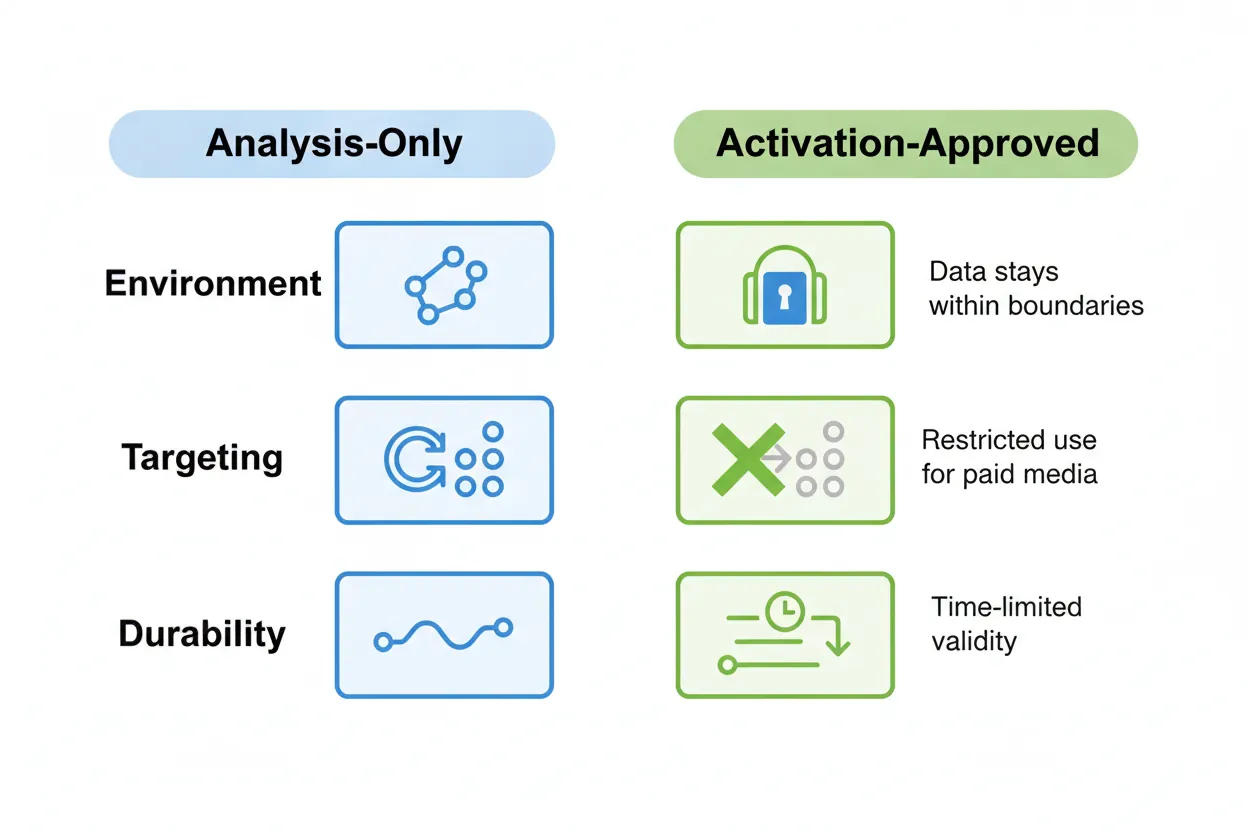
Three boundaries recur in regulated markets. The first is what data may leave the environment it was collected in. Under the HIPAA Privacy Rule there are two routes to de-identified health information: a formal determination by a qualified expert, or removal of specified identifiers combined with absence of actual knowledge that the remaining information could identify someone (HHS).
The same guidance states that both methods, even when properly applied, leave some risk of identification, very small but not zero (HHS). Work that treats de-identification as a binary switch is reasoning from a false premise.
The second is what may be used for targeting. Marketing Powered is built for Google's sensitive healthcare vertical, where retargeting is not permitted.
Google's policy treats health content as a sensitive interest category and does not support advertiser-curated audiences, including customer match lists and an advertiser's own data segments, for promotion in those categories (Google Ads policy).
A segment can be analytically valid and still be restricted as a paid media audience, so analysis-only segments and activation-approved segments should be labeled differently from the day they are created.
The third is durability. Approvals are not permanent facts. The HHS guidance notes that the Privacy Rule does not explicitly require an expiration date on an expert determination, while some practitioners use time-limited certifications because technology and the availability of information change over time (HHS).
Private infrastructure does not by itself establish security or legal compliance. What it provides is configurable boundaries that can be described to a reviewer. An approved operational use should still be judged on whether it moves a business outcome, which is the distinction drawn in why an interaction is not a business outcome.
Deliver a learning loop with owners and refresh dates
A one-time study decays. The closing artifact of a cycle assigns the action, the person accountable for it, the measure that will validate it, and the date the finding gets re-examined.
Validation is the part most often skipped, and it is the part that separates customer insights services from opinion. A segment predicted to expand faster should be checked against what those customers actually did three or six months later. When the prediction holds, the approach earns wider use.
When it does not, the gap points at either the data foundation or the causal story, and that correction is worth more than the original slide. Validation measures are chosen before the change ships and are behavioral wherever possible, because attitudinal measures move for reasons unrelated to the change.
Refresh dates should reflect how quickly the underlying behavior moves. A pricing or offer question in a volatile market ages faster than a structural question about onboarding. Dates live in a calendar rather than a footnote.
Each cycle should leave the organization with a shorter list of open questions, a cleaner map of where evidence lives, and better instincts about which questions justify paying to answer. That is the difference between an analytics purchase and an operating habit.
Related reading for leaders scoping this work: measuring lead quality, customer acquisition cost definitions, and marketing investment economics.

Email Us
Prefer to send the context directly?
Questions leaders ask before scoping this work
Scoping with a customer intelligence agency should settle four things: the decision statement and its owner; an inventory of the systems holding customer records, with approximate counts, date ranges and known quality issues; a plain statement of what data is regulated, restricted or covered by existing agreements, and who authorizes access; and what activation would require if the findings point toward a paid media, sales or service change.
Data ownership, export formats and deliverables are topics covered during scoping. Hosting, access, retention and subprocessors depend on the systems and data involved and are reviewed at the same stage. Fit for a specific data environment is confirmed during scoping.
Marketing Powered is operator-led. The founder is a former healthcare CMO who ran marketing for a treatment network that grew from 3 to 24 locations, managed $1.5 to $2M per month in Google Ads across 11+ behavioral and mental health accounts, and is a court-certified expert witness in advertising strategy.
That history informs how the work is scoped: attribution tracked to admission, not just lead, and analysis judged by whether it changes an operating decision. The firm has been AI-native since 2022, operates owned, local AI infrastructure for HIPAA-aware inference, and is LegitScript-aware and HIPAA-aware.
How is customer intelligence different from marketing attribution?
Attribution answers how a customer arrived and what that arrival cost. Customer intelligence answers why they bought, stayed, expanded or left, and what should change as a result. Consumer intelligence consulting and attribution share plumbing and diverge in purpose, which is why a mature attribution build makes this work faster rather than redundant. Attribution is covered separately under analytics and attribution.
Can we begin with limited customer data?
Yes, with narrower claims. Transaction history alone supports cohort and repeat-behavior analysis. Adding CRM history supports pipeline and lost-reason questions. Adding support records supports experience questions. With less data, the honest output is a smaller set of descriptive findings plus a prioritized list of what to instrument next, rather than a causal story the evidence cannot carry.
How do you combine interviews with transactional evidence?
A typical approach defines the cohort behaviorally first. Interview participants are then drawn from that cohort with appropriate authorization, asked about sequence and expectation rather than general satisfaction, and their responses are grouped into themes. Each theme is tested back against the full population. Where interviews and behavior disagree, that disagreement is reported as a finding rather than smoothed over.
What information and access are needed to scope this work?
A written decision statement and its owner, an inventory of systems holding customer records, approximate record counts and date ranges, and a clear statement of what data is regulated, restricted or subject to existing agreements. Scoping also covers who authorizes access, whether read-only or de-identified extracts are available, and what approvals any activation would require.
What will our organization own and be able to export at the end?
The intent is straightforward: the analytical logic, definitions and conclusions should be usable inside your own systems, without a dependency on an outside provider to read your own results. Ownership, export formats and deliverable specifics are confirmed during scoping rather than assumed from a standard list.
Bring one decision that matters and the evidence you believe bears on it, and scoping starts from there.
More Services
Ready to see where your marketing can improve?
Request a free audit of your paid media, landing pages, attribution, and measurement setup. You'll get a straight assessment of where the opportunities are.
or email us at info@marketingpowered.ai