Capabilities
Data Quality Services for Decisions You Can Defend
A dashboard reports what your records say. It does not repair what your records got wrong. Data quality services work in that gap, where duplicate, conflicting and half-filled records quietly decide which location looks profitable, which campaign gets cut and which number leadership hears.

Start with the decision, not the whole database
Cleanup scoped to a whole system tends to lose its link to a business decision. Start with the decision that is stuck: reallocating budget across locations, consolidating two CRMs, or defending a number to a board that has begun asking how it was produced.
Then work backwards to the fields it depends on, such as a reliable location identifier, one record per person, consistent status values and comparable dates. Duplicates from a second phone inquiry and conflicts between CRM and billing records are why two reports disagree in a Monday meeting.
- Raw records. What you start with: Duplicates, conflicts, blank fields. What the stage produces: A scoped field list for one decision.
- Profiled sample. What you start with: Counts with denominators, by field. What the stage produces: A data quality assessment.
- Rules applied. What you start with: Deterministic, probabilistic, unresolved. What the stage produces: Documented matching and survivor rules.
- Validated result. What you start with: Reconciled totals, inspected matches. What the stage produces: An exception log and monitoring thresholds.
Illustrative sequence for planning discussions, not a results report.

Profile the data before changing a single record
A data quality assessment measures the defect before anyone edits anything. The UK Government Data Quality Framework sets out six core dimensions defined by DAMA UK, the Data Management Association of the UK: completeness, uniqueness, consistency, timeliness, validity and accuracy, measured as plain ratios, for example 294 of 300 expected responses recorded as 98 percent complete (GOV.UK).
Profiling runs on an approved sample, and every count carries its denominator. Definitions come first, because "lead date" and "first contact" are often different fields, as the Healthcare Marketing Data Dictionary: Pipeline Guide shows inside one domain.
Write the matching rules down before you run them
Record matching goes wrong when the logic lives inside a tool and nobody can describe it. Practitioner guides to entity resolution treat cleaning, standardizing and parsing records as preparation that precedes matching (People Data Labs). Data standardization is that preparation: phone formats, address components, name parsing, allowed status values.
Rules then get written in three buckets: deterministic matches on a verifiable shared identifier, probabilistic scores weighed against a documented threshold, and unresolved cases routed to human review. Survivor rules decide which system wins each conflicting field, and who approved that order. Tracing records from source to outcome tests the rules against reality.
Free Audit
Want a straight read on where your budget is leaking?
Protect the source of truth with reversible changes
Nothing destructive should happen in a production system without a rollback path. Corrections can be built as a change set against an extract, reviewed against the documented rules, then applied back with the data owner's approval and a stored record of prior values.
Merges stay reversible, and overwrites stay limited to fields with an agreed owner. Conversion tracking, CRM automation and reporting key off identifiers a careless merge destroys, which is why healthcare attribution implementation depends on source-system integrity. Access, hosting and retention are confirmed in scoping.
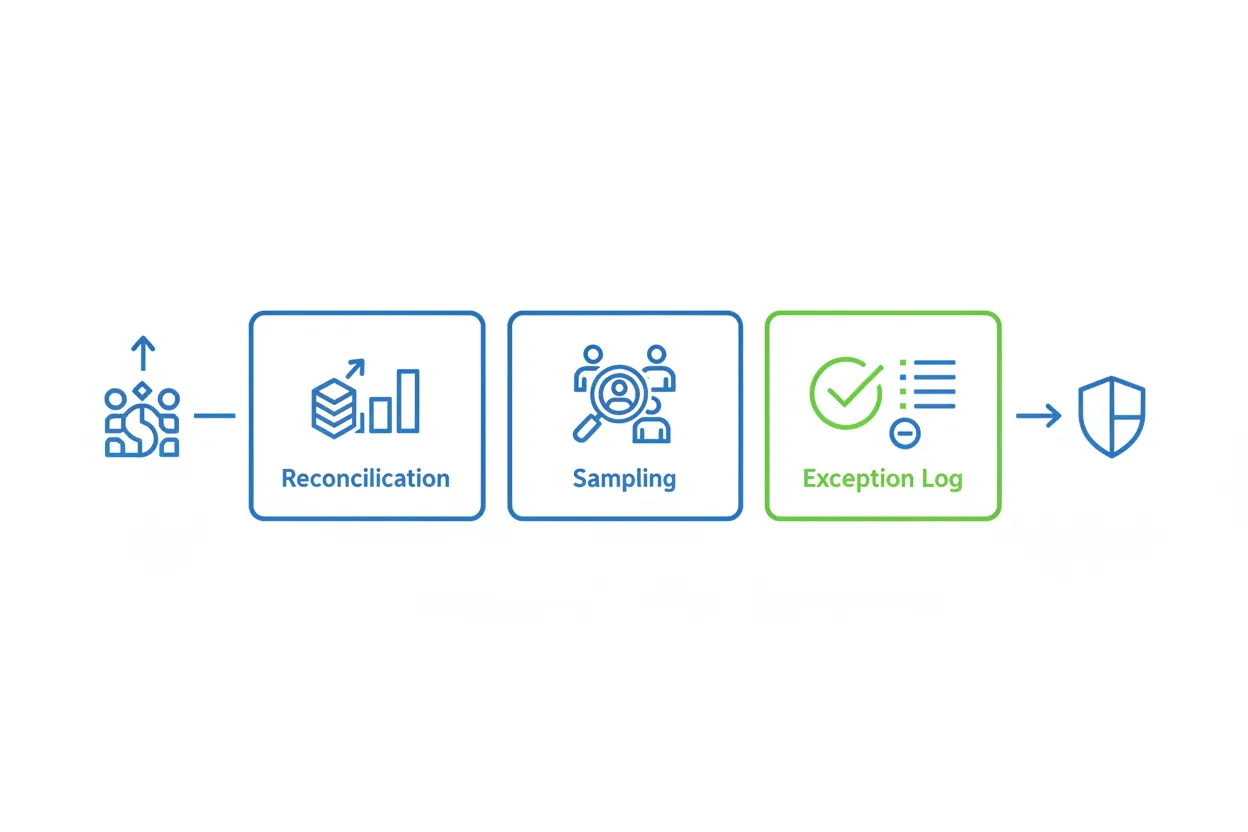
Validate the repaired result, not the row count
A shrinking duplicate count looks like progress and can hide the worst outcome here, two different people merged into one record. Data validation services should be judged on false matches, not volume reduction. Reconcile totals against an independent system so counts of people, encounters or revenue tie back to finance or billing records.
Have someone who knows the business inspect a sample of accepted matches, watching for common names and shared addresses. Keep an exception log of rejected and unresolved cases, because that log is what keeps marketing attribution services defensible. Marketing Powered tracks attribution to admission rather than stopping at the lead, which only holds if the records underneath hold.
Make the fix durable with checks and named owners
Data cleansing services that end at a one-time cleanup tend to decay, because the intake form, import process and integration that produced the defects are still running. The UK framework advises root cause analysis to solve issues at source rather than temporary fixes, with ongoing monitoring and reporting (GOV.UK).
In practice: validation at the point of entry, constrained values on required fields, deduplication checks at record creation, and thresholds that flag a field when completeness drops. Each monitored field needs a named owner and a review cadence, the part that decides whether data quality improvement survives a staffing change. Related work includes workflow integration and tracking, data sovereignty and business control and decision-focused marketing dashboards.

Email Us
Prefer to send the context directly?
Questions teams ask before scoping this work
How do you avoid merging two different customers?
By separating confidence levels instead of guessing. Deterministic matches require a shared verifiable identifier. Probabilistic matches must clear a documented threshold, and borderline scores route to human review rather than an automatic merge. Thresholds can be set to favor leaving records separate when a false merge is the costlier error.
Can source data remain unchanged during cleanup?
Yes. Profiling and rule development can run against extracts or a staging copy, with corrections produced as a change set showing before and after values. Whether those corrections are applied back by your team or by the people doing the cleanup is decided with the data owner during scoping, along with hosting, retention and access.
Which quality measures matter for our use case?
The ones the decision depends on. The six dimensions supply the vocabulary: completeness, uniqueness, consistency, timeliness, validity and accuracy (GOV.UK). Mapping them is a judgment call. Per-location counting leans on uniqueness and a reliable location field, contact performance on valid phone and email formats, pipeline reporting on consistent status values.
What information and access are needed to scope this work?
A list of the systems holding the relevant records, written field definitions, and a read-only extract of an approved sample. Under the HIPAA Privacy Rule's minimum necessary standard, a covered entity's policies must identify who needs access, the categories of protected health information needed, and conditions appropriate to that access (HHS).
Where protected health information is involved, a business associate agreement and a documented data flow come first. Marketing Powered is HIPAA-aware and runs owned, local AI infrastructure for HIPAA-aware inference, which supports controlled processing without, by itself, establishing legal compliance for a workflow.
What will our organization own at the end?
Ownership of the rules and findings is agreed in scope before work starts. The matching and survivor rules describe how your records are matched, and the organization should be able to read and reuse them. Formats, exports and handoff are confirmed in the scoping conversation.
Bring the decision you cannot currently defend, and the work gets scoped against the records feeding it rather than your entire data estate.
More Services
Ready to see where your marketing can improve?
Request a free audit of your paid media, landing pages, attribution, and measurement setup. You'll get a straight assessment of where the opportunities are.
or email us at info@marketingpowered.ai