Capabilities
Pricing Research for Offers, Segments and Buying Decisions
Most price changes get decided on three weak inputs: a competitor's public price page, an industry report nobody can audit, and a finance model built on a guessed response rate. Pricing research services should replace those inputs with evidence you can trace to your own buyers and your own margin. This page explains how we scope that work, what each method can actually prove, and where it stops.

Define the pricing decision before you research it
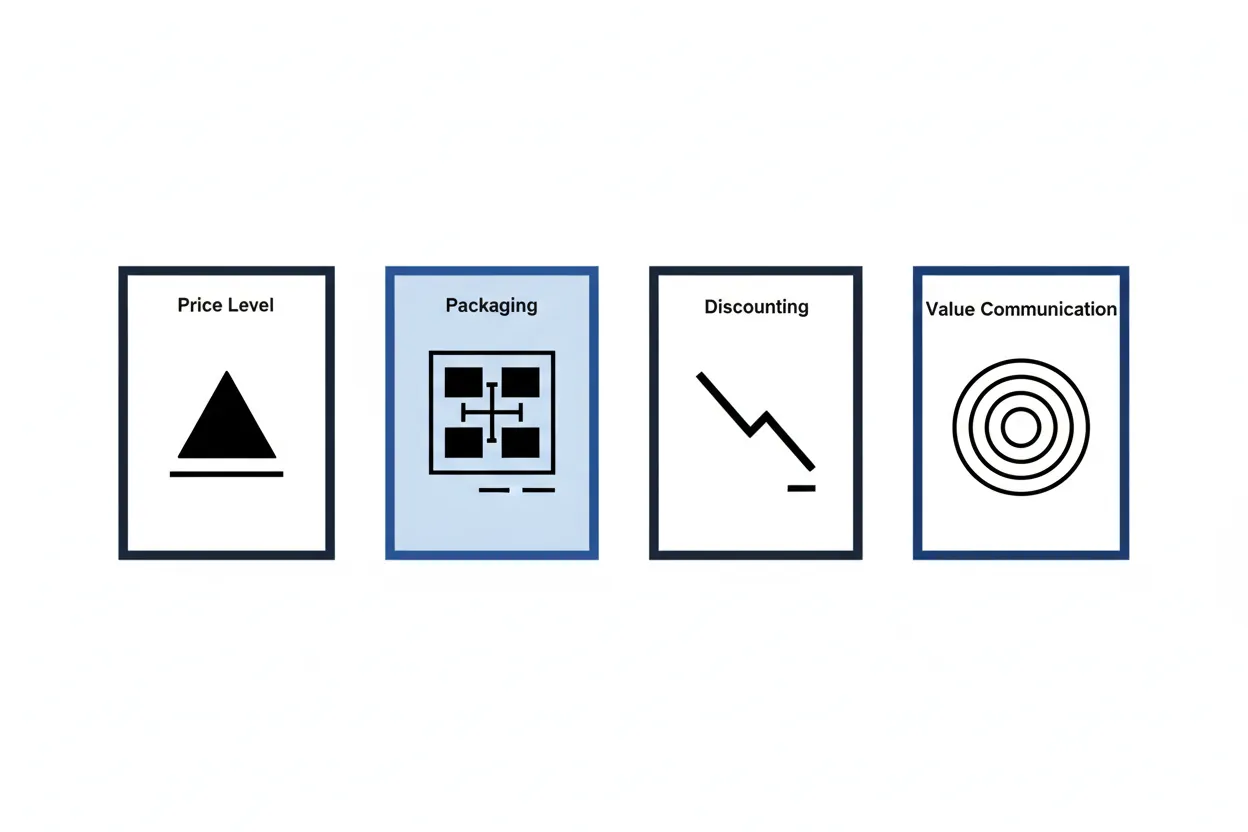
"We need to raise prices" is usually four different decisions wearing one label. Price level is the headline number. Packaging is what sits inside each tier and what gets unbundled. Discounting is the gap between list and realized price, including approval thresholds, legacy accounts and seasonal concessions. Value communication is how the offer is explained at the point of decision.
A business losing deals at the quote stage may have a packaging or communication problem rather than a price problem, and raising or cutting the number will not fix it. Before any fieldwork, we write the decision down in a single sentence, name the segments it applies to, and state what evidence would change the answer. That sentence governs the method selection that follows.
Map the competitive offer, not the published price
A published price is a marketing artifact. The comparison that matters is inclusions, contract length, renewal and cancellation terms, onboarding or setup fees, payment plans, and which segments get which offer. We build a pricing and packaging comparison matrix with those rows, so a competitor's "lower" price can be read against what the buyer actually receives.
Regulated markets make the distinction obvious. Hospitals must publish standard charges that include gross chargemaster charges, discounted cash prices, and payer-specific negotiated charges, which means a single published number is one of several prices for the same service (CMS).
Fees are regulated territory too: the FTC's Rule on Unfair or Deceptive Fees, effective May 12, 2025, requires total price disclosure for live-event tickets and short-term lodging (FTC). Competitive pricing analysis that ignores fees and terms is incomplete. Related reading: marketing investment economics.
Choose a customer research method that fits your buyers
Three families of method, each with a real limit. Interviews with recent buyers, lost prospects and churned accounts surface the reasoning behind a decision, including what was compared and what triggered a discount request. They are small sample by nature, so they describe logic, not distribution. Structured surveys, including willingness to pay research and trade-off exercises across packaging configurations, produce comparable responses across segments, but they measure intention under hypothetical conditions and are sensitive to how the question is framed.
Controlled tests put a real price in front of a real buyer and record what happens. They are the strongest evidence and the slowest, and they need enough volume in the test window to separate signal from noise. Low-volume, high-value businesses usually combine interviews with a sequential quote test instead. Method choice also affects how you read acquisition cost, so the definitions matter: see customer acquisition cost definitions.
Free Audit
Want a straight read on where your budget is leaking?
Connect price to contribution, not customer perception alone
Price sensitivity research without a P&L attached produces interesting findings and no decision. We work the other direction as well: cost to serve by segment, contribution margin at current realized price, and the volume change that would offset a given increase or decrease. If a 5 percent increase needs a defined retention floor to be worth doing, that floor becomes the thing research has to test.
Scenario models are built with every assumption visible and labeled as an assumption, including adoption ranges, discount leakage and churn. We do not publish elasticity figures we have not measured. The lens here is operator rather than analyst.
Marketing Powered is led by a former healthcare CMO who ran marketing for a treatment network that grew from 3 to 24 locations and who managed $1.5 to $2M per month in Google Ads across 11+ behavioral and mental health accounts, with attribution tracked to admission, not just lead. Published work lives in our research hub.

Separate what people say, what they do and what models project
Stated willingness is what a buyer reports in an interview or survey. Observed behavior is what the same buyer does when a price is live and consequences are real. Modeled elasticity is a projection built on both, plus assumptions you chose. These three are often reported as one number, and that is how pricing changes quietly fail.
Our reporting keeps them separate and labels sampling limits, response counts and the conditions under which each finding holds. The discipline is the same one used when evidence has to survive cross-examination, and the founder is a court-certified expert witness in advertising strategy. If a question cannot be answered with the evidence available, that is stated as a gap rather than smoothed over. More on how we handle method and evidence: research methods and resources.
Plan a controlled decision with guardrails and review dates
The output of good pricing decision research is a test plan, not a verdict. A workable plan names the segment or locations included, a holdout that keeps the current price, a time-boxed window long enough to capture the buying cycle, and the specific metrics reviewed: win rate, realized price after discount, mix shift between tiers, churn or cancellation, and contribution per customer.
Guardrails come first. Set a margin floor, a discount approval ceiling, a churn threshold that triggers review, and the conditions under which you roll back. Set the review date before launch so the decision is not made on the first week of noisy data. For multi-location businesses, test design has to account for market differences rather than averaging them away. Related resources: published studies and their evidence, budget allocation principles, and multi-location operating strategy.

Email Us
Prefer to send the context directly?
Questions buyers ask before scoping this work
Can competitor website prices tell us what customers really pay?
No. A published price excludes negotiated terms, discount practice, bundled fees and segment-specific offers. In healthcare the gap is documented, since the same service carries gross charges, discounted cash prices and payer-specific negotiated charges (CMS). Treat published prices as positioning evidence and your own transaction records as price evidence.
Which pricing research method fits a small customer base?
With low buyer counts, structured surveys rarely reach a sample that supports percentages. The stronger approach is interviews with recent wins, losses and churned accounts, combined with a review of your own quote and discount history, then a sequential test applied to new quotes. Findings get reported as ranges and directional patterns, never as precision you did not buy.
How do you test packaging as well as price?
By holding price constant and varying inclusions, then doing the reverse. Trade-off exercises show which components carry value and which are assumed to be included. In a live test, define the tiers precisely and measure mix shift and discount depth alongside acceptance, because a tier that sells only at a discount is a packaging failure, not a pricing win.
What information and access are needed to scope this work?
Historic transaction or quote records with realized prices, current discount and approval practice, cost-to-serve inputs by service or segment, retention or churn data, and access to a limited number of customers and lost prospects for interviews. We also need a named owner on your side for margin assumptions, since those assumptions drive the model.
What will our organization own and be able to export at the end?
The research instrument, the response data, the pricing and packaging comparison matrix, the scenario model with assumptions exposed rather than hidden, and the test plan. Ownership, retention, hosting and access are documented in scope. Where regulated data is involved, work can run on owned, local AI infrastructure for HIPAA-aware inference, which is a data handling choice, not a compliance claim in itself.
More Services
Ready to see where your marketing can improve?
Request a free audit of your paid media, landing pages, attribution, and measurement setup. You'll get a straight assessment of where the opportunities are.
or email us at info@marketingpowered.ai