Capabilities
Channel and Partner Research for Market Access
Channel partner research is the work of testing how your buyers can actually be reached before you commit to a territory, a margin structure or an exclusivity clause. Most of those commitments get made on recycled industry reports, partner-supplied reach claims and internal assumptions nobody pressure-tested. This service evaluates routes to market and partner candidates against evidence you can inspect.

Define the buyer access problem before naming channels
Channel work goes wrong when it starts with a list of companies instead of a definition of the buyer. The first step is specific: which segment, which geography, which titles sign, and what the purchase process actually looks like from first contact to contract.
A hospital system with a value analysis committee, a multi-site clinical group with regional autonomy and a professional services firm with partner-level discretion are three different access problems, and each one rules out channel types that look attractive on paper.
We write that definition down, including the buying triggers, the approvals involved and the realistic sales cycle, so every later comparison is measured against the same standard rather than against a generic market narrative.

Map the routes to market that are actually available
With the access problem defined, we map the channel options that exist in your category: direct sales, marketplaces and procurement platforms, distributors and resellers, and authorized referral relationships. Each is scored against inclusion criteria stated up front, so a channel is kept or dropped for a visible reason.
Channel questions are usually bundled inside broader go-to-market research alongside customer, competitor, pricing and segmentation work, with geography as only one of several decision contexts (Fieldnet Global). Isolating the channel decision is the point here. For organizations where clinician referral is a live route, the mechanics of building a measurable pipeline are covered separately in physician referral marketing.
Assess candidate partners against observable criteria
Partner assessment uses what can be seen and sourced rather than what is pitched. That means documented coverage by geography and segment, evidence of the capabilities a partner claims, existing relationships that create conflict with your offer, and signals of operating stability such as stated client types, hiring patterns and public filings where available.
Claimed reach is recorded as a claim, not a finding, and marked for verification. We also separate research from execution. Evaluating whether a reseller can carry your product is a different job from running demand programs through a channel, which is where execution-specific work such as LinkedIn Ads belongs.
Free Audit
Want a straight read on where your budget is leaking?
Model channel economics before negotiating terms
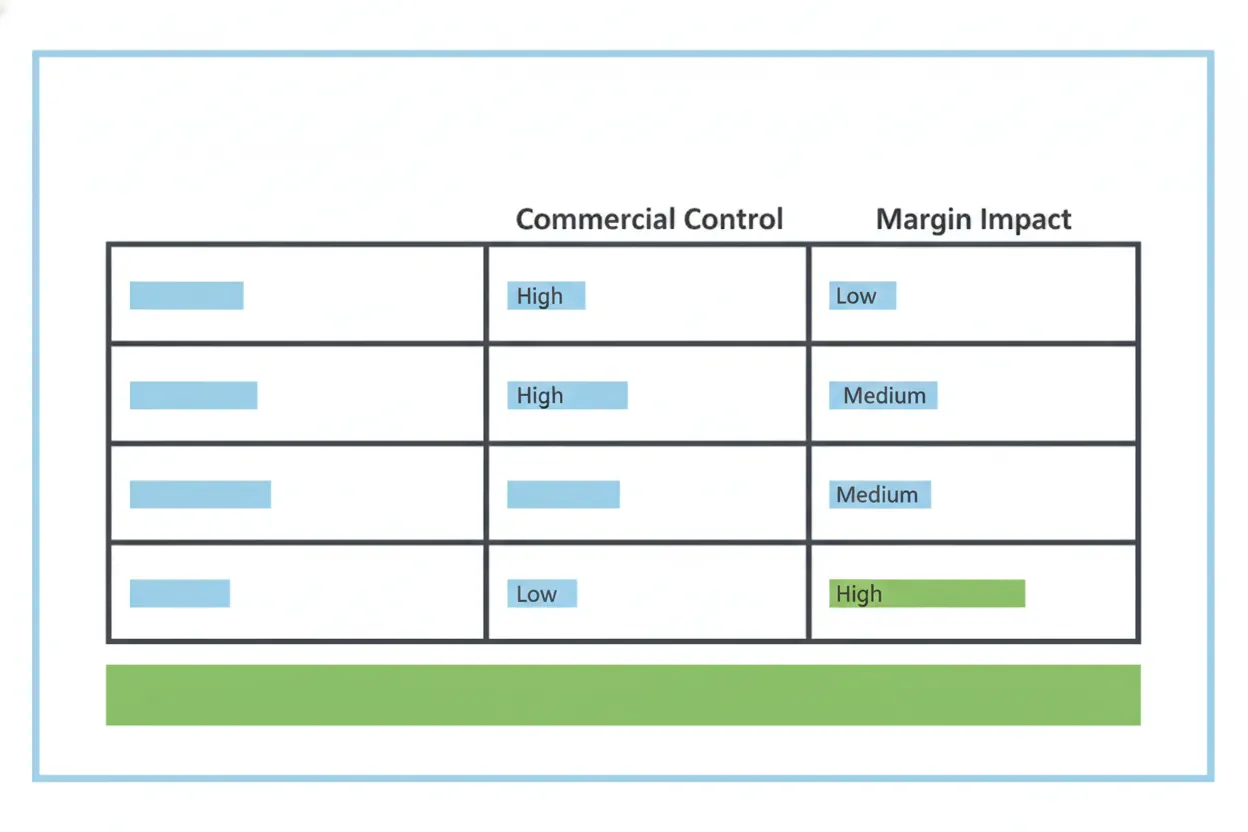
Two channels that deliver the same unit volume can produce very different businesses. We model each shortlisted route on consistent lines: fees and discounts, gross margin after partner compensation, control over pricing and messaging, lead times to first revenue, onboarding cost, and the support obligations you inherit.
Pricing and sales enablement intelligence are standard components of commercial decision support offered by established intelligence firms (Fuld), and they belong in a channel comparison rather than in a later negotiation. Every input is labeled as sourced, estimated or assumed. Related method notes and published work sit in the research hub.
Separate desk research from diligence that needs people
Desk research has limits, and stating them is part of the deliverable. Partner solvency, contract terms, exclusivity history, data handling practices and regulated referral arrangements are questions for interviews, reference calls, counsel and finance, not for public sources. We list each open item, who should answer it, and what evidence would close it.
Healthcare referral and distribution structures in particular carry legal review requirements that belong with your counsel before any agreement is signed. The founder of Marketing Powered is a court-certified expert witness in advertising strategy, which shapes how claims here are documented: if a statement cannot be traced to a source, it is written as an assumption. Methods are described in research resources.
Deliver a prioritized route plan leadership can act on
The output is a decision document, not a market summary. It ranks the viable routes against the defined access problem, names the partner categories or candidates worth a first conversation, and states the entry conditions that would make each route a sound commitment.
Alongside it sits the channel map with inclusion criteria, the source-backed partner comparison and the unresolved diligence list. Growth intelligence is most useful when it is framed around market gaps, customer shifts and emerging business models and feeds investment choices directly (Fuld).
For the financial side of those choices, see published studies, marketing investment economics and budget allocation principles.

Email Us
Prefer to send the context directly?
Common questions about channel and partner research
Can you identify partners as well as analyze channels?
Yes. The work covers both the structural question of which route fits your buyer and the identification of specific candidates within the routes that survive screening. Identification is scoped to what public and purchasable sources support, plus any introductions or lists you already hold. Candidates are presented with the evidence behind their inclusion and the gaps that remain.
How do you verify a partner's claimed reach?
Claimed reach is treated as an input to verify, not a fact. We look for corroboration in public filings, trade and association listings, job postings, site and store locators, customer references and, where you authorize contact, direct conversation with the partner. Where corroboration is unavailable, the claim is reported as unverified rather than averaged into a conclusion.
Does a shortlist replace commercial or legal due diligence?
No. A shortlist narrows the field and tells you what to examine. Financial diligence, contract review, regulatory analysis and background checks remain the work of your counsel, finance team or a specialist diligence provider. The research hands those parties a defined list of questions instead of a blank page.
What information and access are needed to scope this work?
Scoping needs your target segments and geographies, current sales motion, pricing and margin tolerances, any partners already in play, and the decision you are trying to make by a specific date. Access to sales leadership for one or two conversations improves accuracy considerably.
What will our organization own and be able to export at the end?
You own the research deliverables produced for you, including the channel map, inclusion criteria, partner comparison and the open diligence list, in standard document and spreadsheet formats. Ownership, retention and data handling terms are confirmed in writing at scoping.
If a channel or partner decision is on your calendar this quarter, the useful first step is a scoping conversation about what evidence you already have and what is still assumed.
More Services
Ready to see where your marketing can improve?
Request a free audit of your paid media, landing pages, attribution, and measurement setup. You'll get a straight assessment of where the opportunities are.
or email us at info@marketingpowered.ai