Resources
Physician Referral Marketing: Building an Accountable Patient Pipeline
Physician referral marketing drives essential clinical volume for health systems, surgical centers, and specialty groups, yet most leadership teams treat it as an unmeasured relationship activity. Traditional outreach leaves clinical executives with high field costs and little visibility into downstream appointment completion or electronic health record encounters. Transforming referral development into an accountable, multi-channel operational pipeline connects medical liaison activities with verified patient admissions and protects service-line margins.
By Mike Hulick, Founder, Marketing Powered

Why traditional physician outreach fails to produce predictable volume

What is a physician referral in modern health systems?
A physician referral is a structured clinical handoff where a primary care doctor, hospitalist, or medical specialist transfers diagnostic or therapeutic responsibility for a patient to another provider. In modern integrated delivery networks, that handoff takes place through electronic health record (EHR) order sets, direct messaging platforms, or external digital portals.
Historically, clinical teams treated a referral as a simple administrative order placed inside medical records, assuming the patient would naturally schedule and arrive for treatment. Modern healthcare consumerism and fragmented regional delivery models have dismantled that assumption. When an order is generated, the patient must still navigate scheduling delays, network insurance clearance, and geographic travel. At the same time, patients increasingly validate specialist credentials, hospital rankings, and clinic locations through digital search channels before booking an appointment.
True referral marketing healthcare operations recognize that a referral order is only the initiation of a patient acquisition pathway. For health systems, managing this operational handoff requires visibility into both provider engagement patterns and patient scheduling friction. Professional outreach cannot end when a community doctor agrees to recommend a clinical facility. It must extend through the operational systems that turn an initial clinical order into a confirmed specialist encounter.
For decades, health systems have treated physician outreach as a field activity centered on unmeasured personal relationships. Outreach representatives visit medical offices, hand out clinical brochures, drop off gifts, and record subjective notes in generic sales software. This approach isolates field liaisons from digital performance marketing, intake call centers, and service-line clinical capacity.
This siloed model breaks down across three operational points:
- Attribution blind spots: Field representatives report high visit numbers, yet marketing executives cannot correlate those visits to clinical volume inside the EHR. Without unified identification standards such as National Provider Identifiers (NPIs) mapped directly to patient intake forms, leadership cannot tell whether an influx of surgical cases resulted from recent liaison visits, local consumer advertising, or organic patient choice.
- Operational capacity mismatches: Field teams frequently promote service lines that face immediate operational bottlenecks. When a liaison aggressively markets an orthopedic or cardiology clinic that has an eight-week scheduling backlog, referred patients abandon the loop and seek faster care elsewhere. Meanwhile, underutilized outpatient facilities or newly hired specialists sit with empty appointment slots because field priorities do not reflect real-time operational capacity.
- Severe referral leakage: Up to half of external referrals fail to convert into completed appointments across typical provider networks. Friction points include dropped phone calls at central scheduling, complicated medical records requests, and lack of prompt communication back to the referring office. Traditional outreach treats this as an intake defect rather than an acquisition failure, leaving valuable clinical demand on the table.
Health systems cannot justify expanding field sales budgets when marketing programs lack connection to downstream service-line revenue. Transitioning from unstructured outreach to a data-backed pipeline is necessary to maintain clinical growth.
Core physician referral marketing strategies for multi-location networks
Building an effective physician referral program requires the same rigor, audience segmentation, and performance measurement applied to consumer acquisition channels. Rather than deploying liaisons across broad geographic territories without prioritization, high-performing networks run structured outreach strategies that target high-yield clinical partners.
Account tiering and NPI data segmentation
Not every medical practice in a hospital market holds equal referral potential. Clinical leadership should segment regional providers into structured tiers based on historical claims data, geographic density, and specialty alignment:
- Tier 1 (High-Volume Core Accounts): High-volume primary care practices, urgent care centers, and independent physician associations within five miles of specialty facilities. These practices require direct liaison relationships, streamlined electronic ordering workflows, and bi-weekly communication regarding clinical capacity.
- Tier 2 (Growth and Specialty Targets): Sub-specialists, regional community health centers, and practices located along geographic expansion corridors. Outreach focuses on niche clinical programs, unique technology (such as robotic surgical platforms), and specific clinical trial availability.
- Tier 3 (Broad Market Visibility): The wider medical community within the primary service area. These providers are engaged primarily through digital education, continuing medical education (CME) resources, and email updates regarding facility additions or accepted insurance panels.
Standardizing communication and intake workflows
Referring doctors choose clinical partners who make the handoff process effortless for their administrative staff and their patients. Physician referral marketing initiatives must evaluate and simplify intake touchpoints:
- Dedicated provider intake lines: Ensure medical office coordinators bypass consumer phone queues through direct clinical routing.
- Closed-loop status reporting: Provide automated, secure electronic notifications back to the referring physician when their patient is scheduled, seen, and discharged.
- Rapid appointment windows: Establish reserved slots for urgent specialist consultations, assuring referring clinicians that their patients will be evaluated within forty-eight to seventy-two hours.
When administrative friction disappears, referring providers default to your facilities because their staff avoids the administrative burden common to regional competitors.
Free Audit
Want a straight read on where your budget is leaking?
Integrating physician liaison marketing with digital demand channels
Field liaisons achieve higher conversion rates when backed by targeted digital infrastructure. Combining physician liaison marketing with digital acquisition ensures health systems capture professional intent while simultaneously reinforcing consumer confidence.
When a physician liaison visits a medical group to present a newly launched cardiovascular wing, the physicians in that group rarely make an immediate referral on the spot. Instead, practice coordinators and medical assistants investigate the hospital online. They verify accepted insurance plans, assess clinical biographies, and check outpatient clinic wait times. Concurrently, referred patients research the specialist their doctor recommended before agreeing to book an encounter.
If an organization has fragmented digital profiles, outdated provider directories, or poor local search visibility, both the referring staff and the patient hesitate. Digital marketing assets must directly support the liaison's field conversations:
- Condition-specific clinical content: Publish clinical white papers, surgical case summaries, and treatment outcome studies that reinforce clinical excellence to both referring doctors and discerning patients.
- Optimized provider directories: Ensure every specialist profile lists accurate clinical focus areas, educational backgrounds, clinic hours, and accepted payers.
- Search visibility for high-intent queries: Align geographic search campaigns with liaison expansion territories. When patients search for specialized treatments recommended by their doctor, the health system must dominate regional search results.
Digital media must comply strictly with healthcare privacy frameworks. Under the Google Ads Sensitive Categories Policy, campaigns cannot deploy remarketing or retargeting lists based on user health status or clinical conditions. Digital acquisition strategies must focus on capturing high-intent search queries at the exact moment of need rather than relying on tracking pixels that compromise regulatory compliance.
Navigating healthcare compliance: Stark Law, Anti-Kickback, and HIPAA
Every physician outreach initiative must operate within federal and state regulatory constraints. Healthcare marketing leaders must navigate clear legal parameters to protect their organizations from regulatory exposure.
The federal physician self-referral law, commonly known as the Stark Law, and the federal Anti-Kickback Statute establish clear prohibitions against offering financial inducements, below-market medical office space, excessive gifts, or above-market compensation in exchange for patient referrals. Liaison marketing materials, educational events, and medical society sponsorships must adhere to strict fair-market-value thresholds. Health systems cannot tie liaison compensation or physician outreach incentives directly to the volume or value of referrals generated.
Concurrently, measuring the referral pathway requires strict adherence to the HHS HIPAA Privacy Rule. Health systems cannot transmit protected health information (PHI) through commercial web pixels or unsecured marketing platforms. Tracking referral conversions from digital interactions into clinical appointments demands compliant server environments, explicit Business Associate Agreements (BAAs), and isolated data architectures.
Marketing Powered was built specifically for Google's sensitive healthcare vertical, where retargeting is not permitted. The agency maintains owned, local AI infrastructure for HIPAA-aware inference, ensuring patient-identifying data is never exposed to unvetted third-party commercial platforms. Marketing Powered's founder is a former healthcare CMO who ran marketing for a treatment network that grew from 3 to 24 locations, managed $1.5 to $2M per month in Google Ads across 11+ behavioral and mental health accounts, and serves as a court-certified expert witness in advertising strategy. These operational experiences shape outreach programs that respect regulatory boundaries while expanding clinical volume.
To examine how clinical compliance, enterprise digital infrastructure, and service-line expansion work together across healthcare networks, review our comprehensive operating manual: Healthcare marketing: the operating guide for health systems and provider groups.

Closing the intake loop: reducing referral leakage at the point of scheduling
Referral leakage represents an immense loss of downstream revenue for modern health systems. When a patient receives an order from their primary care physician but never completes the recommended diagnostic imaging, physical therapy, or surgical consultation, the health system loses clinical revenue and patient outcomes suffer.
Eliminating intake friction requires operational collaboration between clinical marketing and practice operations:
- Active outbound outreach: Do not wait for referred patients to contact your central scheduling office. High-converting health systems institute automated, HIPAA-aware outbound call workflows or secure SMS notifications within twenty-four hours of receiving an electronic referral order.
- Simplified digital self-scheduling: Empower referred patients to book their consultations online immediately. When primary care doctors send an electronic order, an automated link can invite the patient to select an appointment slot that matches their schedule.
- Dedicated clinical coordinators: For high-value complex service lines like oncology, cardiology, or bariatrics, deploy patient navigators. These coordinators guide the patient through pre-authorization, diagnostic records collection, and intake paperwork, ensuring they complete their scheduled appointments.
- Referral source feedback: Automatically update referring practices when a patient misses an appointment or cancels without rescheduling. Primary care providers appreciate knowing when an order stalls, allowing them to follow up with the patient directly during their next encounter.
Plugging operational leaks at the scheduling desk routinely drives greater net-revenue growth than simply increasing top-of-funnel liaison activity.
Email Us
Prefer to send the context directly?
Closed-loop referral attribution: tracking outreach to clinical admission
A modern referral development program requires accountability. Health systems must move beyond measuring surrogate metrics like liaison office visits, lunch presentations, or printed material distribution. Executive teams must evaluate the return on liaison programs by tracking outreach efforts through to completed appointments, procedural encounters, and inpatient admissions.
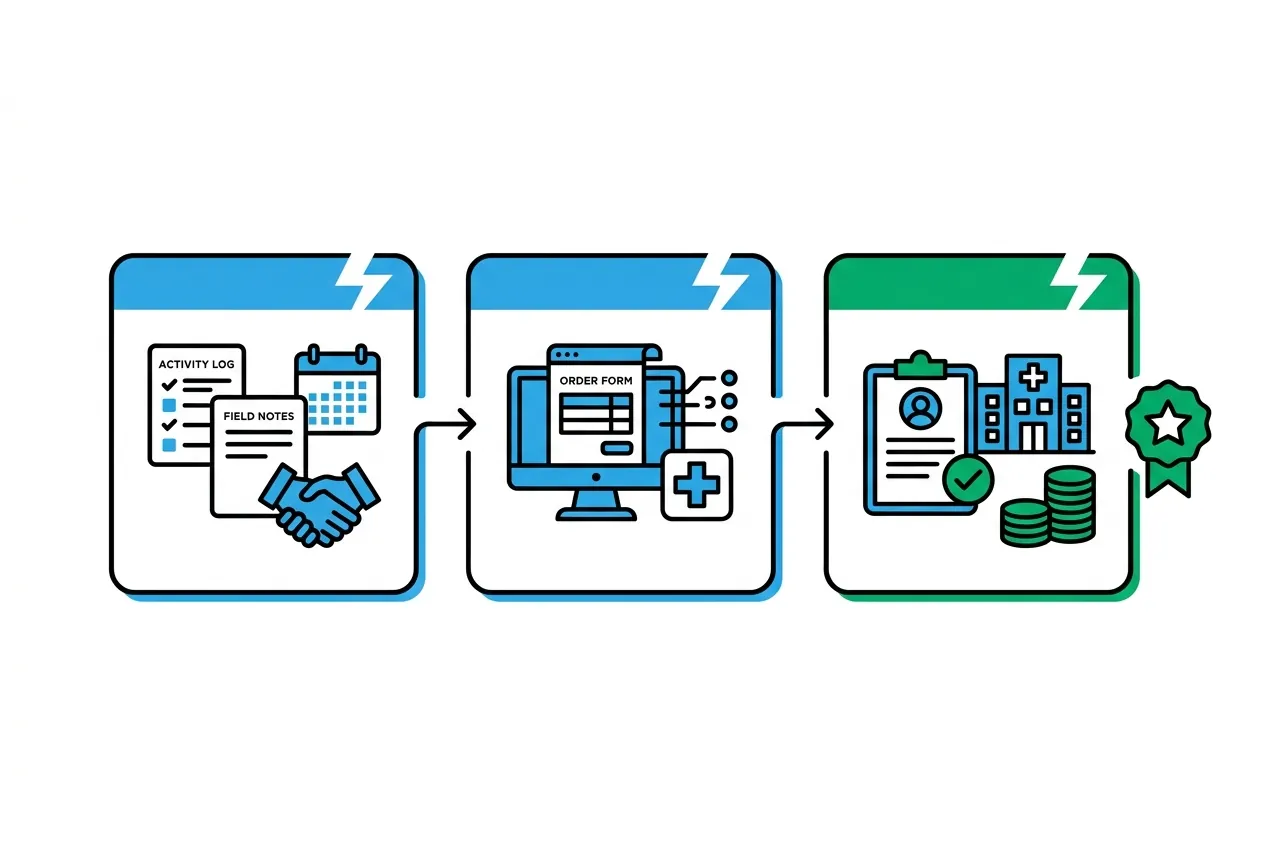
Attributing clinical volume back to referral marketing activities requires joining three distinct operational data sources:
- Liaison operational records: Detailed logs tracking field activity, practice meetings, educational sessions, and account-tier adjustments mapped to individual physician National Provider Identifiers (NPIs).
- Electronic Health Record (EHR) order sets: Electronic referral orders entering the system, recording the referring provider's NPI, order date, service line, and clinical indication.
- Encounter and billing data: Actual completed patient appointments, procedural charges, surgical admissions, and downstream service utilization.
By unifying these datasets within a secure, privacy-compliant analytics environment, healthcare leaders can accurately analyze referral volume trends:
- Which specific liaison activities drive increased referral volume across targeted surgical lines?
- Which community provider accounts have decreased outbound orders, signaling service friction or aggressive competitor recruitment?
- What is the cost per completed clinical encounter across different geographic territories?
Evaluating these metrics allows marketing executives to reallocate liaison coverage, correct operational intake bottlenecks, and substantiate marketing investments to health-system finance committees.
For health systems evaluating whether to build this attribution infrastructure internally or engage external marketing specialists, explore our operational breakdown: Healthcare marketing agency: what to expect and how to choose one. If you are vetting enterprise partners to oversee full-scale network growth, see our selection framework: Hospital marketing company: what a specialist partner delivers and how to vet one.
How Marketing Powered builds measurable physician referral engines
Marketing Powered delivers accountable, multi-channel growth programs for hospitals, health systems, and specialty provider networks. Our approach treats physician acquisition, local digital search, and operational intake as a single unified conversion system.
We do not run disconnected liaison campaigns that operate without performance metrics. Our programs integrate digital demand capture, secure attribution data, and operational workflow optimization:
- Attribution tracked to admission, not just lead: We connect acquisition and outreach activities directly to completed clinical encounters and verified admissions, giving healthcare leadership complete visibility into program performance.
- HIPAA-aware data architecture: Using owned, local AI infrastructure for HIPAA-aware inference, we analyze referral trends, intake logs, and patient friction points without exposing sensitive identifiers to third-party public models.
- Unified field and digital search strategy: We align geographic paid search campaigns with physician liaison targets. When prospective patients validate referring recommendations, your health system maintains top-tier search visibility for essential clinical procedures.
- Operational intake alignment: We identify and resolve intake bottlenecks, working with scheduling desks and clinical administrative teams to ensure incoming referral demand converts into completed encounters.
By bridging the divide between field liaison efforts, digital marketing channels, and operational intake, we help health systems build predictable, defensible clinical referral pipelines.
Questions, Answered.
In hospital marketing, a physician referral is an operational handoff where an external doctor recommends a patient to a specialized facility, surgeon, or diagnostic clinic. Successful hospital marketing treats this handoff as an end-to-end patient acquisition funnel, ensuring the clinical order results in a completed appointment through coordinated intake and digital validation.
Physician liaison marketing focuses on building business-to-business clinical relationships with medical providers, office managers, and health-system discharge planners. Direct-to-consumer (DTC) healthcare marketing targets patients directly through paid search, local SEO, and brand advertising. Modern healthcare systems integrate both strategies, using digital presence to validate professional liaison outreach.
Referred patients drop out primarily due to intake friction, such as delayed scheduling callbacks, long wait times for initial specialist consultations, insurance clearance complications, and poor local search visibility. If a patient encounters delays or finds negative reviews when checking a specialist online, they often request an alternative referral or select a competing facility.
Healthcare organizations track ROI compliantly by using internal, HIPAA-aware analytics architectures that match physician National Provider Identifiers (NPIs) from EHR referral records to liaison operational activity. Marketing Powered utilizes owned, local AI infrastructure for HIPAA-aware inference, enabling detailed attribution to clinical admissions without sharing protected health information (PHI) with commercial tracking pixels. Request an acquisition audit
Ready to see where your marketing can improve?
Request a free audit of your paid media, landing pages, attribution, and measurement setup. You'll get a straight assessment of where the opportunities are.
or email us at info@marketingpowered.ai