Resources
Healthcare Content Marketing: Topics, Governance, and Clinical Review
Healthcare content marketing fails when treated as a volume publishing exercise detached from clinical operations. Sustainable patient acquisition requires connecting editorial calendars directly to facility capacity while replacing bottlenecked medical approvals with structured review workflows. When marketing leaders build around clinical utilization and defensible review protocols, organic publishing becomes an accountable driver of scheduled appointments and patient admissions.
By Mike Hulick, Founder, Marketing Powered

The Disconnect Between Healthcare Content Marketing and Clinical Capacity
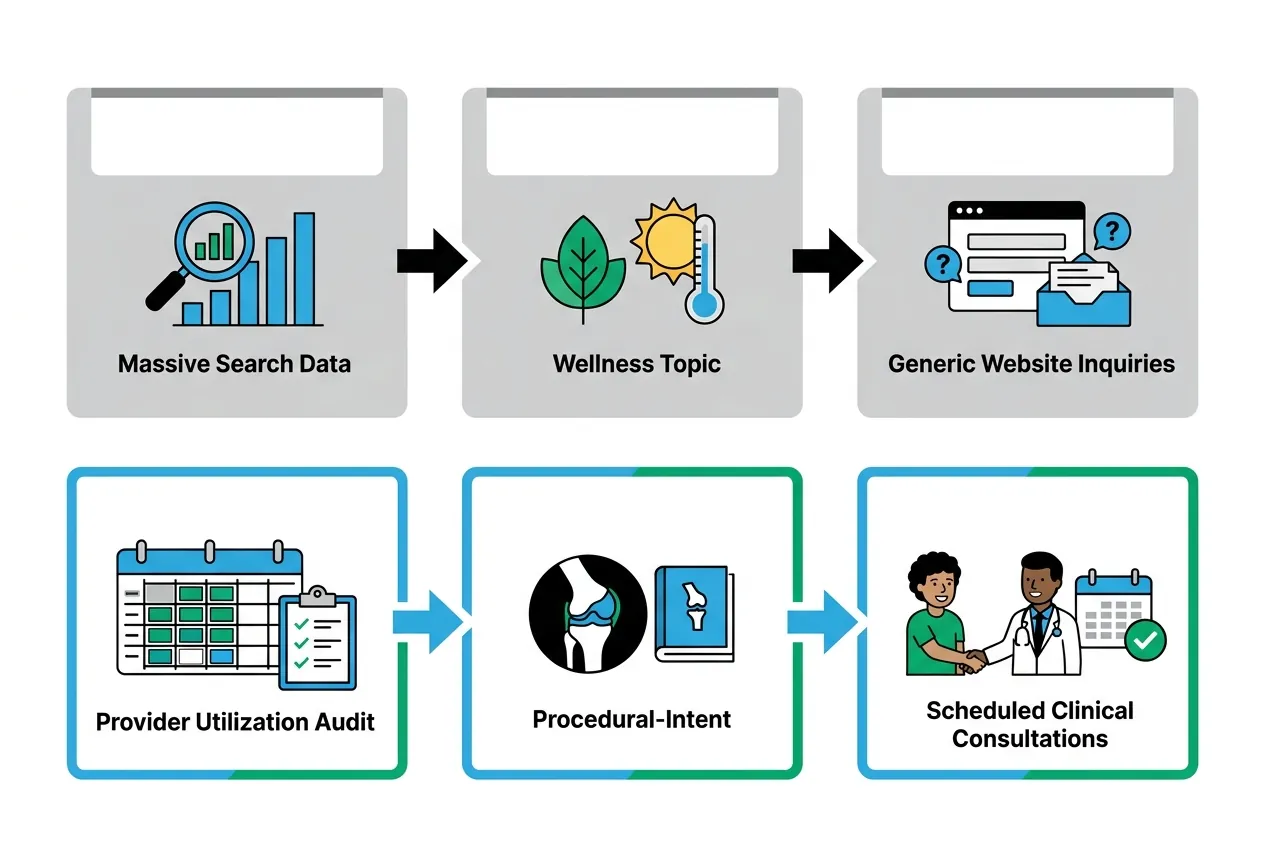
Most hospital editorial programs produce traffic that clinical operations cannot convert. Marketing teams routinely celebrate exponential organic search growth while clinic administrators manage empty exam rooms in specialized service lines and unmanageable backlogs in general medicine. This imbalance occurs because editorial calendars are typically built on unvalidated search volume rather than clinical resource availability. Writing general wellness articles on seasonal allergies or minor headache remedies attracts high impressions, but it rarely produces commercial encounters for hospital surgical suites, specialized diagnostic centers, or dedicated inpatient beds.
Clinical capacity must determine topical priority. Before assigning editorial assets, marketing teams should sit down with clinic managers, practice administrators, and scheduling directors to audit provider utilization across service lines. If an orthopedic surgery group has three joint replacement surgeons operating at 60 percent surgical block utilization, editorial strategy must prioritize high-intent queries surrounding hip arthroplasty, candidate criteria for knee revision, and surgical recovery protocols. Conversely, producing content for an outpatient physical therapy clinic with a six-week new-patient waitlist wastes acquisition budget and frustrates prospective patients who cannot secure an appointment.
Treating search demand as an extension of clinical scheduling resolves the divide between marketing metrics and hospital revenue. Top-of-funnel symptoms, middle-of-funnel diagnostic comparisons, and bottom-of-funnel procedural guides must map to specific facility schedules. When an article addresses a specific medical condition, it must present a direct, friction-free pathway to a clinical team that actually possesses the appointment capacity to evaluate and treat that patient.
Developing a Healthcare Content Strategy Around Service-Line Economics
A commercially viable healthcare content strategy evaluates content topics against contribution margin, clinical resource overhead, and downstream patient encounter value. General health systems operate on razor-thin operating margins, meaning organic search cannot afford to function as an unmeasured public library. Content assets must justify their creation and maintenance costs by generating encounters for service lines that sustain the health system financially.
Editorial teams should categorize all topic candidates into a three-tiered economic framework:
- High-Margin Procedural Topics: These include specialized surgical interventions, complex cardiovascular procedures, oncology treatment pathways, and neurosurgical consultations. Organic search queries in this category exhibit lower total search volume but possess extraordinarily high patient intent. Prospective patients searching for robotic-assisted spinal fusion or transcatheter aortic valve replacement are evaluating definitive clinical interventions.
- Targeted Diagnostic and Screening Topics: Screenings serve as the primary entry point for multi-year patient relationships. Content covering low-dose CT lung screenings, comprehensive metabolic panels, preventative mammography, and advanced colon cancer screenings directly feeds downstream clinical utilization. These topics must clearly explain preparation, insurance coverage considerations, and what occurs if an abnormality is detected.
- Preventative and Chronic Care Management Topics: While broader in reach, chronic condition content covering diabetes management, congestive heart failure monitoring, or outpatient behavioral therapy must focus on structured patient programs rather than generic lifestyle advice. The narrative should guide individuals with poorly controlled conditions into specialized clinical management programs.
Topic prioritization requires analyzing three distinct variables: local search intent, provider capacity, and procedural margin. If high search volume intersects with high margin but zero provider availability, content publication must be paused until clinical staffing expands. Marketing leadership must maintain an active dialogue with service-line administrators to adjust editorial production as physician recruiting and facility expansions alter operational capacity across regional facilities. For a broader framework on aligning organizational resources with growth goals, read our comprehensive guide, Healthcare marketing: the operating guide for health systems and provider groups.
Medical Content Writing Protocols: Decoupling Accuracy from Narrative Editing
The traditional physician review bottleneck occurs because healthcare organizations ask clinical specialists to act as copy editors. A standard draft submitted to an orthopedic surgeon or cardiologist often sits in an inbox for weeks. When the draft finally returns, it is frequently redlined with passive, academic terminology that obliterates reader comprehension, or it is stripped of its conversion pathways because the physician felt uncomfortable with direct marketing language.
Scalable medical content writing requires decoupling clinical accuracy verification from structural, narrative editing. Professional medical writers, trained in clear health communication and health literacy standards, should produce the initial draft. These writers structure the piece for search intent, readability, and patient accessibility, adhering to plain-language principles that keep medical terminology accessible to non-clinical readers.
Once the draft is structured, it enters clinical review with explicit parameters. Physicians, advanced practice registered nurses, and clinical directors must act strictly as technical validators, not copy editors. Establish a standardized clinical review rubric that confines the clinician's role to answering four objective questions:
- Is the pathophysiological description of the condition clinically accurate?
- Are the described treatment options, procedural risks, and diagnostic pathways aligned with current standard of care?
- Are there medical contraindications, urgent symptoms, or exclusion criteria that must be highlighted for patient safety?
- Do the referenced clinical citations represent consensus medical literature?
Clinicians verify facts, safety parameters, and clinical boundaries. Marketing retains total ownership of voice, layout, readability, and call-to-action placement. Establishing this clear boundary cuts review turnaround times from weeks to days while protecting the clarity and conversion performance of the published material.
Free Audit
Want a straight read on where your budget is leaking?
Clinical Governance: Medical Content Under Search Quality Standards
Publishing health information online carries substantial regulatory and algorithmic responsibility. Major search platforms classify healthcare topics under Your Money or Your Life (YMYL) definitions, holding medical content to the highest standards of accuracy, authority, and safety. According to the Google Search Central Helpful Content Guidance, content must demonstrate direct expertise, real-world experience, and clear authoritativeness to rank reliably. Furthermore, the Google Search Quality Evaluator Guidelines explicitly instruct human quality raters to evaluate whether medical advice aligns with established scientific consensus and originates from accredited medical professionals.
A formal clinical governance framework protects the organization from both search visibility penalties and institutional liability. Every published article addressing symptoms, diagnoses, or clinical interventions must display explicit trust signals directly on the page:
- Primary Author Byline: Clear identification of the medical writer or researcher who drafted the article, accompanied by their professional background in health communication.
- Medical Reviewer Credentials: A prominent byline stating that the piece was medically reviewed by a credentialed clinician (MD, DO, NP, PhD), including their medical specialty, board certifications, and clinical affiliation.
- Timestamped Verification: Clear notation of the date the article was written, alongside the exact date of the most recent clinical review, reassuring patients and search engines that the information reflects current clinical standards.
- Peer-Reviewed Citations: Inline or terminal citations pointing directly to reputable medical journals, academic institutions, or clinical clinical trial repositories validating all empirical claims.
- Explicit Editorial Policy: A publicly accessible link detailing the health system's editorial standards, conflict-of-interest disclosures, and the multi-step verification process required before any medical claim is published.
When evaluating external agencies to support this process, health systems must verify that their partners possess authentic clinical workflows rather than generic copywriting capabilities. For detailed evaluation criteria, review our analysis on Healthcare marketing agency: what to expect and how to choose one.

From Healthcare Blog to Intake Pipeline: Privacy-Safe Attribution
Traffic generated by an educational healthcare blog has zero enterprise value if the health system cannot measure how that traffic influences downstream clinical encounters. However, tracking patient journeys across digital properties has become legally and technically complex due to regulatory scrutiny regarding tracking technologies.
The U.S. Department of Health and Human Services (HHS) Office for Civil Rights issued an explicit HHS Bulletin on Online Tracking Technologies clarifying that deploying third-party tracking pixels (such as standard social platform or retargeting scripts) on unauthenticated healthcare webpages can violate HIPAA rules if those trackers capture an individual's IP address alongside health-related search terms or browsing behavior. Furthermore, paid ad platforms enforce strict privacy boundaries; the Google Ads Policy on Personalized Advertising strictly forbids retargeting and personalized audience construction based on sensitive health conditions or medical treatments.
To build an accountable, privacy-safe conversion pipeline, healthcare marketing teams must deploy first-party data architectures:
- Server-Side First-Party Event Capture: Eliminate standard third-party client-side marketing tags from condition-specific content pages. Route tracking through secure, server-side containers where patient identifiers and IP addresses are stripped before non-sensitive analytics pings are logged.
- Privacy-Preserving Call Attribution: Implement dynamic call tracking that uses non-indexed tracking numbers assigned to specific service-line clusters. Integrate call recordings and transcription only within encrypted, HIPAA-aware platforms that do not transmit identifiable medical disclosures to third-party ad networks.
- Scheduling Widget Integration: Connect appointment scheduling directly to the organization's electronic health record (EHR) or patient portal via authenticated, secure APIs. Track the originating content category inside the intake system using internal campaign codes rather than external ad pixels.
- Encounter-Level Reconciliation: Reconcile scheduled encounters against attended appointments and clinical admissions within an internal, protected data warehouse. This connects organic content consumption directly to completed encounters without exposing patient identities to external advertising networks.
Multi-Location Content Operations Across Regional Health Facilities
Regional health systems face an operational challenge when expanding content programs across dozens of outpatient clinics, diagnostic centers, and regional hospitals. Publishing generic health content fails to rank in competitive local search environments, while creating entirely isolated websites for each clinic dilutes domain authority and creates governance chaos.
Multi-location organizations must adopt a hub-and-spoke content architecture. The primary health-system domain serves as the clinical authority hub, hosting exhaustive, medically reviewed condition and procedural resources. Each regional facility, surgical center, or physician practice maintains a dedicated location node that links contextually to these authoritative resources while highlighting facility-specific capabilities.
Every location node must display localized clinical details:
- Attending Medical Staff: Direct biographical profiles of the specific physicians, surgeons, and specialists practicing at that physical location, including their specific clinical focus areas and accepted insurance plans.
- On-Site Diagnostic Capabilities: Clear distinction between locations that provide on-site advanced imaging, surgical suites, or specialized laboratory services versus those operating strictly as primary care consultation offices.
- Location-Specific Scheduling Access: Distinct booking pathways reflecting real-time scheduling capacity for that exact facility, avoiding the friction of central call centers that lack visibility into local provider calendars.
- Accreditation and Facility Honors: Specific hospital safety scores, trauma center designations, or surgical accreditations unique to that physical facility.
Structuring content this way satisfies local organic search algorithms by providing precise geographic relevance while anchoring every regional page to a clinically validated, enterprise-grade content foundation. If your organization is evaluating external support to structure multi-location operations, read our operational review on Hospital marketing company: what a specialist partner delivers and how to vet one.

Email Us
Prefer to send the context directly?
How Marketing Powered Builds Content Systems Tied to Clinical Admissions
Marketing Powered approaches healthcare content marketing as an accountable patient acquisition system, not an unmeasured editorial exercise. Our operating model was built by a former healthcare CMO who ran marketing for a treatment network that grew from 3 to 24 locations, managed $1.5 to $2M per month in Google Ads across 11+ behavioral and mental health accounts, and serves as a court-certified expert witness in advertising strategy. We operate with an intimate understanding of the operational, regulatory, and capacity pressures facing healthcare executives.
Our approach differs fundamentally from traditional marketing agencies:
- Attribution Tracked to Admission: We do not stop at tracking pageviews, form fills, or raw phone calls. We design measurement systems that link marketing engagement directly to verified patient appointments and admissions, providing health-system leadership with clear visibility into service-line economics.
- HIPAA-Aware and LegitScript-Aware Operations: Built specifically for Google's sensitive healthcare vertical, where retargeting is not permitted, our strategies rely on high-intent search capture, rigorous on-page conversion architecture, and strict regulatory adherence rather than vulnerable third-party tracking scripts.
- Owned, Local AI Infrastructure: We have been AI-native since 2022. To protect client confidentiality and sensitive strategic data, we utilize owned, local AI infrastructure for HIPAA-aware inference. This allows our team to accelerate content research, operational analysis, and search optimization without exposing proprietary organizational data to public cloud models.
- Capacity-Aligned Program Architecture: Through our dedicated healthcare and hospital marketing programs, we align editorial calendars with real-time provider schedules and surgical block availability, ensuring marketing dollars drive volume where facilities have immediate clinical capacity.
We treat governance, clinical accuracy, and patient privacy as competitive advantages that establish market authority and protect long-term search performance.
Questions, Answered.
When decoupled from narrative editing, an experienced clinical specialist requires 20 to 30 minutes to review a 1,500-word article against a structured verification rubric. Operating under a defined service level agreement (SLA), clinical teams return validated drafts within 3 to 5 business days, maintaining steady publishing velocity without compromising medical rigor.
Generative AI should be used for research synthesis, structural outlining, and readability adjustments, but never for autonomous drafting of medical claims. Because AI models can hallucinate clinical facts and misinterpret nuanced diagnostic criteria, all medical claims must be written against verified medical literature and validated by credentialed clinical experts before publication.
ROI measurement requires tracking downstream conversions using first-party infrastructure. By utilizing unique, privacy-safe call routing numbers and server-side scheduling events that feed directly into your EHR or CRM with source campaign tags, your analytics team can reconcile marketing interactions against attended clinical appointments and procedural revenue without violating HHS tracking regulations.
Clinical content should undergo scheduled review every 12 to 24 months, or immediately whenever clinical guidelines, pharmaceutical approvals, or standard-of-care protocols change. Updating the "Medically Reviewed On" date and verifying outbound citations confirms to search engines and prospective patients that the material remains clinically accurate. Request a healthcare marketing assessment from Marketing Powered
Ready to see where your marketing can improve?
Request a free audit of your paid media, landing pages, attribution, and measurement setup. You'll get a straight assessment of where the opportunities are.
or email us at info@marketingpowered.ai