Capabilities
Data Strategy Consulting That Produces an Executable Plan
Most organizations have more data projects than data owners, and more dashboards than agreed definitions. Data strategy consulting should settle which decisions improve first, who is accountable for the records behind them, and what has to be built before anything else is trusted. The output is a prioritized roadmap, not another tool recommendation.

Start with the decisions, not the technology audit
The engagement opens in the rooms where decisions already happen: the weekly revenue meeting, the quarterly budget review, the location or service line performance call. We ask which recurring decisions leadership currently makes with incomplete or contested numbers, and what people do to compensate. The honest answers are usually familiar. An analyst rebuilds a spreadsheet every Monday. Two departments bring different versions of the same metric. A report arrives three weeks after the period it describes.
Those workarounds are the real requirements document. They show where data failure costs money, where it only costs patience, and which fixes a leadership team would actually fund.

Assess the data capabilities you already have
Next comes a capability assessment rather than a vendor audit. It covers where records originate, how systems are integrated, how identity is resolved across those systems, what quality controls exist, who can access what, and which skills sit inside the organization versus with contractors. A data maturity assessment here is descriptive, not a scored certification, because scores rarely tell a board what to approve.
This step also classifies downstream applications honestly. A reporting layer such as decision-focused marketing dashboards depends entirely on the groundwork beneath it. If source records are inconsistent or unowned, better visualization only distributes the inconsistency faster.
Design the operating model and name the owners
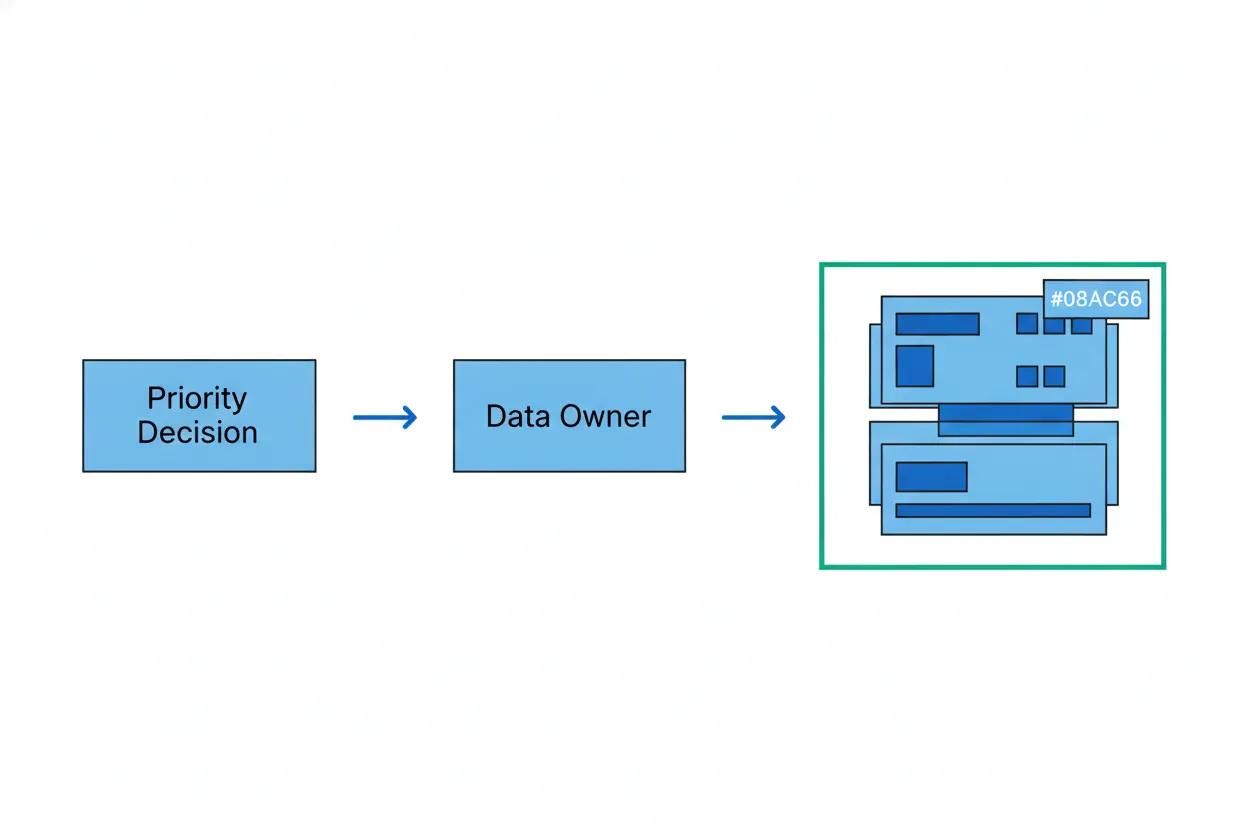
Ownership is the step most roadmaps skip. We define it by role: a product owner for each data domain, stewards responsible for definitions and quality, a named delivery owner for each initiative, and an escalation path when definitions conflict. Assigning everything to IT by default is how organizations end up with technically functional pipelines that no business leader trusts.
Operating model design also sets the rules for shared metrics. Decisions about marketing investment economics, for example, break down quickly when finance, marketing and operations each maintain separate definitions of a qualified opportunity, a customer and a closed outcome.
Free Audit
Want a straight read on where your budget is leaking?
Compare architecture options before approving spend
Architecture choices come after decisions and ownership, and they are presented as tradeoffs rather than recommendations from whichever vendor is in the room. Reuse keeps an existing system in place and adds integration. Migration consolidates records into one platform and absorbs a transition period. Build gives control over logic and retention. Buy gives speed and a support contract while constraining how data can be modeled and exported.
Regulated environments narrow the options further. Google treats health as a sensitive interest category and does not permit advertiser-curated audiences for that targeting, which changes what first-party data can legitimately do in acquisition systems (Google Ads policy). That constraint is why healthcare attribution implementation is an architecture decision, not a reporting preference.
Sequence delivery so early work holds up
Sequencing separates prerequisites from early deliverables and from work that should be deferred. Identity resolution and source system cleanup usually come first because everything downstream inherits their errors. Reporting and modeling come later, once the records they describe have an owner and a definition.
The common failure mode is building the visible layer first. A dashboard shipped on contested records creates confident reporting on top of unresolved data, and the correction costs more than the original build. The same applies to marketing attribution services, which depend on consistent records from first touch through to the outcome that matters, whether that outcome is an admission, a signed engagement or a completed sale.
Define measures and governance that survive the project
Every initiative on the roadmap carries three things: a named owner, an observable outcome, and a review date. Governance is an operating habit rather than a document, so the roadmap specifies who reviews definitions, how changes are approved, and what happens when a source system changes without notice.
Access design belongs here too. The HIPAA Privacy Rule applies a minimum necessary standard, requiring covered entities to limit use, disclosure and requests to what is needed for the purpose (HHS), and the Security Rule requires regulated entities to perform an accurate and thorough risk analysis covering electronic protected health information (HHS). Those obligations shape role design, retention and logging, and no architecture choice by itself satisfies them.
Email Us
Prefer to send the context directly?
What the documented output looks like
The engagement produces working documents, not a presentation. An illustrative decision-to-data map lists each impaired decision in one column, the records and systems it depends on in the next, the current failure mode in the third, and the accountable role in the last. A prioritized roadmap sits beside it, showing initiatives in dependency order with assumptions about cost, effort and internal capacity labeled as assumptions rather than estimates presented as fact.
Marketing Powered brings operator context to that work. The founder is a former healthcare CMO who ran marketing for a treatment network that grew from 3 to 24 locations and managed $1.5 to $2M per month in Google Ads across 11+ behavioral and mental health accounts, with attribution tracked to admission rather than lead. Related reading: workflow integration and tracking, data sovereignty and business control, and tracking records from source to outcome.
More Services
Ready to see where your marketing can improve?
Request a free audit of your paid media, landing pages, attribution, and measurement setup. You'll get a straight assessment of where the opportunities are.
or email us at info@marketingpowered.ai