Capabilities
Private AI Assistants for Authorized Employee Work
A demo that answers anything is easy to build and hard to deploy, because the same flexibility that impresses a leadership meeting is what leaks a salary band, invents a policy or fires off an email nobody approved. A private AI assistant for business is defined less by the model behind it and more by three boundaries: what it knows per employee, what it is allowed to propose, and who signs off before anything changes outside the chat window.

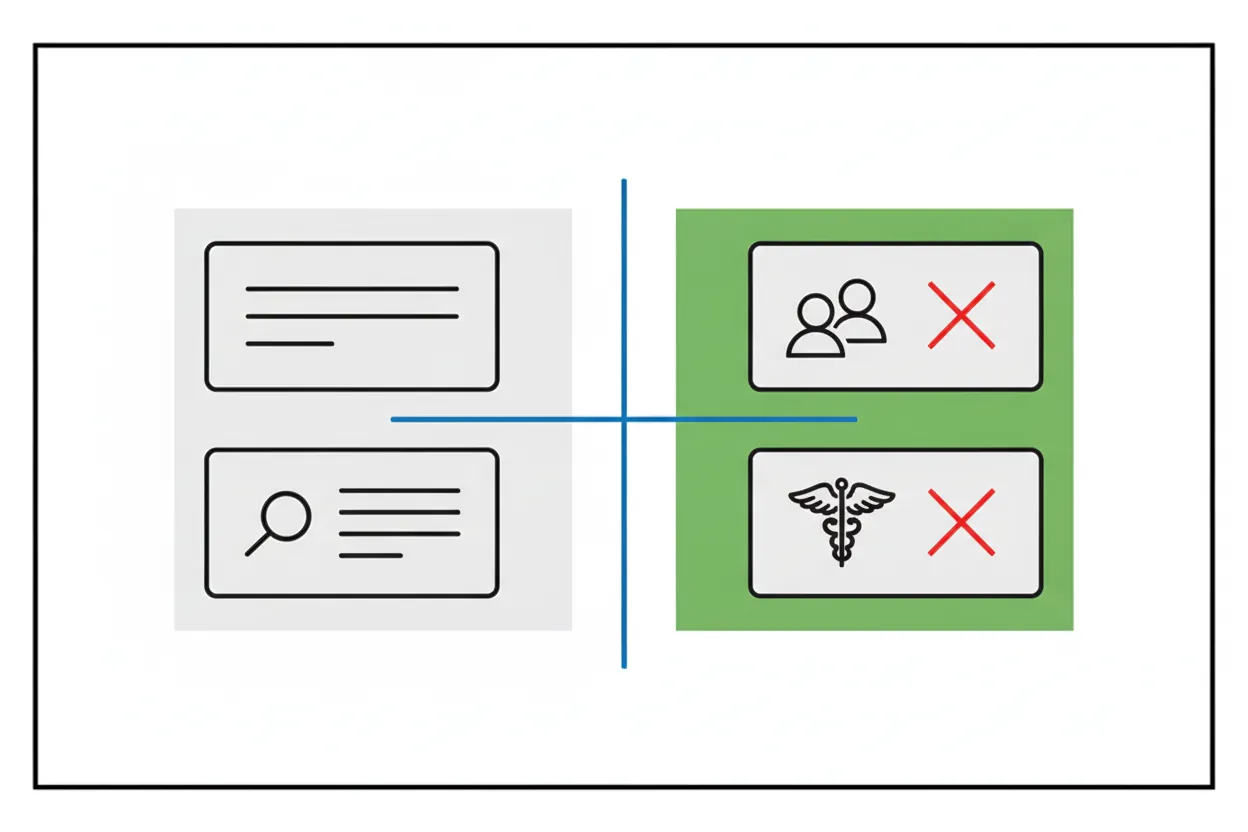
Define employee jobs and exclusions
Scope starts with a short list of jobs, not a capability wish list. Useful starting tasks are usually drafting and rewriting internal documents, summarizing long threads or reports, searching internal knowledge, and giving first-pass answers to policy and process questions with a link back to the source document.
Exclusions matter just as much and should be written down: pricing exceptions, personnel decisions, clinical or legal judgment, contract terms, anything involving regulated patient or client records.
A department head, an operations lead and whoever owns the systems of record should agree on both lists before configuration begins.
When an employee asks for something on the exclusion list, the correct behavior is a refusal plus a route to the human who owns that decision.
Connect knowledge with identity
An internal AI assistant should never become a second, shadow permission system. Retrieval should be filtered by the requesting employee's existing identity and group membership, so the assistant can only surface what that person could already open.
This is an established pattern rather than a novelty: Azure AI Search documents five approaches to document-level access control, including security string filters, POSIX-like ACL and RBAC scopes, SharePoint ACLs and Microsoft Purview sensitivity labels, with query-time trimming based on the user's token (Microsoft Learn).
Two caveats belong in any plan. Purview sensitivity label enforcement is still in preview, and permission refresh does not provide immediate revocation or a corpus-wide freshness guarantee (Microsoft Learn). Scoping agents for marketing workflows follows related logic, covered in our AI Agents for Marketing Agency Selection: Executive Guide.
Expose bounded business actions
The difference between a research tool and an operational risk is tool access. A business AI copilot should hold a short, named action list with fixed parameters: draft a reply for a specific record, flag a record for human review, create a task in a defined queue, file a note against an existing ticket.
That is different from generic authority to operate a CRM, a billing system or an email account. OWASP recommends giving the application its own API tokens, handling functions in code rather than exposing them to the model, and restricting privileges to the minimum needed (OWASP GenAI).
Each action should name the system it touches, the fields it may write and the roles allowed to trigger it. We describe this scoping discipline further in how configurable AI workflows are scoped.
Free Audit
Want a straight read on where your budget is leaking?
Keep authorization understandable
Authorization fails when it becomes a rubber stamp. Before an action runs, the employee should see a plain-language preview: the system, the record, the exact values being written, and the source the assistant used to justify it. After it runs, there should be a record showing who approved it, when, and what changed.
Rejection needs a path too, because a rejected proposal with a reason is the cheapest training data an organization will ever collect. OWASP explicitly recommends human-in-the-loop controls for privileged operations (OWASP GenAI). Approval design is inseparable from where the system runs and who can reach it, which we cover in owned AI systems and deployment boundaries.
Test misuse and failure
Three failure modes deserve deliberate testing before rollout. Prompt injection comes in direct and indirect forms, where instructions hidden in an uploaded file, a webpage or an email alter model behavior, with possible outcomes including disclosure of sensitive information, unauthorized use of connected functions and execution of commands in connected systems (OWASP GenAI).
Mistaken identity is the second: query under several role accounts and confirm each sees only its own material. Unsupported answers are the third, and they trace to retrieval rather than writing style, since retrieval brings its own problems with query understanding, multi-source content, token limits, response time and authorization (Microsoft Learn).
OWASP also suggests adversarial testing that treats the model as an untrusted user. Deployment choices, including supported local processing, change the threat surface but do not remove these tests.

Introduce and improve the workspace
Rollout is change management, not a software install. Start with one department and the task list that department agreed to, show people the exclusions as clearly as the capabilities, and make failure reporting a single click inside the workspace.
Review sessions should look at which questions returned nothing useful, which answers lacked a citable source, and which proposed actions were rejected and why. Adoption counted as logins is vanity. Adoption counted as work completed, answers traced to real documents and a falling rejection rate is a signal.
Email Us
Prefer to send the context directly?
How we scope a secure employee AI assistant
Scoping is a working session, not a product pitch. It involves the department leads who own the tasks, whoever administers identity and permissions, and the owner of each system of record the assistant might touch.
We work through the job list, the exclusions, a role and permission matrix, a proposed action list with previews and approvals, and a test plan covering injection, identity and unsupported answers. Marketing Powered has been AI-native since 2022 and operates owned, local AI infrastructure for HIPAA-aware inference, which gives the deployment conversation real options.
Hosting, retention, access and data flows are documented as part of scope, because a private deployment does not by itself establish security or legal compliance.
Common questions
Can the assistant take action in our CRM or other tools?
Only through a defined list of actions you approve, each tied to a specific system, record type and set of writable fields, and each presented for human approval before it runs. That is deliberately narrower than connecting an assistant to a CRM account and letting it decide what to do.
Does each employee have the same access?
No. Retrieval should inherit your existing identity and permission structure so results are trimmed to what the requester is already authorized to read (Microsoft Learn). Group-based access is easier to maintain than per-user grants, and permission changes at the source need a defined synchronization path.
How are sensitive requests and incorrect answers handled?
Requests on the exclusion list are refused and routed to a human owner. Answers should carry their sources so an employee can check them, and unsupported answers should be reported and traced back to retrieval, since retrieval is a separate concern from answer generation (Microsoft Learn).
What information and access are needed to scope this work?
A role and permission matrix, a candidate task list from the departments involved, an inventory of the systems of record and document repositories in play, and your constraints on hosting and data handling. Nothing requires production access during scoping.
What will our organization own and be able to export at the end?
Ownership, retention and export terms are defined in writing during scoping and reflected in the agreement, covering where the system runs, who holds the data, which subprocessors are involved and in what format knowledge sources and logs can be exported. We set those terms per engagement rather than claiming a standard arrangement.
More Services
Ready to see where your marketing can improve?
Request a free audit of your paid media, landing pages, attribution, and measurement setup. You'll get a straight assessment of where the opportunities are.
or email us at info@marketingpowered.ai