Capabilities
Market Intelligence Dashboards With Traceable Evidence
Intelligence loses its value the second someone asks where a number came from and the room goes quiet. Our market intelligence dashboard services focus on the governed layer between outside signals and internal performance data, so every figure on screen carries a source, a date, a confidence level and a named owner. The display is the easy part. The evidence model underneath it is the asset.

Start with the people and the decisions they own
Three audiences usually share one report, which is why the report satisfies none of them. A health system or professional services executive wants six numbers and a direction of travel before a budget meeting. An analyst wants the full observation trail, including the readings that were rejected and the note explaining why a competitor estimate moved. A regional manager wants an alert when a threshold trips in one market, not a monthly summary.
Scoping begins by naming those people and the decisions they actually own: territory expansion, service line investment, pricing posture, media reallocation. Each view becomes a different permission set and a different refresh expectation drawn from the same underlying records.

Separate what was observed from what was interpreted
Two established categories surround this work. Competitive intelligence firms deliver findings through service lines such as competitor benchmarking, pricing and value intelligence, sales enablement intelligence and early warning systems, as Fuld & Company sets out. Business intelligence consultancies build the analytics practice itself, with ScienceSoft describing BI consulting as work to eliminate data silos and produce trustworthy analytics insights. The connective layer between them is what usually goes unowned.
Many dashboards can blend four different things into one tile: a measured fact, a licensed third-party estimate, an analyst judgment and an extrapolation. Once blended, the tile inherits the credibility of its weakest input. The fix is structural. Store the observation, the source identifier, the retrieval or publication date, the collection method, the confidence rating and the analytical note as separate fields, as in decision-focused marketing dashboards.
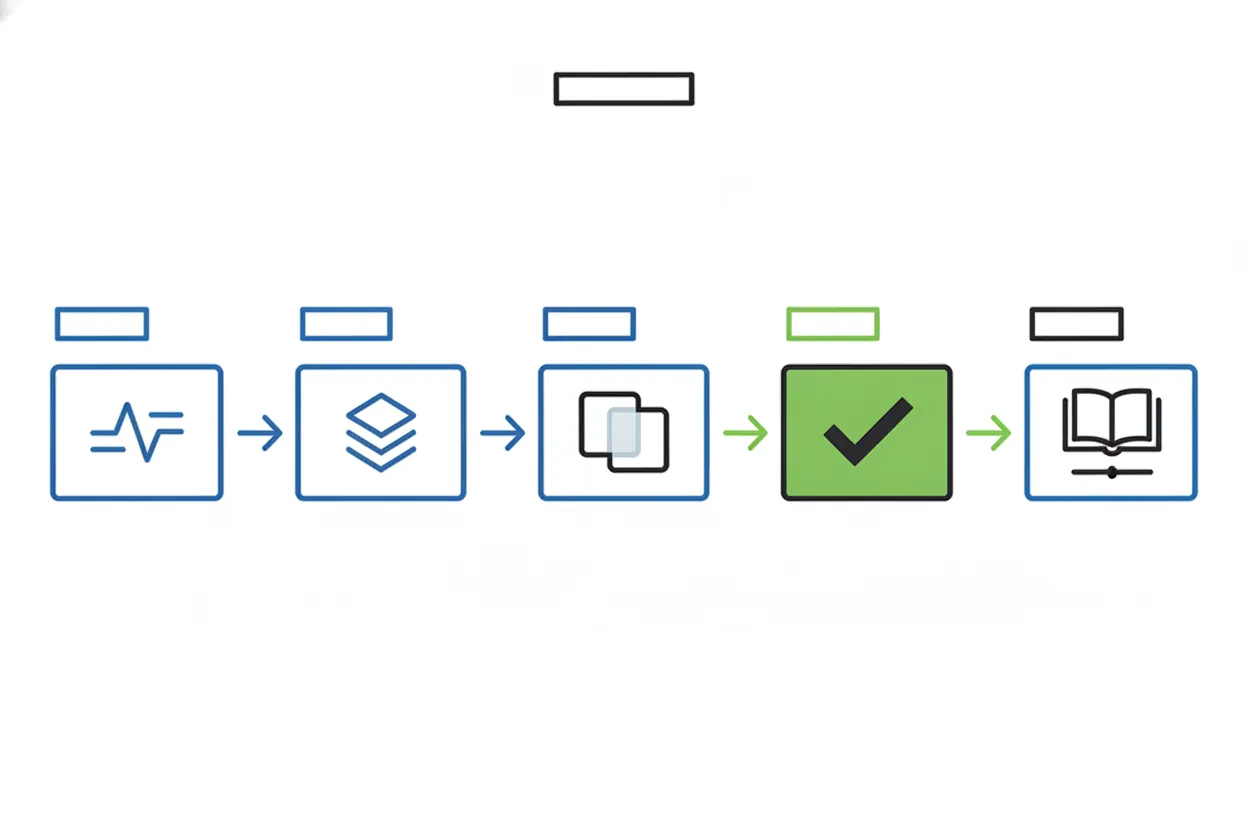
Illustrative evidence flow. Example roles and sources only, not a client deployment. Each state below is labeled in text rather than signaled by color alone.
- Signal captured. What is stored: Source, method, retrieval date. Illustrative example: Public competitor pricing page, collected quarterly.
- Observation stored. What is stored: Value, type, confidence, analyst note. Illustrative example: Modeled spend range, medium confidence, estimate.
- Comparison view. What is stored: Definition, geography, time window, freshness state. Illustrative example: Share of local demand, four quarters, two tiles stale.
- Owner and threshold. What is stored: Accountable role, trigger, response window. Illustrative example: Example owner role: regional marketing director.
- Decision record. What is stored: Decision, evidence cited, date. Illustrative example: Budget shifted, references the two observations above.
Integrate only the data you are permitted to use
Licensing governs design more than engineering does. Syndicated research, subscription datasets, public filings, ad transparency tools and purchased panel data each arrive with different redistribution rights, retention limits and update rhythms. A dataset you may read internally is not automatically a dataset you may surface to an external partner inside a portal.
Integration tooling is generally positioned as preparation work, pairing data integration with data quality so data is ready for analytics and AI, as in Qlik's Talend data integration and quality positioning. The vocabulary is useful; vendor selection still depends on your stack, hosting posture and contract terms.
A scoped engagement would document approved flows, access roles, retention and subprocessors for each source before anything is wired in. Private or owned deployment does not by itself establish security or legal compliance. See our research methods and resources.
Free Audit
Want a straight read on where your budget is leaking?
Build comparisons that survive a challenge
A comparison is only as good as its definitions. If market share means claims volume in one quarter and share of local search impressions in the next, the trend line is fiction. Lock the definition, the geography, the time window and the inclusion rules, then version them so a change is visible rather than silent.
Just as important, show the gaps. If a competitor pricing page has not been collected since last quarter, the tile should say so in words instead of presenting an old number as current. Missing and aging data deserve their own labeled state. That discipline prevents the expensive failure mode, which is a confident decision made on a stale read. See our published research hub.
Attach an owner and a threshold to every finding
A finding with no owner is trivia. For each tracked signal, name the role accountable for the response, define the threshold that triggers review, and set the expected response window. When a new entrant appears in a service area, when a payer or regulatory policy shifts, when paid search auction pressure crosses a set band, someone receives it and acts.
Then record the outcome. A short decision log capturing what was decided, by whom, on which evidence and when turns a market data dashboard into institutional memory, and makes the next budget conversation faster because the prior rationale is retrievable. See our published studies and their evidence.
Plan maintenance, access changes and retirement up front
Intelligence portal development fails quietly. Schemas change, a license expires, the analyst who maintained a collection script leaves, and the dashboard keeps rendering numbers that stopped updating months ago.
Before build, define who maintains each connector, how access is revoked when roles change, how often definitions are reviewed, and what the system does when a license lapses: grey out the tile, flag it, or archive it with its final retrieval date. Ownership and export terms are set in the scope agreement.
Marketing Powered approaches this layer as an operator. From the founder's earlier operating career as a healthcare CMO: court-certified expert witness in advertising strategy, and attribution tracked to admission, not just lead. Evidence that holds up under cross-examination is a different standard than evidence that looks good on a slide.
Related reading: marketing investment economics, budget allocation principles and multi-location operating strategy.
Email Us
Prefer to send the context directly?
Questions buyers ask before scoping
Can a dashboard combine external research with our own performance data?
Yes, provided the two stay distinct. External research carries licensing terms, publication dates and estimate ranges. Internal performance data carries its own definitions, lag and access restrictions. They can sit in one workspace as long as each record keeps its provenance and the interface never implies a modeled estimate is a measured result.
How do users trace a finding to its source?
Each figure expands to its evidence record: source name and identifier, collection or publication date, method, confidence rating and analyst note. Where the source is a public document, the record stores the reference and the retrieval date. Anyone challenged in a meeting should be able to answer the origin question immediately rather than next week.
What happens when an underlying data license changes?
License status is tracked as a field, reviewed on a set cadence and assigned to a named owner. When a license expires or narrows, affected tiles are flagged, dependent comparisons are marked incomplete, and the last valid retrieval date stays on record. Quiet expiry is a common cause of numbers nobody can trace.
What information and access are needed to scope this work?
A scoping conversation covers your current reporting artifacts, the decisions they support, your source inventory with contract terms, your internal data systems and their access controls, and who owns each decision today. Scoping should not require production credentials or protected health information; confirm the data-handling terms before sharing anything.
What will our organization own and be able to export at the end?
Ownership and export terms are set in the scope agreement before build, covering the evidence records, the metric definitions, the decision log and the configuration, alongside hosting, retention and access terms. Owning hardware or running a private deployment does not change who owns your data, and the agreement should state that plainly.
More Services
Ready to see where your marketing can improve?
Request a free audit of your paid media, landing pages, attribution, and measurement setup. You'll get a straight assessment of where the opportunities are.
or email us at info@marketingpowered.ai