Capabilities
Product Validation Research Before Building or Launching
Some offers that fail were built well. They solved a problem that was real but not costly enough to make anyone change what they already do. Product validation research tests that assumption while being wrong is still inexpensive.

State the product hypothesis in falsifiable terms
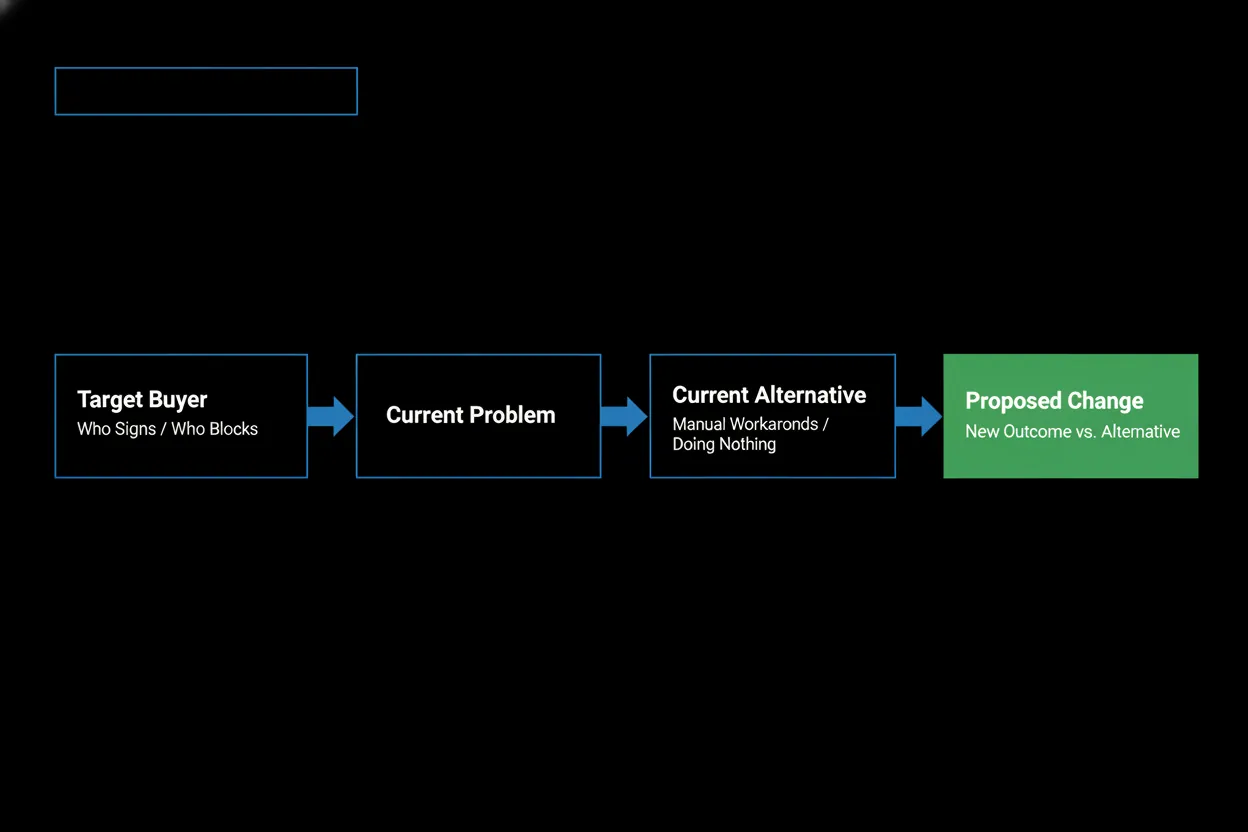
A hypothesis that cannot fail cannot be validated. Before any fieldwork, write the proposed offer as four specific statements: who the buyer is, including who signs and who blocks; what the problem costs them today; what they use instead, including manual workarounds and doing nothing; and what changes if they adopt your offer.
Illustrative example: "mid-market firms want better intake" is not testable, while "practice administrators at multi-site clinics lose booked revenue to after-hours call abandonment and currently absorb it" is. Buyer problem validation starts here because every later method inherits the precision of this step. Vague hypotheses produce research that agrees with whoever commissioned it.
Check the market context before testing demand in isolation
No offer is judged against a vacuum. Buyers compare it to a tool they already pay for, an internal process someone owns, a competing priority on the same budget line, or indifference. Product opportunity assessment maps substitutes, current spending, switching friction, and who inside the organization loses work or standing if the new approach is adopted.
That context determines what a credible test looks like, and it sets the boundary with message testing. Comparing headlines, creative and landing page variants is useful, but it answers a later question. Our creative testing services are built to run after a product hypothesis has survived validation, not as a substitute for it.
Investigate real buyer behavior, not stated enthusiasm
Interviews, observation and behavioral tests each prove different things, and the limits belong in the report, not in a footnote. Interviews surface language, workflow and the trigger events that precede a purchase. Observation shows the workaround people actually run.
Neither establishes price tolerance, because stated value can diverge from value revealed under real economic commitment, a gap the literature formalizes as hypothetical bias (stated choice research synthesis).
Treat stated interest as a routing signal that tells you what to test next, and hold any spending implication against the same marketing investment economics you apply to other acquisition decisions.
- Agrees in an interview that the problem matters. Evidence of buying behavior (illustrative): Books working time to scope a pilot.
- Says the price sounds reasonable. Evidence of buying behavior (illustrative): Names the budget line and the approver.
- Joins a waitlist. Evidence of buying behavior (illustrative): Signs a pilot scope or pays a deposit.
- Describes an ideal future workflow. Evidence of buying behavior (illustrative): Shows the workaround in use today.
Illustrative comparison of signal types, not measured outcomes.
Free Audit
Want a straight read on where your budget is leaking?
Test the offer and constraints under realistic conditions
This is where validation work usually stops short. The question is not whether a buyer likes the concept, it is whether the concept survives their purchase conditions.
In regulated and professional services organizations that commonly means a security review, legal review of data handling, an integration estimate from IT, an operational owner who must change a daily routine, and a budget cycle that may be months away.
Illustrative example: a multi-office accounting firm may agree the problem is real, then discover that the partner who would sponsor it is measured on billable hours, not on the saving. Validation examines each constraint with the people who impose it, not only the enthusiastic sponsor. Method notes and completed work are collected in our published research hub.
Define evidence for go or no-go before you read the results
Decision thresholds are set in advance and written down: what result proceeds, what result changes the offer, what result stops it. Specify respondent criteria, the number and type of conversations, the behavioral signal that counts as commitment, and the price point being tested.
Without a prior threshold, teams reinterpret findings to fit a decision already made, the pattern methodologists call HARKing, where exploratory findings are written up as though they had been predicted (CASRAI preregistration guide). Thresholds also protect a good result from a skeptical executive. The measurement discipline is the same one behind attribution tracked to admission, not just lead: count the commitment, not the compliment. Supporting material sits in our research methods and resources.
Recommend the smallest test that resolves the remaining uncertainty
Validation rarely returns a clean yes. More often it returns a narrowed question: the problem is real but the buyer is one level up, or the offer works only above a certain site count.
The output is the next experiment sized to that question rather than a full build justified by partial evidence. That might be concierge delivery for three accounts, a paid pilot with defined scope, or a landing page smoke test, which measures demand for a product that does not yet exist (landing page smoke test method).
Any page or ad used this way must be accurate about what exists and when it would be available, and should pass advertising policy and legal review first, since advertising must be truthful and non-deceptive and advertisers must have evidence behind their claims (FTC advertising guidance).
A cleared hypothesis then feeds the next allocation decision, covered in our budget allocation principles, and for operators running several sites it raises a second question about whether demand holds across markets, which our multi-location operating strategy addresses. Comparable write-ups appear in our published studies and their evidence.
Questions, Answered.
No. Agreement in an interview costs the respondent nothing, and stated interest can diverge from spending (stated choice research synthesis). Feedback is useful for refining language and choosing who to test next. Validation needs a behavioral signal collected under real cost: time committed, a pilot scoped, budget named, or money exchanged.
Often yes, and that is usually the point. Concept validation can use pilot scoping conversations, manually delivered versions of the service, and demand tests. Each carries a different standard of proof and different disclosure obligations. Anything shown to the market has to describe accurately what currently exists and when it would be available.
That is defined before fieldwork begins. Common stop conditions include buyers who acknowledge the problem but hold no budget line for it, a current workaround that is adequate and free, or a price that fails once implementation effort is counted. A change of direction is more common than a stop: same problem, different buyer, narrower segment, or a different point of entry.
A written statement of the offer hypothesis, the target buyer definition, any existing customer or inquiry data you are permitted to share, the decision this research must inform, and the date that decision is made. Access to a small number of current or prospective buyers speeds the work considerably. Scope is agreed per engagement rather than sold as a fixed package.
Ownership of the questions, criteria, evidence, thresholds and experiment plan is agreed in writing before work starts, along with retention, hosting and any subprocessors involved. Respondent anonymity is a condition of credible research practice: under the ICC/ESOMAR code, a respondent's identity is not revealed to the user of the information without explicit consent (ICC/ESOMAR international code). Bring the hypothesis you are considering spending money on, and we will discuss how to test it. Validate an offer hypothesis
More Services
Ready to see where your marketing can improve?
Request a free audit of your paid media, landing pages, attribution, and measurement setup. You'll get a straight assessment of where the opportunities are.
or email us at info@marketingpowered.ai