Capabilities
Enterprise Search Across Authorized Company Knowledge
Most staff do not need an assistant that talks. They need to find the current policy, the signed version of a contract, or the record a regulator will ask about, and they need it from a system that already knows what they are allowed to open. An enterprise search implementation should start there: approved repositories, preserved permissions, ranked results that lead back to real documents.

Define the failed search journeys
Start with the people, not the platform. A nurse manager looking for the current version of a care protocol, a billing lead checking a payer policy, an operations director hunting for the signed addendum to a vendor agreement: each has a different entry point, vocabulary, and tolerance for a wrong answer.
Document those journeys with the actual search terms people use and the systems they check in order, usually a wiki, then a shared drive, then a message to the one colleague who always knows. The failure modes are specific. Search does not span all systems. Results return superseded files alongside current ones. Or an AI pilot answers confidently without showing which document it drew from.

Connect only approved repositories
Scope the corpus before anything is indexed. For each system, record the owner, the connector or API available, whether indexing is contractually and technically permitted, how often content changes, and which library, site, or folder is in scope. Repositories holding regulated or personally identifying material may be excluded entirely rather than filtered later.
Microsoft's documentation notes that enterprise content spans SharePoint, databases, blob storage and other platforms, and that building a unified search corpus without disrupting data operations is a core challenge (Microsoft Learn). That inventory is also the scoping artifact buyers can reuse, and it follows the same discipline as how configurable AI workflows are scoped.
Preserve identity and permissions
Security trimming means the result set is filtered by the identity of the person searching, not by a disclaimer on the results page.
Documented approaches include string-based security filters, where the application passes a user or group identity into a query filter, and native permission metadata such as access control lists, RBAC scopes and SharePoint permissions evaluated against the caller's token (Microsoft Learn).
Two details decide whether this holds up. Permission refresh is not instant revocation, and the same documentation states it provides no corpus-wide freshness commitment. And when documents are chunked, permissions must be projected onto every chunk, or chunk-level results are not filtered.
Identity flow, logging and connector behavior belong in the same review as workflow integration and tracking.
Free Audit
Want a straight read on where your budget is leaking?
Design retrieval and ranking
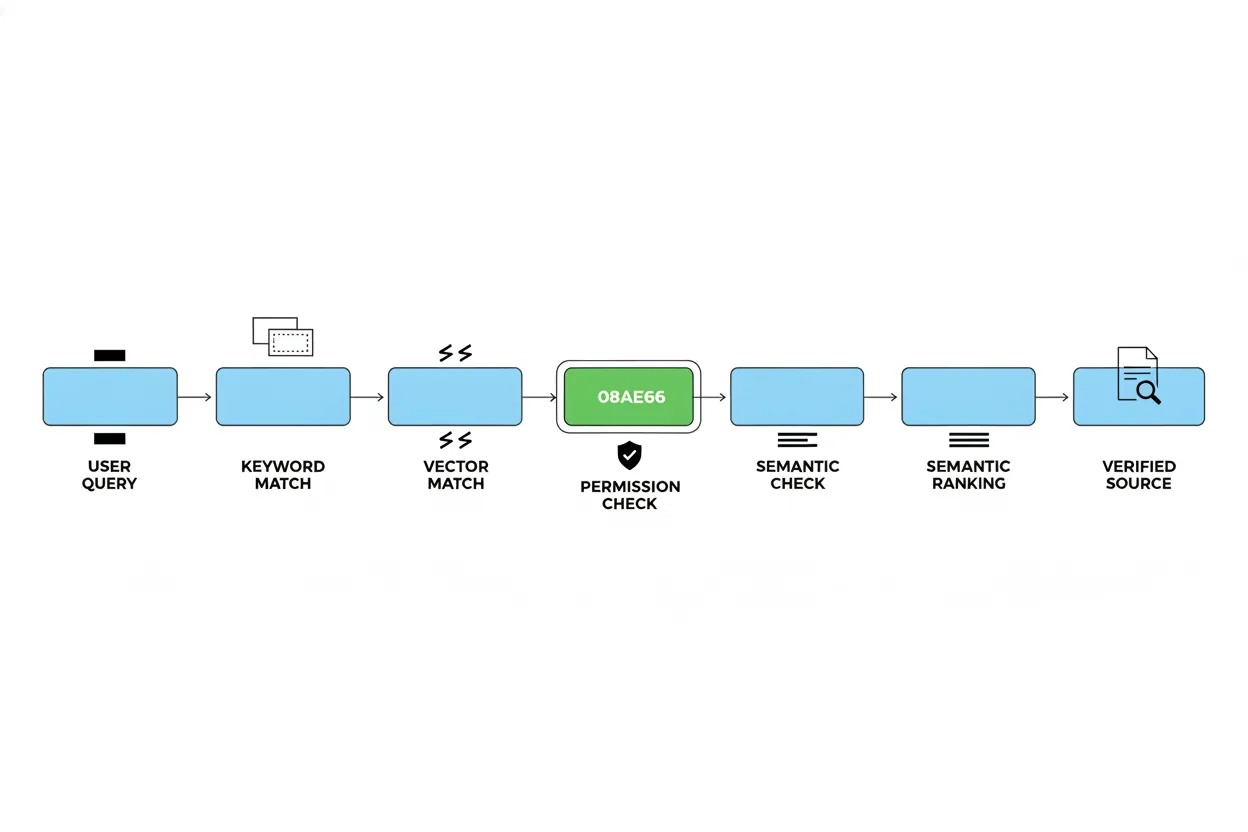
Retrieval is a separate engineering problem from answer generation. The practical build combines lexical matching for exact terms such as policy numbers and drug names, semantic matching for how people actually phrase questions, metadata filters for department, document type, effective date and status, and ranking signals that favor the authoritative version.
Hybrid queries that combine keyword and vector search are documented as the way to maximize recall, with semantic ranking rescoring results by meaning and scoring profiles boosting specific fields (Microsoft Learn).
The result a user sees should show title, source system, owner, date and version, so the next click is into the document. Deployment questions, including where indexes and embeddings sit, are covered under owned AI systems and deployment boundaries.
Test findability with real tasks
Relevance is tested with a written test set, not a demo. Collect real tasks from the people in the first step, record the correct source document for each, then measure whether it appears in the top results, how long retrieval takes, and how often a misleading or superseded document outranks the right one.
Zero-result and near-miss queries are the most useful output, because they show vocabulary gaps worth fixing with synonyms or metadata. Permission testing runs on the same set with accounts at different access levels, including a check that restricted items stay invisible. Where processing location matters to the review, see supported local processing.
Operate the search service
Picture the standing routine rather than a launch date. Someone owns connector monitoring and sees the alert when a nightly crawl fails silently. Deletions and moves propagate so a retired policy stops appearing.
Permission changes are resynchronized on a defined cadence, since automatic refresh intervals vary by source and some changes require an explicit resync (Microsoft Learn). A monthly relevance review reads the query log, fixes the top failures, and retires content that should not be in the index.
Related reading covers AI governance and approval controls, data custody and processing boundaries, and specialized marketing agents.
Email Us
Prefer to send the context directly?
Questions buyers ask before scoping
Is enterprise search the same as an AI chatbot?
No. Retrieval finds and ranks authorized source documents; generation writes prose on top of what retrieval returned. Microsoft's documentation treats retrieval challenges, including query understanding, multi-source access and authorization, as distinct from answer formulation. Build retrieval first and treat generated answers as an optional later layer.
Can it search several systems without exposing restricted documents?
That is the design intent of security trimming, and it depends on the permission model of each connected source rather than on the search layer alone. Documented methods range from identity string filters to native access control list enforcement at query time. Each repository is assessed separately, and sources without a reliable permission signal stay out of scope.
How are moved, deleted or superseded documents handled?
Through incremental indexing, deletion propagation and explicit versioning metadata. Superseded documents are either removed from the index or labeled with status and effective date so ranking can demote them. This is an operating routine with an owner, not a setting.
What information and access are needed to scope this work?
A repository inventory with owners, documentation of the permission and group model, sample search tasks that currently fail, and read access for a limited technical assessment. Internal technology, security and compliance stakeholders should be involved from the first conversation.
What will our organization own and be able to export at the end?
Ownership, retention, hosting, subprocessors and export format are scoping decisions made in writing before build, not assumptions. Expect to define who holds the index, the configuration and the relevance test set, and how each is exported if the engagement ends.
Bring one findability problem you can describe in a sentence, such as a document type staff cannot locate or an access question nobody can answer.
More Services
Ready to see where your marketing can improve?
Request a free audit of your paid media, landing pages, attribution, and measurement setup. You'll get a straight assessment of where the opportunities are.
or email us at info@marketingpowered.ai