Resources
Healthcare Web Forms and HIPAA | Vendor Evaluation
Securing patient data starts at the first point of contact, making hipaa compliant web forms a baseline requirement for medical and behavioral health marketing. Evaluating vendors requires looking past basic encryption to understand how data routes into your operational systems. Marketing Powered builds these data transitions to protect privacy while preserving the attribution visibility needed to measure return on ad spend.
By Mike Hulick, Founder, Marketing Powered

Core Requirements for Privacy Compliance
A digital form transitions from a basic contact tool into a regulated data collection endpoint the moment it is deployed on a medical or behavioral health website. Meeting compliance standards requires a specific architecture that protects patient data from the browser to the database. The foundational requirement is a Business Associate Agreement. This legal contract mandates that the software vendor shares the liability for protecting Protected Health Information. Without this agreement in place, no configuration of technical security features makes the software suitable for healthcare use.
Technically, compliance requires strong encryption for data in transit and data at rest. When a patient submits their information, the data packet must travel via TLS protocols directly to a secure server. It cannot pass through intermediary servers that log the plain text, and it cannot trigger standard unencrypted email notifications containing the patient name or phone number. Furthermore, the storage environment must enforce strict access controls. Only authorized admissions or medical staff with unique, auditable login credentials should possess the ability to view the submitted records.
The regulatory landscape enforces these technical boundaries strictly. According to the United States Department of Health and Human Services, individually identifiable health information collected on a regulated entity's website or mobile app generally constitutes Protected Health Information, even if the individual does not have an existing relationship with the facility HHS guidance on tracking. This ruling fundamentally changes how healthcare organizations must architect their intake infrastructure.

When Does a Contact Form Contain PHI?
In the context of behavioral health, addiction treatment, and hospital environments, the definition of Protected Health Information extends beyond formal medical records. A common misunderstanding among digital marketers is that a form must ask for specific medical conditions or social security numbers to trigger privacy regulations. The reality is much stricter. The simple combination of personal identifiers and the context of the healthcare provider creates a protected record.
If an individual visits a substance abuse treatment facility website and submits a form containing only their name and phone number, that submission is protected. The presence of the individual on a specific medical service page implies a health condition or a desire for treatment. This context alone elevates basic contact details into sensitive health data. This strict interpretation applies across all regulated medical facilities, including specialized mental health clinics and multi-location hospital networks.
Marketers must operate under the assumption that every digital touchpoint on a clinical website deals with protected data. This reality necessitates secure patient web forms across all landing pages, contact pages, and gated resource downloads. Failing to recognize the implied medical context of a simple contact submission creates massive liability and exposes the organization to severe regulatory penalties.
Mistakes in Healthcare Form Implementation
The transition to secure infrastructure frequently stalls due to implementation errors that compromise otherwise compliant software. One of the most prevalent mistakes is pairing a secure form builder with an insecure notification system. A hospital might procure a contracted form vendor, but then configure the tool to send an email alert to the admissions department containing the submitted name, phone number, and inquiry details. Because standard email protocols do not encrypt messages end-to-end, this configuration broadcasts protected data across the open internet, nullifying the security of the form builder itself.
Another critical vulnerability involves the presence of third-party tracking pixels. Marketing teams often deploy platforms like Meta Pixel or Google Analytics tracking codes across their entire website. If these scripts are present on the page where the form is hosted, they can capture form-field inputs or submit button clicks, inadvertently transmitting patient data to unauthorized advertising networks. Relying on basic website architectures without conducting a thorough tracking technology assessment leads to systemic privacy violations.
It is also crucial to understand what the data cannot prove. A form submission indicates a baseline level of interest or a request for contact. However, basic marketing analytics cannot prove that the individual is clinically appropriate for the facility, financially qualified for admission, or geographically viable. Evaluating the success of a campaign based solely on raw submission volume leads to bloated marketing budgets and strained admissions teams. Organizations need an infrastructure that connects the initial digital touchpoint to the final operational outcome without compromising privacy. Integrating secure forms with HIPAA compliant analytics provides a clearer picture of actual business value.
Free Audit
Want a straight read on where your budget is leaking?
Step-by-Step Implementation and Owner Roles
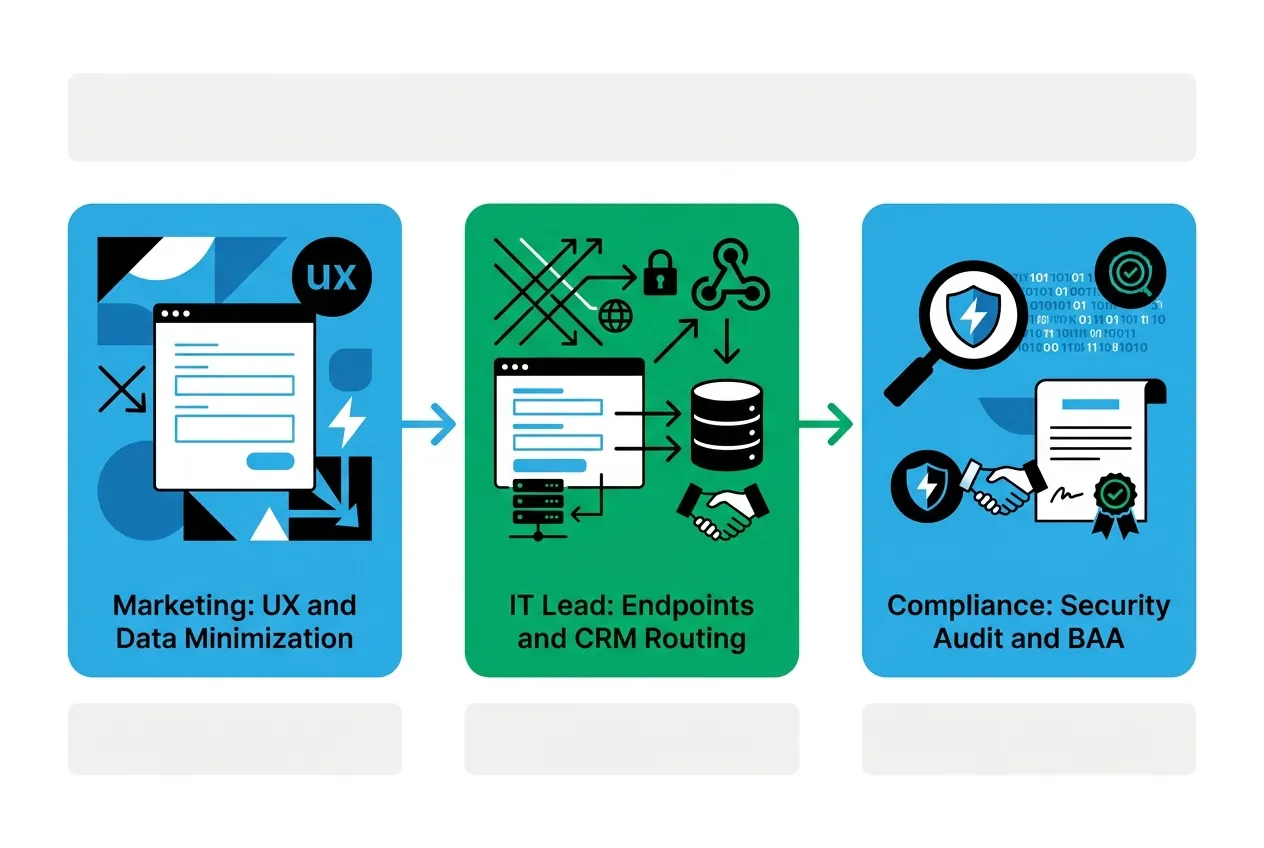
Deploying secure data collection requires a coordinated process that aligns marketing objectives with technical security and legal compliance. In a typical hospital or multi-location healthcare setting, this process involves distinct roles operating in a defined sequence. The marketing director, the IT lead, and the compliance officer must align on the architecture before any code is deployed to the live website.
The marketing team initiates the process by defining the user experience and the required fields. Their primary responsibility is establishing a data minimization strategy, ensuring the organization only asks for the exact information needed to facilitate the next step in the intake process. Following this, the IT department configures the technical routing. The IT lead builds the secure endpoints, sets up encrypted webhooks, and verifies that the data bypasses insecure channels to land directly in the organization's secure Customer Relationship Management system.
The compliance officer serves as the final gatekeeper. They must review the data flow, audit the access controls, and officially execute the Business Associate Agreement with the chosen software vendor. A former healthcare CMO who ran marketing for a treatment network that grew from 3 to 24 locations understands that misalignment between these departments paralyzes growth. Marketing Powered operates on the principle that structured, cross-departmental alignment accelerates deployment. By defining these roles clearly, organizations launch robust conversion systems without regulatory delays.
Measuring Forms Against Qualified Admissions
Healthcare marketing requires a fundamental shift away from basic lead generation metrics. Measuring forms against raw volume creates a false sense of success, particularly in sectors with high disqualification rates like addiction treatment and specialized mental health. Attribution must be tracked to admission, not just the lead. This requires a closed-loop measurement system that connects the initial advertising click to the final financial or clinical outcome.
Building this closed-loop system in healthcare presents unique technical constraints. Advertising platforms restrict how medical advertisers can track and target users. Because Google restricts personalized advertising based on physical or mental health conditions Google Ads Personalized Advertising policy, retargeting is not permitted in the sensitive healthcare vertical. Advertisers cannot follow users around the internet with reminder ads after they visit a treatment page.
Managing $1.5 to $2M per month in Google Ads across 11+ behavioral and mental health accounts requires a sophisticated approach to first-party data. Secure forms must be configured to capture anonymous ad click identifiers, such as the GCLID, alongside the secure patient data. This identifier travels with the patient record into the secure CRM. When that individual ultimately admits to the facility, the CRM strips away all protected health data and sends only the anonymous click identifier back to the advertising platform. This offline conversion tracking methodology trains the bidding algorithms to optimize for actual revenue and census growth rather than cheap, unqualified form fills. The architecture of your mental health website design must natively support these secure data handoffs.
Vendor Evaluation Checklist and Worksheet
Selecting the right software vendor requires a methodical evaluation of their technical capabilities and legal commitments. Organizations should utilize a standardized worksheet to compare vendors objectively. This checklist should serve as the primary evaluation document during the procurement process, ensuring no critical security requirements are overlooked in favor of aesthetic features or lower costs.
The evaluation must begin with a definitive assessment of the vendor's willingness to sign a Business Associate Agreement. If the vendor refuses or offers a modified agreement that limits their liability, they must be immediately disqualified. The checklist then moves to data routing capabilities. The vendor must demonstrate the ability to push data via secure webhooks or encrypted APIs directly into your existing electronic health records or CRM systems, without forcing data to rest indefinitely in a vulnerable third-party dashboard.
Further evaluation points include data minimization controls and script management. The platform must allow administrators to strictly limit the fields presented to the user. Additionally, the form software should include technical safeguards that block unauthorized third-party analytics scripts from scraping inputs while the user is typing. For organizations looking to process complex marketing data internally, evaluating owned, local AI infrastructure for HIPAA-aware inference provides a distinct advantage. This allows the organization to analyze marketing trends and patient acquisition costs without exposing sensitive datasets to public AI models.
Questions, Answered.
No. Standard form builders typically lack a Business Associate Agreement and often route submission data through unencrypted email notifications. Using these basic tools on a medical or behavioral health website exposes the organization to severe privacy violations and regulatory penalties.
Data minimization is the practice of requesting only the absolute minimum amount of information necessary to facilitate the immediate next step in care. For a digital marketing form, this usually means asking only for a name and a phone number to schedule a callback, rather than requesting a full medical history on the initial web touchpoint.
Yes. Healthcare advertisers can utilize offline conversion tracking. This method involves capturing an anonymous click identifier via the secure form, storing it in a compliant CRM, and sending only the anonymous identifier back to the advertising platform upon a successful admission. This trains the ad platform without transmitting Protected Health Information.
Major advertising networks prohibit the use of personal health data for targeted advertising. Because visiting a specific medical treatment page implies a health condition, platforms restrict advertisers from creating remarketing audiences based on that site activity to protect user privacy. Request an acquisition audit
Ready to see where your marketing can improve?
Request a free audit of your paid media, landing pages, attribution, and measurement setup. You'll get a straight assessment of where the opportunities are.
or email us at info@marketingpowered.ai