Capabilities
Mental Health Website Design | Provider Conversion
Effective mental health website design functions as the conversion layer between paid search traffic and scheduled appointments. For multi-location clinics and group practices, a digital presence must solve for patient intake friction while measuring acquisition outcomes precisely. Marketing Powered builds the operational infrastructure required to turn online discovery into sustainable, qualified patient demand.

When to Engage an Agency for Mental Health Website Design
When practice leaders sit in a conference room reviewing a printed site map and analytics dashboard, the core problem is rarely a lack of website traffic. The fundamental issue is that existing traffic fails to convert into scheduled appointments at a sustainable, measurable rate. Mental health practice owners and outpatient clinic executives managing multiple locations eventually reach a threshold where generic digital templates actively harm commercial outcomes.
Mental health website design requires a highly specialized approach because search platforms enforce strict privacy rules. Google and Meta restrict retargeting for behavioral health advertisers, preventing campaigns from following users across the web. A visitor who leaves the site without submitting a confidential inquiry is often lost permanently. The digital platform must compel a first-touch conversion. Organizations should engage an agency when their cost per acquisition rises, intake friction prevents successful patient routing, and existing digital assets fail to support complex psychiatry group acquisition goals.

Operator Diagnosis of Current Website Performance
A rigorous diagnosis of therapy group practice marketing starts with evaluating the structural connection between paid media spend and actual facility admissions. Sites with high aesthetic polish often fail because they lack clear patient routing and precise data attribution. An operator looks closely at bounce rates on critical service-line pages, the functionality of mobile click-to-call buttons, and the exact drop-off points in the patient intake process.
A former healthcare CMO who ran marketing for a treatment network that grew from 3 to 24 locations understands that diagnostic criteria must focus purely on business mechanics. If a multi-location site cannot attribute a specific phone call to the exact paid search click that generated it, the underlying digital architecture is fundamentally broken. Effective diagnosis maps the current data flow against the required business outcomes, identifying exactly where patient intent dissipates.
Buyer Decision Criteria for Group Practices and Clinics
When selecting a partner for a foundational rebuild, executive decision criteria must prioritize operational capabilities over fleeting visual trends. Leaders evaluating website design for psychiatry and behavioral health need robust platforms built for strict platform governance and secure first-party data capture. The site must support distinct mental health service-line campaigns across different geographical locations without cannibalizing local search rankings or confusing prospective patients.
Decision makers should mandate digital architectures that handle complex intake scheduling needs, multi-provider directories, and location-specific regulatory requirements. A court-certified expert witness in advertising strategy knows that poor foundational design exposes healthcare organizations to compliance risks and wasted media spend. The correct decision hinges entirely on finding infrastructure that connects raw online discovery to validated commercial outcomes.
Free Audit
Want a straight read on where your budget is leaking?
Core Elements for Mental Health Website Design
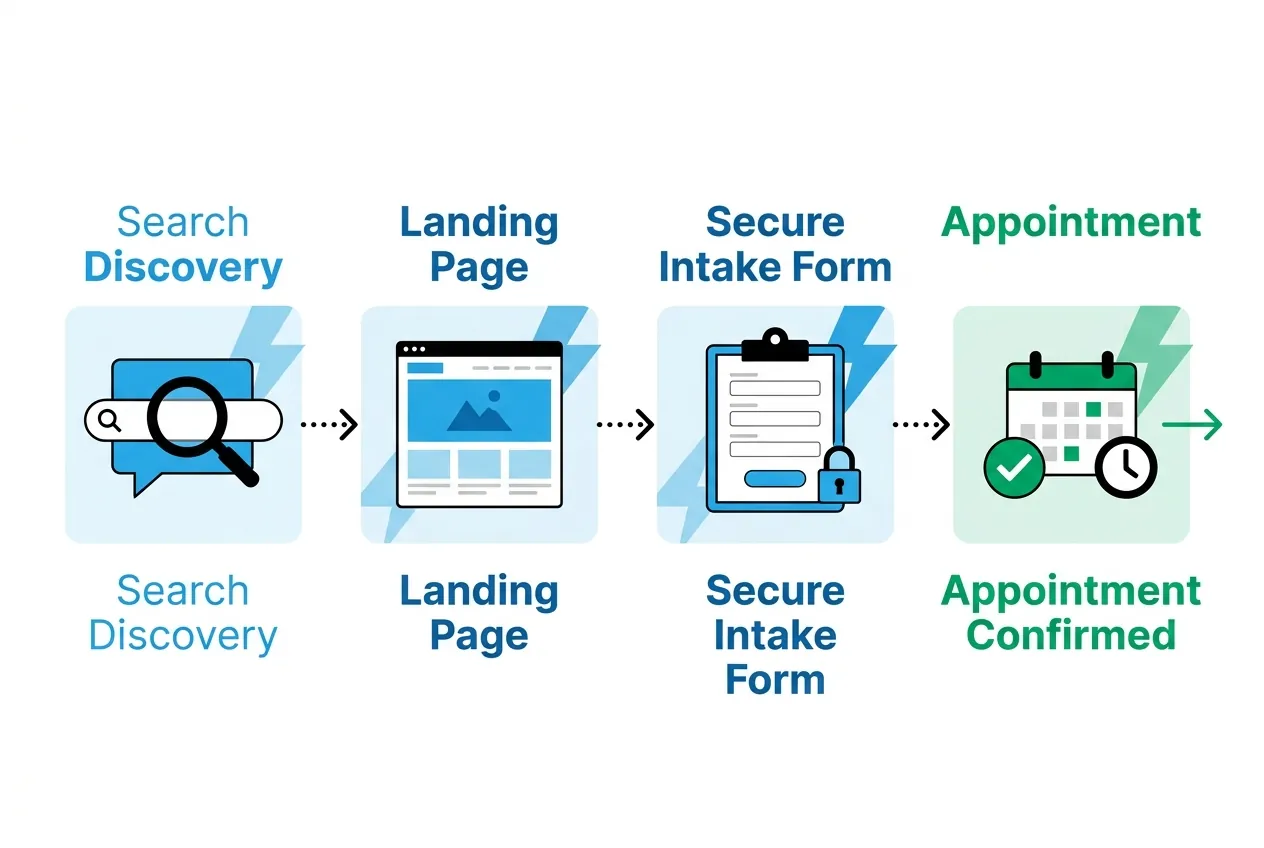
The structural foundation of mental health web design relies on mapping a precise, frictionless user journey. Picture a linear patient path diagram: a user initiates a late-night search, arrives on a highly relevant landing page, navigates smoothly to a secure form, and receives immediate confirmation of their next steps. This required path demands strict accessibility standards, prominent trust signals, and secure forms that minimize cognitive load while protecting sensitive medical information.
Website design for mental health professionals must account for patients arriving in states of high distress. The visual layout must provide immediate clarity regarding active insurance acceptance, available clinical services, and exact appointment availability. By combining friction-free scheduling interfaces with compliance-aware data routing, the platform effectively transforms a passive online visitor into an active participant in the intake process.
Measuring Qualified Inquiries Through to Admissions
Success in behavioral health marketing is defined by completed clinical appointments. Raw traffic volume remains a secondary metric. High-performing acquisition campaigns rely on attribution tracked to admission, not just the initial lead. This level of precise measurement requires deep, technical integration between the website frontend, call tracking software, and the facility customer relationship management system.
Managing $1.5 to $2M per month in Google Ads across 11+ behavioral and mental health accounts demonstrates that accurate measurement dictates the efficiency of all media spend. Every digital interaction must pass source data seamlessly through the intake pipeline, allowing operators to see exactly which specific campaigns drive actual facility revenue. When appointment demand is accurately attributed, organizations can confidently scale their highest-performing channels with total financial clarity.
Request an acquisition audit to evaluate current conversion tracking and measurement capabilities.
Governance, Policy Dependencies, and Data Handling
Deploying patient acquisition systems requires strict adherence to search advertising policies and stringent privacy standards. The digital infrastructure must be LegitScript-aware and HIPAA-aware, built explicitly for Google's sensitive healthcare vertical. Search and social platforms prohibit retargeting in this space, making secure first-touch data capture imperative.
Furthermore, patient data sovereignty remains paramount for any growing clinical organization. The system utilizes owned, local AI infrastructure for HIPAA-aware inference. As an operating entity that has been AI-native since 2022, the architectural approach prioritizes explicit data handling and configurable privacy boundaries at every level. By controlling the technology stack and the entire data environment, the resulting digital infrastructure aligns fully with the regulatory realities of modern healthcare advertising.

Email Us
Prefer to send the context directly?
Onboarding, Deliverables, and Acquisition Audit Scope
The engagement begins with a comprehensive, data-led review of existing acquisition mechanics. Visualize an operator at a desk with dual monitors displaying call-tracking and CRM dashboards, methodically mapping the current disconnects between paid ad clicks and scheduled clinical appointments. The detailed onboarding process defines the entire scope of the required rebuild, establishing rigid baselines for cost per acquisition and intake velocity.
Project deliverables extend far beyond standard wireframes and website copy. The process includes deploying accessible intake form patterns, establishing measurable digital experiment hypotheses, and configuring the exact data connections that support full-funnel visibility. The acquisition audit identifies exactly where the current site leaks qualified patient inquiries and outlines the precise technical roadmap required to capture them efficiently.
Request an acquisition audit to begin diagnosing intake friction.
Questions, Answered.
The most critical features prioritize secure patient intake and precise data attribution. Mobile click-to-call functionality, prominent insurance verification paths, location-specific provider directories, and compliant contact forms actively drive conversion. Aesthetic elements must serve these core operational features, ensuring a distressed user faces zero navigational friction when attempting to schedule professional care.
Performance should be measured by continuously connecting the initial digital click to the final facility admission. A platform succeeds when clinical operators can trace a specific scheduled appointment back to the exact paid media campaign and landing page that generated the inquiry. This requires integrating the website with robust call tracking and CRM software, moving entirely beyond simple traffic metrics to evaluate true commercial return. Request an acquisition audit
Ready to see where your marketing can improve?
Request a free audit of your paid media, landing pages, attribution, and measurement setup. You'll get a straight assessment of where the opportunities are.
or email us at info@marketingpowered.ai