Resources
Healthcare SEO: A Strategy for Health Systems and Provider Groups
Healthcare marketing leaders face an environment where generic wellness blogs no longer produce qualified clinical appointments. Implementing an effective healthcare seo framework requires moving beyond disconnected content to engineer an integrated network of clinical service lines, accredited regional facilities, and credentialed medical providers. When health systems anchor this architecture with documented clinical governance and systematic point-of-care review acquisition, they establish durable local search visibility that compounds across every market they operate.
By Mike Hulick, Founder, Marketing Powered

What is Healthcare SEO and Why Multi-Location Systems Struggle
Healthcare SEO is the technical, architectural, and content process of connecting prospective patients to verified medical services and licensed clinicians at the exact moment of care discovery. Unlike standard commercial search, medical queries operate under Google's strictest search quality thresholds. Health-related topics carry substantial potential impact on a person's physical health, mental well-being, or financial security, placing them firmly within what search engines classify as Your Money or Your Life (YMYL) content.
Most multi-location health systems, hospital networks, and regional provider groups struggle with organic search discovery because their digital infrastructure mimics traditional corporate websites rather than clinical operations. When marketing teams scale up digital presences across dozens of clinical sites, execution breaks down across three distinct friction points:
First, decentralized administrative teams often spin up fragmented digital assets. Separate subdomains, unlinked microsites, and disconnected web portals cause self-cannibalization. Instead of presenting a unified, authoritative domain to search crawlers, clinics within the same health system compete against each other for identical geographic terms, diluting overall domain strength.
Second, medical organizations frequently rely on high-volume informational wellness blogging to drive search impressions. While publishing diet tips or general lifestyle advice may produce transient traffic, that traffic rarely converts into clinic appointments or specialty consultations. Informational searchers reading broad health topics are seldom local, qualified prospective patients looking for immediate care.
Third, health systems face strict advertising limitations that compound the necessity of organic search. Under the Google Ads Policy on Personalized Advertising, medical organizations cannot deploy personalized retargeting based on user health conditions or sensitive clinical searches. Health networks that neglect foundational search engine optimization find themselves paying repeatedly for the exact same commercial queries month after month, exposing their patient acquisition budgets to escalating media costs.
Achieving sustainable organic visibility requires health systems to abandon disconnected blogging tactics and focus entirely on structured entity validation that mirrors how modern search engines interpret clinical care.

The Three-Tier Architecture: Service Lines, Locations, and Providers
Sustainable medical search visibility depends on an architectural framework that reflects the physical realities of clinical practice. Successful medical seo relies on a structured three-tier taxonomy that connects clinical capabilities, physical locations, and individual medical practitioners.
Tier 1: Clinical Service-Line Hubs
Service-line pages must function as comprehensive medical specialty hubs rather than thin marketing brochures. A Cardiology or Orthopedic surgery hub should provide an exhaustive overview of conditions treated, diagnostic procedures offered, therapeutic modalities, accepted insurance networks, and clinical quality metrics. Each service-line page must explicitly link downward to every facility providing that specific service, as well as to the individual physicians credentialed to perform those procedures.
Tier 2: Physical Facility and Location Pages
Location pages represent the digital front door for individual hospitals, ambulatory surgical centers, and regional clinics. To avoid being flagged as duplicate doorway pages, each facility page must feature unique, site-specific operational data:
- Exact physical street address, dedicated local phone number, and verified department extensions.
- Interactive facility maps, driving directions, parking instructions, and public transit access details.
- Daily operating hours, emergency triage protocols, and walk-in versus appointment policies.
- Embedded Google Business Profile map links and specific insurance plans accepted at that individual facility.
- A contextual roster of credentialed providers currently practicing on-site.
Tier 3: Credentialed Provider Directories
Doctor and specialist directories are critical trust assets for healthcare networks. Every provider profile must document the clinician's complete medical training, board certifications, active state medical licenses, and National Provider Identifier (NPI) number. Furthermore, each provider page must programmatically link upward to their associated clinical service lines and laterally to the specific physical facilities where they examine patients.
This three-tier relational model gives search engines the structural proof needed to validate medical claims. When a patient searches for a specialist within their municipality, search crawlers can parse the direct connection between the clinical condition, the local facility, and the licensed doctor. To learn more about structuring regional pages without triggering search filters, read our deep dive on Multi-location SEO: how to rank every location without duplicate content.
Clinical Governance and E-E-A-T Compliance for Health Systems
Because medical queries directly affect patient outcomes, search engines evaluate healthcare websites through the rigorous framework of Experience, Expertise, Authoritativeness, and Trustworthiness (E-E-A-T). For health systems and hospital networks, demonstrating compliance cannot remain a theoretical marketing goal. It must exist as an enforceable clinical governance workflow.
Every health article, procedure description, and condition overview published across a healthcare domain must pass formal medical oversight before publication. Healthcare organizations should implement a clear clinical review panel composed of credentialed physicians, registered nurses, or board-certified specialists.
Published clinical content must display prominent editorial metadata at the top of the page, including:
- Clear attribution to the primary author alongside their professional healthcare writing credentials.
- The name, medical degree, board certifications, and professional affiliation of the reviewing clinician.
- The exact calendar date the content underwent clinical review and verification.
- Direct footnote citations linking out to reputable peer-reviewed journals, professional medical societies, or federal health agencies.
Beyond human editorial protocols, technical implementation of structured data translates this clinical credibility directly into machine-readable code. Health systems must implement schema.org markup across all three architectural tiers.
Using specific schema types such as MedicalCondition, MedicalProcedure, Hospital, MedicalClinic, and Physician, web teams can define explicit relationships for search engine indexing. By nesting the reviewedBy property within a MedicalWebPage schema, the health system explicitly connects the published page to the reviewing doctor's external clinical profile, institutional records, and medical board licensing. This level of technical transparency prevents algorithmic ambiguity and secures organic visibility for competitive medical search queries.
Free Audit
Want a straight read on where your budget is leaking?
Local Pack Dominance and Google Business Profile Infrastructure
For health systems, multi-site specialty practices, and urgent care clinics, the majority of high-intent patient acquisition happens within the local map pack. When prospective patients search for urgent care near me or pediatric cardiology in a specific city, Google serves the three-pack map display before standard organic web listings. Dominating these positions requires continuous, systematic management of every Google Business Profile (GBP) across the health system's regional footprint.
According to Google Business Profile Help, local ranking prominence is determined by how well an organization's business details match user search queries, geographic proximity to the searcher, and the depth of information Google gathers about the business across the web, including review volume and review ratings.
Optimizing local profiles across a multi-location healthcare enterprise requires executing several non-negotiable operational controls:
- Category Discipline: Every individual facility must select the most accurate primary category available (for example, Urgent Care Clinic rather than simply Medical Clinic). Secondary categories must reflect the actual service lines physically housed inside that specific facility.
- Provider Versus Department Listings: Health systems must implement Google's specific nested listing structure. Main hospital campuses require parent profiles, while emergency rooms, outpatient imaging centers, and accredited walk-in clinics require separate, correctly categorized departmental listings sharing the same campus address. Individual practitioner profiles should be created only for customer-facing doctors who can be scheduled directly at that specific site.
- Data Uniformity Across Directories: Inconsistent names, addresses, and phone numbers (NAP) create indexing friction. Health networks must maintain absolute synchronization between the structured location pages on their primary domain and the corresponding public business registries, medical licensing boards, and local mapping ecosystems.
When geographic location pages reflect the exact operational data contained within local profiles, search engines develop high algorithmic confidence in the health system's physical presence, expanding the geographic radius across which the clinic ranks within local map packs.
Point-of-Care Review Acquisition: Operationalizing Powered Cards
Review volume, recency, and overall rating scores directly influence local pack positioning and patient conversion. Prospective patients evaluating a medical provider scrutinize authentic patient feedback before booking an initial consultation. However, relying on automated post-discharge emails or delayed SMS blasts yields minimal engagement, with review conversion rates frequently lingering below two percent. By the time a patient opens a follow-up email days after discharge, their willingness to leave detailed public feedback has dissipated.
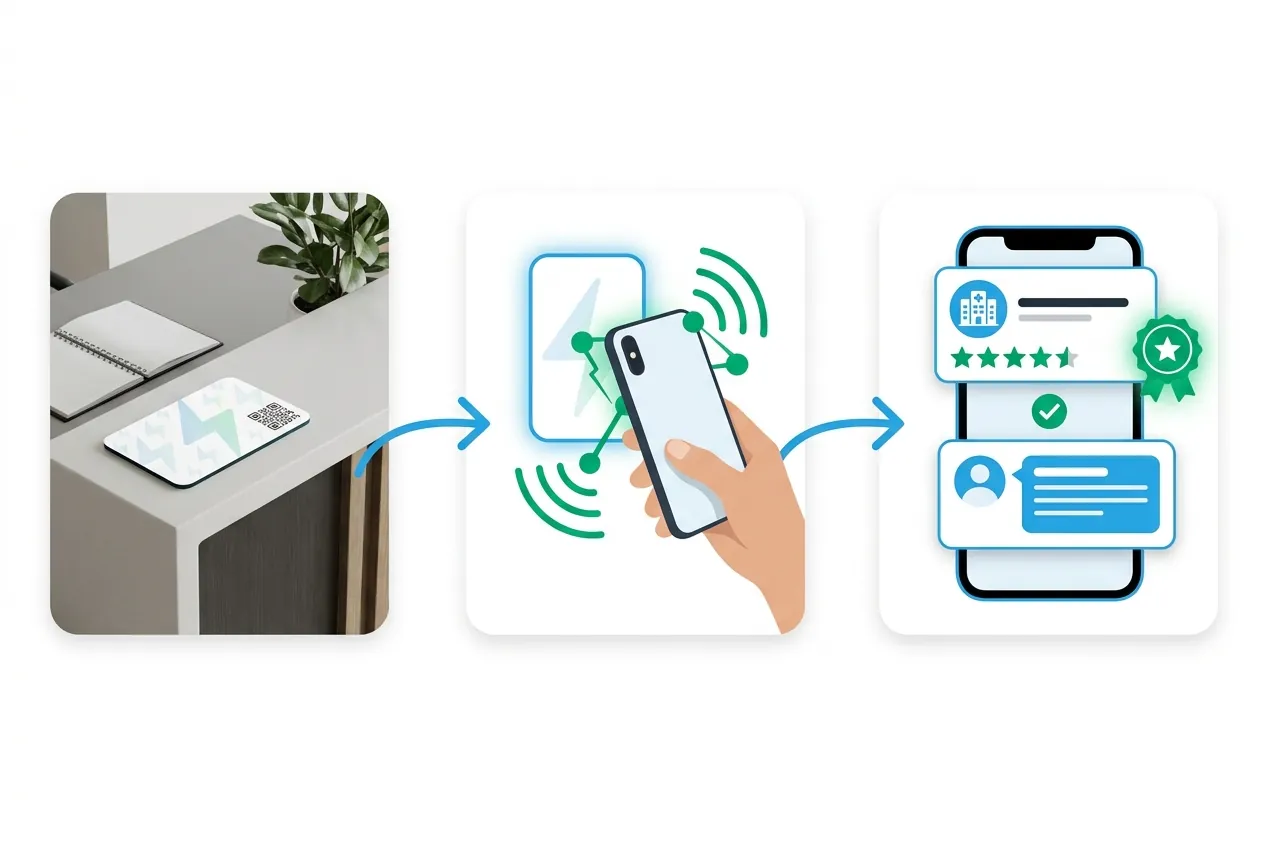
Capturing authentic patient sentiment requires transitioning to point-of-care review collection. Equipping clinic front desks, discharge counters, and patient intake stations with physical interaction points allows facilities to capture patient feedback while the clinical interaction is fresh.
Marketing Powered addresses this operational bottleneck through Powered Cards. These physical, tap-to-engage tools combine Near Field Communication (NFC) chips and dynamic QR codes to provide an immediate digital touchpoint for departing patients. A patient simply taps their smartphone against the card or scans the QR code at the reception desk, routing them directly to the clinic's verified Google Business Profile review submission modal within seconds.
To maintain regulatory and platform compliance, healthcare reputation programs must adhere strictly to platform policies and federal guidelines. Under the Google Maps User Contributed Content Policy, organizations are explicitly prohibited from review gating, paying for reviews, offering commercial incentives, or filtering negative feedback before it reaches public platforms. Furthermore, the FTC Consumer Reviews and Testimonials Rule enforces severe civil penalties against deceptive review practices, including creating fake consumer testimonials or demanding specific review sentiment.
Medical staff must be trained to extend neutral, pressure-free invitations that respect patient privacy:
- Reception staff should invite feedback as part of standard service quality checks without asking for specific star ratings.
- Clinicians must never solicit reviews inside private exam rooms, preserving patient-provider trust and HIPAA boundaries.
- Powered Cards must direct all patients to an unhindered, direct review submission link, ensuring equal opportunity for positive and critical feedback alike.
By integrating physical review cards directly into the clinical workflow, multi-location healthcare systems can systematically generate steady streams of compliant, authentic reviews that solidify local pack prominence. To explore physical review hardware deployment, read our guide on Google review cards: using NFC and QR cards to collect reviews at the point of service.
Technical SEO and Site Architecture for Hospital Networks
Executing hospital seo across sprawling institutional domains presents significant technical complexities. Health systems frequently maintain enterprise web platforms spanning tens of thousands of URLs, multiple content management platforms, patient portal subdomains, and third-party scheduling integrations. Without rigorous technical hygiene, search engine crawlers waste their crawl budgets on non-indexable utility pages rather than clinical service content.
Healthcare organizations must enforce strict architectural standards across five key technical areas:
1. Unified Subfolder Hierarchy Over Disjointed Subdomains
Many hospital systems maintain independent subdomains for regional branches or newly acquired practices (such as springfield.healthsystem.org). Splitting regional facilities across separate subdomains fragments domain authority and requires multiple distinct backlink acquisition campaigns. Health systems should consolidate all regional facilities into a unified subfolder architecture (such as healthsystem.org/locations/springfield/), allowing local clinic hubs to inherit and strengthen the authority of the root medical domain.
2. Crawl Efficiency and URL Parameter Hygiene
Sprawling physician directories frequently rely on complex faceted navigation systems, allowing users to filter doctors by specialty, language, insurance accepted, and clinic location. If left unmanaged, faceted URL parameters generate hundreds of thousands of near-duplicate search indexations. Web teams must implement clean, self-referencing canonical tags, configure canonical parameters, and block unneeded facet combinations within robots.txt to direct crawl budgets toward primary clinical pages.
3. Core Web Vitals and Mobile Performance
Patients navigating medical websites frequently experience acute anxiety or urgent care needs. A slow mobile page load directly damages engagement and conversions. Health systems must optimize site speed across mobile devices by eliminating render-blocking legacy scripts, configuring modern image formats, and streamlining heavy electronic health record (EHR) scheduling widgets that degrade mobile interactivity.
4. Canonical Tag Architecture for Regional Services
When a healthcare network provides an identical clinical service (such as digital mammography or sports physicals) across 15 different regional facilities, marketing teams often worry about duplicate content penalties. Rather than writing thin, artificially rewritten variations of the same medical text, each regional service page must feature a self-referencing canonical tag supported by unique operational data: on-site technologists, specific imaging equipment models, direct phone numbers, and local insurance variations.
5. Structured Breadcrumb and Navigation Hierarchies
Search crawlers rely on predictable contextual paths to understand clinical relationships. Health systems must implement structured breadcrumbs backed by schema markup across every level of the digital asset:
This structured taxonomy reinforces the parent-child relationship between overarching clinical specialties and physical regional points of care.
Email Us
Prefer to send the context directly?
How Marketing Powered Executes Multi-Location SEO
Marketing Powered operates as an AI-native marketing and technology firm engineered for multi-location health systems, hospital networks, and regulated clinical providers. We reject superficial vanity metrics such as raw organic impressions and third-party portal rankings, focusing entirely on qualified patient acquisition, facility-level visibility, and closed-loop clinical intake.
Our team brings direct operational expertise to healthcare growth challenges:
- Our founder is a former healthcare CMO who led marketing for a clinical treatment network that scaled from 3 to 24 locations.
- Our founder managed $1.5 to $2M per month in Google Ads across 11+ behavioral and mental health accounts.
- Our founder serves as a court-certified expert witness in advertising strategy.
- We deploy owned, local AI infrastructure for HIPAA-aware inference, ensuring clinical data governance remains absolute during research, taxonomy mapping, and technical analysis.
- Our systems are LegitScript-aware and HIPAA-aware, built explicitly for Google's sensitive healthcare advertising vertical where retargeting is prohibited.
- We track marketing attribution to verified patient admission and intake, rather than stopping at top-funnel web leads or phone calls.
When evaluating a specialized partner, health systems require an organization capable of bridging enterprise medical governance with multi-location local search execution. Our engagements systematically audit technical hierarchies, map structured data across providers and facilities, eliminate duplicate location conflicts, and deploy point-of-care Powered Cards to accelerate local reputation.
To review how our specialized team structures regional enterprise engagements, explore our overview of Multi location seo services: what a specialist partner delivers and how to vet one.

Measuring What Matters: From Organic Visibility to Patient Admission
The ultimate failure of traditional seo for healthcare lies in broken attribution models. Agency reporting dashboards frequently celebrate upward-trending organic traffic graphs, keyword ranking increases, and aggregate organic impressions. However, executive leadership teams and hospital boards cannot measure operational health system success in web traffic. The only metrics that matter are patient intake volume, qualified clinical encounters, and facility utilization rates.
Health systems must replace generic marketing vanity metrics with a closed-loop attribution framework that connects search discovery directly to patient encounters.
Building a defensible healthcare measurement system requires implementing tracking across four key milestones:
Dynamic Call Tracking with HIPAA Safeguards
A substantial portion of high-intent healthcare search journeys culminate in a direct phone call to a regional clinic. Multi-location health networks must deploy dynamic number insertion (DNI) across regional location pages while ensuring call tracking platforms operate under signed Business Associate Agreements (BAAs). Tracking software must capture traffic source, campaign source, and geographic origin while systematically scrubbing sensitive patient voice data and personal health information (PHI) to preserve patient privacy.
Scheduling Integration and Form Intake Tracking
Whether a patient reserves an appointment through an embedded scheduling widget or submits a confidential intake request, conversion tracking must record the interaction at the facility and service-line level. Tracking pixels must never capture clinical condition data, ensuring that search analytics tools receive only scrubbed, HIPAA-compliant event triggers confirming a completed booking.
CRM and Electronic Health Record (EHR) Reconciliation
Marketing data must integrate directly into internal intake management systems or patient relationship platforms. By matching offline intake logs and verified patient arrivals back to primary acquisition channels using privacy-compliant identifiers, marketing leaders can accurately determine which clinical service lines and geographic pages are generating actual patient volume.
Facility-Level Attribution Dashboards
Health system executives require clear reporting that breaks down customer acquisition costs and patient admissions across every individual facility. When leadership can view the organic search cost-per-encounter for a local clinic alongside paid search acquisition costs, they can allocate capital dynamically, scaling organic infrastructure in markets where local search dominance drives consistent patient volume.
Questions, Answered.
Healthcare SEO is the specialized discipline of optimizing a medical organization's digital assets so that credentialed providers, physical clinics, and clinical service lines rank prominently in search engine results when prospective patients search for treatments, symptoms, or nearby care. It combines technical website architecture, structured provider data, E-E-A-T clinical governance, and multi-location Google Business Profile management to drive patient acquisition across every market served.
Standard local SEO focuses primarily on basic geographic proximity and general review generation for local retail or trade businesses. Medical SEO operates under Google's strict Your Money or Your Life (YMYL) standards, requiring documented clinical oversight, credentialed author bylines, and complex entity schema linking providers to their medical licensing data and physical facilities. Additionally, healthcare organizations face strict HIPAA privacy rules and ad platform restrictions that prohibit personalized retargeting, making compliant organic visibility far more critical.
Individual location pages provide search engines with unique, site-specific operational data necessary to validate a physical medical presence. When a health system lumps all regional facilities onto a single contact page, search engines cannot accurately associate specific clinical specialties, operating hours, and accepted insurance networks with individual geographic areas, resulting in diminished local map pack visibility.
According to Google's local search documentation, review count and review sentiment represent key factors in determining local pack prominence. A steady stream of authentic, positive patient reviews signals to search algorithms that a clinic is active, trusted, and operationally reliable, which directly expands the geographic radius across which that facility ranks in local search results.
Post-discharge surveys sent via email or text often suffer from low completion rates and cannot be automatically published to public search profiles. Furthermore, selecting only satisfied survey respondents to leave a public Google review violates Google's explicit prohibitions against review gating. To build a durable reputation, healthcare organizations should deploy neutral, point-of-care collection systems, such as physical Powered Cards at reception or discharge desks, allowing every patient an equal opportunity to leave direct, verified public feedback. Get a multi-location visibility audit from Marketing Powered
Ready to see where your marketing can improve?
Request a free audit of your paid media, landing pages, attribution, and measurement setup. You'll get a straight assessment of where the opportunities are.
or email us at info@marketingpowered.ai