Resources
Local SEO for Doctors: How Medical Practices Win the Local Pack
Patients searching for immediate care or specialized treatment evaluate proximity, physician credentials, and reviews before booking an appointment. Executing local seo for doctors requires coordinating individual physician profiles, clinic facility listings, and structured website data to capture top placement in Google's Local Pack. When managed properly, local search visibility establishes an automated, predictable patient acquisition pipeline across every practice location.
By Mike Hulick, Founder, Marketing Powered

How the Google Local Pack Works for Healthcare Practices
When a prospective patient enters an urgent or specialty medical query on a smartphone, Google rarely shows standard organic website listings first. Instead, the search engine displays the Google Local Three-Pack: a dedicated map module highlighting three physical clinic locations alongside user ratings, operational hours, addresses, and direct phone links.
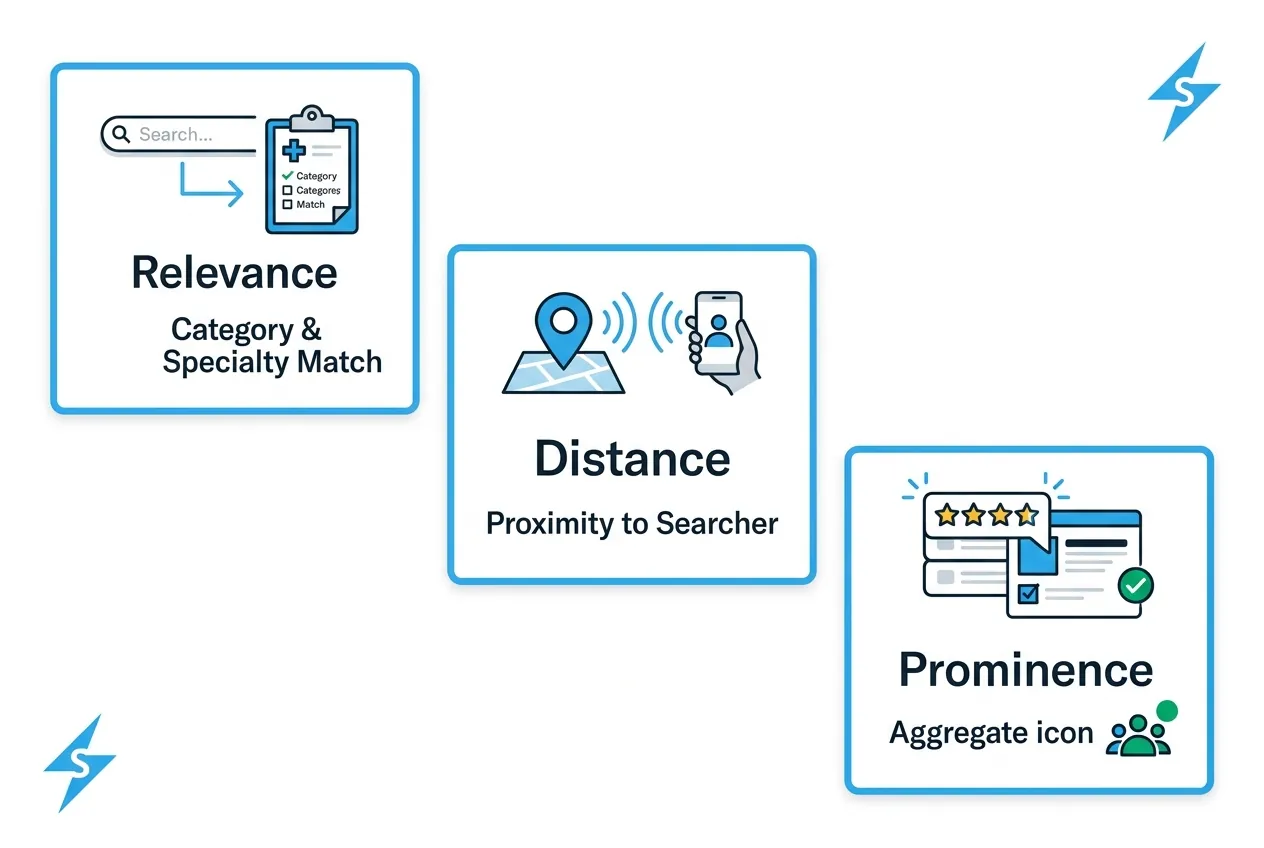
Winning space in this three-pack requires an understanding of how Google determines rank. According to Google Business Profile Help, local search ranking is governed by three primary pillars:
- Relevance: How accurately a business profile matches what the searcher needs. If a user searches for pediatric cardiology, Google assesses whether the primary and secondary categories on the listing explicitly mention that specialty.
- Distance: How far the physical clinic is from the searcher's physical location or the geographic area specified in the search query. Proximity serves as a strict filter in mobile searches.
- Prominence: How well-known and reputable the healthcare provider appears across the web. Prominence incorporates aggregate review counts, average star ratings, local citation consistency, and organic website authority.
In commercial healthcare searches, proximity and relevance drive immediate action. A patient suffering from acute back pain or seeking an in-network pediatrician operates with high commercial intent. Capturing visibility in local seo healthcare queries connects your clinical team with patients at the exact moment clinical intervention is required, delivering conversion rates that outperform generalized national search campaigns.
The Provider Versus Practice Dilemma in Google Business Profiles
The single greatest source of data fragmentation in medical marketing is the conflict between individual physician profiles and practice facility profiles. In a multi-provider clinic, individual doctors frequently create their own Google Business Profiles or have listings generated automatically by third-party directory aggregators. Left unmanaged, these individual doctor profiles compete directly against the main clinic profile for the same medical keywords in the same geographic radius.
According to the official practitioner guidelines on Google Business Profile Help, individual healthcare professionals are permitted to have their own verified profiles if:
- The professional is public-facing.
- The professional can be contacted directly at the stated physical location during published operating hours.
- The professional operates within an established organization that also maintains a verified profile.
When managed carelessly, this allowance splits patient review equity. A patient might leave a five-star review on Dr. Smith's solo profile while the main clinic profile remains starved for feedback. Furthermore, if Dr. Smith departs for a competitor, the practice risks losing the geographic prominence associated with that listing.
To resolve this conflict across multi-location healthcare networks:
- Establish the facility listing as the primary authority. The primary physical office must carry the primary business category (such as "Medical Clinic", "Urgent Care Clinic", or "Surgical Center") and the official clinic phone number.
- Nest practitioner listings under the facility. Practitioner profiles must use the title format [Doctor Name, Title]: [Clinic Name] only where permitted, or simply [Doctor Name, Title], while selecting secondary medical specialty categories that complement rather than mirror the primary clinic listing.
- Link practitioner listings to provider bio pages. Direct the website link on an individual doctor's profile to their unique biography page on the clinic website, not the clinic homepage.
- Audit departures immediately. When a provider leaves the group, mark their affiliation as moved or remove administrative access, ensuring the profile does not display outdated practice numbers or redirect patients to rival health systems.
For multi-site healthcare operations, coordinating these listings is an essential step in maintaining clean data across every market. Review our strategic guide on Multi-location SEO: how to rank every location without duplicate content to see how location taxonomy protects organic visibility across large footprints.
Medical Practice SEO: Technical On-Page and Schema Architecture
A well-optimized Google Business Profile cannot maintain Local Pack prominence without a technically sound, entity-anchored website. In modern medical practice seo, your website functions as the primary verification engine for Google's search algorithms, confirming that your clinics and physicians are legitimate, licensed, and located exactly where your listings claim.
To support multi-location search performance, your web infrastructure must adhere to three technical requirements:
1. Dedicated Location Pages
Every physical clinic must feature a dedicated URL (for example, /locations/dallas-north/). This page must display complete and crawlable Name, Address, and Phone (NAP) data that matches the corresponding Google Business Profile down to the suite number. The page should also host operational hours, directions, parking notes, intake forms, and direct appointment scheduling links.
2. Comprehensive Healthcare Schema Markup
Structured data tells search engine bots how different medical entities relate to one another. Every clinic location page must deploy MedicalClinic JSON-LD schema containing:
- Clinic name, official address, and telephone coordinates.
- Precise geo-coordinates (latitude and longitude).
- Accepted health insurance networks and payment options.
- Links to medical specialties offered (MedicalSpecialty).
- An array of working physicians using alumniOf, knowsAbout, and employee schema properties.
3. Integrated Physician Biographies
To maximize organic performance for doctor seo searches, individual doctor profiles must live on dedicated practitioner pages (for example, /physicians/dr-jane-doe/). These pages must feature Physician schema incorporating the provider's National Provider Identifier (NPI), medical school credentials, residency training, board certifications, and accepted hospital affiliations. Linking the individual's Google Business Profile directly to this page anchors the search engine's knowledge graph to your digital property.
Free Audit
Want a straight read on where your budget is leaking?
Citation Synchronization and Directory Hygiene Across Multiple Clinics
Local search algorithms rely on data consistency across external directories to verify the physical existence and reliability of a medical group. If major data aggregators display conflicting telephone numbers, outdated suite numbers, or closed clinic locations, search engines lose confidence in your clinic's geographic signals.
Healthcare directories operate on a multi-tiered distribution network. Aggregators feed data downstream to hundreds of consumer-facing medical directories. A single clinic relocation or physician departure can trigger cascading errors across platforms such as Healthgrades, WebMD, Vitals, Doximity, Sharecare, and Yelp.
Maintaining citation hygiene requires an operational cadence:
- Audit Data Aggregators Annually: Regularly inspect primary data aggregators (such as Data Axle and Neustar Localeze) to ensure parent records for each clinic facility are current.
- Clean the National Provider Identifier Registry: Discrepancies between public NPI records and website NAP data confuse local search algorithms. Ensure that administrative staff update NPI practice location addresses whenever physicians rotate clinics.
- Standardize Suite Designations: Inconsistent address formatting across directories (such as writing "Suite 400" on Google, "Ste 400" on Healthgrades, and omitting the suite number on WebMD) degrades citation matching. Maintain a rigid address standardization document across all digital profiles.
- Suppress Duplicate Profiles: Aggregators routinely generate duplicate doctor profiles using variations of names (such as "Robert Johnson, MD" versus "Bob Johnson"). These rogue profiles split citations and dilute local search authority until merged or removed.

Review Acquisition at the Point of Care Using Powered Cards
Online patient reviews directly impact healthcare prominence. In the Google Business Profile Help documentation, Google confirms that a higher review count and consistent positive ratings improve a business's local ranking. Furthermore, patient feedback shapes whether an individual searching for care actually converts into a scheduled consultation.
However, healthcare organizations face severe operational hurdles when collecting patient feedback:
- Front-desk teams are consumed with clinical check-in and billing tasks, leaving little time to manually explain review processes.
- Post-discharge SMS and email sequences experience steep drop-offs because patients disconnect emotionally once they leave the physical facility.
- Strict privacy boundaries prevent medical staff from publicly acknowledging treatment details or conditioning care on positive sentiment.
To bridge this operational gap, medical practices deploy Powered Cards directly at the physical point of service. Powered Cards are durable, branded physical cards equipped with Near Field Communication (NFC) chips and high-contrast dynamic QR codes. Positioned at the checkout desk, in discharge packets, or in consultation rooms, these cards allow a patient to tap their smartphone or scan the code, immediately opening the clinic's verified Google review window on their mobile screen.
Point-of-service review collection eliminates friction. Instead of searching for the business name or navigating complex URLs, the patient accesses the rating form in seconds while their positive clinical experience is fresh. Explore our tactical breakdown in Google review cards: using NFC and QR cards to collect reviews at the point of service to understand how physical hardware accelerates digital reputation workflows.
Regulatory and Policy Guardrails for Medical Reviews
Review acquisition programs in healthcare must respect both platform terms and federal consumer protection statutes:
- Google Content Guidelines: The Google Maps user-contributed content policy prohibits offering incentives (such as gift cards, discounts, or co-pay credits) in exchange for reviews. Google also prohibits review gating, which involves screening customers to route unhappy patients to private forms while sending satisfied patients to public platforms.
- FTC Consumer Review Regulations: The Federal Trade Commission rule on consumer reviews bans deceptive review practices, including fake consumer reviews, paid testimonials that mandate positive sentiment, and employee-written praise.
- Patient Privacy Boundaries: When responding to patient reviews online, clinical teams must never confirm, deny, or reference a reviewer's patient status, diagnosis, treatment plan, or appointment history, regardless of what the patient discloses in their public comment. All review responses must remain neutral, grateful, and compliant with federal privacy standards.
How Marketing Powered Delivers Local SEO for Doctors
Marketing Powered approaches local healthcare search as an engineering and operational discipline, not a generic keyword exercise. Local search equity is an enterprise asset that directly determines appointment volume and clinic revenue.
Our technical execution is built on executive-level healthcare marketing leadership. Marketing Powered was founded by a former healthcare CMO who ran marketing for a treatment network that grew from 3 to 24 locations, managing $1.5 to $2M per month in Google Ads across 11+ behavioral and mental health accounts. As a court-certified expert witness in advertising strategy, our leadership designs local search frameworks that withstand intense regulatory scrutiny.
Our local search deployments include:
- Entity Disambiguation: We map the data architecture across your entire network, cleanly separating facility profiles from individual practitioners to protect review equity and prevent keyword cannibalization.
- Technical Geo-Taxonomy: We build and deploy compliant location pages, provider directory engines, and structured JSON-LD schemas (MedicalClinic, Physician, and MedicalSpecialty) that establish authoritative entity signals.
- Turnkey Point-of-Care Review Hardware: Through Powered Cards, we provide physical point-of-service review tools that overcome clinical intake friction, helping front-desk teams collect authentic feedback without violating platform policies or regulatory boundaries.
- Admission-Level Attribution: We track local search engagement beyond preliminary phone clicks and form submissions, mapping discovery paths directly to booked appointments and completed intakes.
- HIPAA-Aware Inference Systems: As an AI-native organization since 2022, we operate owned, local AI infrastructure for HIPAA-aware inference. This allows our partners to process operational marketing data without exposing sensitive corporate assets or protected health records to public third-party models.
For multi-site healthcare operators vetting strategic support, our analysis in Multi location seo services: what a specialist partner delivers and how to vet one outlines the structural criteria necessary to manage complex medical footprints.

Email Us
Prefer to send the context directly?
Measuring Local Healthcare Visibility Beyond Impressions
Tracking local search performance requires looking past national rankings and vanity search metrics. A medical clinic does not serve an entire state; it serves a specific geographic radius dictated by patient drive times, traffic patterns, and municipal transit routes.
Tracking Doctor SEO Performance with Geo-Grid Technology
Standard rank-tracking tools that report a single average rank for a city fail to capture local search reality. A practice might rank in position #1 for "pediatrician" when the searcher stands in the clinic parking lot, but fall to position #12 when the searcher travels two miles south across a municipal border.
To diagnose true market coverage, practices deploy geo-grid ranking technology. Geo-grid systems run automated search queries across a matrix of physical coordinate points over a clinic's trade area, generating a visual heatmap of Local Pack rankings. This spatial data reveals exactly where physical proximity weakens, allowing marketing teams to identify geographic zones that require stronger localized on-page content, targeted citation development, or localized paid media support.
Connecting Local Pack SEO for Doctors to Booked Appointments
Local visibility holds commercial value only when it translates into operational clinical utilization. Healthcare organizations must track local search touchpoints through to finalized patient appointments.
A complete local measurement framework integrates:
- Call Tracking with Dynamic Number Insertion (DNI): Maintaining separate, tracked telephone numbers for the website and Google Business Profile allows clinical call centers to measure inbound appointment inquiries generated by local map listings versus organic search clicks.
- Scheduling Engine Integrations: Connecting web-based scheduling widgets directly to the practice management or Electronic Health Record (EHR) system tracks which local landing pages generate verified intake bookings.
- Intake and Admission Verification: By reconciling call logs and booking records against completed patient admissions, marketing leadership evaluates search performance based on booked revenue rather than superficial map impressions.
Questions, Answered.
Yes, if the doctor is a public-facing practitioner who meets with patients at that physical facility during published hours. However, solo practitioner profiles must be carefully managed with secondary categories to avoid competing with the main clinic's primary Google Business Profile. For groups with high provider turnover, marketing teams should focus review acquisition on the clinic's primary facility profile first.
When an employed physician leaves, the practice should immediately update the doctor's profile on Google Business Profile to reflect their departure or mark the listing as relocated if the doctor has opened a new solo office. Remove the physician's biography from the practice website, archive their Physician schema, and update the primary phone number on the profile to prevent outbound patient inquiries from being misdirected.
Yes, clinical and front-desk staff can invite patients to share authentic feedback about their operational experience. However, staff must remain neutral. Platforms strictly prohibit offering incentives, gifts, or discounts in exchange for reviews. Review requests should focus on the quality of service, facilities, and staff responsiveness, while reminding patients not to disclose sensitive personal medical details in public comments.
Traditional organic SEO optimizes web pages to appear in standard search engine text listings, competing on state, regional, or national scales for informational queries. Local map pack SEO focuses specifically on the Google Three-Pack module, using geographic proximity, Google Business Profile configuration, citation consistency, and patient review velocity to capture high-intent patients searching within immediate driving distance. Request a multi-location visibility audit from Marketing Powered
Ready to see where your marketing can improve?
Request a free audit of your paid media, landing pages, attribution, and measurement setup. You'll get a straight assessment of where the opportunities are.
or email us at info@marketingpowered.ai