Who We Help
Marketing for Peptide Telehealth Providers
Peptide telehealth marketing usually breaks for structural reasons, not creative ones: the campaign describes a business that the prescribing, pharmacy and platform arrangements do not actually support. The work starts by mapping the entities, licences and handoffs that demand has to land on, then building acquisition on top of that map.

Map the care arrangement before planning any demand
A storefront clinic has one legal entity, one address and one set of licences. A prescribing telehealth business usually has five or more moving parts: the brand entity that holds the patient agreement, the professional corporation or clinician network that employs prescribers, the dispensing partner, the payment processor, and the intake, lab or shipping vendors that sit between the consultation and fulfillment.
Each of those relationships changes what can be claimed in an ad and who is accountable for the claim.
This matters beyond tidy documentation. LegitScript's certification standards treat partners and affiliates as part of the application: a merchant's affiliates and partners must comply with program standards, partner pharmacies responsible for fulfilling prescription medication are generally expected to be certified or accredited by a recognized body, and the applicant must provide all domain names and websites under its control and disclose affiliates (LegitScript healthcare certification standards).
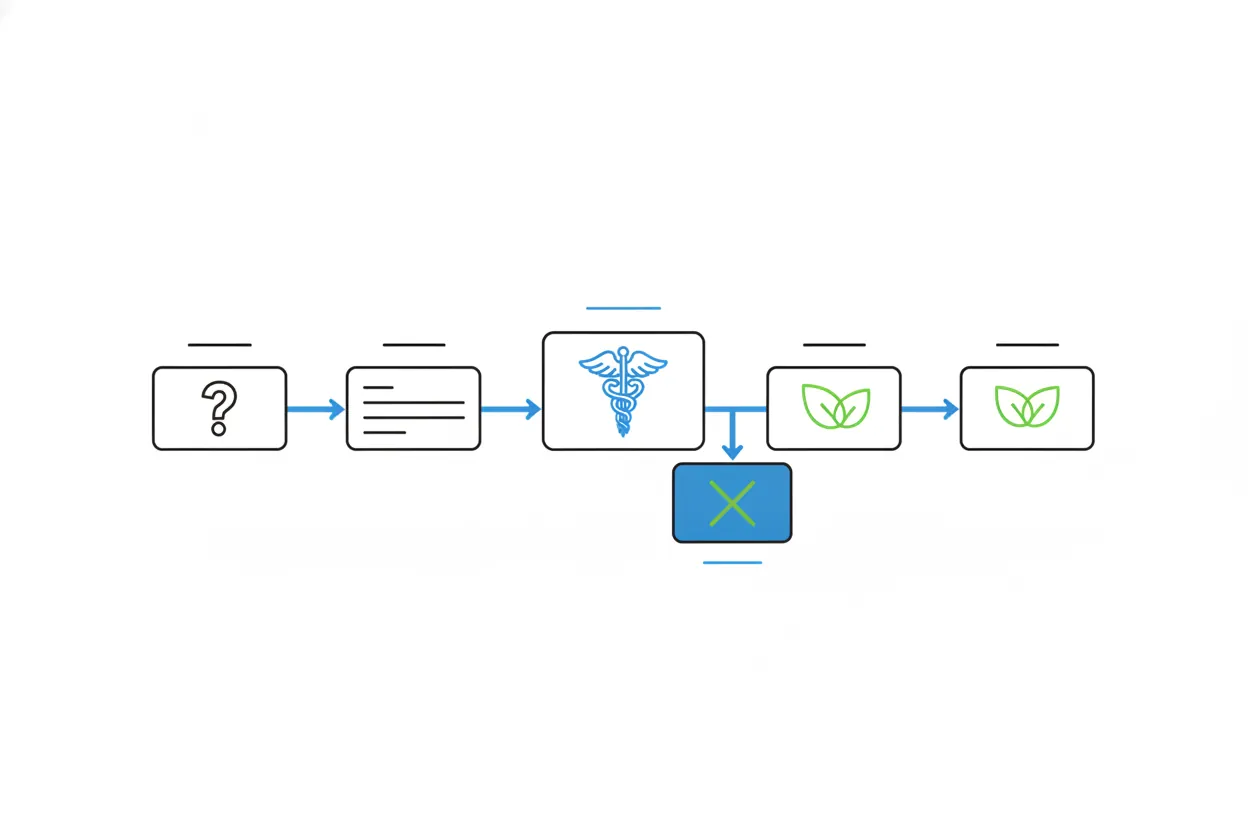
Before any media plan, write the diagram down: entity names, who prescribes, who dispenses, who the patient is contracting with, which domains are in scope, and which entity will be the advertiser of record.
Match service areas to actual prescribing authority
Geography in peptide telemedicine acquisition is not a radius around an office. It is the intersection of where your clinicians hold licences, where the dispensing partner may lawfully ship, and where the advertising platform permits the offer.
LegitScript's licensure standard reaches both ends of the encounter, covering the jurisdiction from which medications are prescribed or dispensed as well as the jurisdiction where the patient is located, and its patient services standard expects websites to clearly disclose all states, territories, provinces or countries in which services are available (LegitScript healthcare certification standards).
The practical version is a licensure register that campaign targeting is built from rather than reconciled against later. One row per state: licensed prescribers, dispensing coverage, effective and expiry dates, and the person who confirmed it. Geo lists, location exclusions, landing page availability copy and call routing all inherit from that register. The discipline here is the same one that governs multi-market campaigns in healthcare lead generation for multi-location providers, with licensure replacing the service-area map.
Separate service, product, certification and account questions
Four questions get collapsed into one in most peptide provider growth plans, and that is where accounts fail. First, is the clinical operation lawful in each jurisdiction served.
Second, what is the regulatory status of the specific product being dispensed, including whether a compounded preparation relies on a bulk substance that FDA has placed in a category raising significant safety concerns rather than one under evaluation (FDA bulk drug substances nominated for use in compounding under section 503A).
Third, does a certification exist and what exactly does it cover. Fourth, is the ad account itself eligible and in good standing.
Platform rules sit on top of all four. Google restricts promotion of services related to the online prescribing, dispensing and sale of prescription drugs, decides whether a business is in scope based on factors including ad, site and app content, and applies extra caution to landing pages that link or refer to content that appears to facilitate online prescription or dispensing (Google Ads prescription drug services policy).
In the United States, online pharmacies and telemedicine are allowed with limitations, with telemedicine providers required to hold LegitScript Healthcare Merchant Certification or NABP Healthcare Merchant Accreditation and to also be certified with Google (Google Ads healthcare and medicines policy).
Meta requires online pharmacies and telehealth providers to be actively certified with LegitScript, limits prescription drug ads to audiences 18 and over in the United States, Canada or New Zealand, and treats general telehealth service promotion differently from prescription drug promotion (Meta drugs and pharmaceuticals advertising standard).
Those positions change, so the current policy text belongs in the pre-launch file alongside the broader telehealth marketing strategy decisions.
Free Audit
Want a straight read on where your budget is leaking?
Build an enrollment journey that describes the evaluation
Walk the enrollment path the way a patient experiences it: the eligibility questionnaire, the account creation step, the intake and medical history forms, the asynchronous or live clinician visit, the pricing and subscription terms, the shipping disclosure, and the cancellation and refund screens. Then walk the path a patient takes when the clinician declines to prescribe, which is the screen most funnels never design and the one reviewers look for.
Copy should describe the evaluation and what the fee purchases, never a prescribing outcome. LegitScript's prescription validity standard states that a prescription or prescription drug must not be prescribed or dispensed before the provision of care by a licensed medical professional, and its transparency standard requires accurate, non-misleading disclosure of material details about the pharmacy, practitioners, drugs, treatments and financial transactions, including claims of benefits not supported by a regulatory body (LegitScript healthcare certification standards).
Pricing tables, comparison modules, quiz results and automated emails all count as claims. Route them through legal and clinical review before launch, using a documented pass such as the healthcare marketing compliance checklist.

Track acquisition to approved consultations and retained cohorts
A form fill is not a result in this model. The defensible measurement chain runs from qualified inquiry to verified eligibility, completed clinician evaluation, approved and fulfilled order, second fulfillment, and retention past the first billing cycle, with cancellations, refunds and chargebacks reported against the same cohort. Blended cost per lead will look healthy for months while contribution per cohort erodes, because the decline rate and the first-cycle cancellation rate are doing the damage, not the auction.
Marketing Powered's attribution practice is built to track to admission rather than to lead, and the same structure applies here with the approved consultation and fulfilled order standing in for admission.
It is also built for Google's sensitive healthcare vertical, where retargeting is not permitted, so measurement has to work with consented first-party events and server-side handling rather than audience rebuilding.
Keep health-indicative parameters out of platform event payloads, and keep certification scope in view when funnel pages change; cost, rules and sequencing are covered in LegitScript certification: cost, rules and timeline.
Commission the operating model, not just a campaign
Ownership questions decide how fast you can act when something breaks. Google requires healthcare certification applications at the child account level rather than the manager account, asks that the customer ID and certified domain be included, and expects an agency applying on behalf of an advertiser to document its relationship with the advertiser or licence holder (Google Ads prescription drug services policy).
Decide in advance who holds the account and domains, who approves clinical language, who recertifies when the pharmacy relationship changes, and who rechecks platform policy on a fixed cadence.
The evidence pack is short and specific: the relationship diagram for every entity, the jurisdiction and licensure register, documentation of what each certification actually covers, and reviewed enrollment and pricing screens. Marketing Powered brings operator history to that review.
Our founder is a former healthcare CMO who ran marketing for a treatment network that grew from 3 to 24 locations, managed $1.5 to $2M per month in Google Ads across 11+ behavioral and mental health accounts, and is a court-certified expert witness in advertising strategy.
The firm has been AI-native since 2022, is LegitScript-aware and HIPAA-aware, and runs owned, local AI infrastructure for HIPAA-aware inference. Related reading: healthcare marketing agency vetting and strategy guide, healthcare paid media: search, social and attribution, and the Marketing Powered security overview.
Email Us
Prefer to send the context directly?
Questions operators ask before scaling spend
How is telehealth marketing different from clinic marketing?
A clinic borrows trust from a physical place: an address, staff photos, local reviews and directions. A prescribing telehealth brand has to substitute verifiable licensure, named clinician credentials, clear disclosure of which states are served, and a plainly described evaluation process. Creative that works for a local practice tends to under-disclose for a virtual one.
Does the pharmacy partner's certification cover our website?
No. Certification applies to the entity, practices and domains that were reviewed. LegitScript's standards require applicants to provide all domain names and websites under their control and to disclose affiliates, and partner pharmacies are generally expected to hold certification or accreditation of their own (LegitScript healthcare certification standards). A partner's status does not extend to claims you make on your property.
Can every state be targeted?
Only where your clinician network is licensed and the product may lawfully be dispensed to a patient in that state, and only where the platform permits the offer. That is a register you maintain, not a setting you switch on. Treat any vendor claim of blanket national eligibility as a reason to ask for the underlying licence list.
How should consultation and prescription outcomes be separated in copy?
Advertise the evaluation, the clinician review and the service terms. Do not present a prescribing decision as the thing being purchased. Google evaluates ads, site and app content together and scrutinises destinations that appear to facilitate online prescribing, so the landing page and everything it links to has to hold the same line as the ad (Google Ads prescription drug services policy).
What must be verified before launch?
Four artifacts, confirmed by qualified legal and clinical review: the entity relationship diagram, the jurisdiction and licensure register, documented certification scope, and reviewed enrollment and pricing screens. Re-read the current platform policy text immediately before launch, since account eligibility can shift independently of your clinical arrangements.
Ready to see where your marketing can improve?
Request a free audit of your paid media, landing pages, attribution, and measurement setup. You'll get a straight assessment of where the opportunities are.
or email us at info@marketingpowered.ai