Resources
Telehealth Marketing: A Strategy for Virtual Care Growth
Health systems invested heavily in digital infrastructure, but converting patient search intent into attended clinical consultations remains an operational challenge. Sustainable telehealth marketing requires far more than national brand visibility; it demands precise geographic alignment with provider licensing, strict adherence to digital advertising policies, and conversion workflows that connect directly into clinical scheduling systems. When these elements operate in silos, patient acquisition costs escalate while available clinical capacity sits idle.
By Mike Hulick, Founder, Marketing Powered

The Licensure Boundary: Why National Campaigns Waste Budget

What Is Telehealth Marketing in Regulated Health Systems?
Telehealth marketing is the strategic acquisition and engagement of patients for remote clinical encounters, including synchronous video visits, asynchronous consultations, and remote patient monitoring. In an enterprise hospital or health system, telehealth marketing operates under fundamentally different constraints than direct-to-consumer wellness subscriptions. Direct-to-consumer brands often sell cash-pay recurring memberships for lifestyle therapies, relying on aggressive social media retargeting and broad national campaigns. Enterprise healthcare systems must instead integrate virtual care into accredited regional service lines, such as urgent care, behavioral health, endocrinology, neurology, and post-discharge follow-ups.
This integration changes the commercial objective. The goal of health system virtual care marketing is not simply to collect top-of-funnel email addresses or contact forms. The goal is to route a clinically qualified, insured or self-pay patient in a specific geographic jurisdiction into an active clinical schedule. Every campaign must account for active provider shifts, credentialing, patient payer mix, and the technical requirements of the host electronic health record (EHR) system.
Consider an ambulatory care coordinator managing morning clinic queues: one screen shows physician availability across three physical outpatient clinics, while another monitors virtual room check-ins. If the marketing engine directs patient demand to providers who are uncredentialed for the patient's coverage or located in states where the physician lacks practice authority, the digital intake queue clogs with unbillable administrative rejections. Effective virtual care marketing aligns digital demand with real-time operational capacity.
The primary source of financial waste in virtual care advertising is geographic mismatch. Under United States medical licensing regulations, clinical care is legally deemed to occur at the physical location of the patient at the time of the encounter, not at the location of the treating physician. While initiatives such as the Interstate Medical Licensure Compact facilitate multi-state licensing for physicians, few clinical networks maintain active, universal licensure across all 50 states for their entire provider panel.
When an internal growth team or external agency launches digital advertising campaigns with broad geographic targeting, ad spend quickly bleeds into states where the health system cannot legally bill for services. An ad click from a patient searching for virtual urgent care while traveling in an adjacent state yields zero revenue if the on-call physician is not licensed in that jurisdiction. Worse, it creates patient frustration and damages brand trust when the user reaches the scheduling screen only to be turned away by an address validation rule.
A disciplined telehealth marketing strategy establishes rigid geographic geofencing mapped directly to clinician rosters. Paid search campaigns must be segmented by state or metropolitan service areas, with bid schedules calibrated to active provider shifts. If pediatric virtual urgent care is staffed by clinicians licensed only in Ohio and Pennsylvania between 5:00 PM and 10:00 PM, advertising delivery in Michigan or outside those hours must be suppressed. Managing virtual care campaigns as operational supply-and-demand schedules rather than evergreen promotional blasts prevents unserviceable clicks and protects media budgets.
Navigating Platform Ad Restrictions and Healthcare Tracking Rules
Digital advertising for healthcare operates under stringent platform policies and federal privacy enforcement. Marketers who apply standard ecommerce acquisition playbooks to virtual care encounter swift account suspensions, legal liabilities, and compromised patient trust.
The first major barrier is platform policy regarding sensitive categories. Under the Google Ads Personalized Advertising Policy, advertisers are strictly prohibited from using personalized advertising, remarketing lists, or custom audience targeting based on sensitive personal categories, including physical or mental health conditions, clinical treatments, and personal health challenges. Virtual care providers cannot place a retargeting pixel on a depression screening page or a virtual cardiology portal and subsequently serve targeted follow-up display or video ads to those users across the web. Acquisition must succeed on first-touch intent capture, message clarity, and immediate conversion.
The second critical barrier involves patient privacy regulations governing digital tracking technologies. The U.S. Department of Health and Human Services (HHS) Office for Civil Rights (OCR) issued definitive regulatory guidance on this subject. As outlined in the HHS OCR Guidance on Tracking Technologies, covered entities and business associates violate HIPAA privacy rules when third-party tracking pixels (such as standard Meta, Google, or TikTok marketing tags) deployed on public-facing websites or patient portals transmit protected health information (PHI), including IP addresses combined with search terms or appointment selections, without valid patient authorization or a compliant Business Associate Agreement.
Navigating these dual constraints requires an engineered tracking architecture:
- Deploy server-side conversion tracking that strips IP addresses, personal identifiers, and clinical query parameters before event data reaches ad networks.
- Avoid third-party client-side pixels across all pages that mention specific health conditions, treatments, symptoms, or doctor scheduling.
- Rely on privacy-safe first-party data capture, using zero-party interactive triage tools that disclose data use policies transparently.
- Build direct offline conversion imports to send appointment completions back to advertising platforms via secure, hashed identifiers that omit clinical details.
Free Audit
Want a straight read on where your budget is leaking?
Solving the Intake Drop-Off: Connecting Demand to Booked Visits
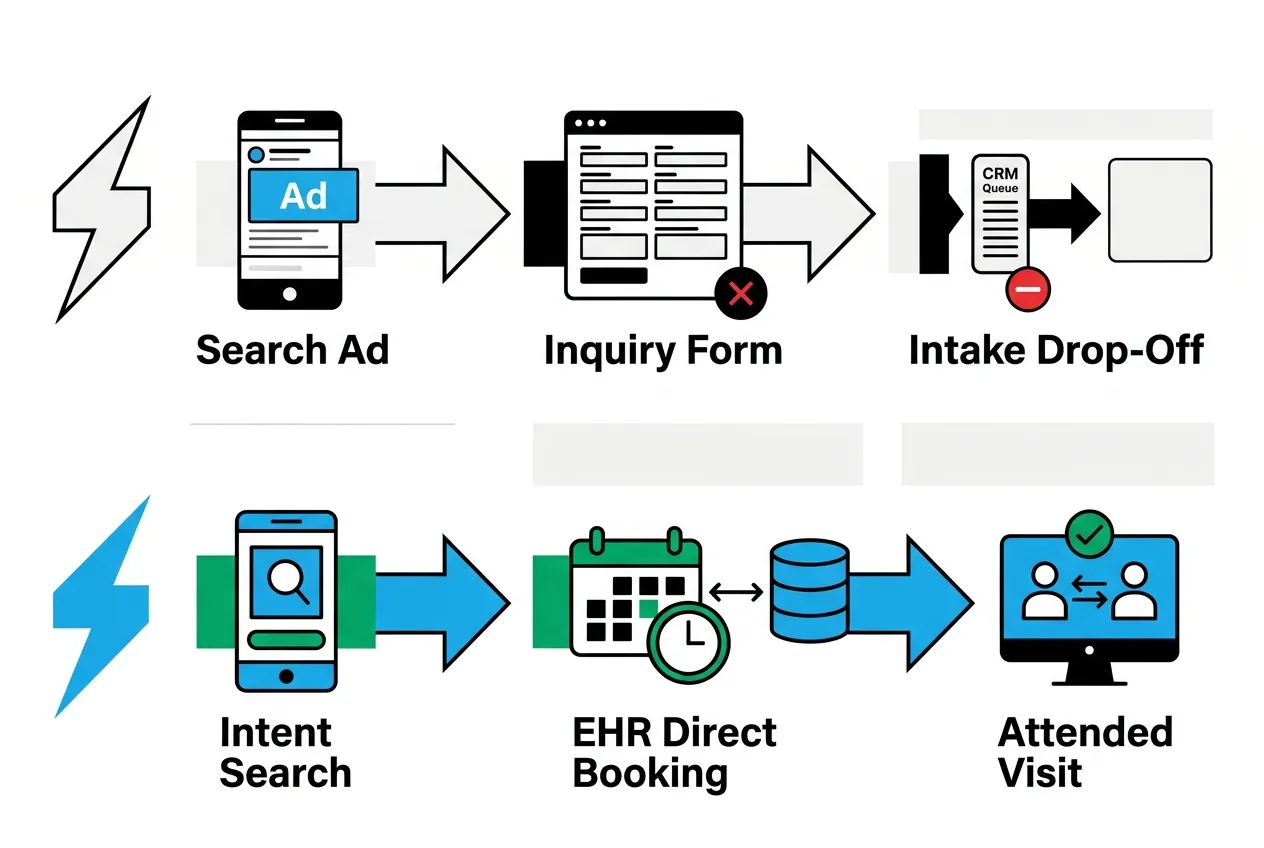
The greatest point of friction in virtual care delivery sits between the marketing landing page and the electronic health record scheduling workflow. In traditional healthcare service lines, digital campaigns frequently direct traffic to an inquiry form: a user enters their name, phone number, and symptom, which drops into a customer relationship management (CRM) queue for an outbound phone call within 24 hours.
For telehealth, that delayed model fails completely. Virtual care search queries represent high-urgency, immediate-intent demand. A patient seeking a virtual consultation for an acute illness, a prescription renewal, or an urgent behavioral health crisis will not wait four hours for an intake coordinator to return a voicemail. If they cannot confirm a visit time immediately, they return to the search engine results page and book with a competing provider.
To maximize media efficiency, health systems must bridge the intake gap with direct digital scheduling. Picture the patient journey: a user clicks a paid search ad on a mobile device, lands on a streamlined service page, selects their insurance payer, and immediately views real-time available appointment slots pulled directly from an EHR platform like Epic, Cerner, or Athenahealth. Within three screen taps, the appointment is confirmed, the digital waiting room link is generated, and a calendar invite arrives via SMS.
Evaluating marketing efficiency solely on top-of-funnel lead forms obscures underlying unit economics. Marketing teams must measure downstream conversion:
- Ad click to scheduling page arrival.
- Scheduling page arrival to confirmed visit booking.
- Confirmed visit booking to completed, attended clinical encounter.
When marketing measurement stops at form submission, health systems routinely invest thousands of ad dollars into leads that never convert into billable clinical encounters due to scheduling latency or technological drop-off.
Search Intent Architecture for Virtual Care Services
Developing organic search visibility for virtual care requires structuring content around exact patient intent rather than broad clinical categories. When prospective patients search for remote care, their queries fall into three distinct functional categories: urgent acute care, chronic disease management, and specialized behavioral health support.
A successful virtual care marketing architecture builds targeted landing page clusters that match these operational entry points:
Acute Care and Virtual Triage
Queries in this category are highly transactional: "virtual urgent care open now," "telehealth doctor for sinus infection," or "online prescription refill tonight." Content supporting these terms must minimize marketing copy and emphasize logistical facts: current estimated wait times, pricing for self-pay patients, accepted health insurance plans, and technical requirements (such as needing a smartphone with a front-facing camera).
Specialty Virtual Consultations
Patients seeking specialty care, such as pediatric behavioral health, endocrinology, or neurology second opinions, have a longer evaluation window. Their search queries incorporate credentialing and condition specifics: "telehealth pediatric ADHD evaluation" or "virtual neurologist for migraine management." These pages must highlight physician board certifications, state practice boundaries, expectations for the first consultation, and the referral process if laboratory work or in-person imaging is required.
Operational and Insurance Transparency
The primary reason users abandon virtual care booking pages is ambiguity regarding coverage. Pages must clearly display participating commercial, Medicare, and Medicaid plans. Providing an interactive insurance verification step directly on the page removes hesitation before the user enters the scheduling software.
Delivering Accountable Healthcare Marketing Programs
Scaling virtual care requires technical rigor, regulatory literacy, and financial accountability across paid media and search channels. Marketing Powered delivers comprehensive healthcare and hospital marketing programs tailored to the exact operational realities of health systems, regional provider groups, and specialized clinical networks.
Our approach is informed by executive-level operational leadership. The founder of Marketing Powered is a former healthcare Chief Marketing Officer who led marketing operations for a specialized multi-facility treatment network that expanded from 3 to 24 locations, personally managed $1.5 to $2M per month in Google Ads across 11+ behavioral and mental health accounts, and serves as a court-certified expert witness in advertising strategy.
We do not treat healthcare marketing as generic digital lead generation. Having operated inside Google's sensitive healthcare vertical since our inception, we build custom marketing engines that respect strict regulatory guardrails:
- Attribution Tracked to Clinical Arrival: We reject vanity metrics like impression volume and unverified form fills. We engineer attribution architectures that track spend directly to completed patient appointments and admissions where authorized data systems permit.
- Sensitive Vertical Expertise: We are LegitScript-aware and HIPAA-aware. Our media plans operate cleanly within platform restrictions where retargeting is prohibited, winning demand through search intent capture, positioning, and conversion architecture.
- Owned, Sovereign AI Infrastructure: Operating as an AI-native organization since 2022, Marketing Powered utilizes owned, local AI infrastructure for HIPAA-aware inference. This allows our partners to process operational insights, automate structured campaign assets, and analyze non-PHI marketing data without leaking organizational intelligence to public third-party model providers.
Our methodology links paid search, search engine optimization, and intake integration into an accountable operating system, designed to work alongside broader institutional resources. For an expansive overview of healthcare growth strategy, consult our foundational guides: Healthcare marketing: the operating guide for health systems and provider groups, Healthcare marketing agency: what to expect and how to choose one, and Hospital marketing company: what a specialist partner delivers and how to vet one.
Email Us
Prefer to send the context directly?
How to Evaluate Telehealth Marketing Companies and Agencies
Selecting external support for virtual care marketing requires evaluating a firm's technical and operational depth rather than creative agency portfolios. Many generalist agencies apply retail marketing tactics to clinical environments, resulting in HIPAA compliance violations, wasted geographic media budgets, and poor clinical utilization.
Consider an executive conference room during quarterly service-line planning: the CMO, Chief Medical Officer, and VP of Operations examine patient acquisition cost dashboards. If the marketing firm's presentation highlights ad clicks and social video views while the clinical operations director points out hundreds of unstaffed appointment cancellations and out-of-state drop-offs, the engagement has failed.
When vetting prospective telehealth marketing companies or a specialized telehealth marketing agency, health-system executives should evaluate partners against specific operational criteria:
- Licensure Awareness. Critical Capability Requirement: Ability to build dynamic campaign schedules mapped strictly to provider state licensure and shift hours. Red Flag / Disqualifier: Running national or regional broad-match campaigns without location-based geofencing.
- Platform Compliance. Critical Capability Requirement: Proven experience navigating Google sensitive vertical rules and advertising policies without relying on retargeting. Red Flag / Disqualifier: Proposing condition-based retargeting, custom audience uploads of patient lists, or standard remarketing pixels.
- Privacy Engineering. Critical Capability Requirement: Expertise in server-side tracking, zero-party data intake, and strict alignment with HHS OCR tracking guidance. Red Flag / Disqualifier: Installing standard Meta or Google tracking tags directly on symptom pages or EHR scheduling flows.
- Intake Integration. Critical Capability Requirement: Technical fluency with healthcare APIs, EHR scheduling software, and friction-free direct booking pathways. Red Flag / Disqualifier: Directing paid ad traffic to generic static forms that require outbound manual follow-up calls.
- Accountable Attribution. Critical Capability Requirement: Tracking performance through to completed clinical encounters and attended virtual visits. Red Flag / Disqualifier: Reporting exclusively on impressions, clicks, cost-per-lead, or raw web page views.
Questions, Answered.
Telehealth marketing is the practice of positioning, promoting, and acquiring patients for remote clinical services across digital and traditional channels. It encompasses search engine optimization, paid intent advertising, provider profile management, and conversion path design specifically engineered to direct patients into synchronous video or asynchronous digital clinical encounters.
Telehealth affiliate marketing is an acquisition model where third-party publishers or digital platforms receive compensation for referring users who sign up for virtual care services. While widely used by cash-pay direct-to-consumer wellness brands, health systems must approach affiliate arrangements with extreme caution due to federal Stark Law, the Anti-Kickback Statute, and state fee-splitting prohibitions governing patient referrals in clinical medicine.
To market telehealth services effectively, health systems must align digital paid search and organic landing pages with exact provider licensure boundaries. Focus on capturing high-intent search queries for acute symptoms, ensure total transparency around insurance coverage and pricing, and eliminate conversion friction by integrating digital scheduling directly into the electronic health record system.
The most sustainable model pairs strong local health system brand equity with an accessible digital front door. Rather than competing as an anonymous nationwide app, regional health systems succeed by positioning virtual visits as an integrated access point connected to physical clinics, specialist referrals, and trusted local hospital networks. Request a healthcare marketing assessment from Marketing Powered
Ready to see where your marketing can improve?
Request a free audit of your paid media, landing pages, attribution, and measurement setup. You'll get a straight assessment of where the opportunities are.
or email us at info@marketingpowered.ai