Resources
LegitScript Certification: Requirements, Cost, and Timeline for Treatment Advertisers
Navigating legitscript certification is the primary operational hurdle for any behavioral health facility seeking to reach patients through digital search and paid social campaigns. Major advertising platforms require third-party verification to confirm that treatment providers operate legally, transparently, and in full alignment with clinical licensing standards. Preparing your operational, corporate, and digital documentation before submitting your application prevents protracted review cycles and protects non-refundable vetting fees.
By Mike Hulick, Founder, Marketing Powered

What Is LegitScript Certification and Why Ad Platforms Require It
LegitScript certification is an independent regulatory compliance credential that validates whether an addiction treatment provider, outpatient center, or behavioral health network operates legally, ethically, and in accordance with consumer safety standards. Founded in 2007, LegitScript functions as the designated compliance gatekeeper for major digital networks, including Google, Meta, and Microsoft Advertising.
Before 2018, the digital addiction treatment space suffered from pervasive predatory practices. Deceptive marketing syndicates deployed call centers that routed vulnerable individuals searching for help to unaccredited facilities, collected undisclosed bounty payments, and engaged in patient brokering. In response to regulatory scrutiny and patient safety concerns, the Google Ads Healthcare and medicines policy established a strict mandate: no advertiser may run paid ads targeting addiction treatment keywords in the United States without active LegitScript certification. Meta soon followed, establishing identical prerequisites detailed in the Meta Business Help Center.
For a treatment facility executive, clinical director, or marketing officer, this credential is not a superficial digital badge. It is a mandatory commercial license required to deploy search engine marketing, targeted video, and sponsored social messaging. When your admissions team plans to scale census, certification is the prerequisite that unlocks high-intent demand channels.
The verification process involves an exhaustive forensic audit. LegitScript compliance analysts review your state licenses, corporate holding entities, medical directorship agreements, facility leases, insurance claims protocols, and public-facing websites. They look past creative ad copy to inspect the physical premises, checking whether clinical operations match state health authority filings. If your center offers medical detox, residential care, partial hospitalization, or intensive outpatient services, LegitScript assesses whether your on-site medical staffing and clinical controls comply with state and local healthcare mandates.

Which Behavioral Health Providers Must Obtain Certification?
Not every healthcare provider requires certification, but any organization touching substance use disorder recovery must understand the boundary lines. LegitScript certification applies specifically to organizations that provide, refer to, or market substance use disorder services.
In-Person Addiction Treatment Centers
Any physical facility providing residential inpatient care, medically supervised withdrawal management (detox), partial hospitalization programs (PHP), intensive outpatient programs (IOP), or standard outpatient addiction counseling must obtain certification before launching paid digital campaigns. If a facility operates multiple physical campuses under a shared brand, each physical location providing clinical care must be reviewed and certified.
Telehealth and Digital Substance Use Programs
Virtual addiction care platforms, outpatient telemedicine providers, and medication-assisted treatment (MAT) clinics prescribing buprenorphine or naltrexone remotely must obtain certification. LegitScript reviews their prescribing protocols, prescriber licensing across every state where patients reside, and compliance with federal Ryan Haight Act guidelines.
Dual-Diagnosis and Mental Health Facilities
Facilities that treat primary mental health disorders, such as depression, generalized anxiety, or bipolar disorder, do not automatically require LegitScript certification to run paid ads on Google or Meta. However, if a mental health facility mentions co-occurring substance use treatment, offers dual-diagnosis programming, or bids on addiction-related search terms, platform policy algorithms flag the account. The advertiser must either secure LegitScript certification or remove substance use references from their marketing collateral and landing pages. In our foundational guide, Behavioral health marketing: an operator's guide to ethical growth, we explore how leadership teams should evaluate whether to restrict service messaging or invest in full certification.
Mutual-Help and Recovery Support Organizations
Non-profit mutual-help groups, community recovery networks, and sober living environments that provide recovery support services must also comply with platform rules. If a sober living residence provides or coordinates clinical treatment, or if an organization directs individuals to specific clinical treatment providers, it falls under the purview of third-party vetting.
LegitScript Requirements: The 15 Core Clinical and Corporate Standards
The LegitScript Certification Standards for Addiction Treatment define strict criteria that providers must fulfill. Understanding these legitscript requirements prior to submission ensures your application moves swiftly through the compliance pipeline.
1. State Licensure and Regulatory Standing
Every facility, treatment level, and bed count must hold active, unrestricted licenses issued by the relevant state Department of Health or behavioral health licensing board. Applications encounter immediate delays if a facility operates a level of care, such as an overnight residential program, under an outpatient-only license.
2. Physical Facility Verification
LegitScript verifies that every physical location is an active, dedicated commercial treatment center. Virtual offices, shared co-working spaces, mail forwarding addresses, and residential properties without dedicated zoning approval are grounds for outright denial. Analysts cross-reference county tax records, commercial leases, and geographic photography.
3. Medical Oversight and Clinical Credentials
Applicants must provide verified documentation of their Medical Director and Clinical Director credentials. LegitScript confirms that medical directors hold active medical licenses in good standing in the state where the facility operates, without disqualifying disciplinary actions, consent decrees, or board suspensions.
4. Transparent Corporate Ownership
The application requires disclosure of all parent corporations, holding companies, subsidiaries, and beneficial owners holding five percent or more equity in the organization. Concealing ownership stakes or using shell entities will result in immediate rejection.
5. Domain Name Ownership and Transparency
Your organization must hold registered ownership of every website domain name used in your advertising. Domain privacy protections (such as WHOIS proxy services) that mask the true registrant identity must be removed or validated with legal documentation proving ownership.
6. Accurate and Defensible Marketing Claims
Your public-facing website, social profiles, and advertising materials must be strictly factual. You cannot claim proprietary success rates, promise cures, or publish misleading claims regarding insurance coverage. Landing pages must clearly display the legal entity name and physical address of the facility.
7. Prohibition of Patient Brokering and Lead Selling
LegitScript strictly enforces federal guidelines, including the Eliminating Kickbacks in Recovery Act (EKRA). Facilities are prohibited from paying or receiving referral fees, volume-based call-routing bounties, or per-patient admission compensation. Call center tracking must demonstrate that inbound inquiries connect directly to your clinical intake team, rather than a third-party lead aggregator.
8. Background Checks for Key Personnel
Owners, executive officers, clinical directors, and medical directors undergo comprehensive criminal and civil background screenings. Prior convictions or civil judgments involving healthcare fraud, insurance manipulation, or patient harm will disqualify the applicant.
9. Written Policies and Clinical Best Practices
Facilities must submit written clinical policies that prove evidence-based treatment standards. LegitScript evaluates protocols governing intake screening, patient assessments, individualized treatment plans, medication management, and discharge planning.
10. Financial Solvency and Stability
Operators must demonstrate that their enterprise possesses sufficient operational stability to deliver uninterrupted patient care. Facilities operating under active bankruptcy or severe tax liens face heightened vetting friction.
11. Property and Real Estate Compliance
If the applicant operates residential treatment or sober living housing, the real estate must meet local building, occupancy, and fire safety codes. LegitScript inspects lease agreements to verify that arrangements do not violate anti-kickback statutes.
12. Transparent Pricing and Insurance Disclosures
Websites must clearly state network participation status. If your facility is out-of-network with private commercial health insurers, your marketing copy cannot claim to accept all insurance plans without explicitly clarifying out-of-network financial obligations for deductibles and co-insurance.
13. Privacy and Patient Rights
Your digital properties must maintain explicit privacy policies that honor applicable state and federal healthcare privacy laws. Intake forms, digital trackers, and lead capture systems must respect confidential health disclosures.
14. Compliance with Prescription Drug Monitoring Programs
Facilities offering medical detox or utilizing controlled substances must prove enrollment in and routine utilization of their state Prescription Drug Monitoring Program (PDMP).
15. Ongoing Operational Cooperation
Certification is not a one-time approval; it is an ongoing compact. Operators must agree to provide unannounced updates, submit annual recertification filings, and notify LegitScript within ten business days of any adverse regulatory action, license suspension, or change in executive leadership.
Free Audit
Want a straight read on where your budget is leaking?
LegitScript Cost: Application Fees, Annual Monitoring, and Vetting Tiers
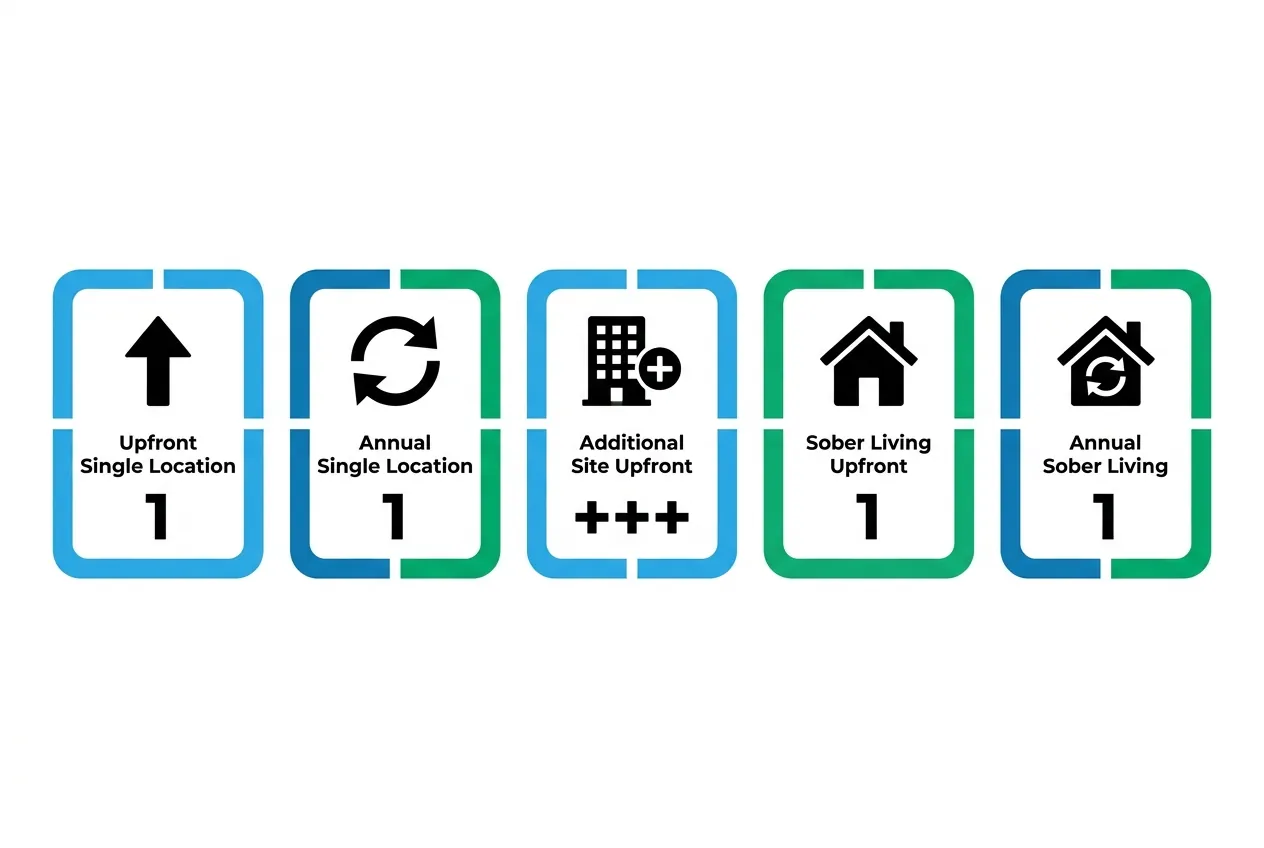
Budgeting for legitscript cost requires evaluating both the initial application review fees and the ongoing annual monitoring fees. LegitScript separates fees into non-refundable application charges and recurring annual costs, with pricing scaling based on facility type, corporate complexity, and the number of physical sites.
The published schedule on the LegitScript Addiction Treatment Certification Pricing page outlines the financial investment:
- Upfront Application Fee. In-Person Facility (Single Location): $995. Multi-Location Facility (Per Additional Site): $495 to $995. Sober Living / Recovery Residence: $995.
- Annual Monitoring Fee. In-Person Facility (Single Location): $1,995 to $3,250. Multi-Location Facility (Per Additional Site): Discounted per location tier. Sober Living / Recovery Residence: $1,995.
- Expedited Review Fee. In-Person Facility (Single Location): Optional tier (varies by review scope). Multi-Location Facility (Per Additional Site): Variable add-on. Sober Living / Recovery Residence: Variable add-on.
- Corporate Structure Surcharge. In-Person Facility (Single Location): Applied to complex holding companies. Multi-Location Facility (Per Additional Site): Applied per entity layer. Sober Living / Recovery Residence: Not applicable.
The application fee is non-refundable regardless of whether your center receives approval, encounters deficiencies, or withdraws its submission. If LegitScript finds material compliance failures that you cannot resolve within the allotted remediation window, the application is closed. Resubmitting at a later date requires a brand new application fee.
Beyond primary certification costs, multi-location healthcare operators must budget for:
- Domain Add-On Fees: Each unique domain name or sub-brand associated with your clinical operations requires independent compliance vetting.
- Legal and Advisory Expenses: Retaining healthcare regulatory counsel to review clinical policies, medical directorship contracts, and lease agreements prior to submission is standard operational practice.
- Website Remediation Labor: Internal or agency design hours needed to remove non-compliant tracking pixels, rewrite marketing copy, update footer legal disclosures, and establish transparent out-of-network statements.
How Long Does LegitScript Certification Take? Realistic Approval Timelines
A primary question among admissions directors and chief marketing officers is the review timeline. Under optimal conditions, where an applicant submits complete, defect-free documentation, the standard LegitScript review takes approximately four to eight weeks. However, missing paperwork, ambiguous corporate structures, or website deficiencies can extend the process to three to six months.
The review progression follows a structured sequence.
Operators seeking rapid entry into paid advertising often assume that paying an expedited review surcharge accelerates the actual verification standards. While expedited processing shortens the queue before an analyst examines your file, it does not bypass forensic review. If your medical directorship documentation is outdated or your website contains deceptive statements regarding insurance coverage, expedited processing simply accelerates how quickly you receive a formal deficiency notice.
The most practical path to an eight-week turnaround is conducting an exhaustive internal audit before paying the initial fee. Operators must ensure their marketing, clinical, and administrative assets align across all public and state records.
Operational Friction Points That Cause Application Rejections and Delays
Applications fail or stall not because LegitScript is arbitrarily strict, but because treatment operators treat the application as a simple marketing chore rather than an intensive compliance examination. In our operational reviews across behavioral health networks, the following friction points routinely trigger formal deficiency notices:
1. Inconsistencies Between Corporate Filings and Marketing Names
If your facility operates under a registered "Doing Business As" (DBA) name that is not clearly documented in your state corporate filings and facility licenses, analysts pause the review. The name on your website footer, your state healthcare license, your bank records, and your corporate articles must establish an unbroken legal chain of ownership.
2. Concealed Domain Ownership and Proxy Protections
Marketing teams frequently register domains using private domain registration services to avoid telemarketing spam. However, LegitScript standards prohibit hidden domain ownership. The registrant organization listed in public WHOIS data must match the legal entity applying for certification, or the applicant must submit registrar documentation proving that the operating entity maintains sole control over the asset.
3. Vague Call-Center Routing Disclosures
When an individual dials the telephone number on your landing page, who answers? If the call routes to a centralized call center that handles inquiries for multiple independent treatment centers, or if you use an unbranded intake clearinghouse, your application will face scrutiny. Your landing pages and website must explicitly disclose where the call routes, which physical facility receives the inquiry, and the exact legal entity responsible for clinical triage.
4. Overstated Clinical Claims and Non-Approved Treatments
Websites featuring claims such as "100% success rate," "guaranteed cure," or marketing unproven therapies alongside primary clinical modalities trigger regulatory scrutiny. LegitScript requires all treatment programs to describe services grounded in evidence-based medicine.
5. Hidden Tracking Pixels and Patient Privacy Risks
Digital advertising historically relied on third-party tracking pixels to track conversions. However, running standard commercial advertising tracking tags on intake forms, assessments, or treatment inquiry pages risks sharing protected health information (PHI) with ad networks. Regulators, including the Federal Trade Commission enforcement actions on healthcare data privacy, have prioritized digital health privacy. LegitScript evaluates whether your intake funnels protect sensitive patient disclosures.
6. Ambiguous Out-of-Network Financial Information
Misrepresenting insurance relationships is an immediate red flag. LegitScript mandates that facilities accurately present their commercial payer relationships. Stating "We accept all major PPO insurance" without an explicit, conspicuous disclosure explaining that the facility is out-of-network and that patients may incur substantial out-of-pocket costs constitutes a deceptive marketing practice.

Email Us
Prefer to send the context directly?
Translating Approval into Compliant Paid Media and Admissions Growth
Securing your LegitScript certification number is a critical milestone, but it does not automatically launch your ad campaigns. You must manually sync your credentials with advertising platform governance systems, configure compliant conversion tracking, and manage platform restrictions.
Google Ads Account Onboarding
Once approved, you must submit your LegitScript certificate identifier and authorized domain list directly through the Google Ads addiction services certification form. Google verifies the domain against LegitScript's live database, a process that typically takes two to four business days. Once verified, the administrative restriction on addiction-related keywords is lifted from your Google Ads account.
However, treatment operators must navigate strict vertical restrictions. The Google Ads Policy on Healthcare and Medicines strictly prohibits personalized advertising for sensitive healthcare categories. This means you cannot run remarketing lists, create lookalike audiences, or build customer match lists targeting individuals who have visited your treatment website or engaged with your addiction content.
Because audience retargeting is prohibited, your media performance relies on capturing active, high-intent search queries and directing that traffic to conversion-optimized landing pages. Marketing teams must build campaigns that educate families and patients, establish immediate clinical credibility, and capture conversions directly on the first interaction.
Compliant Admissions Measurement and Attribution
At Marketing Powered, we operate as an AI-native marketing and technology firm focused on accountable business outcomes. Our founder is a former healthcare Chief Marketing Officer who directed marketing operations for a treatment network that expanded from 3 to 24 locations, managing $1.5 to $2M per month in Google Ads across 11+ behavioral and mental health accounts, and serving as a court-certified expert witness in advertising strategy.
We know that generating inquiries is only a preliminary metric; true performance is measured by qualified admissions. In restricted healthcare environments where platforms cannot use remarketing pixels, marketing success requires joining front-end media spend directly to operational intake systems.
Marketing Powered delivers this through our specialized behavioral health and addiction treatment marketing services. We architect compliant paid media systems that capture verified search demand, deploy conversion systems built for patient privacy, and establish attribution pipelines that track performance down to the verified admission, rather than stopping at an unvalidated raw phone call. To protect patient data integrity, we maintain owned, local AI infrastructure for HIPAA-aware inference, allowing clinical intake notes and lead scoring models to be analyzed without routing protected information across third-party consumer clouds.
Treatment leaders vetting specialized agencies should evaluate whether their prospective partner understands these vertical-specific constraints. Our strategic guide, Addiction treatment marketing agency: how to vet one before you sign, provides the evaluation criteria required to verify an agency's regulatory literacy before signing an agreement.
Questions, Answered.
For a single in-person addiction treatment location, the upfront application fee is $995, and the recurring annual monitoring fee ranges from $1,995 to $3,250 depending on the facility type and clinical scope. Application fees are non-refundable regardless of the outcome. Multi-location facilities and complex corporate entities pay tiered add-on fees for each additional location.
The standard review timeline is four to eight weeks for applications that submit complete documentation, transparent corporate disclosures, and compliant website messaging. If LegitScript issues deficiency notices regarding clinical directorship, domain registrations, or deceptive marketing claims, the timeline can extend to three to six months while the facility remediates the issues.
Facilities treating exclusively primary mental health disorders, such as depression, anxiety, or post-traumatic stress disorder, are not required to hold LegitScript certification to advertise on Google or Meta. However, if your campaigns bid on substance use keywords, mention dual-diagnosis care, or reference addiction treatment on your website, platform automated compliance filters will suspend your ads until you provide certification. In our comparative guide, Mental health marketing agency: what a specialist partner should deliver, we analyze how dedicated psychiatric providers can structure compliant campaigns without triggering addiction-related advertising holds.
No. While LegitScript certification permits you to bid on addiction-related search terms and run search campaigns, Google's platform policies strictly prohibit personalized advertising (including remarketing, display retargeting, and customer match lists) for sensitive healthcare verticals, including addiction and mental health. Advertisers must rely on high-intent search, compliant content, and high-converting landing pages.
If LegitScript uncovers disqualifying compliance issues that cannot be resolved during the remediation period, the application will be denied and the application fee is forfeited. LegitScript issues a formal notification outlining the specific standards that were not met. Depending on the violation, applicants may face a mandatory waiting period of six to twelve months before they are permitted to re-apply. Talk with Marketing Powered about your admissions and marketing economics
Ready to see where your marketing can improve?
Request a free audit of your paid media, landing pages, attribution, and measurement setup. You'll get a straight assessment of where the opportunities are.
or email us at info@marketingpowered.ai