Resources
Marketing Attribution Tools: How to Choose a Platform You Will Actually Trust
Every growth leader eventually confronts the same reporting paradox: Google Ads claims eighty conversions, Meta claims sixty-five, and your internal customer database records only ninety sales for the entire month. Evaluating marketing attribution tools requires cutting through vendor dashboards and algorithmic promises to address the underlying data architecture that makes measurement trustworthy. Software cannot fix broken data collection, which is why choosing the right platform starts with your data pipeline, your sales cycle, and your CRM integration.
By Mike Hulick, Founder, Marketing Powered

Why the "Best Marketing Attribution Tools" Fail Without First-Party Data

What Are Marketing Attribution Tools and Why Do They Break?
Marketing attribution tools are software systems designed to track touchpoints along the prospective customer path, assign commercial credit to specific channels, and show which marketing investments yield pipeline or closed revenue. In theory, an attribution engine provides a single source of truth across paid search, paid social, organic search, display networks, and offline marketing touchpoints. In practice, marketing executives frequently abandon these platforms within six months of deployment because the reports conflict with executive accounting and operational intake logs.
Attribution software breaks primarily at the collection layer rather than inside the algorithmic attribution model. For years, commercial platforms relied on third-party tracking cookies and client-side JavaScript tags executed inside a user's web browser. When an individual clicked a search ad, visited a landing page, browsed three services, and submitted a form, client-side scripts dropped identifiers to stitch those events together.
Three structural shifts have dismantled that legacy tracking environment:
First, browser-level privacy controls, ad blockers, and mobile operating system frameworks severely restrict cross-site tracking and truncate cookie lifespans. Apple Safari's Intelligent Tracking Prevention and privacy frameworks across mobile devices actively scrub third-party identifiers and wipe transient client-side cookies within days or hours. If a prospective client researches a service over a thirty-day evaluation period, client-side tracking software treats that user as multiple disconnected visitors.
Second, regulatory enforcement has changed what client-side pixels are legally permitted to collect. In regulated categories like healthcare, federal regulators scrutinize tracking technologies that transmit user IP addresses or page-level URLs to commercial advertising networks. The HHS Guidance on Online Tracking Technologies clarifies that HIPAA covered entities and business associates cannot deploy tracking scripts that disclose protected health information to third-party vendors without required authorizations or business associate agreements. Standard client-side pixels that automatically transmit data back to consumer ad platforms expose organizations to serious regulatory and legal risks.
Third, commercial advertising platforms enforce their own vertical rules that limit tracking mechanics. Under the Google Ads Personalised Advertising Policy, advertisers cannot run interest-based retargeting or build audience segments based on sensitive categories, including physical or mental health conditions. When traditional attribution tools rely on standard browser retargeting tags to maintain identity across platforms, they fail in sensitive verticals where those techniques are restricted or prohibited.
When client-side data arrives at an attribution engine stripped of user identifiers, the software cannot magically reconstruct the journey. It fills gaps with probabilistic assumptions or defaults to crediting whatever ad network dropped the most recent tag.
Search online for the best marketing attribution tools, and software review sites will present listicles ranking platforms by interface design, pre-built connector libraries, and machine-learning attribution models. These software comparisons routinely overlook the foundational question: where does the platform source its identity data?
If an attribution platform depends on the standard tracking snippets provided by consumer ad networks or its own client-side script, it inherits every vulnerability of browser-based data loss. A platform cannot build an accurate multi-touch model when forty percent of mid-funnel interactions never reach its database. Upgrading from a basic first-touch model to a sophisticated algorithmic data-driven model inside a broken tracking environment simply applies complex math to corrupted inputs.
Attribution platforms only produce reliable figures when powered by an owned, first-party data architecture:
To establish trust in marketing attribution, organizations must capture identity data server-side, under their own domain, before transmitting scrubbed events to analytics platforms. This approach captures the click identifier, such as the Google Click Identifier (GCLID) or Meta Click Identifier (FBCLID), alongside session parameters, landing page context, and referring source, storing them in a secure first-party data repository.
When a prospective buyer converts via a phone call, chat session, or form submission, that initial click identity must bind directly to the internal customer record in your CRM. Without this architectural bridge, the top-rated software platforms merely generate decorative charts that collapse under financial reconciliation.
Evaluating Marketing Attribution Platforms: Five Non-Negotiable Criteria
Selecting between competing marketing attribution platforms requires evaluating their technical plumbing rather than their default user interface. When vetting vendors or architectural approaches, demand clear proof across five technical criteria.
1. Server-Side Data Ingestion and Domain Sovereignty
Does the platform process user activity through server-side container endpoints hosted on your own subdomains, or does it require third-party scripts loaded from an external vendor server? Server-side collection isolates your data flow, prevents browser blockers from stripping tracking parameters, and allows you to strip sensitive query strings or protected health information before data is processed. Platforms incapable of server-side webhook ingestion cannot protect data integrity over extended evaluation windows.
2. Native Dynamic Call Tracking and Telephony Ingestion
In high-consideration transactions, high-intent prospects pick up the telephone. Whether an individual is contacting an emergency clinical facility, an enterprise software sales desk, or a boutique law firm, phone conversations represent the most valuable conversion touchpoints. If an attribution tool treats a phone call as an isolated event disconnected from the originating ad click, keyword, and landing page session, your attribution picture is cut in half. The platform must dynamically swap tracking numbers based on session parameters and pass call metadata back into the attribution log.
3. Bidirectional Integration with Your Operational CRM
Many attribution platforms feature superficial, one-way connections: they push attribution source tags into standard lead fields in Salesforce or HubSpot, and stop tracking there. Trustworthy attribution requires bidirectional communication. The attribution platform must read downstream milestone changes from the CRM: qualification status, clinical assessment, discovery call completion, proposal delivery, and closed revenue. If the platform cannot update its attribution weightings when an opportunity converts to an actual customer or verified patient admission, it optimizes for lead volume rather than commercial yield.
4. Direct Access to Raw Log Data
Proprietary black-box attribution systems lock your event data inside their software. If you decide to transition to a new platform or run custom queries in an enterprise data warehouse, your historical event history is lost. Verify whether the platform provides direct, unaggregated SQL or API access to raw event logs. Your team must be able to audit the raw timestamps, click parameters, and conversion flags that underpin any aggregated dashboard metric.
5. Regulatory Alignment and Sensitive Data Governance
For organizations operating in regulated markets such as healthcare, legal services, or finance, data transmission must adhere to strict statutory safeguards. The attribution tool must allow strict controls over what variables are captured, stored, and sent downstream. It must operate without exposing unencrypted personal identifiers to third-party ad networks, ensuring compliance with privacy mandates while preserving acquisition measurement.
Free Audit
Want a straight read on where your budget is leaking?
Data Sources and Sales Cycles: Matching Software to Your Business Model
Attribution requirements differ fundamentally based on commercial velocity and transaction complexity. Selecting the right platform requires diagnosing how your customers buy and where data handoffs fail.
- High-Volume E-Commerce. Sales Velocity: Minutes to days. Primary Conversion Touchpoint: Direct online checkout. Core Attribution Vulnerability: Cross-device drop-off and cart abandonment. Technical Architecture Priority: Server-side Conversion APIs (CAPI), direct pixel reconciliation.
- B2B Enterprise Software. Sales Velocity: 3 to 12 months. Primary Conversion Touchpoint: Form submission, demo, pipeline review. Core Attribution Vulnerability: Account-level buying committees with multiple stakeholders. Technical Architecture Priority: Account-based matching, CRM pipeline stage mapping.
- Healthcare & Treatment Networks. Sales Velocity: Hours to weeks. Primary Conversion Touchpoint: Phone intake, confidential assessment, insurance check. Core Attribution Vulnerability: Call tracking disconnection, HIPAA sensitive-data restrictions. Technical Architecture Priority: Server-side call ingestion, offline admission matching.
- High-End Professional Services. Sales Velocity: 1 to 6 months. Primary Conversion Touchpoint: Confidential consultation, formal engagement. Core Attribution Vulnerability: Long deliberation cycles, manual retainer processing. Technical Architecture Priority: First-party identity logging, offline conversion feedback loops.
In low-ticket e-commerce, click-to-purchase cycles are short, and the transaction concludes directly inside the browser. Standard marketing attribution tools built for consumer goods excel here because the entire buying cycle occurs within a single digital ecosystem.
In contrast, high-value, high-consideration services involve protracted consideration cycles and human intake workflows. Prospective clients research options across multiple sessions, discuss decisions offline with family members or business partners, and initiate contact via phone or secure portal.
When a prospective patient contacts a healthcare facility, the operational intake workflow involves insurance verification, clinical screening, scheduling, and finally an on-site or virtual admission. If your marketing attribution tool only tracks the initial phone call or form submission, marketing spend optimizes toward high-volume, low-intent inquiries that intake teams end up rejecting. The attribution framework must follow the conversion through the intake department and match the verified admission back to the original media campaign.

Why B2B Marketing Attribution Software Requires Offline CRM Integration
In enterprise environments, the term lead is frequently misleading. An individual downloading a whitepaper, registering for a webinar, or submitting an ambiguous contact form has shown surface interest, not buying intent. If your b2b marketing attribution software attributes financial return based on marketing qualified leads (MQLs), the marketing team will direct capital toward channels that generate inexpensive form fills while starving campaigns that drive genuine pipeline.
True enterprise attribution requires deep synchronization between marketing events and pipeline velocity inside the CRM. The system must map marketing interactions to accounts rather than isolated email addresses, recognizing that a decision-maker clicking an ad may not be the same employee who submitted the preliminary inquiry form.
To achieve trustworthy measurement, the attribution platform must ingest offline milestone updates:
- Discovery Completed: Confirms that the prospect meets ICP criteria and has an active commercial project.
- Technical Validation or Assessment: Confirms that the operational or clinical team can service the client.
- Proposal Delivered: Quantifies the actual pipeline opportunity value rather than an assumed deal size.
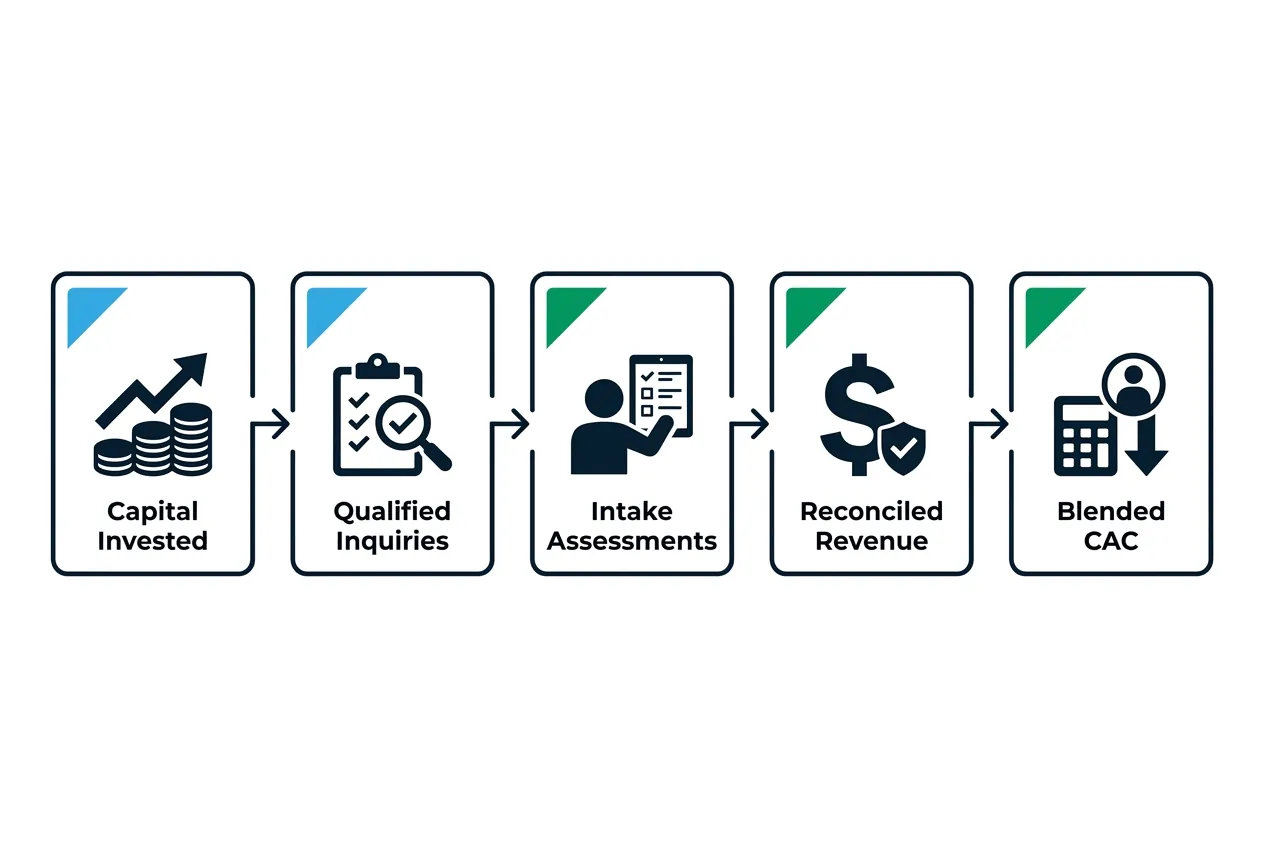
- Closed-Won Revenue or Admission: Reconciles the closed transaction, the signed contract, or the physical intake against marketing spend.
When offline milestone data feeds back into your analytics stack, marketing leadership can evaluate spend based on Pipeline Contribution and Customer Acquisition Cost (CAC) rather than Cost Per Lead (CPL). Furthermore, passing these verified offline conversion signals back to advertising platforms via server-side APIs allows machine-learning bidding algorithms to optimize for actual pipeline revenue rather than unvetted form submissions.
The Attribution Dashboard: What Executive Reporting Must Show
A marketing attribution dashboard should clarify strategic resource allocation, not overwhelm executives with vanity data. Most native reporting interfaces present vanity metrics: impression volume, average click-through rates, platform-reported return on ad spend (ROAS), and theoretical multi-touch fractional credits.
Executive leadership and finance teams do not allocate budgets based on theoretical fractional points. They require direct commercial clarity:
A functional attribution dashboard answers four fundamental resource-allocation questions:
1. Marginal Yield by Channel
What is the incremental acquisition cost of adding the next dollar of spend to Google Search versus Meta, LinkedIn, or programmatic display? As spend scales within a channel, customer acquisition costs eventually rise due to audience saturation. Your reporting must reveal where diminishing returns set in.
2. Channel Role Differentiation
Which channels act as genuine demand capture versus demand generation? Paid search typically captures existing, high-intent commercial demand from buyers actively evaluating solutions. Paid social and content initiatives introduce your brand to buyers before they enter an active buying cycle. A dashboard must show how top-of-funnel interactions shorten the sales cycle for bottom-of-funnel capture channels.
3. Campaign-Level Return on Invested Capital
Rather than relying on ad platform ROAS metrics that double-count revenue, the dashboard must tie ad spend directly to verified financial outcomes pulled from your accounting or CRM database. For a multi-location operation, this means breaking down financial performance by facility, service line, and market geography.
4. Conversion Lag and Cohort Velocity
How many days elapse between a user's initial interaction and closed revenue? Understanding conversion lag prevents marketing teams from prematurely shutting off high-performing awareness campaigns that require thirty, sixty, or ninety days to yield closed revenue.
Email Us
Prefer to send the context directly?
Architecture Over Software: How Marketing Powered Approaches Attribution
At Marketing Powered, we approach attribution as a systems-engineering challenge rather than a simple software subscription. Purchasing a license to an off-the-shelf attribution tool without fixing data collection infrastructure simply digitizes bad measurement.
Our approach to data and analytics architecture focuses on building durable, first-party tracking infrastructure that marketing and executive teams can rely on:
- Operator-Led Strategic Focus: Marketing Powered's founder is a former healthcare CMO who ran marketing operations for a treatment network that expanded from 3 to 24 locations, managing $1.5 to $2M per month in Google Ads spend across 11+ behavioral and mental health accounts. We understand the high-stakes reality of commercial scaling where every dollar of media spend must justify itself against admissions, retainers, or closed revenue.
- First-Party and Server-Side Pipeline Design: We design tracking systems that bypass client-side vulnerabilities. By deploying server-side tagging containers, custom data routing, and dynamic call tracking parameters, we capture click identifiers and session metadata in a secure first-party repository.
- Sensitive Vertical and Regulatory Awareness: As a court-certified expert witness in advertising strategy, our leadership brings deep scrutiny to tracking governance. We build systems that are fully LegitScript-aware and HIPAA-aware. In regulated healthcare environments where platform policies strictly ban interest-based retargeting, we create compliant conversion pipelines that protect privacy while delivering precise acquisition data.
- Tracking to Ultimate Business Outcomes: We do not stop tracking at the web form or the raw phone call. We integrate marketing endpoints directly into your enterprise CRM or intake platform, tracking every prospect through clinical assessment, discovery, proposal, and final admission or sale.
- Owned, Local AI Infrastructure: Operating as an AI-native firm since 2022, we maintain owned, local AI infrastructure for HIPAA-aware inference, data transformation, and deep cohort analysis. This allows advanced modeling without routing sensitive, proprietary business intelligence through public third-party APIs.
Our foundational pillar resource, Marketing attribution: a practical guide for teams that need real answers, outlines how organizations can transition away from superficial web analytics toward integrated measurement. To understand how outsourced execution fits your internal capabilities, review our companion guides on Marketing attribution agency: what a specialist partner delivers and how to vet one and Call tracking services: what a specialist partner delivers and how to vet one.
Software alone will never fix a disconnected attribution framework. True attribution requires an architecture that joins media spend, session tracking, intake operations, and closed revenue into a single, verifiable feedback loop.
Questions, Answered.
Marketing attribution tools are software applications that evaluate customer touchpoints across multiple advertising channels, search engines, and offline interactions. They evaluate user journeys to determine which marketing campaigns, ads, keywords, and creative assets contributed to an inquiry, lead, opportunity, or closed sale.
Ad networks like Google Ads, Meta, and LinkedIn operate as walled gardens. Each platform measures conversions using its own attribution window and tracking pixel. If a prospect clicks a Google Search ad, later clicks a Meta remarketing ad, and finally submits a contact form, both platforms claim credit for the conversion. Attribution tools using first-party identity resolution deduplicate these interactions, attributing commercial value across channels without double-counting revenue.
Browser updates, ad blockers, and mobile operating system frameworks restrict third-party cookies and shorten the lifespan of client-side tracking scripts. When an attribution platform relies on standard front-end JavaScript, it loses tracking visibility if a user converts several days after their initial visit. Organizations must implement server-side tracking and first-party identity storage to maintain accurate measurement over extended sales cycles.
Yes, but only if the software integrates with dynamic number insertion (DNI) call-tracking systems and your internal CRM. Dynamic call tracking assigns a unique telephone number to each website visitor based on their ad session. When the visitor calls, the platform captures the original click parameters and passes them into your CRM, allowing closed offline sales or patient admissions to link back to the specific marketing campaign that generated the call.
Multi-touch attribution (MTA) tracks individual user journeys using first-party digital identifiers and CRM records, making it ideal for tactical optimization of digital media spend. Marketing mix modeling (MMM) is a top-down statistical analysis that evaluates aggregated historical spend, sales data, and external market variables to assess macro-level channel efficiency. High-scale organizations often deploy both: MTA for granular digital campaign optimization and MMM for macro-level budget allocation. Book an attribution audit with Marketing Powered
Ready to see where your marketing can improve?
Request a free audit of your paid media, landing pages, attribution, and measurement setup. You'll get a straight assessment of where the opportunities are.
or email us at info@marketingpowered.ai