Resources
LegitScript Certification Cost: The Operator's Budgeting Guide
Evaluating the total LegitScript certification cost requires looking far beyond the published filing fee on the application portal. Treatment center leaders and healthcare executives often budget for a single administrative payment, only to face multi-location fee multipliers, technical landing page remediation, and months of paid media dormancy. Building an accurate acquisition model demands accounting for direct vendor fees alongside the operational carrying costs of delayed patient admissions.
By Mike Hulick, Founder, Marketing Powered

Direct LegitScript Pricing: Application Fees and Annual Renewals

What Is LegitScript Certification and Why Is It Mandatory?
LegitScript is an independent third-party verification and compliance monitoring service that vets healthcare organizations, pharmacies, and behavioral health providers. In response to widespread predatory marketing practices, illicit call centers, and patient-brokering schemes in the addiction treatment space, major digital platforms made third-party verification mandatory. Today, platforms such as Google and Meta require specialized certification before any advertiser can purchase digital ad inventory related to drug and alcohol rehabilitation.
The requirement is codified directly within ad network compliance rules. The Google Ads Healthcare and Medicines Policy mandates that advertisers running campaigns targeting drug or alcohol addiction services in the United States must obtain certification through LegitScript before their ads can serve. The Meta Policy on Addiction Treatment enforces an identical restriction across Facebook and Instagram properties. If an addiction treatment center attempts to bid on search keywords or publish social ads without an active certification linked to their ad account IDs, their ad campaigns will be disapproved immediately.
Beyond basic keyword approval, advertising in this vertical operates under strict user privacy protections. The Google Ads Personalized Advertising Policy explicitly prohibits retargeting, remarketing lists, and audience-building based on sensitive health conditions, including substance use disorders and mental health treatments. Gaining certification gives an operator access to high-intent search demand, but it does not permit audience tracking tricks. Operators must rely on clean technical landing pages, direct search intent, and transparent disclosures to earn admissions.
Direct platform payments consist of two separate line items: an initial non-refundable application fee and an annual monitoring fee. LegitScript structures its charges per physical facility and business model rather than per corporate brand. The published fee schedule available on the LegitScript Addiction Treatment Certification page outlines the baseline financial requirements for healthcare facilities.
For standard addiction treatment facilities, the baseline non-refundable application fee generally ranges between $1,050 and $1,575 per location, depending on the complexity of the service tier and corporate structure. This fee covers the forensic background audit conducted by the compliance review team. If an organization withdraws its submission or fails the review, this fee is not returned.
Once an application receives preliminary clearance, the provider must pay an annual monitoring fee before the certification becomes active. This recurring annual monitoring charge typically sits between $2,100 and $3,250 per facility, billed every twelve months. Maintaining active status requires paying this recurring charge every year without lapse.
- Application Fee. Typical Price Range: $1,050 to $1,575 per facility. Payment Frequency: One-time upon submission. Refundable Status: Strictly non-refundable.
- Annual Monitoring Fee. Typical Price Range: $2,100 to $3,250 per facility. Payment Frequency: Recurring annually. Refundable Status: Non-refundable once active.
- Expedited Processing Review. Typical Price Range: $1,200 to $1,500 per facility. Payment Frequency: Optional one-time fee. Refundable Status: Non-refundable.
Operators facing firm clinical launch dates often consider the optional expedited review service. Expedited processing costs approximately $1,200 to $1,500 in additional surcharges per application. While it compresses the queue time for analyst review, it does not bypass background screening, state licensing checks, or medical credentialing requirements. Paying for speed makes commercial sense only when idle facility overhead exceeds the surcharge cost.
The Hidden Certification Cost: Multi-Location Multipliers and Idle Beds
The single largest budgeting error in behavioral health expansion is assuming one corporate certification covers an entire health system. LegitScript evaluates certification based on physical licensure, corporate entity formation, and distinct treatment addresses. If an operator manages a network with three residential centers and two partial hospitalization facilities across two states, each facility with its own state department of health license must undergo separate review and pay separate fees.
Consider a regional provider scaling from one facility to four distinct locations:
- Initial Application Charges: Four distinct filings at $1,050 each generate $4,200 in immediate, non-refundable filing expense.
- Initial Annual Fees: Four locations assessed at a baseline of $2,100 each require $8,400 in monitoring fees upon preliminary approval.
- Total Year One Platform Fees: The operator expends $12,600 directly to the verification body before buying a single search click.
The direct invoice, however, is dwarfed by the carrying cost of operational delay. A standard review cycle frequently takes between 60 and 90 days, particularly if the reviewing analyst requests supplementary documentation regarding corporate ownership, zoning approvals, or medical director agreements. If an executive team hires admissions coordinators, signs agency agreements, and leases clinical space two months before certification clears, the facility absorbs substantial monthly burn with zero inbound digital patient volume.
For a residential facility with an average daily bed revenue of $600 and ten open beds, two months of marketing inactivity represents substantial uncaptured admissions value. Treating certification as a minor administrative task rather than a critical-path milestone on the real estate development timeline leads directly to capital drain.
Free Audit
Want a straight read on where your budget is leaking?
Digital Compliance Checks: The Technical Landing Page Audit
Securing certification requires passing a thorough digital compliance check across all public digital assets. LegitScript analysts do not merely review state licensing records; they inspect every URL, landing page, tracking domain, and privacy disclosure an organization intends to use in advertising campaigns. If a domain fails transparency standards, the application stalls.
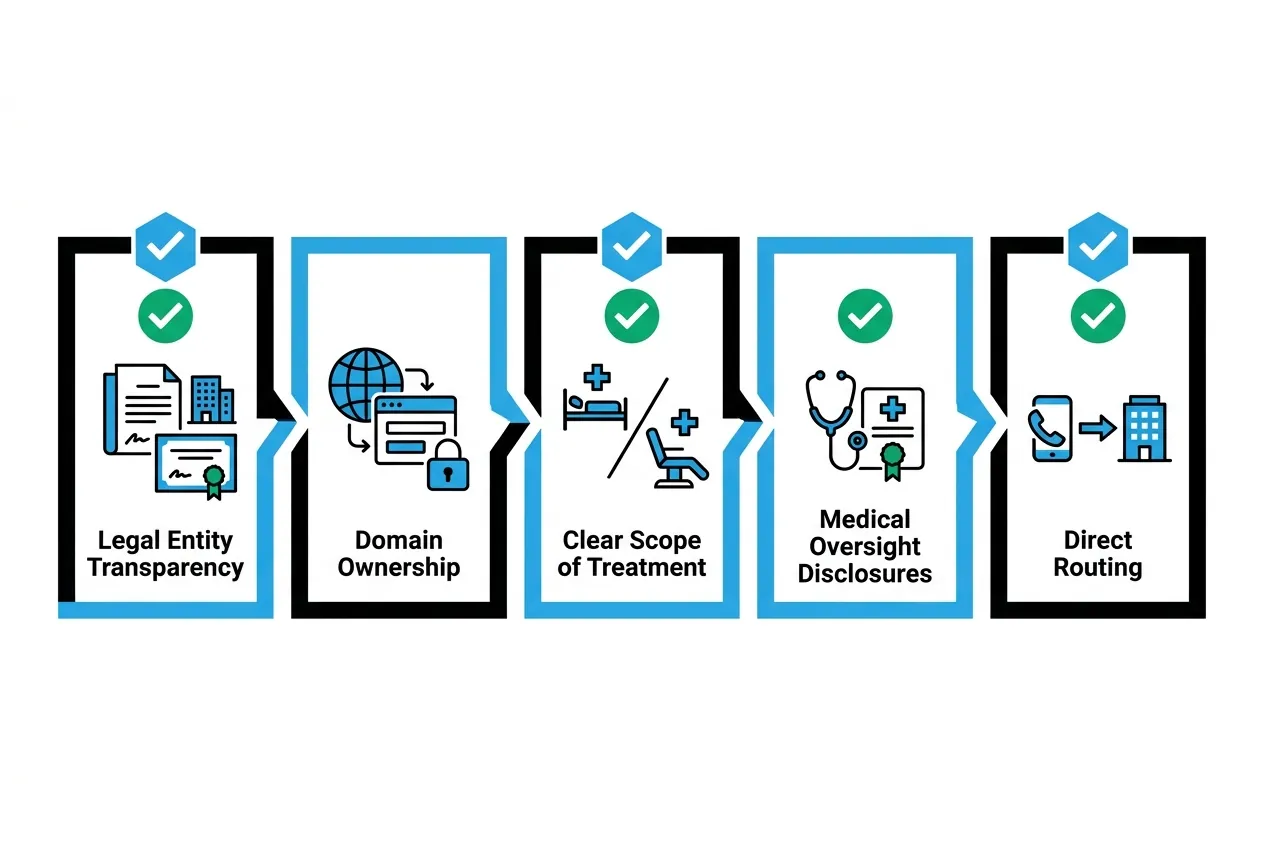
Analysts look for explicit corporate accountability across several core areas:
- Legal Entity Transparency: The footer of every web property must clearly state the full legal business name of the operating entity, the physical address of the facility, and the primary state operating license number.
- Domain Ownership (WHOIS): The registered owner in domain registration records should match the legal entity applying for certification. Masked domain registrations or discrepancy between parent entities and operating websites prompt review flags.
- Clear Scope of Treatment: Digital content must accurately depict the levels of care provided on-site. Marketing residential detoxification services on a website for an outpatient-only clinic triggers compliance violations.
- Medical Oversight Disclosures: Sites must clearly disclose the qualifications and licensure of clinical leadership, specifically the medical director and psychiatric supervisors.
- Absence of Lead Generation Triggers: Websites cannot direct calls to centralized, unbranded call centers that broker callers out to third-party providers. All phone numbers must route to the transparently disclosed treatment facility.
Remediating these items after an analyst issues a notice of deficiency adds weeks to the approval process. Preparing web assets, author pages, and corporate disclosures before submission prevents back-and-forth review loops.
How to Conduct a LegitScript Search to Vet Partners and Competitors
The public verification registry provides total market visibility for healthcare operators, payors, and patients. Anyone can perform an active legitscript search using the public database to verify whether a competing center, co-occurring partner, or digital vendor maintains valid credentials.
Navigating to the registry allows a search by brand name, legal entity name, or website domain. The search results disclose whether an entity is actively approved, pending review, suspended, or revoked. Operators evaluating strategic referral partnerships or acquisition targets should confirm that every prospective partner is properly legitscript certified before signing joint operating agreements.
For internal marketing governance, performing a routine audit on your own live domains protects against accidental lapses. If a billing credit card expires on the annual renewal date, or if a corporate name change is not filed with the certification team, an ad account can face immediate suspension across Google and Meta. Regularly checking your listing status confirms that all live web properties and corporate DBAs remain in good standing.
How Marketing Powered Structures Compliant Behavioral Health Growth
Managing patient acquisition within regulated healthcare requires marketing infrastructure built specifically for sensitive environments. Marketing Powered approaches behavioral health growth from the perspective of experienced operators, not generalist ad managers. The agency founder served as a healthcare CMO who ran marketing for a treatment network that grew from 3 to 24 locations, managed $1.5 to $2M per month in Google Ads across 11+ behavioral and mental health accounts, and serves as a court-certified expert witness in advertising strategy.
Marketing Powered delivers dedicated behavioral health and addiction treatment marketing designed around platform compliance, privacy boundaries, and verified clinical outcomes:
- Compliance-First Account Architecture: We audit landing pages, corporate entities, and domain tracking structures prior to campaign submission, resolving technical flags that lead to ad disapprovals.
- Privacy-Safe Tracking Infrastructure: Because Google explicitly bans personalized retargeting for sensitive conditions, we build acquisition engines focused on direct search intent and clean first-party data capture. Our work uses owned, local AI infrastructure for HIPAA-aware inference, avoiding unvetted third-party data processing.
- Attribution Tracked to Admission: High click volumes and cheap contact form submissions do not fund clinical payroll. We architect conversion systems that track attribution to verified admission, not just initial lead creation, connecting ad spend directly to facility occupancy.
Operators planning major service-line expansions can examine strategic playbooks in our comprehensive resource, Behavioral health marketing: an operator's guide to ethical growth. If you are currently evaluating external vendors, review Mental health marketing agency: what a specialist partner should deliver alongside Addiction treatment marketing agency: how to vet one before you sign to verify partner capabilities.

Email Us
Prefer to send the context directly?
Strategic Timing: When to Submit Your Application
Submitting an application at the wrong point in a facility opening timeline causes expensive operational friction. Submitting too early, before state facility inspection approvals and clinical personnel contracts are finalized, leads to immediate administrative rejections and forfeit application fees. Submitting too late leaves a fully staffed clinical facility sitting empty while analysts review documents.
The ideal submission window opens the moment state facility licensure is formally approved and the facility has an active medical director under contract. At this juncture, the marketing team should prepare the production website, ensuring that all physical addresses, phone routing, and legal entity disclosures match state filings.
Budgeting for paid acquisition requires sequencing the certification timeline directly into your capital allocation model. By planning for direct fees, multi-facility requirements, technical landing page preparation, and analyst communication windows 90 days before your intended media launch, you protect capital and ensure paid campaigns launch smoothly the day facility doors open.
Questions, Answered.
LegitScript certification is an independent regulatory compliance credential required by major digital ad networks, including Google and Meta, for healthcare providers advertising substance use disorder and addiction treatment services in the United States. It verifies facility licensing, medical oversight, ownership transparency, and patient-safety standards to prevent deceptive marketing and patient brokering.
For a single standalone treatment location, the total Year One LegitScript certification cost typically ranges from $3,150 to $4,825. This includes a non-refundable application fee ($1,050 to $1,575) and the standard annual monitoring fee ($2,100 to $3,250). Optional expedited review services can add approximately $1,200 to $1,500.
Standard processing generally takes between 60 and 90 days from the initial application date, depending on application volume, documentation completeness, and the speed with which the applicant responds to analyst deficiency requests. Choosing the expedited review option can reduce queue time, though the exact timeline depends on the complexity of state licensing and background checks.
No. LegitScript evaluates each physical location and state facility operating license individually. If a treatment network operates four distinct physical facilities across multiple locations or states, each licensed facility must submit its own application, pay its own filing fee, and maintain an individual annual monitoring fee.
Google and Meta automatically detect addiction treatment keywords, creative text, and landing page URLs. If an advertiser attempts to run addiction treatment campaigns in the United States without having an approved LegitScript certification linked directly to their advertising account ID, the campaigns will be disapproved immediately, and repeated attempts can trigger permanent ad account suspensions. Talk with Marketing Powered about your admissions and marketing economics
Ready to see where your marketing can improve?
Request a free audit of your paid media, landing pages, attribution, and measurement setup. You'll get a straight assessment of where the opportunities are.
or email us at info@marketingpowered.ai