Capabilities
B2B Peptide Lead Generation for Laboratory Buyers
Peptide and custom synthesis companies rarely have a traffic problem. They have a buyer identification problem. B2B peptide lead generation works when an inquiry can be traced to a real laboratory, a real project and a real purchase authority, and it fails when a consumer funnel is pointed at an institutional market.

Define the institutional buyer before writing a single ad
Institutional demand comes from organizations you can name: university core facilities, contract research organizations, diagnostics and device manufacturers, biotech discovery teams, and hospital or government research labs. Inside those accounts, three roles behave differently. The principal investigator or bench scientist defines the sequence and the experiment. The lab manager controls the budget line and the timeline. The purchasing agent owns vendor onboarding, payment terms and the purchase order.
A written ICP should record organization type, typical order size, required documentation such as certificate of analysis, HPLC purity and mass spec confirmation, and the split between a catalog buyer reordering a stock reagent and a custom synthesis requester bringing a novel sequence. Laboratory peptide supplier leads that cannot be mapped to one of those profiles are unqualified contacts, not pipeline.

Map the buying process as three separate decisions
Scientific procurement is not one conversion event. The first decision is technical evaluation, where a scientist checks whether your chemistry matches the sequence, modification and purity the protocol needs. The second is feasibility, where your synthesis team scopes length, difficult residues, cyclization or labeling, scale and realistic lead time. The third is commercial approval, where procurement compares quotes, confirms vendor status and issues the PO.
Each stage needs different material and a different follow-up, and the same account can stall at any one of them. That only becomes visible if form data, quote requests and CRM stages are connected rather than sitting in separate systems. Build the measurement layer first through workflow integrations and tracking, because peptide manufacturer demand generation without stage-level data is guesswork dressed as reporting.
Build capability documentation that answers procurement questions
Credible demand assets are documentation, not slogans. Publish the specifics a buyer screens on: sequence length ranges, supported modifications, purity grades, the analytical package included with each order, QC and documentation standards, scale from milligram to gram, storage and shipping conditions, and how quotes and lead times are calculated. Then answer the questions procurement actually asks, including how change requests are handled and what happens when a synthesis fails.
Channel rules shape this content too. Google's pharmaceutical manufacturers policy states that suppliers of antibodies, peptides and compounds for commercial labs may advertise only in Canada and the United States, and that advertisers in this area apply for healthcare certification at the child account level, not the manager account (Google Ads policy). Documentation-led acquisition follows the same logic used in regulated healthcare lead generation: make the evidence the offer.
Free Audit
Want a straight read on where your budget is leaking?
Qualify opportunities without inventing researcher status
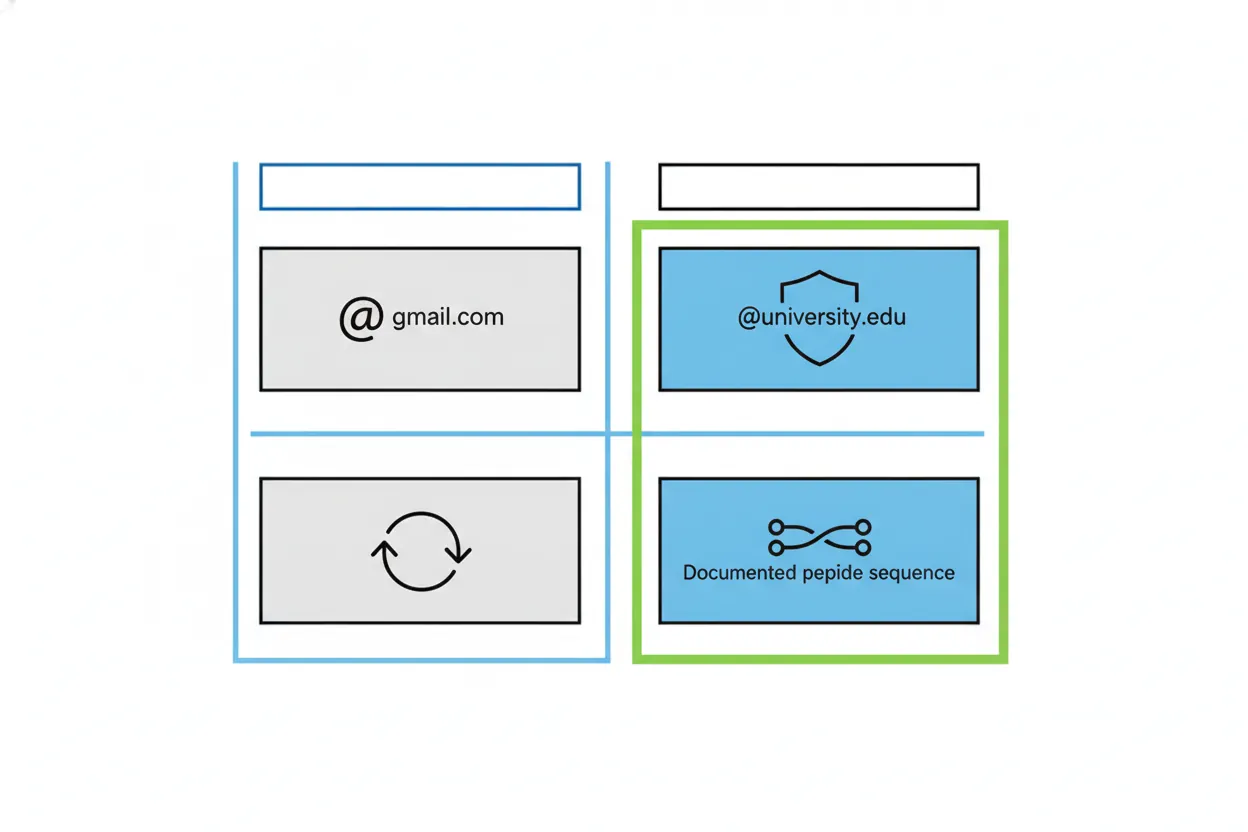
Qualification is a record, not a checkbox. A usable inquiry form captures institution name, institutional email domain, shipping destination, project context, target sequence or modification, quantity, required purity and needed delivery date. A named reviewer, usually inside sales or a technical account manager, confirms the organization exists and that the described use fits a laboratory context before anything reaches a quoting queue.
What qualification is not: a research use only disclaimer. In a March 31, 2026 warning letter to Gram Peptides, FDA stated that despite labeling products for "Research Use Only" and as not intended for human consumption, evidence from the firm's website established that the products were intended as drugs for human use (FDA warning letter).
Surrounding marketing content is treated as evidence of intent. Our work includes reviewing that surface against a documented standard, using a structure similar to the healthcare marketing compliance checklist, with qualified legal and regulatory review for anything approaching a product status conclusion.
Hand off RFQs with owners, standards and stage definitions
Most custom synthesis RFQ marketing breaks at the handoff. Fix it with four written rules: who owns an inbound RFQ within business hours, what response standard applies to a feasibility question versus a catalog reorder, which fields must be complete before an opportunity is accepted, and what evidence moves a record from inquiry to accepted opportunity to quoted to won.
Channel eligibility belongs in the same operating discipline. Accreditation and certification paths, documented for a different vertical in our resource on LegitScript certification, show the pattern: lawful operation, product status, third-party accreditation, channel eligibility and account standing are five separate questions. Google's policy page also notes that violations in this area trigger a warning at least seven days before account suspension, which makes pre-launch diligence cheaper than remediation.
Measure accepted opportunities, not contact volume
Report on sales-accepted opportunities, quotes issued, quote-to-order conversion, average order value, reorder rate and time from inquiry to PO. Raw contact counts and cost per lead will flatter a program that is attracting the wrong buyers. The principle is the one our founder applied in Google's sensitive healthcare vertical, where attribution was tracked to admission rather than to lead, after managing $1.5 to $2M per month in Google Ads across 11+ behavioral and mental health accounts.
Search volume, competition and conversion baselines for this category are unavailable rather than zero, so the honest position before launch is a defined measurement model and a first measurement window, not a projection. Related reading: healthcare marketing agency vetting, paid media and attribution and our security overview.
More Services
Ready to see where your marketing can improve?
Request a free audit of your paid media, landing pages, attribution, and measurement setup. You'll get a straight assessment of where the opportunities are.
or email us at info@marketingpowered.ai