Resources
Research Use Only: Marketing Boundaries for Peptide Suppliers
A research-use-only label describes how a product is labeled. It does not settle who the buyer is, what the site implies the product does, or how the sale is conducted, and that gap is where most research use only peptide marketing risk sits. Regulators and advertising platforms read the full commercial presentation first, then weigh the label against what they find.
By Mike Hulick, Founder, Marketing Powered

Start with actual intended use, not the disclaimer
Intended use is a legal conclusion built from evidence, not a sentence a supplier writes at the bottom of a product page.
Under FDA's regulation on the meaning of intended uses, intent refers to the objective intent of the persons legally responsible for an article's labeling, and it may be shown by their expressions, by the design or composition of the article, or by the circumstances surrounding distribution, including labeling claims, advertising matter, and oral or written statements by the firm or its representatives (eCFR, 21 CFR 201.128).
FDA has applied the same totality-of-circumstances reasoning in its guidance on distribution of in vitro diagnostic products labeled research use only, a separate device context that nonetheless shows how the agency assesses intended use around an RUO statement (FDA guidance).
The practical translation for a marketing team is simple. Open the site the way a reviewer does: cold, with no internal context, starting at the homepage and moving through category pages, a product page, the FAQ, the shipping and returns policy, the blog, the cart, and the order confirmation email.
Add the ad copy and keywords feeding those pages, the chat widget replies, and the post-purchase sequence. That sequence is the evidence record. A reviewer does not read the disclaimer in isolation and does not weight it above everything surrounding it.
Peptide intended use marketing fails most often in the connective tissue, not the product spec. Purity, lot number, storage conditions and hazard information read as laboratory supply. Appetite, body weight, glucose response and before-and-after framing read as a consumer product with a disclaimer attached.

What the FDA case shows, narrowly
One documented example makes the reasoning concrete. On March 31, 2026, FDA's Center for Drug Evaluation and Research issued a warning letter to Gram Peptides, reference 721806, after reviewing the firm's website from January to March 2026 (FDA warning letter).
The letter is explicit about the label question. FDA wrote that despite statements marketing the products for research use only and as not intended for human consumption, medical use, or veterinary use, "evidence obtained from your website establishes that your products are intended to be drugs for human use" (FDA warning letter).
The cited evidence came from the product pages themselves, which described effects on appetite, insulin sensitivity, body weight, glucose handling and lipid profiles. FDA also pointed to the sale of bacteriostatic water for injection alongside peptide products requiring reconstitution, stating that selling them together demonstrated an intent for combined injection use.
On that basis, the agency concluded the products were unapproved new drugs, gave the firm fifteen working days to describe corrective steps, and noted that the violations listed were not an all-inclusive statement of possible violations (FDA warning letter).
Read this narrowly. It is one warning letter against one firm, and a warning letter states the agency's position rather than a court's. It does not establish that every supplier using a research-only label is operating unlawfully, and nothing here is legal advice about any particular catalog.
What transfers is the method: claims plus adjacent products plus presentation, weighed together. If your governance process reviews product descriptions but never reviews the bundle, the blog or the ad copy, it is auditing a narrower surface than FDA did. Broader editorial controls are covered in our guide to healthcare content marketing governance and clinical review.
What supports genuine institutional procurement
Plenty of suppliers sell real reagents to real laboratories. The facts that support that position are operational, and they show up in records rather than in copy.
Buyer qualification is the first one. Institutional sales typically involve a named organization, a verifiable business or academic address, a purchase order or quote request, tax and credentialing documentation, and an account contact who is identifiable as research personnel.
Payment patterns follow the same logic: invoices and net terms against an institution, not consumer checkout with a single vial going to a residential address. Fulfillment detail matters too, including cold-chain handling, certificates of analysis issued as quality documentation, and quantities and formats that match bench work.
Catalog language is the second. Product pages written for laboratory supplier advertising rules address assay context, sequence, purity method, solubility, storage and safety handling. They do not provide human administration instructions, protocols or comparisons to prescription therapies.
Channel eligibility is a separate question from lawful operation, and it has its own rules. Google treats bulk drug manufacturers, medical professional suppliers, and suppliers of antibodies, peptides and compounds for commercial labs as a restricted category permitted to advertise in Canada and the United States only, with healthcare certification required and applications submitted at the child account level (Google Ads healthcare certification policy).
The same policy page states that violations will not lead to immediate suspension without prior warning, and that Google will issue a warning at least seven days before suspending an account (Google Ads healthcare certification policy).
Planning a search program against those constraints is a different exercise from standard ecommerce acquisition, which is why eligibility should be settled before budget is committed in paid media.
Free Audit
Want a straight read on where your budget is leaking?
Signals reviewers weigh beyond the research-only label
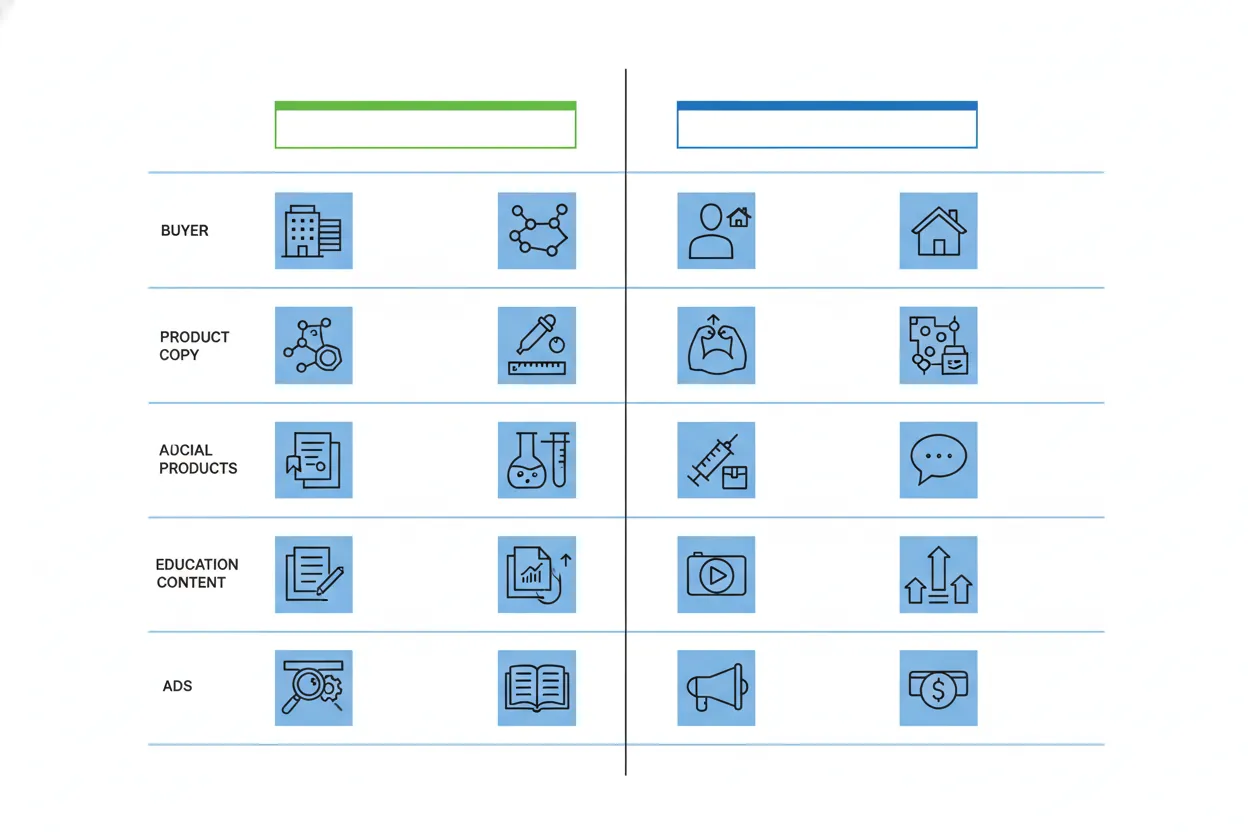
The table below is an illustrative audit frame, built from the reasoning in the warning letter above and from the advertiser categories in the Google policy cited above. It is not a scoring system, a legal test, or a prediction of any review outcome.
- Buyer. Reads as laboratory supply: Named institution, purchase order, verifiable research contact. Reads as human-use promotion: Anonymous individual checkout, residential delivery, single units.
- Product copy. Reads as laboratory supply: Sequence, purity method, storage, handling, assay context. Reads as human-use promotion: Appetite, weight, glucose, energy, recovery outcomes.
- Adjacent products. Reads as laboratory supply: Buffers and labware tied to assay workflows. Reads as human-use promotion: Injection supplies and reconstitution kits bundled at checkout.
- Social proof. Reads as laboratory supply: Citations, methods references, technical documentation. Reads as human-use promotion: Personal results testimonials, transformation photos, influencer codes.
- Education content. Reads as laboratory supply: Assay design, handling and stability topics. Reads as human-use promotion: Protocol, stacking and dosing explainers.
- Ads and keywords. Reads as laboratory supply: Reagent and supply terms aimed at laboratories. Reads as human-use promotion: Branded drug terms and consumer benefit language.
The pattern is consistent. One ambiguous element rarely decides anything. A column of them, pointing the same direction, is the record.
Audit the catalog and everything linked around it
A research peptide website claims audit that stops at the product page misses most of the exposure. The review should cover six surfaces.
Benefit language is the first, including mechanism-of-action copy that describes effects in people rather than in models or assays. Imagery is second: lifestyle photography, body-composition visuals and clinical-looking settings imply a human-use context regardless of the caption.
Testimonials and reviews are third, and consumer endorsements carry their own exposure under the FTC's rules on endorsements, influencers and reviews (FTC business guidance). Bundles and accessories are fourth, since items sold alongside a product can themselves become evidence of intended use, as the warning letter above shows.
Linked education content is fifth, including blog posts, comparison pages, glossary entries and gated PDFs that describe human effects. Paid and affiliate distribution is sixth, covering ad copy, keyword lists, affiliate pages and any partner writing claims you did not approve.
Health-benefit claims also sit under FTC advertising law, which looks for claims to be truthful, not misleading and supported by science (FTC Health Products Compliance Guidance). That standard applies to the claim as consumers reasonably understand it, including implied claims, which is why a disclaimer placed beneath a benefit paragraph does not neutralize the paragraph. Our healthcare marketing compliance checklist covers the review workflow for regulated catalogs in more detail.
Correct the operating model, not the optics
If the audit shows that content and sales conduct point toward individual consumers, the fix is the business practice, not the presentation of it. That means removing unsupported human-effect claims rather than relocating them, ending accessory bundles that imply self-administration, changing buyer qualification so institutional status is verified rather than asserted, retiring affiliate and influencer arrangements that generate claims outside review, and restricting distribution where the model cannot support the sale.
What it does not mean is concealment. Serving different content to reviewers, creating replacement accounts, or qualifying buyers with a checkbox that no one verifies are not remediation. They add a second problem on top of the first, and they do nothing about the underlying intended-use record that a regulator would assemble from the public site.
Keep five questions separate, because they have different answers and different owners: whether the business operates lawfully, what the regulatory status of each product is, whether any third-party certification applies, whether the advertising channel permits the category, and what condition the ad account is in.
Certification is its own track, and Google notes that some healthcare certifications require third-party accreditation before application, naming LegitScript among the accreditors (Google Ads healthcare certification policy). Our guide to LegitScript certification cost, rules and timeline explains how that process works in adjacent healthcare categories.
Marketing Powered is LegitScript-aware and HIPAA-aware, and builds acquisition programs for Google's sensitive healthcare vertical, where retargeting is not permitted.

Email Us
Prefer to send the context directly?
Document the review and monitoring process
The habit that holds up later is dated evidence, maintained by a named owner. In practice that is a small set of living artifacts rather than a one-time project.
Keep an approved-language library: the exact product description patterns that review has cleared, with the date and the reviewer. Keep a catalog change log, so every edit to a product page, bundle or category description is attributable. Keep a buyer-qualification record describing how institutional status is verified, what documentation is collected and how exceptions are handled.
Keep an advertising record covering live ad copy, keyword lists, landing pages and any affiliate or partner material. Keep a source-freshness note on the policy pages you rely on, since platform policy text changes without notice and should be re-read on a fixed cadence and immediately before a launch.
Assign the work. One owner for catalog language, one for buyer qualification, one for paid media, and qualified legal review for any conclusion about intended use or product status. Marketing should not be the function deciding what is lawful, and legal should not be discovering the ad copy after it runs.
Related reading: how to vet a healthcare marketing agency, the Marketing Powered security overview for how data handling is structured, and healthcare marketing attribution through admissions for connecting acquisition spend to downstream outcomes rather than form fills.
Questions, Answered.
No. Intended use is determined from objective evidence, including labeling claims, advertising matter and the circumstances of distribution (eCFR, 21 CFR 201.128). In the March 2026 Gram Peptides letter, FDA stated that website evidence established the products were intended as drugs for human use despite research-only and not-for-human-consumption statements on the labeling (FDA warning letter). The disclaimer is one data point, and it carries little weight when the rest of the presentation points elsewhere.
Describing published findings is different from promoting a product for human use, and the line is drawn by context rather than by phrasing alone.
In the case above, FDA cited product-page statements about appetite suppression, body weight, glucose handling and lipid profiles as evidence of drug intended use (FDA warning letter). Benefit framing on a purchase page, written for the buyer rather than for a research method, is the pattern that draws attention.
Any health-related claim also needs support under FTC advertising standards (FTC Health Products Compliance Guidance).
No. A certificate of analysis documents identity and purity testing for a specific lot against the supplier's specification. It says nothing about safety or effectiveness in people, which in the United States is established through the drug approval pathway, and FDA treated products marketed with human-use evidence and no approved application as unapproved new drugs in the letter cited above (FDA warning letter). Presenting a certificate of analysis as reassurance to individual buyers is itself a signal of consumer positioning.
Suppliers of antibodies, peptides and compounds for commercial labs are a recognized advertiser category, permitted to advertise in Canada and the United States only, with healthcare certification required and applications made at the child account level (Google Ads healthcare certification policy).
Eligibility is assessed against the business model and the destination site, so approval is specific to an applicant rather than automatic for a category. Policy text and location lists change, so confirm the current page before building a campaign plan around it.
Everything a reviewer can reach: homepage and category framing, bundles and accessories, imagery, reviews and testimonials, blog and education content, comparison pages, affiliate and influencer material, ad copy and keywords, chat scripts, and post-purchase email. Also audit the non-public side, including how buyers are qualified, what sales conversations promise, and which documents are sent after checkout.
Sales conduct is part of the record even when it never appears on the website. If your catalog, audience and sales process already match a laboratory supply model, the acquisition work is mostly ordinary, and the constraints are known in advance. If they do not, the useful sequence is to fix the model first and plan the spend second. Assess your research supplier positioning
More Resource Topics
Ready to see where your marketing can improve?
Request a free audit of your paid media, landing pages, attribution, and measurement setup. You'll get a straight assessment of where the opportunities are.
or email us at info@marketingpowered.ai