Resources
Geographic Eligibility for Peptide Marketing
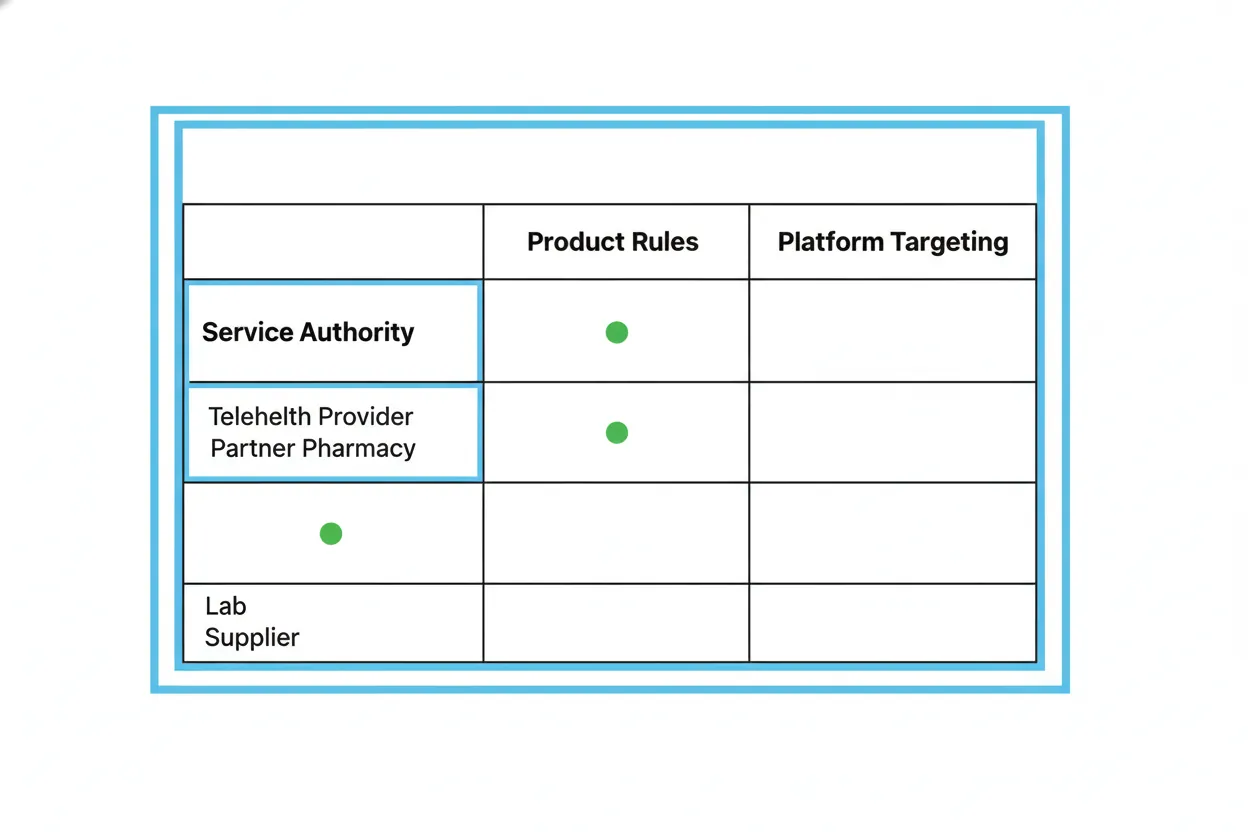
Peptide advertising geographic restrictions are not one list. They are three overlapping lists: where your entity is authorized to deliver the service, where the product itself can lawfully be sold and promoted, and where the advertising platform will let the account target at all. This guide shows how to reconcile those three into a single market-permission register before budget moves, and where to stop and get qualified review.
By Mike Hulick, Founder, Marketing Powered

List every entity and every service before anything else
Most peptide businesses are not one company. A typical structure includes a clinical entity that employs or contracts prescribers, a management or marketing entity that owns the domain and the ad account, a dispensing partner such as a compounding or mail-order pharmacy, and sometimes a separate supplier selling materials to laboratories or distributors. Each of those has its own authority, its own geography, and its own exposure. One license held by one of them does not travel to the others.
Start with a working session that includes the people who actually hold the authority, not just the marketing team. In practice that means the clinical lead or medical director, the pharmacist in charge or the dispensing partner's compliance contact, the operations lead who owns fulfillment and shipping, outside counsel or a licensing consultant, and whoever controls the ad accounts and the website.
The output of that session is a simple roster: entity name, legal role, the specific service or product it provides, the authority it claims, and the person who can produce the document that proves it.
The distinction matters because certification programs look at the whole chain, not the entity that happens to be running ads. LegitScript's healthcare certification standards state that merchants must be adequately licensed for the services they offer and in the jurisdictions they serve, including the jurisdiction from which medications are prescribed or dispensed as well as the jurisdiction in which the patient is located, except where permitted by law (LegitScript healthcare certification standards).
The same standards extend to partners: organizations essential to the applicant's continuum of care, such as partner pharmacies responsible for fulfillment, are generally required to be LegitScript-certified or accredited by another recognized body, with limited exceptions permitted only at LegitScript's sole discretion (LegitScript healthcare certification standards).
Applicants are also required to disclose all domains and websites under their control and all affiliates.
Write the roster down even when it feels obvious. A marketing team that cannot name which entity holds which authority cannot build a defensible market list, and it will default to the broadest possible targeting because nothing in the plan tells it otherwise.
Build a jurisdiction register with qualified confirmation
The register is a matrix, one row per entity-and-jurisdiction pair. Useful columns: entity, authority type, jurisdiction, status, evidence document, issue and expiry dates, who confirmed it, and the date of confirmation. Authority types differ by function. A clinical entity carries prescriber licensure and telehealth practice requirements.
A pharmacy carries resident and nonresident permits, and separately whatever dispensing or shipping authority applies to the products it fulfills. A supplier selling to commercial laboratories carries distribution and registration obligations that have nothing to do with patient care.
Two rules keep the register honest. First, a row is not confirmed until a qualified reviewer confirms it. That means licensing counsel, a regulatory consultant, or the licensing board itself.
It is not a marketing decision, it is not an agency decision, and a screenshot of a competitor advertising in that state is not evidence. Second, every row carries a review date.
Licenses lapse, nonresident permits renew on their own schedules, and a register that was accurate at launch is a liability eighteen months later.
Separate the columns that people habitually collapse. Lawful to operate, lawful to promote the specific product, certified to advertise, and currently permitted by the platform are four different states. A business can be fully licensed in a state and still be ineligible to run a given ad there. The reverse never holds: platform permission does not create operating authority.
For pharmacy marketing state eligibility, keep the fulfillment geography on its own rows. The states where a prescriber can see a patient and the states where the dispensing partner can actually ship are frequently different sets, and the intersection is what the campaign can support. For research and laboratory suppliers, the register tracks customer type as well as geography, because selling to a credentialed laboratory buyer and selling to a consumer are different businesses with different rules.
Once the register exists, it becomes the input to everything downstream: site copy, intake logic, targeting, and sales scripts. If you are also managing search architecture across markets, the sequencing in Multi-Location Marketing: Centralized Strategy assumes this upstream question is already answered.
Compare platform geography against the confirmed register
Platform rules form a ceiling that sits independently above your licensure floor. Google restricts promotion of services related to online prescribing, dispensing and sale of prescription drugs, and states that businesses subject to the policy include but are not limited to online pharmacies and telemedicine providers (Google Ads prescription drug services policy).
Classification is not based on your self-description. Google says it determines whether an advertiser is promoting such services based on factors including the content of the ads, site or app and the products or services offered, and that it errs on the side of caution, especially for landing pages that link or refer to content that appears to facilitate online prescription, dispensation or sale of medicines (Google Ads prescription drug services policy).
Peptide advertising countries are therefore defined by policy lists, not by where you would like to grow. Google allows promotion of some prescription drug services in a defined set of locations and requires advertisers to be certified in order to serve those ads (Google Ads prescription drug services policy).
A detail that catches teams out: the locations where approved advertisers may bid on keywords containing prescription drug terms are a separate and shorter list than the locations where the services may be promoted, and places such as Brazil and France appear on the promotion list without appearing on the keyword list (Google Ads prescription drug services policy). Promotion eligibility and keyword eligibility are two switches, not one.
Supplier-side businesses sit in a different category again. Google's pharmaceutical manufacturers policy states that bulk drug manufacturers, medical professional suppliers, and suppliers of antibodies, peptides and compounds for commercial labs may advertise in Canada and the United States only, and that pharmaceutical manufacturers must be certified by Google in order to serve ads (Google Ads pharmaceutical manufacturers policy).
If a single holding company runs both a patient-facing telehealth brand and a laboratory supply brand, those are two eligibility problems that should never share one account structure or one landing page.
Application mechanics belong in the register too. Google directs advertisers to identify the specific certification type that matches the business model, for example Online Pharmacy, Telemedicine or Pharmaceutical manufacturer, and not to apply for a category that does not match; some certifications require third-party accreditation first, from bodies including LegitScript, NABP or G2 (Google Ads prescription drug services policy).
Applications are made at the child account level rather than the manager account level, agencies applying on behalf of an advertiser are asked to document their relationship with the advertiser or license holder, and separate applications are submitted for each location or group of locations (Google Ads pharmaceutical manufacturers policy).
Google also notes that if a campaign targets a location that is not listed, promotion of those products in that location is not allowed (Google Ads pharmaceutical manufacturers policy).
Expect limited rather than full delivery once you are approved. Google states that for most healthcare policies, if the campaign targets allowed locations and the domain is properly certified, the ad is labeled "Eligible (limited)" and can run in allowed locations (Google Ads healthcare and medicines policy). Organic visibility follows the same market discipline, which is why the register should feed location page architecture as well as paid targeting. Our approach to that is outlined in Multi-Location Healthcare SEO.
Free Audit
Want a straight read on where your budget is leaking?
Reconcile what the website promises with what fulfillment delivers
Walk the buyer path in one sitting, in order, with the register open beside you. Click the ad. Read the landing page headline and any service-area statement. Open the intake form and look at the state dropdown.
Answer the eligibility questions as a resident of a state that is not on the register and see what happens. Continue to checkout or scheduling. Look at the shipping or routing logic and the confirmation messaging.
Then ask the operations lead what actually happens next, including which pharmacy receives the order and which states that pharmacy is permitted to ship to.
Most mismatches surface in the first five minutes of that walkthrough. The state dropdown offers all fifty. The service-area copy says "available nationwide" because it was written before licensure was confirmed. The FAQ promises next-day shipping in markets the dispensing partner does not cover. The blog contains a product page that reads as a direct offer rather than clinical information. Every one of those is a public promise that the register does not support.
Disclosure is not optional under certification review. LegitScript's standards require that applicants' websites clearly disclose all states, territories, provinces and countries in which services are available, and that the applicant and its affiliates keep all practices and offers accurate, transparent and not misleading, including claims of benefits not supported by a regulatory body such as the FTC or FDA (LegitScript healthcare certification standards).
The standards also require that a prescription or prescription drug is not prescribed or dispensed prior to the provision of care by a licensed medical professional (LegitScript healthcare certification standards). Site copy that implies a product arrives before a clinical interaction contradicts that standard even when the operational process is correct.
Supplier sites need their own pass. Material sold for laboratory or research use should be presented that way throughout, including imagery, testimonials, dosing-adjacent content and any user-generated comments. If a page reads as a consumer offer, platform reviewers and certification reviewers are entitled to read it that way too, and the geographic rules that follow will be the consumer ones.
Record the walkthrough as a website-to-fulfillment checklist with a pass or fail per step and an owner for each failure. The structural questions overlap heavily with the broader Healthcare Marketing Compliance Checklist, which is worth running alongside this one rather than instead of it.

Audit campaign settings against the approved market list
Geographic drift is almost always a settings problem rather than a strategy problem. Export every location setting across every active account and compare it line by line with the register.
The items that cause the most trouble: radius targets drawn around a clinic address that cross a state line, campaigns left on the default location option that reaches people interested in a location rather than only people present in it, excluded locations that were removed during a performance experiment and never restored, asset-level and feed-level locations that were not updated when the campaign targets changed, and automated or broad-reach campaign types that expand placement and geography by design.
Then audit the inbound side, because targeting is a statement of intent and inquiries are the evidence. Tag every lead with the state or country it came from, and compare that field against the approved market list on a fixed cadence.
The useful metric is the share of inquiries that are disqualified on geography alone. If that number is material, you are paying for demand the business cannot convert, and the cost is not only media. It is intake time, sales time, and a consumer who was told something the company cannot deliver.
This is where attribution discipline pays. Marketing Powered tracks attribution to admission rather than stopping at the lead, which makes geographic waste visible as a gap between inquiries and completed care or fulfilled orders instead of hiding inside a flattering cost-per-lead figure. Build the same cut for peptide telehealth service areas: inquiries by state, qualified by state, fulfilled by state.
Set the cadence before you need it. Monthly for active accounts, and immediately after any of four events: a licensure change, a dispensing partner change, a landing page or offer change, and a platform policy update. Policy pages change without notice, so re-read the primary sources on a schedule rather than trusting a cached summary.
Enforcement is not instantaneous, which gives a prepared team room to act. Google states that violations of the healthcare and medicines policy will not lead to immediate account suspension without prior warning and that it will issue a warning at least seven days before suspending an account (Google Ads pharmaceutical manufacturers policy).
That window is only useful if someone owns the inbox it lands in and can produce the register on request. If certification sits ahead of you on the roadmap, LegitScript Certification: Cost, Rules and Timeline covers what the review process examines.
Require approval before a new territory goes live
Expansion is the moment registers break. A new state gets added to targeting because a sales lead came in from there, or because a competitor is visible there, and the authority confirmation follows weeks later or never. Make the sequence explicit and make it one direction: confirm authority, then confirm product and channel eligibility, then update public disclosure, then change campaign settings. Marketing moves last.
Define the approval packet so it is the same every time. It contains the license or permit evidence for each entity involved, the dispensing or fulfillment path for that territory with the partner named, the platform certification scope that covers the new location, the proposed site disclosure and intake changes, the exact campaign settings to be changed, and a rollback instruction if any element fails.
Define the approvers by role rather than by name on a spreadsheet: licensing counsel or the regulatory consultant signs the authority section, the clinical lead signs the service model, the pharmacist in charge or dispensing partner signs fulfillment, operations signs capacity, and marketing signs last to confirm the settings match what was approved. Date every signature and keep the packet with the register.
The approval meeting itself is short when the packet is complete. It is a fifteen minute review where each approver confirms their section or names the blocker. The alternative, which is an informal decision in a channel thread, leaves no record of who confirmed what, and no record is what makes a suspension or a certification review expensive.
Certification programs look at advertising behavior as part of the picture. LegitScript's standards state that applicants advertising on internet platforms in apparent violation of the platforms' terms of service may be considered to be attempting to circumvent the goals of the certification program, and that such advertising may be grounds for denial or revocation (LegitScript healthcare certification standards). Platform eligibility and certification status are not independent systems. Treating one as a workaround for the other puts both at risk.
Related reading: Healthcare Marketing Agency: Vetting and Strategy Guide for how to evaluate a partner in a restricted category, Healthcare Paid Media: Search, Social and Attribution for the acquisition model that sits on top of a confirmed register, and the Marketing Powered Security Overview for how we handle data in regulated engagements.
Questions, Answered.
Not automatically, and rarely in practice. Your floor is set by where the prescribing and dispensing entities hold authority, which for telehealth generally includes the jurisdiction where the patient is located. LegitScript's standards require licensure both in the jurisdiction from which medications are prescribed or dispensed and in the jurisdiction where the patient is located, except in circumstances permitted by law (LegitScript healthcare certification standards).
Platform rules then apply a separate ceiling, since Google requires certification to serve prescription drug service ads and limits promotion to listed locations (Google Ads prescription drug services policy). Nationwide targeting is only defensible when the register says every state is covered and the fulfillment path exists for each one.
A partner's license covers the partner's activity. It does not extend the marketing entity's own authority or make its service claims accurate.
Certification review treats the chain as a whole: LegitScript requires that affiliates and partners comply with all program standards, defines affiliates broadly to include partner pharmacies, supplying wholesalers, co-owned companies and associated medical personnel, and requires that all affiliates and partners operate legally (LegitScript healthcare certification standards).
Review each entity's role separately and state publicly only what the entity doing the advertising can support.
No. They are different categories with different geography. Google's pharmaceutical manufacturers policy places suppliers of antibodies, peptides and compounds for commercial labs in a restricted group permitted to advertise in Canada and the United States only (Google Ads pharmaceutical manufacturers policy), while prescription drug services carry their own location list, certification requirement and keyword approvals (Google Ads prescription drug services policy).
Google also directs advertisers to apply only for the certification type that matches the business model. If one company operates both models, keep the domains, accounts, creative and landing pages separate.
Yes, and the match should be exact in both directions. Targeting wider than the register produces inquiries no one can serve and public promises the business cannot keep. Targeting narrower than the register wastes authority you are already paying to maintain.
Google notes that if a campaign targets a location that is not listed in the policy, promotion in that location is not allowed (Google Ads pharmaceutical manufacturers policy), and certification standards require the website to disclose clearly where services are available (LegitScript healthcare certification standards).
Licensed service area marketing means the register, the site, the intake logic and the campaign settings all state the same thing.
A named function, documented in advance, not whoever notices the opportunity first. At minimum that is licensing counsel or a regulatory consultant for authority, the clinical lead for the service model, the dispensing partner or pharmacist in charge for fulfillment, and marketing for the settings change.
Marketing agencies, including this one, do not provide legal, clinical or regulatory conclusions. The useful division of labor is that qualified reviewers confirm what is permitted and the marketing team makes sure nothing is published, targeted or promised beyond that confirmation.
Treat it as a living document with two triggers. A calendar trigger, monthly for active accounts and before any quarterly budget shift, catches license renewals and lapsed permits.
An event trigger catches everything else: new or terminated dispensing partners, new product lines, site or offer changes, certification status changes, and platform policy updates. Policy pages are revised without advance notice, so verify the primary source directly before each planning cycle and immediately before launching in a new location.
If you are running acquisition in a restricted category and cannot produce a single reconciled market list on request, that is the work to do first.
We can review your entity structure, licensure evidence, platform certifications, site disclosures and live campaign geography together, and tell you where the three layers disagree. Audit your market alignment
More Resource Topics
Ready to see where your marketing can improve?
Request a free audit of your paid media, landing pages, attribution, and measurement setup. You'll get a straight assessment of where the opportunities are.
or email us at info@marketingpowered.ai