Resources
Peptide Advertising Policy Change Intelligence
Peptide rules move across four independent layers: federal policy, certifier standards, advertising platforms and payment providers. None of them updates in sync, and none of them answers the whole question on its own, which is why peptide advertising policy updates cause as much trouble when they are good news as when they are bad. A source change is an input to a decision, not the decision itself, and the difference between those two things is where most remediation cost is created.
By Mike Hulick, Founder, Marketing Powered

Define the source universe before you monitor anything
Most monitoring failures are category errors. A compliance lead reads that a federal agency has loosened its stance on a product class, forwards the article to growth, and a campaign goes live three days later against a platform policy that has not changed at all. The source was real. The inference was not.
Start by writing down the four source categories separately, because they answer four different questions.
Regulators answer whether an activity is lawful or subject to enforcement. The clearest recent example is the US Department of Health and Human Services notice of availability published in the Federal Register on October 30, 2026, describing an enforcement discretion policy for certain peptide bulk drug substances used in Section 503A compounding (Federal Register). Enforcement discretion describes what an agency intends to do about enforcement. It is not product approval.
Certifiers answer whether a merchant can be certified. LegitScript describes itself as an independent third-party certification organization that assesses businesses against its own standards and states plainly that it does not control the policies of advertising platforms, payment processors, acquirers or card brands (LegitScript).
Platforms answer whether an account, a domain and a specific ad can run. Google's healthcare and medicines policy, for example, permits promotion of telemedicine services by providers accredited through LegitScript's Healthcare Merchant Certification Program, with country-specific limitations (Google Ads policy). Platform eligibility is granted by the platform, under its own text, on its own timeline.
Payment providers answer whether money can move. Acquirers, processors and card brands underwrite independently of all three layers above.
Picture the review table where this actually happens: a compliance officer with the policy document open, a pharmacy or clinical operations lead who knows which formulations are actually dispensed, a growth lead with the live campaign list, and someone from finance who knows which processor underwrites the merchant account.
Four people, four source categories, one register. If any of those seats is empty, the organization is guessing in that category. Governance habits for that kind of structured review are covered in AI Governance for Healthcare Marketing Leaders.

Capture versions, dates and what actually changed
Peptide policy monitoring fails quietly when teams record conclusions instead of versions. Six weeks later nobody can say which document the conclusion came from, whether it was a draft, or whether it has been revised.
Record three dates separately for every entry, because they are frequently different:
- Publication date. When the source made the change public.
- Effective date. When the change applies. LegitScript stated that it updated its certification review approach effective November 2, 2026 to reflect the conditional allowances in the HHS policy (LegitScript).
- Observed date. When your team saw it. This is the honest record of your own exposure window.
Add a fourth field for status, because draft, interim, final and withdrawn carry different weight. The HHS material was announced as a draft policy with a public comment docket, and legal analysts noted the comment window closing November 13, 2026 under docket HHS-OASH-2026-0496 (Holland & Knight).
A document in an open comment period is a weaker basis for a permanent business change than a settled final rule, and your register should make that visible without anyone having to re-read the source.
Platforms version their policies too, and the dated notice is often the only way to see what moved. Google publishes dated update pages alongside its standing policy text, such as its update to the healthcare and medicines policy in April 2026 (Google Ads policy update). Capturing the notice URL and its date, rather than a paraphrase, means a later reviewer can diff the change rather than trust a summary.
An illustrative source and change register with these fields looks like this.
- Source category. Example entry (illustrative): Certifier.
- Source and URL. Example entry (illustrative): LegitScript certification review update, article URL recorded.
- Status. Example entry (illustrative): Published, in effect.
- Publication date. Example entry (illustrative): November 2, 2026.
- Effective date. Example entry (illustrative): November 2, 2026.
- Observed date. Example entry (illustrative): Date your team logged it.
- What changed, in one sentence. Example entry (illustrative): Review approach updated to reflect conditional allowances in the HHS policy.
- Business areas potentially touched. Example entry (illustrative): Product scope, certification standing, claims language.
- Assigned reviewer. Example entry (illustrative): Named individual, not a department.
- Decision status. Example entry (illustrative): Under review, action taken, no action, superseded.
The register is the artifact that turns peptide regulatory change intelligence from a reading habit into evidence. It also answers the question an auditor, a platform representative or a board member will eventually ask: what did you know, when did you know it, and who decided what to do about it.
Assess actual scope before assuming anything changed
Scope assessment is where most over-generalization happens. A narrow, conditional policy becomes "peptides are approved now" in three retellings, and the cost of that drift lands on the campaign that gets disapproved or the merchant account that gets terminated.
Work the scope question product by product. The HHS enforcement discretion policy concerns six specific peptide ingredients, described by LegitScript as BPC-157 acetate, TB-500 acetate, Epitalon acetate, Semax free base, KPV acetate and MOTS-C acetate, with specified ingredient forms and routes of administration for each, under a set of ten conditions (LegitScript).
That is a short list with real edges. Several of those edges catch businesses by surprise: 503B outsourcing facilities are not covered, only single active pharmaceutical ingredient formulations are addressed, and delivery devices co-packaged with or containing the compounded drug are limited to FDA 510(k)-cleared syringes (LegitScript).
A business selling a combination formulation, or dispensing through a facility type outside the policy, has not been touched by the change at all.
Run every logged change through the same impact-assessment template so that scope is argued on paper rather than assumed in a meeting.
- Which products or offerings does the source name?. What to record: Exact ingredients, forms and formats, quoted from the source.
- Which business model does it apply to?. What to record: Facility type, prescriber relationship, dispensing path.
- Which markets or jurisdictions?. What to record: Country and state limits, including any transition dates.
- Which channels could it affect?. What to record: Paid search, paid social, organic content, email, landing pages.
- Which layer does it actually bind?. What to record: Lawful operation, product status, certification, channel eligibility, account status.
- What is unchanged?. What to record: Explicit list, so no one infers change where none occurred.
- Evidence gaps. What to record: Questions the source does not answer.
The last three rows matter most. Keeping lawful operation, product status, certification standing, channel eligibility and account standing as five separate columns prevents the single most expensive inference in this category, which is treating compounding enforcement discretion as advertising permission. The broader pre-launch review habits that sit around this work are in the Healthcare Marketing Compliance Checklist.
Free Audit
Want a straight read on where your budget is leaking?
Route each question to the reviewer who can answer it
A scope assessment produces questions of four different kinds, and one generalist cannot competently answer all four. Clinical questions about formulation and route belong with a clinical or pharmacy reviewer. Legal and regulatory questions belong with qualified counsel. Privacy questions about tracking, audience data and intake belong with whoever owns your data handling. Operational questions about campaign structure, claims language and landing pages belong with marketing leadership.
The same principle applies to AI assistance. Summarization is genuinely useful here, because the volume of source material across regulators, certifiers, platforms and processors is larger than most teams can read closely every month. Summarization is not adjudication.
NIST's voluntary AI Risk Management Framework, including the Generative AI Profile released as NIST-AI-600-1 on July 26, 2024, is built around governance, documentation and oversight practices rather than automation of judgment (NIST).
Using it as the backbone for how AI participates in peptide policy monitoring keeps the model in a drafting and retrieval role, with a named human accountable for every conclusion that reaches a campaign.
An approval responsibility matrix makes that explicit.
- Source summary and register entry. Prepared by: Analyst or AI-assisted draft. Reviewed by: Compliance lead. Approved by: Compliance lead.
- Product and formulation scope. Prepared by: Clinical or pharmacy operations. Reviewed by: Clinical reviewer. Approved by: Clinical reviewer.
- Legal or regulatory interpretation. Prepared by: Compliance lead. Reviewed by: Qualified counsel. Approved by: Qualified counsel.
- Certification implications. Prepared by: Compliance lead. Reviewed by: Certification contact. Approved by: Compliance lead.
- Channel eligibility and ad claims. Prepared by: Marketing lead. Reviewed by: Compliance lead. Approved by: Marketing executive.
- Payment and underwriting exposure. Prepared by: Finance. Reviewed by: Processor relationship owner. Approved by: Finance executive.
Two rules keep the matrix honest. First, no row may be approved by the person who drafted it. Second, an AI system never appears in the approved-by column. Certification questions in particular tend to arrive with assumptions attached, and the practical requirements, costs and timelines are set out in LegitScript Certification: Cost, Rules and Timeline.
Translate findings into action only after review is recorded
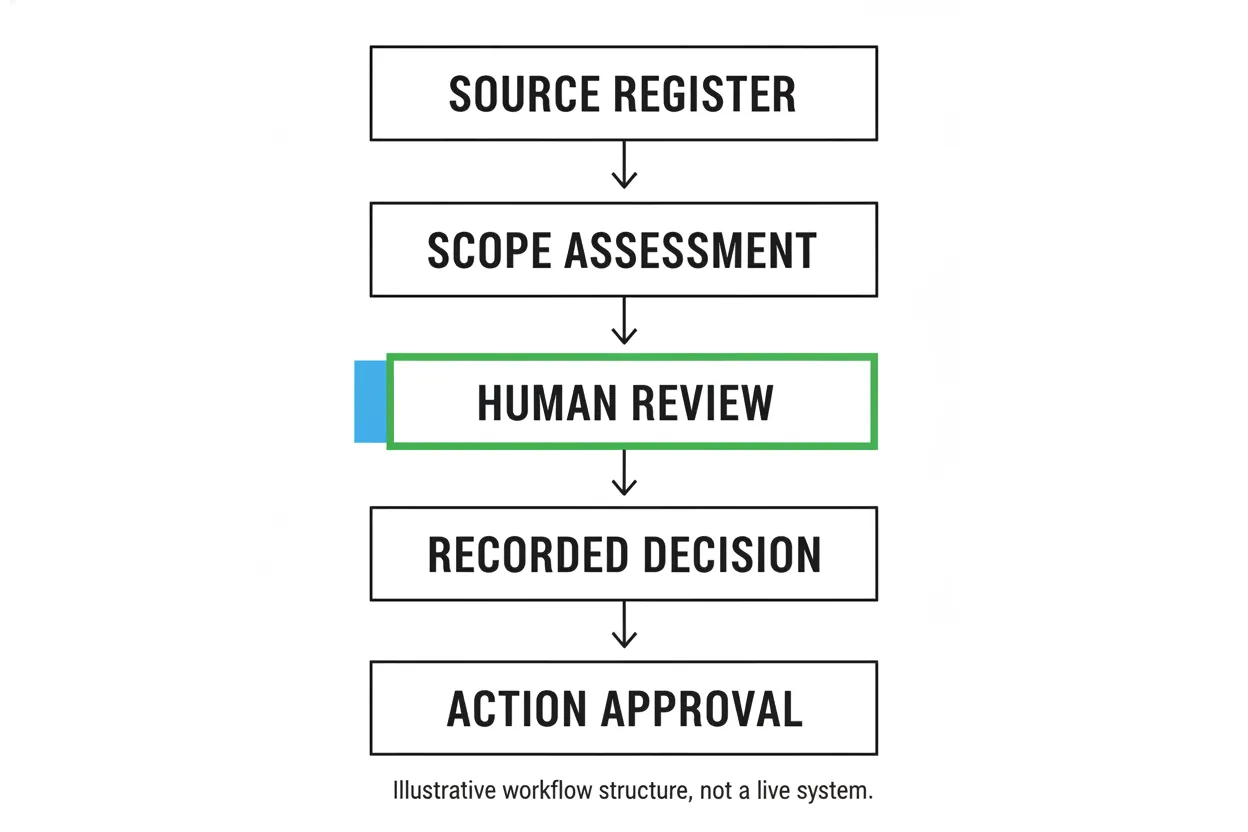
Detection should never trigger publication. The workflow runs in one direction: source change, register entry, scope assessment, routed review, recorded decision, then action. Automating the first three steps is reasonable. Automating the last two is how an organization ends up advertising something it cannot support.
When review is complete, action takes one of a small number of forms. Claims language gets updated, usually by subtraction rather than addition, because the most common defect after a permissive-sounding change is marketing copy that implies approval where only conditional enforcement discretion exists. LegitScript's own preparation guidance for businesses includes reviewing labels, marketing and patient communications to avoid suggesting that enforcement discretion means FDA approval (LegitScript).
Second, the internal eligibility register is updated. This is a per-offering table with a current status such as advertisable, restricted to specified channels, organic only, or paused, each with the date and the decision that set it. Campaign approvals then reference the eligibility register rather than someone's memory of a meeting.
Third, campaign status changes, and only for the offerings the assessment actually touched.
Here is an illustrative source-to-action sequence, labeled illustrative because it describes the method rather than a specific engagement. A certifier publishes a dated update to its review approach. The register logs the publication, effective and observed dates.
Scope assessment finds that two of a client's six peptide offerings fall inside the named ingredient and formulation conditions, one is a combination product that does not, and three are unaffected. Clinical review confirms the two products' forms and dispensing path. Counsel reviews the regulatory read.
The eligibility register moves two offerings from paused to organic-content-permitted, and leaves channel eligibility unchanged pending a direct check of each platform's current policy text and effective dates. Marketing updates two landing pages to remove approval-adjacent phrasing.
Total elapsed time is measured in days, and every step has a name and a date attached.
Note what did not happen in that sequence: nothing went live on the basis of the certifier update alone. LegitScript states that even when a platform intends to update its policies to reflect the enforcement discretion policy, implementation may take time, may not align with the certifier's timeline, and businesses should independently confirm each platform's current requirements and the effective date of any changes (LegitScript).
If you are evaluating an outside partner to run any part of this, the diligence questions are in the Healthcare Marketing Agency: Vetting and Strategy Guide.
Report uncertainty, corrections and reversals in writing
Interim policies get revised. Draft policies get withdrawn or finalized with different conditions. Certifier interpretations get refined as clarification arrives. LegitScript's own article flags that further clarification may become available on at least one condition, and advises businesses to monitor updates and be prepared to adjust offerings if the policy is revised or withdrawn, including within any applicable transition periods (LegitScript). Any monitoring process that cannot handle a reversal is not a process, it is a one-time reading.
Build three habits into the register. Mark confidence on every interpretation, using plain labels such as directly stated in source, reasonable inference, or open question pending review.
Supersede rather than overwrite, so that a later entry links back to the one it replaces and the earlier record stays visible with its original date.
Issue corrections to the same internal audience that received the original summary, with the correction dated and attached to the register entry, because an uncorrected internal summary circulating in Slack outlives the document it misread.
Then keep a decision history separate from the change log. The change log records what sources did. The decision history records what your organization did, when, on whose authority and on what basis. In a dispute with a processor, a platform or a regulator, that second record is the one that demonstrates diligence, and it is also the one most organizations do not have.
Related reading for the operational layers this connects to: Healthcare Paid Media: Search, Social and Attribution for how channel eligibility shapes acquisition planning, Marketing Powered Security Overview for how source records and client data are handled, and Healthcare Marketing Attribution Through Admissions for measuring what the surviving campaigns actually produce.
Email Us
Prefer to send the context directly?
Turn peptide advertising policy updates into a standing routine
This is the checklist version, which is what gets used on a Tuesday when something has changed and three people want an answer.
Standing setup.
- Name an owner for each of the four source categories, with a named backup.
- List the specific source URLs you will check, including the certifier's updates page and each platform's policy and policy-update pages.
- Create the register with the fields above, in a system with version history.
- Create the eligibility register, one row per offering, with status, date and deciding reviewer.
- Publish the approval responsibility matrix where marketing can see it.
Every 28 days.
- Recheck each primary source and log a dated observation, including unchanged observations. A no-change entry is evidence.
- Review open questions from prior assessments and close or escalate them.
- Reconcile the eligibility register against what is actually running in each ad account.
On any detected change.
- Log the entry within one business day, with all three dates and status.
- Run the impact-assessment template, including the unchanged list.
- Route questions by category, not by whoever is available.
- Record the decision, the approver and the date before anything is edited or launched.
Immediately before publication or launch.
- Re-verify the primary sources that the decision depends on, because a check from three weeks ago is not a current check.
- Confirm channel eligibility against the platform's own current policy text and its stated effective date, separately from certification standing.
- Confirm claims language does not imply approval, safety or efficacy that the source does not support.
Marketing Powered brings operator background to this kind of review rather than a general compliance template. The founder is a former healthcare CMO who ran marketing for a treatment network that grew from 3 to 24 locations, managed $1.5 to $2M per month in Google Ads across 11+ behavioral and mental health accounts, and is a court-certified expert witness in advertising strategy.
The firm is LegitScript-aware and HIPAA-aware and built for Google's sensitive healthcare vertical, where retargeting is not permitted, and it has been AI-native since 2022, with owned local AI infrastructure for HIPAA-aware inference. None of that substitutes for qualified legal, clinical or regulatory review, and it is not meant to.
Questions teams ask about peptide policy monitoring
Does a regulator update automatically change platform rules?
No. They are separate layers with separate decision-makers. A federal enforcement discretion policy describes what an agency intends to do about enforcement, while advertising eligibility is set by each platform's own policy text, often with country-specific limitations and its own certification requirements (Google Ads policy). LegitScript states directly that its review updates do not change the independent requirements of advertising platforms or payment providers (LegitScript). Treat every layer as requiring its own current verification.
Strategy
Want to start with a quick message?
How should conflicting sources be handled?
Determine whether the sources are actually in conflict or are answering different questions, which is the usual case. A certifier saying an offering can be certified and a platform saying an ad category is restricted are consistent statements about different layers.
Where a genuine conflict exists, the more restrictive and more directly binding source governs the action, and the conflict itself becomes a register entry with an assigned reviewer. Do not resolve conflicts by choosing the source that permits the campaign you already planned.
Can AI summarize changes without making the final decision?
Yes, and that is the appropriate division of labor. AI is well suited to retrieval, diffing versions, drafting register entries and flagging which offerings a change might touch. NIST's voluntary AI framework and its Generative AI Profile are organized around governance, documentation and human oversight rather than removing human judgment (NIST). The operating rule is simple: an AI output can enter the register as a draft, and a named human must approve anything that changes claims, eligibility or spend.
Which dates should be recorded?
Publication date, effective date and the date your team observed the change, at minimum. Add comment-period or transition deadlines where they exist, since a draft policy in an open comment window, such as the HHS docket that closed November 13, 2026, carries different weight than a final rule (Holland & Knight). Record the date of your own decision separately from all of these.

Free Audit
Want a straight read on where your budget is leaking?
How should a revoked or revised policy be handled?
Treat reversal as a normal state, not an exception. LegitScript advises businesses to monitor updates to the enforcement discretion policy and be prepared to adjust offerings if it is revised or withdrawn, including within any applicable transition periods or deadlines (LegitScript).
Supersede the register entry rather than deleting it, reassess scope against the revised text, issue a dated correction to everyone who received the original summary, and move affected offerings in the eligibility register before, not after, the next campaign review.
More Resource Topics
Ready to see where your marketing can improve?
Request a free audit of your paid media, landing pages, attribution, and measurement setup. You'll get a straight assessment of where the opportunities are.
or email us at info@marketingpowered.ai