Resources
FDA Approval, Registration and Certification in Peptide Marketing
Peptide businesses accumulate official-looking records: an NDC number, a facility registration, a certificate of analysis, a merchant certification. Teams then compress all of it into one word, and peptide FDA approved marketing claims end up in headlines that no document in the folder supports. FDA has published plain language on what these records mean for drugs and for cosmetics, and the gap between the record and the headline is where budget, accounts and legal exposure are lost.
By Mike Hulick, Founder, Marketing Powered

Identify what each credential actually covers
Start every claim review by asking which of four things a document describes: a product, a facility or establishment, a merchant or seller, or a single activity such as one laboratory test on one lot. These are different objects with different issuers, and almost every bad peptide claim comes from swapping one for another.
FDA states the boundary directly: mere registration of an establishment or listing of a drug or device does not denote approval of the establishment, the drug or device, or other drugs or devices of the establishment, and it does not mean that a product may be legally marketed (FDA, Is It Really 'FDA Approved'?).
The same page notes that FDA does not approve manufacturing facilities independently, although it inspects regulated facilities to verify compliance with current good manufacturing practices and other requirements.
Approval, by contrast, is a specific finding. For new human drugs and biological products, a company must demonstrate that the product is safe and effective for its intended use and that it can be manufactured to federal quality standards (FDA). If no one made that demonstration and FDA did not issue that finding, the word does not apply, regardless of how many other records exist.
The following reference framework is illustrative and is not a legal determination for any specific product or business.
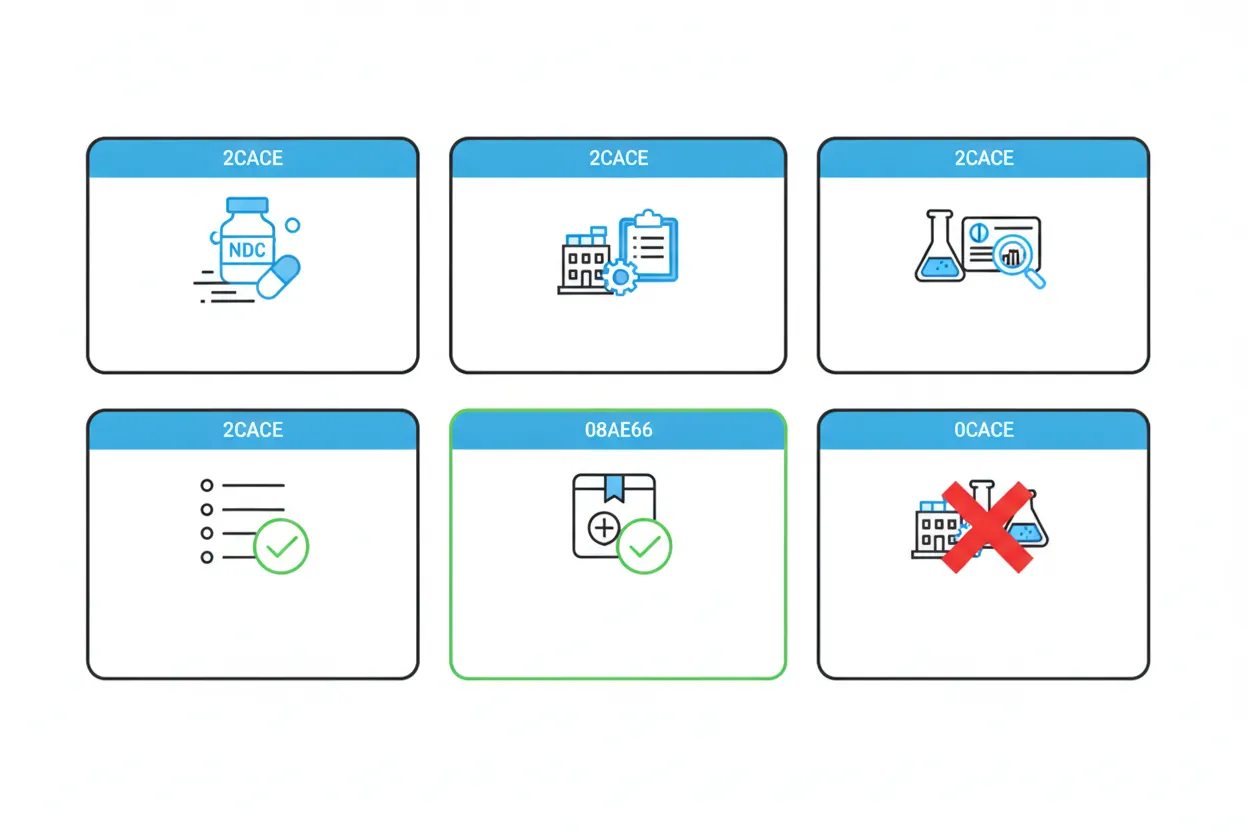
- NDC listing. What it establishes: A listed product record exists in FDA's drug listing system. What it does not establish: FDA review, approval, legal marketability or payer coverage. Workable wording: "Listed with FDA under NDC 00000-000-00". Wording to avoid: "NDC approved", "FDA-approved NDC".
- Drug establishment registration. What it establishes: The establishment is registered as required. What it does not establish: Approval of the firm or its products. Workable wording: "FDA-registered facility" used only about the facility. Wording to avoid: "FDA-registered product", "FDA approved facility".
- Cosmetic facility registration and product listing. What it establishes: Registration and listing obligations were met. What it does not establish: FDA approval of the facility or the product. Workable wording: "Registered and listed under MoCRA requirements". Wording to avoid: "FDA approved", "FDA certified", "FDA compliant".
- Certificate of analysis. What it establishes: Test results for a specific lot on a specific date. What it does not establish: Approval, safety for human use or legal marketability. Workable wording: "Lot 1234 tested at 99.1% purity by [method]". Wording to avoid: "Lab certified safe", "clinically proven".
- Third-party merchant certification. What it establishes: The merchant met that program's published standards. What it does not establish: FDA approval, product efficacy or clinical benefit. Workable wording: "Certified under [program] merchant standards". Wording to avoid: "Government approved", "certified safe and effective".
NDC numbers prove listing, not FDA review
Section 510 of the Federal Food, Drug and Cosmetic Act requires registered drug establishments to give FDA a current list of all drugs they manufacture, prepare, propagate, compound or process for commercial distribution, and products are identified using a unique three-segment number, the National Drug Code, which serves as a universal product identifier for human drugs (FDA, National Drug Code Database Background Information).
Part of that number is self-assigned: the labeler code is assigned by FDA, while the product and package codes are assigned by the firm.
FDA's own disclaimer is unambiguous. Inclusion of a firm or its products in the NDC Directory does not denote FDA approval of the firm or any of its marketed products, is not a determination that a product is a drug as defined by the Act, and does not denote that a product is covered by or eligible for reimbursement by Medicare, Medicaid or other payers (FDA).
Approval status lives in a separate field: a number in the FDA approved application number field is an NDA or ANDA number signifying approval for marketing based on a review of safety and effectiveness, while the value "OTHER" signifies a product that may not be approved for both safety and efficacy under an NDA or ANDA.
Practical rule for NDC number approval claims: printing an NDC on a label or invoice is a listing fact. Writing "NDC approved" or implying government review in an ad, a product page bullet or a wholesaler sell sheet is a claim about a finding that the listing does not contain. Teams building broader review habits can work from the healthcare marketing compliance checklist.
Compounded products are not approved products
Compounded drugs are not FDA approved, which means the agency does not review their safety, effectiveness or quality before they are marketed (FDA, Human Drug Compounding). FDA adds the statutory reason: by statute, compounders do not need to prove to FDA that their products meet the same standards that drug manufacturers meet, so there is no premarket review of compounded drugs for safety, effectiveness or quality (FDA).
Whether a given compounded preparation may lawfully be distributed turns on the conditions in the applicable compounding provisions, not on an approval event. That distinction matters commercially because conditional regulatory treatment can change, while marketing assets live for years in retailer catalogs, affiliate pages and cached ad copy.
Compounded product approval claims also create channel risk: ad platforms and payment processors evaluate advertiser eligibility separately from product status, and a certification decision is not a regulatory finding about the preparation. Our guide to LegitScript certification covers how that separate merchant review works.
Free Audit
Want a straight read on where your budget is leaking?
Read a certificate of analysis for what it tested
A certificate of analysis is a laboratory document about one lot. It names the material, the lot or batch identifier, the sample receipt and test dates, the testing laboratory, the analytical methods and the specifications the lot was measured against, typically identity, assay or purity, water content, residual solvents and endotoxin or bioburden where the dosage form calls for it. Read in that frame, a COA is useful evidence of what a specific batch tested as on a specific day.
It is not a regulatory status document. It says nothing about whether the finished product is approved, whether it may be legally marketed, or whether the ingredient is appropriate for human use, and the testing laboratory is not speaking for FDA. Marketing reviewers should treat phrases like "lab certified," "third-party verified safe" and "pharmaceutical grade" as claims requiring their own support, not as restatements of the COA.
Cosmetic peptide brands face a related trap. FDA has stated that cosmetic product facility registration and product listing is neither a cosmetic approval program nor a promotional tool, and the assignment of a facility registration number or product listing number does not indicate FDA approval of the facility or its cosmetic products, and that the agency does not provide certificates or other documents to verify compliance for cosmetic facility registration or listing, including verification letters and documents confirming that a facility is not required to register, even though ecommerce platforms may ask sellers for proof of FDA registration (FDA, Cosmetics Constituent Update, September 9, 2026).
A marketplace asking for a document FDA does not issue is not a reason to manufacture one, or to describe a registration confirmation screen as approval. Teams evaluating outside help can use our healthcare marketing agency vetting guide to test how a vendor handles exactly this kind of request.

Audit badges, headlines and the overall impression
Review claims the way a reader encounters them, not the way the legal file is organized. Pull the full set: paid search headlines and sitelinks, landing page hero and badge row, product detail bullets on retail marketplaces, packaging and insert copy, the sales deck, email sequences, affiliate and influencer scripts, and the FAQ that someone wrote two years ago. For each asset, name the specific document that supports each claim and the exact scope sentence from the issuer.
Then check adjacency, because impression is cumulative. An agency seal next to the words "FDA" and "approved" in separate sentences, a government-style shield icon, a lab photograph beside a safety statement, or a registration number placed under a headline about safety can all combine into an approval impression that no single sentence states.
Media buying teams should treat claim support as a prerequisite for scale rather than a cleanup task, which is how disciplined healthcare paid media programs avoid rebuilding accounts and creative libraries mid-flight. Our founder's background includes managing $1.5 to $2M per month in Google Ads across 11+ behavioral and mental health accounts, where claim language and account eligibility were operating constraints, not afterthoughts.
Maintain a credential register your team can actually use
Keep one register, owned by a named person, with a row per credential and these columns: credential name, issuing body, the issuer's own scope sentence copied verbatim with its source URL, identifier number, issue date, renewal or expiry date, renewal owner, approved wording, prohibited wording, and every asset where the credential currently appears. The last column is what makes removal possible in an afternoon instead of a quarter.
Renewal cadence belongs in the register because registrations lapse on fixed schedules. Under MoCRA, facility owners or operators are generally required to register with FDA and renew every two years, and the responsible person for each marketed cosmetic product must list each product and provide updates annually (FDA). On the drug side, registered establishments must update listing data in June and December each year (FDA).
Store the register where document handling and access controls are already defined, which is the same discipline described in our security overview. Connect it to performance reporting so claim changes are visible alongside conversion and pipeline movement in your analytics and attribution setup, and run the same scope check across evergreen organic pages, since SEO content outlives most ad creative.

Email Us
Prefer to send the context directly?
Questions marketing reviewers ask about approval language
Does an NDC number mean a peptide product is approved?
No. FDA states that inclusion of a firm or its products in the NDC Directory does not denote approval of the firm or any of its marketed products, nor does it establish payer coverage. The number identifies a listed product record. Use it as an identifier in operational contexts, and keep it out of headlines where it would read as regulatory endorsement.
Does facility registration prove product approval?
No. FDA says registration of an establishment or listing of a drug or device does not denote approval of the establishment or the product, and does not mean a product may be legally marketed. For cosmetics, assignment of a facility registration or product listing number does not indicate FDA approval. In copy, keep facility language about the facility and never let it modify the product.
Does a certification program certify drug effectiveness?
Third-party certification programs used by advertising platforms and payment providers evaluate a merchant against that program's published standards. They do not perform the premarket review that approval represents, which for new drugs requires a demonstration that the product is safe and effective for its intended use and can be manufactured to federal quality standards. Describe certification by naming the program and its scope, and read the certifying body's current published standards before writing anything.
What does a certificate of analysis establish?
It establishes test results for a defined lot, against defined specifications, using defined methods, on a defined date. It does not establish regulatory status, legal marketability, clinical benefit or suitability for human use. Keep COA references factual and lot-specific, and avoid turning an analytical result into a safety or efficacy claim.
How should a compounded offering be described?
Describe the practice and the preparation accurately, and state plainly that compounded drugs are not FDA approved and are not reviewed by the agency for safety, effectiveness or quality before marketing (FDA). Keep clinical decisions with licensed prescribers, avoid comparative superiority language against approved products without support, and have qualified legal and regulatory counsel review the final wording before it runs.
Credential language is cheap to fix before launch and expensive to fix after a marketplace, a payment processor or a regulator reads it differently than you did. If your current headlines, badges and product pages have drifted from what your documents actually say, bring them in and have the gap mapped against the issuing bodies' own scope language.
More Resource Topics
Ready to see where your marketing can improve?
Request a free audit of your paid media, landing pages, attribution, and measurement setup. You'll get a straight assessment of where the opportunities are.
or email us at info@marketingpowered.ai