Resources
Advertiser Identity Readiness for Peptide Businesses
Most peptide advertiser verification problems are not arguments about the product. They are mismatches between the registered entity, the payment profile name, the public brand, the domain registrant and the person clicking submit. The work below is the matching exercise to finish before any document is uploaded.
By Mike Hulick, Founder, Marketing Powered

Map legal and commercial identities
Peptide businesses rarely operate as one clean entity. There is usually a consumer brand, a DBA filed in one state, a holding company that signs leases, and sometimes an affiliated pharmacy or telehealth group that fulfills orders. Verification does not evaluate that structure on its merits.
It compares documents against the organization name already recorded in your payments profile, and Google instructs advertisers to make sure submitted document details exactly match payments profile information, including the organization name, with the option to change the payments profile name during the task if there is a mismatch (Google Ads document requirements).
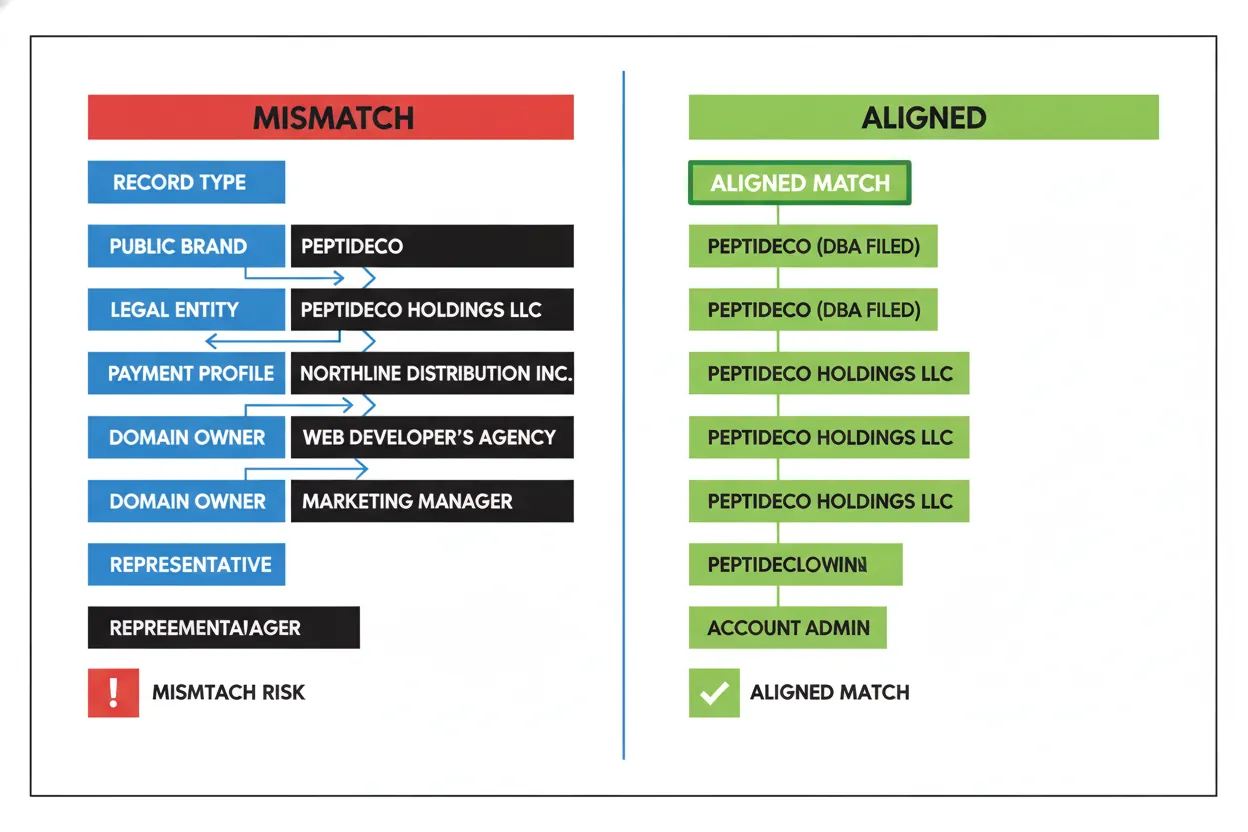
Build a one-page entity and DBA register before anything else. The illustrative comparison below shows the pattern that stalls submissions versus the pattern that survives review.
- Public brand. Common mismatch (illustrative): PeptideCo. Aligned: PeptideCo (DBA on file).
- Legal entity. Common mismatch (illustrative): PeptideCo Holdings LLC. Aligned: PeptideCo Holdings LLC.
- Payments profile name. Common mismatch (illustrative): Northline Distribution Inc. Aligned: PeptideCo Holdings LLC.
- Domain registrant. Common mismatch (illustrative): Web developer's agency account. Aligned: PeptideCo Holdings LLC.
- Representative. Common mismatch (illustrative): Marketing manager, no admin access. Aligned: Account admin named in the register.
This table is illustrative guidance for structuring your own audit, not a reproduction of any real account.
Confirm the payer of record and authorized admins
Identity verification has a named human in it. Google defines an authorized representative as an admin of the Google Ads account and/or the payments profile paying for the ads, and organizations may be required to supply both registration documents and that representative's government-issued photo ID (Google Ads document requirements). Only a Google Ads account admin can complete the required tasks (tasks required for advertiser verification).
That creates two practical failure points for peptide operators. First, the card on file belongs to a distributor, a founder's separate LLC or an agency, which means the payer of record is not the business you intend to verify. Second, the person who actually knows the entity history, usually the owner or the finance administrator, has standard access rather than admin access, so the submission waits on whoever happens to hold the login.
Fix both before you start. Build an authorized access inventory listing every user on the account, their access level, who controls the payments profile, and which named individual will provide identity documentation. Our approach to handling that information is described in the Marketing Powered security overview.
Check current requirements against your account circumstances
There is no single universal document list. Google states that required tasks vary depending on your account, billing setup and other factors, that your payments profile account type of individual or organization affects which tasks you receive, and that accounts paying by monthly invoicing may follow a different verification process (tasks required for advertiser verification). Review can take up to five business days, and in rare cases up to 30 days (tasks required for advertiser verification).
So check the live requirement page for your country and account type rather than reusing a checklist from a submission made last year. Acceptable U.S. organization registration documents currently include IRS-issued or IRS-stamped letters stating the organization name, a state certificate of incorporation, a recent SEC filing, or a business credit report from Experian, Equifax or TransUnion (Google Ads document requirements).
This is identity and documentation operations work, separate from campaign management. Marketing Powered's founder managed $1.5 to $2M per month in Google Ads across 11+ behavioral and mental health accounts and is a court-certified expert witness in advertising strategy, and the firm is built for Google's sensitive healthcare vertical, where retargeting is not permitted. For how we scope account management itself, see Google Ads agency: vetting criteria and deliverables.
Free Audit
Want a straight read on where your budget is leaking?
Resolve public inconsistencies in names, domains and assets
Sit down with six things open at once: the state registry filing, the payer details in billing, the domain registration record, the website footer and contact page, the business listing, and the invoice template your billing system sends. Read the business name on each one aloud. Most teams find at least one version nobody intended, often a legacy LLC name on the registrar record or an abbreviation on the site footer.
This matters directly for ad assets. Google states that if your business name does not exactly match either the domain name or the legal name verified through advertiser verification, the asset will not be approved, and the verified name is shown on the Account page in the Admin section (about business information).
Where you hold an active trademark registration for a different name or logo, there is a separate brand verification process for business information, which also covers sub-domains of a verified domain and multiple lines of business (about business information).
Correct the record truthfully rather than editing the ad to match a name nothing supports. The healthcare marketing compliance checklist covers the wider public-facing audit.

Handle documents through official routes only
Route sensitive material through the product, not through email threads or shared drives. Google directs advertisers to submit only the requested documents through the Ads interface rather than over email, and states that agencies or third parties should not upload documents for multiple advertisers in the same file (Google Ads document requirements).
The same page specifies that a government-issued photo ID must be unexpired and in color, that front and back are submitted separately when requested, that the image should be an original photo taken with the device camera rather than a photocopy or screenshot, and that digital IDs are not accepted.
Common rejection reasons listed by Google include an unverifiable document, a name mismatch, or an unsupported document type (Google Ads document requirements).
Keep three questions separate while you do this: whether the business operates lawfully, whether the products and any required certification status are in order, and whether the ad account identity is verified. Clearing one does not clear the others. Certification economics and sequencing are covered in LegitScript certification: cost, rules and timeline.
Maintain change control after entity or domain changes
Verification is a state, not a milestone, and peptide businesses change structure often: a new fulfillment partner, a new pharmacy affiliation, a second DBA for a product line, a move to a different billing address.
Give one person the register and a short trigger list. If the wrong organization was verified, or the name in the ad disclosure needs to change, an account admin can reset verification and verify again, and a new deadline is issued if one applied (change name or ownership).
A legal name change requires a document showing the name changed while the entity remained the same, and Google advises that the legal name and address in the payments profile exactly match the government-issued ID or business registration documents (change name or ownership).
Changing payments profile country or ownership requires contacting Google Ads support, and creating a new payment profile forfeits existing promotional credits (change name or ownership).
Questions, Answered.
For business name assets, Google requires an exact match to either the domain name or the legal name verified through advertiser verification, otherwise the asset is not approved. A trademark-based brand verification path exists for names or logos you hold an active registration for (about business information).
An admin on the Google Ads account, since only an account admin can complete the tasks (tasks required for advertiser verification). The identity document comes from an authorized representative, defined as an admin of the account and/or the payments profile paying for the ads (Google Ads document requirements).
No. A certification held by a pharmacy, lab or fulfillment partner describes that partner, not your legal entity or your ad account. Identity verification asks who the advertiser is; certification and product eligibility are assessed separately, and clearing one does not resolve the others.
No. Agencies managing ads for a client are instructed to answer yes to the agency question during verification, and failing to do so can result in the account being paused or suspended (tasks required for advertiser verification). Agencies also should not upload documents for multiple advertisers in one file (Google Ads document requirements).
Through the Ads interface only, using the requested document types, with images that meet the stated quality and format conditions. Google states that personal data and documents submitted for verification are not shared with third parties (Google Ads document requirements). Internally, limit who holds copies and record where each file lives. Assess advertiser identity readiness
More Resource Topics
Ready to see where your marketing can improve?
Request a free audit of your paid media, landing pages, attribution, and measurement setup. You'll get a straight assessment of where the opportunities are.
or email us at info@marketingpowered.ai