Resources
What the 2026 HHS Peptide Policy Means for Marketing
The 2026 HHS enforcement discretion policy is narrower than most of the copy already written about it. For teams making HHS peptide policy marketing decisions, the useful question is not what the policy allows a pharmacy to compound, but which existing claims it can support and which it was never about. This page separates the determinations that peptide advertising routinely collapses into one.
By Mike Hulick, Founder, Marketing Powered
What the 2026 HHS peptide policy actually says
HHS published a notice of availability for an "Enforcement Discretion Policy Regarding 503A Compounding Using Certain Peptide Bulk Drug Substances" in the Federal Register on October 30, 2026, under Docket No. HHS-OASH-2026-0496 (Federal Register notice, Vol. 91, No. 209).
The policy describes conditions under which HHS does not intend to take enforcement action against a state-licensed pharmacy, federal facility, or licensed physician compounding with a listed peptide bulk drug substance while the 503A bulks list is developed through rulemaking (HHS enforcement discretion policy).
Two sentences in the notice matter more to marketers than anything else in it. The draft policy "does not establish any rights for any person and is not binding on HHS or the public," and HHS may revisit the interim policy in whole or in part if a safety signal or product quality issue arises (Federal Register notice).
Written comments were accepted for two weeks after publication, so the underlying rulemaking is still open. Both documents above were retrieved and checked on November 22, 2026. Confirm current status before you publish anything that depends on it.

The narrow scope of this enforcement discretion
Appendix A lists six peptide bulk drug substances: BPC-157, Epitalon, KPV, MOTS-c, Semax and TB-500. Coverage is conditional on ten circumstances being present at once, including the specified identity and route of administration for each substance, bulk substance from a facility registered under section 510 with a valid certificate of analysis, original manufacturer verification, adverse event and product quality reporting, labeling that states "This is a compounded drug product.
Not for resale.", a single active pharmaceutical ingredient from Appendix A, a co-packaged delivery device limited to an FDA 510(k)-cleared syringe, and the section 503A patient-specific prescription requirement (HHS enforcement discretion policy).
Read that as a specification, not a permission slip. The conditions describe sourcing, documentation, formulation and dispensing, not efficacy, indications or outcomes. Nothing in the policy supports dosing content, treatment recommendations or a general statement that peptides are now allowed. Channel rules sit on top of all of it, which is why the copy question runs through platform policy as well as federal policy: Healthcare Advertising: Google and Meta Policy Guide.
Four determinations marketers keep collapsing into one
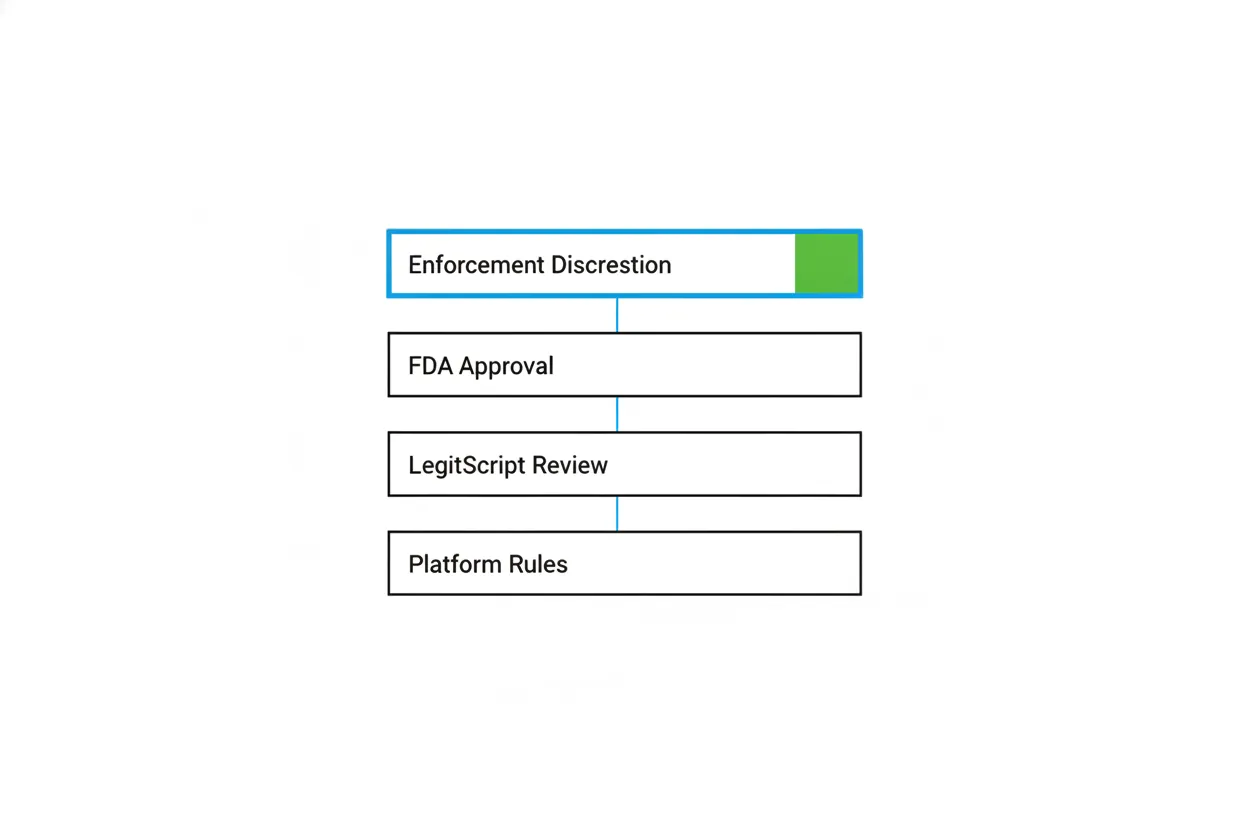
Enforcement discretion is a statement of prosecutorial intent. It is not legalization, approval, certification or ad eligibility, and each of those moves under a different authority on a different clock. Keeping them separate is the whole job.
- Enforcement discretion. Who decides: HHS. What it addresses: Whether HHS intends to act against specified 503A compounding. What it does not do: Does not approve a product or bind HHS or the public.
- FDA approval. Who decides: FDA. What it addresses: Premarket review of safety, effectiveness and quality. What it does not do: Compounded drugs are not FDA-approved.
- Certification. Who decides: LegitScript. What it addresses: Whether a merchant meets certification standards. What it does not do: Does not change platform or payment provider requirements.
- Channel eligibility. Who decides: Each ad platform and payment provider. What it addresses: Whether an account and its creative may run. What it does not do: Does not validate product status or compounding lawfulness.
Compounded drugs are not FDA-approved, which means FDA does not review their safety, effectiveness, or quality before they are marketed (HHS enforcement discretion policy). LegitScript updated its certification review approach effective November 2, 2026, and states that offering a covered peptide does not by itself establish eligibility (LegitScript). For how that review works in practice, see LegitScript Certification: Cost, Rules and Timeline.
Free Audit
Want a straight read on where your budget is leaking?
Marketing language that needs a line-by-line review
Pull every peptide-related asset into one place: product and service pages, landing pages, ad copy and extensions, intake scripts, email sequences, affiliate pages and provider bios. Then read each claim against the four determinations above. LegitScript advises reviewing labels, marketing and patient communications so they do not suggest that enforcement discretion means FDA approval (LegitScript).
Illustrative corrections, not an approved claim list:
- "FDA approved" or "now legal" becomes a factual description of the compounding pathway and its conditions.
- "HHS approved these peptides" becomes a reference to a conditional, interim enforcement policy with a date.
- Stacked or combination offers conflict with the single active pharmaceutical ingredient condition and should be re-examined before they are promoted.
- Route and form language should match the identity and route specified for that substance rather than a generic product category page.
- Safety and outcome language has no support in this policy, because the policy reviews none of it.
Treat the sweep as a documented pass with a reviewer and a date, not a copy edit. The sequencing is covered in the Healthcare Marketing Compliance Checklist.

Recheck every relationship and channel independently
One approval does not vouch for another. Confirm the facility type first, because 503B outsourcing facilities are not covered by this policy (LegitScript). Then confirm the substance form and route, the certificate of analysis and manufacturer registration, the prescription workflow, and the documentation your compounding partner can actually produce on request.
Only after that does the channel question make sense. LegitScript states that it does not control the policies of advertising platforms, payment processors, acquirers or card brands, that its updates do not change their independent requirements, and that platform implementation may take time and may not align with its own timeline (LegitScript). Verify each platform and payment relationship directly, in writing, with the effective date recorded.
Marketing Powered's founder managed $1.5 to $2M per month in Google Ads across 11+ behavioral and mental health accounts, work built for Google's sensitive healthcare vertical, where retargeting is not permitted. That background informs how we vet acquisition programs in restricted categories: Healthcare Marketing Agency: Vetting & Strategy Guide.
Build a change register, not a one-time edit
A live policy needs a live record. Name one internal owner for peptide policy monitoring, and give that person authority to pull copy. Keep a simple register with one row per claim: the claim text, where it appears, the source URL, the retrieval date, the reviewer who approved it, the next recheck date, and the retirement trigger that makes it false.
Set a recheck cadence of no more than 28 days, and run an additional check immediately before any campaign, landing page or offer launch.
Add triggers outside the calendar: any revision or withdrawal of the HHS policy, any movement in the 503A bulks list rulemaking, any certification standard update, and any platform or payment policy change. When a trigger fires, the owner retires affected claims first and rewrites second.
That order protects the account. The reverse order is how live assets outlive their evidence.
Related resources.
More Resource Topics
Ready to see where your marketing can improve?
Request a free audit of your paid media, landing pages, attribution, and measurement setup. You'll get a straight assessment of where the opportunities are.
or email us at info@marketingpowered.ai