Resources
Circumventing Systems: Remediation for Peptide Advertisers
A peptide Google Ads circumventing systems finding is a judgment about conduct, not a verdict on one ad. It says the platform believes someone tried to work around review or enforcement, and relaunching faster will not clear it. This guide explains what the policy actually covers, what a defensible correction looks like, and how to evaluate anyone offering to fix the situation for you.
By Mike Hulick, Founder, Marketing Powered

Read the actual finding before you respond to it
The first mistake is reading a circumvention notice as though it were a disapproval. A disapproval is an asset-level decision about one ad or one destination. A circumventing systems finding sits in a different category.
Google treats violations of this policy as egregious, meaning a violation serious enough to be unlawful or to cause significant harm, and accounts found in violation are suspended on detection without prior warning Google Ads policy: Circumventing systems.
The same page states plainly that the advertiser will not be permitted to advertise with Google Ads again unless an appeal succeeds.
That distinction changes who needs to be in the room. A disapproval is usually handled by whoever runs the account. A circumvention finding reaches ownership, finance and counsel, because it affects every entity connected to the business, not one campaign. The suspension email itself is the first document in your record.
Advertisers receive an in-account notification and an email that identifies all policies the account was suspended for violating, along with a link to submit an appeal Google Ads Help: account suspensions overview. Read the full list of named policies before assuming you know the cause. Circumvention is often cited alongside a product or destination policy, and those are separate problems requiring separate fixes.
It also helps to know what this policy is not used for. Accounts are not suspended under the circumventing systems policy for editorial disapprovals such as formatting problems or misspelled words Google Ads policy: Circumventing systems. Ordinary repeat violations run through a different track.
Repeated violations of certain policies move through a strike system in which no strike is issued for a first violation, the first and second strikes bring temporary account holds of three and seven days, and a third strike results in suspension Google Ads Help: account suspensions overview.
If your notice arrived with no warning and no strike history, that is consistent with an egregious category rather than an accumulation of small errors.
One more detail shapes the whole response. In deciding whether an advertiser or destination violates this policy, Google may review information from multiple sources including the ad, the website, accounts and third-party sources Google Ads policy: Circumventing systems. You are not rebutting one screenshot. You are answering a picture assembled from your whole operating footprint, which is why the correction has to start with knowing that footprint yourself.

Map account and domain history before you write anything
Before a single word of an appeal gets drafted, build an authorized account-relationship map. This is an internal evidence artifact, not a submission. It lists every Google Ads account ever associated with the business, the manager accounts above them, the login emails and the people who hold them, the billing instruments, the domains and subdomains each account promoted, agencies or contractors who had access, and the dates for each relationship. Add prior suspensions, prior appeals and the outcome of each.
This matters because peptide ad account association is how enforcement actually travels. Accounts related to a suspended account may themselves be suspended, and new accounts the advertiser creates may also be suspended, so Google recommends reinstating suspended accounts before attempting to create new ones Google Ads Help: account suspensions overview. The association logic can also work in your favor.
If an account was suspended because other accounts verified with the same identity documents were suspended, it is automatically reinstated once those other accounts are successfully appealed Google Ads Help: account suspensions overview. You cannot use that sequencing if you do not know which accounts share identity documents.
Two procedural points belong on the map. A separate appeal is submitted for each suspended account, and before appealing, all linked, previously linked and related accounts should comply with Google's policies Google Ads Help: account suspensions overview. An appeal filed while a sibling account is still running the same problem is an appeal that answers its own objection badly.
The policy page also describes the hygiene standard a clean structure should meet. Google's stated best practices include avoiding bulk account creation across different email addresses, connecting each advertising account to a real business, using trusted payment methods, resolving existing suspensions through successful reinstatement, and contacting the agency or third party that manages the account about the suspension Google Ads policy: Circumventing systems.
Most multi-entity advertisers accumulate accounts by accident rather than by design: a test account from a freelancer, a legacy account from a previous agency, a second account opened because billing broke. None of that is sinister, but unexplained, it looks like structure built to spread risk.
Our guidance on how an account relationship should be documented and audited is in the Google Ads agency vetting criteria and deliverables guide. Write the history down while you still have read access, since suspended accounts remain viewable but may become inaccessible after an extended period.
What the policy prohibits, described at policy level
Three named behaviors sit under this policy. Understanding them at a definitional level is necessary for Google Ads policy evasion remediation. Operational detail about how any of them is executed has no place in a remediation plan, and any vendor offering that detail is selling you the next suspension.
Cloaking. Cloaking means showing different content on your website to different people or to Google in order to hide things that might break the rules Google Ads policy: Circumventing systems. The boundary is clearer than most advertisers assume.
Showing slightly different content is acceptable, such as different languages, different special offers, or adjustments for geography or slower connections, as long as the promoted product or service is the same for everyone Google Ads policy: Circumventing systems. Variation in presentation is normal. Variation in what is actually being sold is the violation.
The policy also notes that an intrusive interstitial blocking most of a site's content can prevent Google from assessing the destination at all.
Multiple account abuse. This covers creating multiple accounts after a suspension to get around policies or to show content that breaks the rules, and the policy's examples include creating new websites or accounts to show ads similar to ones already disapproved, spreading violating ads across two or more accounts, and using several accounts to promote products or services for which the advertiser lacks the required certifications Google Ads policy: Circumventing systems.
That last example is the one peptide and compounded-product advertisers most often trip, because certification eligibility and account structure get treated as separate projects by separate teams.
Verification falsification. Providing false or fraudulent information as part of advertiser verification is prohibited, and doing so means losing verified status and having the account suspended Google Ads policy: Circumventing systems. The stated rationale is that hidden advertiser identity prevents users from making informed choices.
A fourth pattern is worth naming because it is the one people rationalize: bypassing enforcement by creating variations of ads, domains or content that have been disapproved Google Ads policy: Circumventing systems. Rebuilding a disapproved page at a new URL with different wording is not a fix.
Broader platform context for regulated categories is in our healthcare advertising policy guide. Keep three questions separate as you work: whether the business operates lawfully, whether the product is eligible to be advertised, and whether the account conduct was compliant. They have different answers and different remedies.
Free Audit
Want a straight read on where your budget is leaking?
Correct the problem transparently across every public destination
Transparent correction is tedious, which is why vendors sell shortcuts instead. The work is a side-by-side reconciliation of what a crawler can retrieve, what a reviewer sees, and what a customer sees, for every destination you intend to advertise.
A practical version looks like this. Marketing, web development and whoever owns regulatory review sit together with a list of every landing page, redirect, click tracker and subdomain in use. For each destination, the team pulls the live page, the crawler-accessible version, and the page as served from a different region and device.
Any difference in promoted product, claim, price or offer gets written into a single sheet with an owner and a resolution date. Differences in language or formatting stay. Differences in substance get eliminated. The resulting document is a public-content consistency check, and it is more persuasive than any appeal narrative, because it describes conditions a reviewer can confirm independently.
The policy's own best practices point at the same work: serve policy-compliant content rather than sending people to content that violates policy while showing Google something different, make sure Google can easily find all pages on the site, use a click tracker certified by Google, and run a security check because sites can be hacked and cloaking content added without the owner's knowledge Google Ads policy: Circumventing systems.
That last point is not an excuse to reach for. It is a real diagnostic path for advertisers who genuinely did not configure the behavior they are accused of, and it produces checkable artifacts: scan results, server logs, change tickets.
Then there is the harder part. Consistency only helps if the single consistent version is one you can actually advertise. For peptide and compounded-product advertisers, that usually means removing human-use positioning from products that are not presented that way to regulators, removing outcome claims the evidence does not support, separating clinical content from commerce, and making the identity of the selling entity obvious on the page.
If the only version of the offer that passes review is a version the business cannot operate profitably, that is information worth having before you spend money on recovery, not after. Our healthcare marketing compliance checklist is a working framework for that pass.
The honest test is simple: if the reviewer, the customer and a regulator all read the same page, does your answer change?

Prepare the factual record of what changed and when
A regulated advertiser circumventing systems appeal is an evidence exercise, not a persuasion exercise. The record you assemble should let a stranger reconstruct what happened without trusting your adjectives.
Build an action chronology. Each row carries a date, the specific change made, the system it was made in, the person who made it, and the artifact that proves it. Account closed or reinstated. Redirect removed. Landing page replaced. Agency access revoked. Certification applied for. Keep the entries factual and avoid characterizing intent you cannot document. Then add a short section describing what remains unresolved, because unresolved items stated openly are far less damaging than unresolved items discovered later.
Identity documentation has its own standard. If asked for a government-issued photo ID, registration or license, the information must be accurate and unmodified, and business documents must be accurate with only proprietary or personal information hidden or edited Google Ads policy: Circumventing systems. Verification attempts are finite.
Certain advertisers must complete advertiser verification successfully in order to appeal a suspension, and if identity cannot be verified after three attempts, they will not be allowed to appeal Google Ads Help: account suspensions overview. Assemble documents before you start, not between attempts.
Know the submission mechanics too. The appeal is filed through the Contact Us link in the account notification, the account shows an appeal pending status while it is processed, the outcome arrives by email, and a rejected appeal can be re-appealed through the same process Google Ads Help: account suspensions overview.
Volume is counterproductive. Filing too many appeals for the same suspension may mean they are not processed, and indications of appeals misuse can lead to a seven-day pause on processing certain appeals Google Ads Help: account suspensions overview.
There is time to do this properly: advertisers have at least six months from the date of suspension to submit an appeal Google Ads Help: account suspensions overview. Use the weeks. A thorough first submission beats four rushed ones.
Where third-party certification applies to your product category, treat it as a separate workstream with its own timeline, documented in the chronology as applied, pending or granted rather than implied. Cost, rules and sequencing are covered in our LegitScript certification guide.
Legal, clinical and regulatory conclusions in this record should be reviewed by qualified counsel before submission. Marketing Powered operates with a LegitScript-aware and HIPAA-aware posture and is built for Google's sensitive healthcare vertical, where retargeting is not permitted, and that posture informs how we document, not whether we certify anything.
Evaluate the provider before paying for account recovery
This is where buyers lose the most money. Under revenue pressure, a suspended advertiser account review gets outsourced to whoever answers the phone first with confidence. A useful hypothesis, not a measured statistic: growth-stage regulated advertisers are disproportionately likely to hire recovery help from vendors they have not vetted, precisely because the suspension removed the revenue that funds careful vetting.
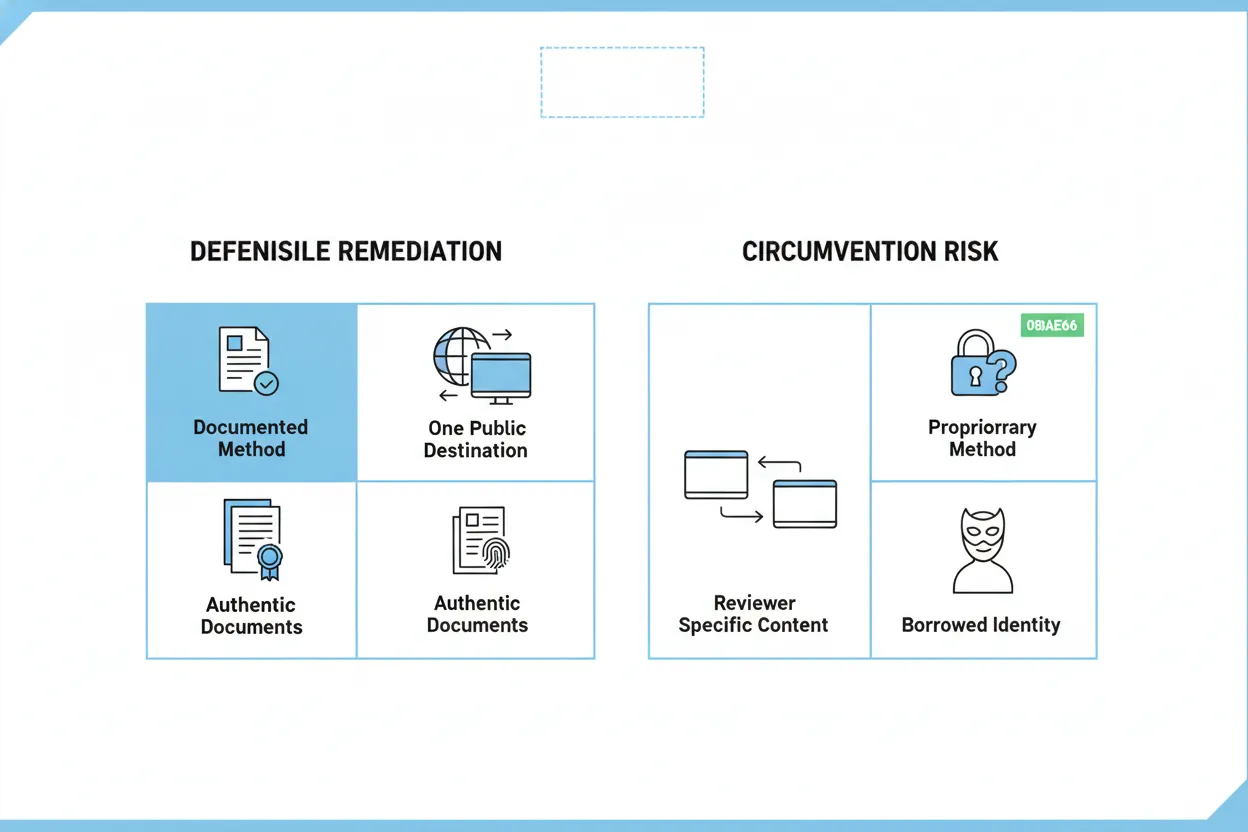
The following comparison is illustrative, built from the prohibited-practice categories in the policy and from the documentation a defensible correction produces. It is a decision aid, not a scoring system.
- "We can promise reinstatement". What it usually means: The vendor is claiming authority over a decision it does not control. Defensible alternative: A written assessment of what is correctable, what is not, and what the realistic range of outcomes is.
- "We have aged accounts ready to go". What it usually means: Account creation or borrowed identity after a suspension decision. Defensible alternative: Reinstatement of the accounts you actually own, in sequence.
- "We handle the review page separately". What it usually means: Content shown to reviewers differing from public content. Defensible alternative: One public destination that both reviewer and customer see.
- "Use our entity on the verification". What it usually means: Verification submitted under an identity that is not the advertiser. Defensible alternative: Authentic, unmodified documents for the real operating entity.
- "Just move to a fresh domain". What it usually means: Variation of disapproved content under a new URL. Defensible alternative: Resolution of the underlying claim, offer or eligibility problem.
- "Our method is proprietary". What it usually means: The method cannot survive being described in writing. Defensible alternative: A documented method, named steps, and artifacts you keep.
Three refusals are worth stating directly. Marketing Powered does not promise reinstatement, because accounts are only reinstated in compelling circumstances, such as a mistake Google Ads Help: account suspensions overview. We do not advertise through accounts or identities belonging to someone else. We do not build reviewer-specific content. A vendor that will not put its methodology in writing is asking you to accept enforcement risk you cannot inspect.
Ask for the practitioner's actual history, not the firm's adjectives. Our founder managed $1.5 to $2M per month in Google Ads across 11+ behavioral and mental health accounts and is a court-certified expert witness in advertising strategy, which informs how evidence gets assembled here, though nothing on this page is legal advice. For related context, see our healthcare marketing agency vetting and strategy guide, our approach to healthcare paid media, search, social and attribution, and our security overview.
Email Us
Prefer to send the context directly?
Questions buyers ask after a circumvention notice
Can a suspended advertiser open another account?
Opening a replacement account to continue advertising is the behavior the policy targets. Creating new accounts to re-enter the system after a previous suspension decision is listed as prohibited conduct Google Ads policy: Circumventing systems, and new accounts an affected advertiser creates may also be suspended, with the recommendation to reinstate suspended accounts first Google Ads Help: account suspensions overview. The correct sequence is appeal first, then rebuild.
Is different reviewer content acceptable?
Not when the difference is substantive. Presentation differences such as language, special offers, geography or connection speed are acceptable provided the promoted product or service is the same for everyone Google Ads policy: Circumventing systems. The useful internal test is whether a difference exists to serve the user or to change what a reviewer concludes about the offer.
Can changing domains erase the underlying problem?
No. Creating variations of ads, domains or content that have been disapproved is itself listed as circumvention Google Ads policy: Circumventing systems. A new domain changes the address of the problem. It also adds a new fact to the enforcement picture, since review draws on ads, accounts, websites, content, user complaints, consumer reviews, regulatory warnings and rulings, and other third-party sources Google Ads Help: account suspensions overview.
What does a genuine correction record contain?
An account-relationship map, a public-content consistency check for every destination, a dated action chronology with named owners and supporting artifacts, authentic verification documents, and an explicit list of what is still unresolved. It should also explain the circumstances plainly, which is what the policy asks for when it directs advertisers to describe why different content was shown, or why multiple accounts exist and how prior suspensions were resolved.
How should a recovery vendor be evaluated?
Ask for the method in writing, ask what they will refuse to do, ask who performs the work, and ask what happens if the appeal is rejected. Decline promised reinstatement, borrowed accounts and reviewer-only content. Then ask the business question underneath: if the compliant version of this offer is the only version you can run, does the acquisition math still work? That answer determines whether recovery is worth funding at all.
More Resource Topics
Ready to see where your marketing can improve?
Request a free audit of your paid media, landing pages, attribution, and measurement setup. You'll get a straight assessment of where the opportunities are.
or email us at info@marketingpowered.ai