Resources
Local Service Ads: Who Should Use Them and How to Manage Lead Disputes
Local service ads move the billing event from the click to the phone call, which sounds like progress until you count how many of those calls never reach a booking, a consult or an admission. The format rewards organizations that answer the phone, collect real reviews and review lead quality on a schedule. It punishes the ones that treat it as a set-and-forget channel.
By Mike Hulick, Founder, Marketing Powered

What local service ads are and where they appear
Google Local Services Ads are profile listings that typically sit at the top of a local search result, above standard search ads. A searcher looking for an emergency electrician, an estate planning attorney or an urgent care clinic sees a small set of provider cards rather than headlines and landing page links. Each card carries the business name, a star rating, a review count, a verification badge and a direct way to make contact by call, message or booking.
The commercial model is the real difference. In a standard search campaign you buy clicks and hope the landing page converts them.
In Local Services, the amount you set is the maximum you are willing to pay for a lead, and you may end up paying less (Google: About ad rankings). That changes what your marketing team has to be good at.
Instead of optimizing a page, you are managing an intake desk, because the charge happens at the moment a person reaches you.
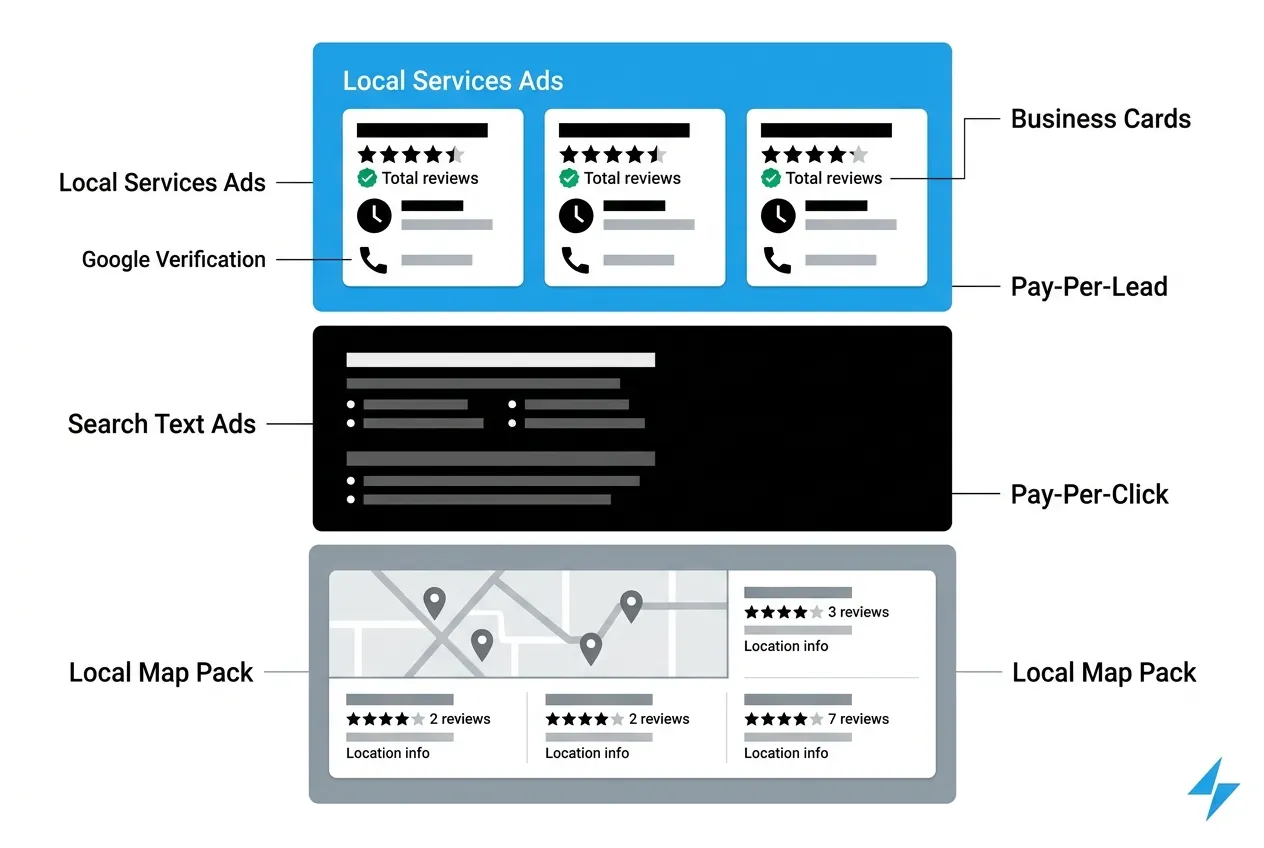
How Google ranks local service ads
Rank is not a reward for a tidy profile alone. Listings are displayed and ranked through an auction that takes into account bid and overall profile quality. The inputs Google names are specific and operationally useful:
- Likelihood the ad produces a lead, which includes your responsiveness to customer inquiries, where missed calls may negatively affect that responsiveness.
- Search context and relevance, including the service a customer is searching for, the time of the search, location, and how relevant your business and bio are to that search.
- Contact methods enabled. Turning on message or booking leads gives customers more ways to reach you, which can increase the likelihood of receiving a lead, particularly at night and on weekends when nobody can answer the phone.
- Profile quality, which Google describes as your rating, number of reviews, average response time, use of high-quality images and the verification checks you have completed.
Two points matter more than the rest for anyone running multiple sites. First, higher quality profiles, including those with images, may rank higher and may also pay lower costs per lead, so profile work is a cost lever, not a cosmetic one.
Second, if your business has multiple locations serving the same geographic area, Local Services shows only the highest ranking ad for a user's query. Clinics and firms that stacked locations in one metro to win more map visibility do not get the same stacking benefit here.
Reviews feed that profile quality score, and they have to be real. Google's contributor rules prohibit fake engagement, incentives and review gating (Google: Prohibited and restricted content). A review program built on quotas or filtered feedback is a liability, not a ranking tactic.
Who should run lsa ads, and who should not
Eligibility is the first filter and it is narrower than most buyers expect. Availability depends on your category and your location, and requirements can include licensing, insurance and background screening. Check Google's own criteria for your market rather than an agency summary (Google: How providers qualify for Local Services Ads) and its screening and verification requirements.
Google Guaranteed and Google Screened badges
Verified providers display a badge on the profile card, and which badge applies depends on the category you are approved for. Treat the badge as a trust signal that shortens consumer hesitation, not as a performance promise. It does not fix a weak intake process, and it does not change what Google charges you for a lead.
Three types of organization should think twice. Those without staffed phone coverage during search hours, because missed calls may negatively affect responsiveness, which feeds ranking. Those whose demand is regional or referral-driven rather than local and immediate. And those in healthcare categories where availability is unclear in their state or metro. In regulated health marketing, assume nothing about eligibility or policy and confirm it before you build a plan around it.
Free Audit
Want a straight read on where your budget is leaking?
What local services ads cost, and how bidding works
There is no published benchmark price that will tell you what a lead will cost in your category and city. Cost moves with category, local competition and the quality signals above, and the only honest source of your number is your own account.
What you can control is the bidding and budget setup. Google recommends setting bid mode to "Maximize Leads", which lets Google set the bid to get the most leads for your budget, noting that providers with equivalent quality and budgets who use it typically get more leads than those who do not.
A manual ceiling gives you margin protection and costs you auction entries. Pick deliberately, write down why, and revisit the choice when your intake capacity changes rather than when a dashboard nudges you.
Here is the arithmetic that should drive the decision, using illustrative numbers rather than benchmark data. If a search campaign costs you a given amount per click and one in ten clicks produces a phone call, your true cost per call is ten times the click price.
Compare that against the Local Services cost per lead in the same market, then adjust both for the share of contacts that become booked appointments. A channel that delivers cheaper contacts and worse contacts is not cheaper. That comparison only works if you track beyond the lead to the consult or admission.

Lead quality, credits and the weekly review that pays for itself
Pay-per-lead accounts bleed money quietly. The calls that cost you are the wrong numbers, the sales solicitations, the job seekers and the people outside your service area, and they look identical to good leads on a spend report.
Build a routine rather than a reaction. Someone with intake context, usually the front desk supervisor rather than the media buyer, works through the lead inbox on a fixed cadence, listens to the recordings, marks which contacts were genuine prospects and flags the invalid ones through whatever options Google currently offers in the account.
Keep a short written reason for each flagged lead. That log does two things: it supports the credit request, and it tells you whether the problem is Google's targeting or your own category and service area settings. Repeated out-of-area calls usually mean your service boundary is wrong, not that the platform is broken.
Credit handling has changed, and Google now documents an automated approach (Google: About Automated Local Services Ads lead credits), alongside its guidance on how leads work. Read the current pages before you write an internal process document, and expect the mechanics to shift again. What does not shift is the principle: a lead that was never a prospect is a billing question, while a lead that chose a competitor is a sales question.
Why LSAs do not replace your search campaigns
Local Services captures category-level, ready-now demand. It does not let you write the ad, build the landing page or bid on the long-tail queries where considered decisions actually start, such as a specific procedure, a condition, a credential or a comparison between providers. Run it as a capture layer on top of structured search campaigns and a maintained Business Profile, not as a substitute for them.
Packaging is also in motion. Google has published help documentation on Local Services Ads transitioning to Performance Max campaigns with pay-per-lead goals, which means media leaders should expect the surface, the reporting and the controls to change inside Google Ads.
Plan your measurement so it survives that, which means your own call tracking, CRM stages and downstream reporting rather than a platform screenshot. For the wider structure, see our pillar guidance on healthcare PPC and structuring paid search for qualified patient demand, and our guides on vetting healthcare PPC services and vetting a Google Ads agency.

Email Us
Prefer to send the context directly?
How Marketing Powered works in regulated paid media
Marketing Powered is led by a former healthcare CMO who ran marketing for a treatment network that grew from 3 to 24 locations and managed $1.5 to $2M per month in Google Ads across 11+ behavioral and mental health accounts. The founder is a court-certified expert witness in advertising strategy, which is a useful discipline here: claims have to hold up under questioning.
Our Google and Meta paid media management work focuses on tying spend to admissions and consultations rather than lead counts, on reviewing lead quality inside the account, and on building campaigns for Google's sensitive healthcare vertical, where retargeting is not permitted and first-touch capture carries the weight. We are LegitScript-aware and HIPAA-aware, and our AI infrastructure is owned and local, built for HIPAA-aware inference.
More Resource Topics
Ready to see where your marketing can improve?
Request a free audit of your paid media, landing pages, attribution, and measurement setup. You'll get a straight assessment of where the opportunities are.
or email us at info@marketingpowered.ai