Resources
Patient Acquisition: Channels, Costs, and the Metrics That Matter
Sustainable patient acquisition requires healthcare organizations to bridge the operational divide between digital media investment and completed clinical appointments. For hospital systems, specialty provider groups, and regional clinical networks, generating raw inquiry volume without closed-loop conversion tracking consistently inflates overhead while leaving facility capacity underutilized. Establishing an accountable acquisition engine demands rigorous cost accounting, alignment with clinical schedules, and absolute compliance with regulatory privacy frameworks.
By Mike Hulick, Founder, Marketing Powered

The Modern Patient Acquisition Funnel: From Search Intent to Clinical Intake

What Is Patient Acquisition in Regulated Healthcare?
Patient acquisition is the comprehensive clinical, operational, and commercial workflow of identifying, educating, converting, and onboarding a new individual into an ongoing care relationship. While consumer e-commerce focuses on immediate transactional checkout, healthcare patient acquisition operates within clinical urgency, geographic constraints, strict insurance network alignments, and provider capacity boundaries.
The primary regulatory reality governing modern healthcare acquisition is patient data privacy. Under federal oversight, digital marketers cannot deploy standard consumer tracking mechanisms across digital intake environments. Guidance from the HHS Office for Civil Rights establishes that third-party tracking technologies, such as common advertising pixels, cannot capture or transmit protected health information (PHI) or unauthenticated user interactions that reveal clinical intent without appropriate safeguards.
Simultaneously, major media networks enforce strict policy boundaries around medical search. Under Google's Personalized Advertising Policies, advertisers cannot deploy remarketing lists or build retargeting audiences based on sensitive health categories, chronic conditions, mental health status, or specific medical procedures.
Because healthcare marketers cannot lean on automated retargeting funnels to recapture abandoned web visits, campaigns must be engineered for first-interaction conversion. The messaging, site speed, clinical credentialing, insurance clarity, and scheduling pathway must provide complete clarity immediately. Acquisition fails when organizations treat healthcare promotion like retail lead generation, relying on top-of-funnel traffic spikes while ignoring the privacy rules and direct operational handoffs required to turn a search query into an attended clinical encounter.
A functional patient acquisition funnel tracks the complete path from initial clinical problem awareness to the physical or virtual clinical visit. Treating web forms as the terminal conversion point creates an inaccurate assessment of pipeline health.
Top of the Funnel: Active Search and Condition Awareness
Patients rarely enter a clinical funnel out of casual curiosity. The journey begins with acute symptoms, a new diagnosis, a physician referral, or geographic relocation. Queries split into unbranded symptom searches, specialty provider queries, and branded provider research. Because platform policies limit re-engagement, top-funnel touchpoints must establish organizational authority, transparent accepted insurance listings, and immediate geographic accessibility.
Middle of the Funnel: Provider Credentialing and Operational Fit
Once an individual identifies a facility, the evaluation shifts from clinical capability to operational viability. Patients evaluate board certifications, physician biographies, facility accreditations, and patient reviews. More critically, they evaluate logistical friction: Which facility location has immediate availability? Does the provider accept their specific payer tier? Is parking accessible, or is telehealth offered? Unclear insurance information at this stage produces significant abandonment.
Bottom of the Funnel: Intake and Scheduling Routing
The bottom of the funnel is purely operational. It comprises two primary mechanisms: centralized call centers and direct digital self-scheduling engines. If a prospective patient calls a central scheduling line and encounters a three-minute hold, a disconnected interactive voice response (IVR) tree, or a representative unfamiliar with specialty intake, the media investment spent generating that call is lost.
Post-Funnel: The Attended Clinical Encounter
The final conversion event in healthcare is never a form submission or an inbound phone call. It is the attended encounter, whether that is an outpatient clinic check-in, an inpatient admission, or a completed telehealth appointment. Attribution tracked to admission, not just lead, ensures marketing budgets reflect actual organizational revenue.
High-Yield Channels for New Patient Marketing
Balancing media investment across service lines requires deploying channels that match the urgency and commercial value of specific clinical specialties. A comprehensive patient acquisition strategy incorporates four core channels.
High-Intent Paid Search
Paid search via Google Ads remains the most reliable digital driver for acute and planned clinical needs. When a patient searches for an orthopedic spine specialist or an intensive behavioral health facility, intent is immediate. To succeed within Google's sensitive healthcare vertical, campaigns must rely on granular exact-match and phrase-match structures combined with exhaustive negative keyword lists. This prevents wasted budget on non-converting clinical terms, academic medical research, or out-of-network Medicaid and Medicare queries when treating facilities do not accept those payers.
Local Search Architecture and Google Business Profiles
For multi-location health systems, local organic search drives the highest-converting call volume. Each clinical location and individual credentialed provider requires an optimized, actively managed Google Business Profile (GBP). Structuring accurate National Provider Identifier (NPI) records, correct primary categories, localized phone routing, and clean schema markup ensures local facilities capture map-pack visibility when nearby users search for emergency, primary care, or urgent care services.
Conversion-Centric Organic Content
Clinical content marketing fails when it acts solely as an encyclopedia of diseases. Effective educational content answers specific commercial and practical considerations: treatment timelines, surgical recovery expectations, what to expect during an initial evaluation, and out-of-pocket payment explanations. Content must connect directly to relevant medical staff bios and immediate scheduling options.
Referral and Provider Alignment Networks
Digital channels should reinforce traditional physician liaison efforts. Providing clear digital intake pathways, dedicated provider-to-provider consultation lines, and rapid documentation turnaround ensures regional primary care physicians can direct complex specialty cases to hospital service lines without administrative delay.
Free Audit
Want a straight read on where your budget is leaking?
What Is Patient Acquisition Cost and How to Calculate It Accurately
A central search query for healthcare marketing executives is how to calculate patient acquisition cost accurately. Many internal marketing reports understate acquisition costs by calculating simple Cost Per Lead (CPL): dividing direct media spend by the number of digital form fills or phone calls.
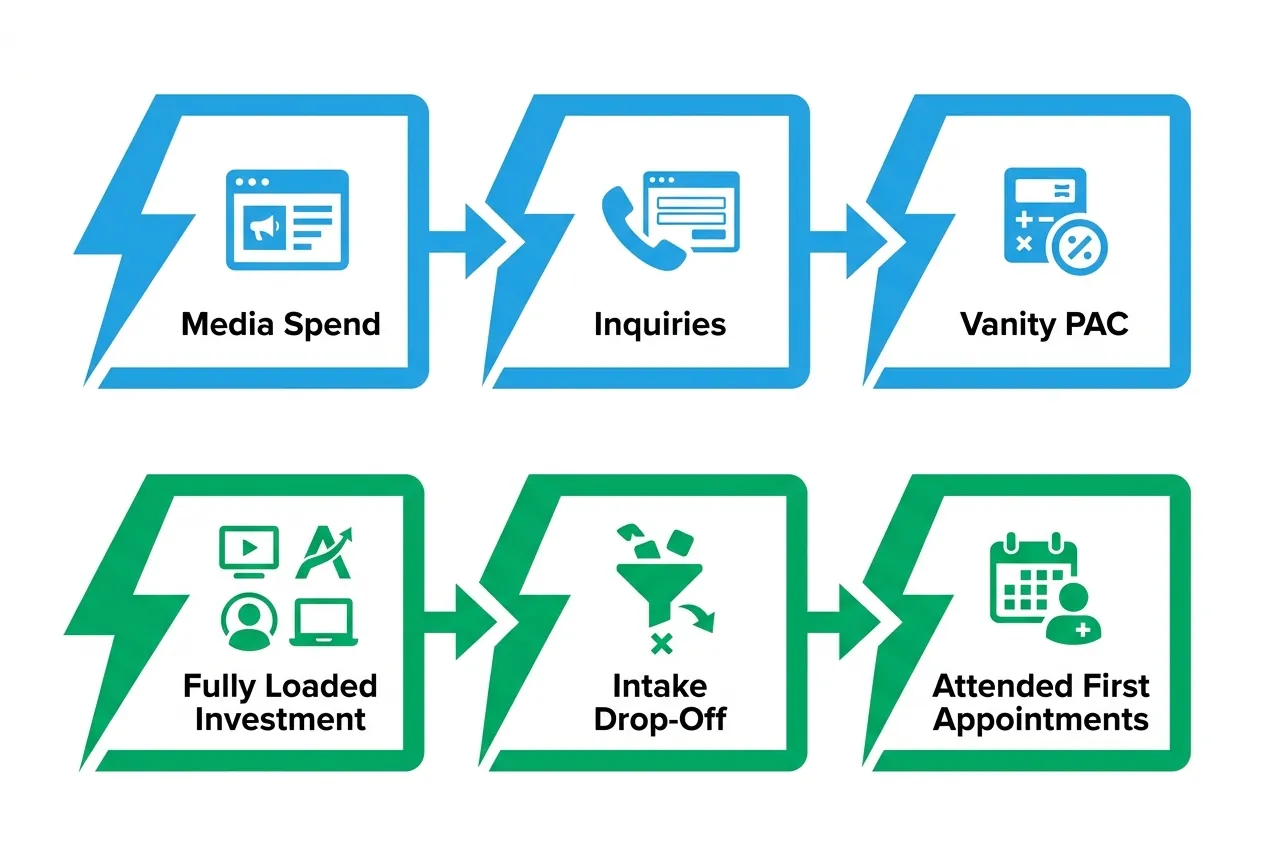
This creates a distorted view of marketing efficiency. A campaign can generate inquiries at $40 each, but if intake staff only converts 10% into scheduled appointments, and 30% of those scheduled patients fail to show up, the actual economic acquisition cost is drastically higher.
Patient acquisition cost must reflect the total fully loaded investment required to generate an attended clinical visit or verified admission:
Patient Acquisition Cost (PAC) = (Media Spend + Agency Fees + Attributed Intake Overhead + Direct MarTech Cost) ÷ (Attended First Appointments or Verified Admissions)
Consider an illustrative comparative scenario for a specialty service line over a single quarter:
- Direct Media Spend. Shallow Lead Model: $60,000. True Operational PAC Model: $60,000.
- Agency & Technical Overhead. Shallow Lead Model: Not Included ($0). True Operational PAC Model: $15,000.
- Allocated Intake & Call Center Cost. Shallow Lead Model: Not Included ($0). True Operational PAC Model: $10,000.
- Total Acquisition Investment. Shallow Lead Model: $60,000. True Operational PAC Model: $85,000.
- Gross Inquiries (Calls + Forms). Shallow Lead Model: 600. True Operational PAC Model: 600.
- Cost Per Inquiry / CPL. Shallow Lead Model: $100. True Operational PAC Model: $141.67.
- Operational Intake Drop-Off (Unqualified/Lost). Shallow Lead Model: Ignored. True Operational PAC Model: 360 Inquiries (60%).
- Scheduled Appointments. Shallow Lead Model: 300 (Assumed). True Operational PAC Model: 240 Inquiries (40%).
- Appointment No-Show / Cancellation Rate. Shallow Lead Model: Ignored (0%). True Operational PAC Model: 25% (60 Patients).
- Attended First Encounters / Admissions. Shallow Lead Model: 300 (Projected). True Operational PAC Model: 180 (Actual).
- Calculated Acquisition Cost. Shallow Lead Model: $200 (Vanity PAC). True Operational PAC Model: $472.22 (Real PAC).
In this scenario, relying on top-of-funnel lead reporting obscures the real unit economics. The true acquisition cost is more than double the vanity projection. Executive teams must evaluate performance against attended clinical encounters to understand whether their payer mix and reimbursement rates yield a positive return on investment.
Metrics That Matter: Moving Beyond Vanity Indicators to Revenue Alignment
To maintain financial control across multi-facility networks, marketing leadership must establish measurement frameworks centered on operational accountability. Metrics fall into three categories:
Top-Funnel Efficiency Metrics
- Conversion Value per Cost: Focusing paid media bid strategies on conversion value per cost rather than vanity click volume ensures algorithms prioritize search queries showing higher commercial qualification.
- Search Impression Share on Core Branded and High-Intent Specialty Terms: Maintaining dominant visibility on proprietary provider names and core regional procedures prevents competing networks from diverting brand equity.
Operational Conversion Metrics
- Intake Contact Rate: The percentage of digital web leads or raw inbound calls that result in a live, two-way diagnostic conversation with an intake specialist.
- Inquiry-to-Scheduled-Appointment Rate: The efficiency with which the administrative or call center team verifies insurance eligibility and books an open slot in the scheduling system.
- No-Show and Early Cancellation Rate: The proportion of scheduled patients who fail to attend their initial visit. High no-show rates point to scheduling friction, long lag times between inquiry and appointment date, or poor pre-visit reminder communication.
Commercial and Revenue Metrics
- Attended Encounter Acquisition Cost: The fully loaded cost to place an individual into a physical clinic room or telehealth session.
- Target Payer Mix Percentage: The proportion of acquired encounters matching the organization's commercial contracting priorities. Generating high patient volume that falls entirely into non-contracted payers strains clinical staff without supporting revenue goals.
- Downstream Clinical Contribution Margin: In hospital systems, the initial encounter often represents only the gateway to secondary procedures, imaging, surgical interventions, or ongoing disease management. Evaluating marketing investments alongside lifetime service-line contribution reveals the true business impact of patient acquisition.
Identifying and Fixing Friction Across Multi-Facility Intake
The greatest point of failure in patient acquisition is rarely campaign creative or keyword targeting; it is administrative friction inside the intake pathway. When multi-location networks scale, organizational complexity often degrades the patient booking experience.
Disconnected Regional Call Routing
When a prospective patient clicks a local paid search ad for an outpatient facility, they expect to reach staff familiar with that clinic. Too often, calls route to an unspecialized central call center where agents cannot see immediate local calendar availability. Implementing localized call tracking and intelligent dynamic routing ensures inquiries reach intake teams trained on specific service lines and facility schedules.
Protracted Scheduling Delays
Clinical demand decays rapidly over time. If a patient seeking a specialist appointment must wait three weeks for an opening, cancellation and no-show rates climb significantly. Intake systems should prioritize rapid digital self-scheduling for non-complex appointments, alongside automated waitlist backfilling to reallocate cancelled slots to incoming inquiries immediately.
Asynchronous Data Silos
Marketing reporting platforms, call center telephony systems, and electronic health records (EHR) frequently operate without communication. Marketing teams celebrate low cost-per-lead numbers while clinic administrators struggle with empty appointment slots. Bridging this operational disconnect requires regular data synchronization: integrating call-center disposition tracking with scheduling data to identify which campaigns yield attended clinical encounters.

Email Us
Prefer to send the context directly?
How Marketing Powered Structures Accountable Patient Acquisition
Marketing Powered operates as an accountable partner to health systems, hospitals, and specialty medical groups seeking measurable growth. We structure patient acquisition as an operational discipline rather than an isolated creative exercise, connecting demand generation to verifiable clinical appointments.
Our healthcare marketing execution focuses on key operating realities:
- Specialized Paid Search Management: With direct operator experience managing $1.5 to $2M per month in Google Ads across 11+ behavioral and mental health accounts, our campaigns are engineered specifically for Google's sensitive healthcare vertical, where retargeting is not permitted.
- LegitScript and Regulatory Awareness: We build acquisition engines that navigate strict platform policies and compliance standards, avoiding account suspensions while capturing high-value clinical demand.
- Closed-Loop Attribution: We connect marketing touches, call recording metadata, and CRM workflows so attribution is tracked to admission and attended appointments, not just raw leads.
- Privacy-Safe Technical Infrastructure: Marketing Powered utilizes owned, local AI infrastructure for HIPAA-aware inference, ensuring operational workflows adhere to data sovereignty standards without exposing internal operational assets to external models.
- Multi-Location Operational Alignment: We align paid search, technical local SEO, and conversion optimization to match physical provider capacity across service lines and regions.
To review our structural approach to healthcare growth across hospitals, health systems, and provider groups, explore our comprehensive framework in Healthcare marketing: the operating guide for health systems and provider groups.
For organizations evaluating external support models, understand capabilities and vetting requirements through our guide on Healthcare marketing agency: what to expect and how to choose one, or learn how to assess institutional partners in Hospital marketing company: what a specialist partner delivers and how to vet one.
To explore our dedicated service offerings for clinical networks, visit our Healthcare and hospital marketing programs page.
Questions, Answered.
Patient acquisition is the strategic and operational process of attracting, qualifying, scheduling, and onboarding a new patient into a healthcare network. Unlike basic lead generation, true patient acquisition measures success by attended clinical appointments, verified admissions, and completed procedures rather than digital form submissions or raw phone clicks.
Accurate patient acquisition cost (PAC) is calculated by dividing total acquisition expenses by the number of attended first appointments or verified admissions. Total expenses must include direct media spend, agency management fees, allocated intake and call center overhead, and marketing technology costs. Evaluating media spend solely against raw web leads generates an incomplete figure that ignores operational drop-offs.
Major advertising platforms enforce strict privacy rules regarding medical marketing. Under Google's personalized advertising policies, advertisers are prohibited from deploying retargeting lists or tracking cookies based on personal health conditions, medical treatments, or clinical categories. Additionally, HHS guidelines restrict the use of third-party tracking pixels on platforms that handle protected health information without appropriate safeguards.
After initial acquisition and the completed first clinical encounter, the operational focus shifts to retention, care plan adherence, and patient loyalty. This includes automated follow-up communication, transparent billing processes, coordinated referral loops for secondary specialty care, and proactive satisfaction measurement to encourage ongoing engagement within the health system.
Intake friction occurs when prospective patients encounter long hold times, delayed scheduling callbacks, insurance ambiguity, or complex intake forms. When prospective patients drop out between the initial inquiry and the scheduled appointment, the marketing dollars spent driving that initial interaction are wasted, which directly increases the fully loaded acquisition cost for each attended patient. Request a healthcare marketing assessment from Marketing Powered
Ready to see where your marketing can improve?
Request a free audit of your paid media, landing pages, attribution, and measurement setup. You'll get a straight assessment of where the opportunities are.
or email us at info@marketingpowered.ai