Resources
What Is HIPAA Marketing? A Plain-Language Guide for Healthcare Leaders
Under federal privacy rules, what is hipaa marketing comes down to any communication by a covered entity or business associate that encourages recipients to purchase or use a service, unless a specific statutory exception applies. When promotional efforts involve protected health information, organizations must secure explicit individual authorization before using or disclosing that data. For healthcare executives, managing this requirement means establishing operational infrastructure that protects patient data without sacrificing digital measurement.
By Mike Hulick, Founder, Marketing Powered

The Core HIPAA Marketing Requirements for Healthcare Growth

What Does HIPAA Say About Marketing Communications?
Under the Privacy Rule established by the U.S. Department of Health and Human Services (HHS), a hipaa marketing communication is defined under 45 CFR § 164.501 as any communication about a product or service that encourages recipients to purchase or use that product or service. The baseline statutory standard is straightforward: a covered entity or business associate may not use or disclose protected health information (PHI) for marketing purposes without a signed, valid HIPAA authorization from the individual.
There are specific statutory exclusions where communications are not classified as marketing. These exceptions permit covered entities to communicate with patients without prior authorization under defined operational circumstances:
- Treatment communications: Discussions regarding an individual's specific treatment, coordination of care, or recommendations for alternative treatments, therapies, healthcare providers, or care settings.
- Case management and care coordination: Communications aimed at directing or managing care, including contacting individuals about treatment alternatives and appointment reminders.
- Describing health-related products and services: Communications describing the health-related products or services offered by the covered entity, or included in a plan of benefits, provided the entity receives no direct or indirect financial remuneration from a third party for making the communication.
Financial remuneration changes the regulatory standard entirely. If a hospital, medical practice, or specialized clinic receives payment from a pharmaceutical company, medical device manufacturer, or external service vendor to promote a product to its patient list, the communication is classified as marketing. In those instances, written patient authorization is required regardless of whether the communication involves treatment alternatives.
In practice, healthcare compliance officers and marketing directors frequently evaluate these boundaries across physical and digital intake touchpoints. When intake staff conduct patient outreach, send secure appointment reminders, or mail wellness program details to established patients, these workflows typically sit within treatment exceptions. The regulatory risk escalates when promotional outreach incorporates prospective patient tracking data, intake form submissions, or externally hosted campaign lists.
What Is Considered Marketing Under HIPAA in Modern Digital Advertising?
Traditional marketing compliance historically focused on physical mailers, newsletters, and outbound telemarketing lists. Today, the primary compliance risks exist inside digital ad tech stacks. Standard web analytics tools, ad network conversion pixels, and call tracking snippets routinely process technical data that can constitute PHI under federal regulatory scrutiny.
According to the HHS OCR Guidance on Online Tracking Technologies, tracking technologies deployed on covered entities' websites or mobile applications collect user interactions that may expose individually identifiable health information (IIHI). Under HIPAA, IIHI includes identifiers such as IP addresses, unique device IDs, email addresses, and phone numbers when combined with metadata that reveals an individual's healthcare search intent, treatment inquiry, or medical condition.
If a prospective patient visits a hospital website, navigates to an oncology page, and submits a consultation request, the transmission of that event back to a commercial ad network via standard client-side browser tags creates severe regulatory exposure. The combination of the user's IP address and the specific URL indicating medical care establishes identifiable health data. Transmitting this data to a third-party ad platform that uses it for its own ad optimization algorithms without a Business Associate Agreement (BAA) constitutes an impermissible disclosure under the Privacy Rule.
Compliant healthcare marketing separates general public awareness from individual data handling. Running paid search ads targeting non-stigmatizing medical terms remains permissible. The violation occurs when the conversion tag fires unmanaged user data back to the advertising platform, allowing the ad network to ingest browsing behaviors, form submissions, and diagnostic interest points into proprietary advertising databases.
Executing digital growth initiatives while respecting federal privacy rules requires leadership teams to implement technical safeguards. Navigating hipaa marketing requirements requires marketing, IT, and legal teams to align across four structural controls:
1. Mandatory Business Associate Agreements
Every third-party vendor that touches, routes, or stores PHI on behalf of a covered entity must sign a BAA. This agreement binds the vendor to the administrative, technical, and physical safeguards of the HIPAA Security Rule. Major consumer ad networks do not execute BAAs for their standard advertising pixels or conversion tags. Marketing teams cannot simply place standard browser tags on sensitive intake workflows and assume privacy obligations are met.
2. Valid Individual Authorization for Promotional PHI Use
If an organization chooses to use patient testimonials, clinical case studies, or patient records for public-facing promotional campaigns, it must obtain an explicit, legally binding HIPAA authorization form. This document must state clearly how the information will be used, specify whether the covered entity receives remuneration, identify who will receive the data, and provide an expiration date alongside clear revocation instructions.
3. Absolute Prohibition on the Sale of PHI
Passing tracking data, contact lists, or prospective patient browsing activity to third parties in exchange for value or discounted advertising services can be interpreted as an unauthorized sale of health data. The Privacy Rule strictly prohibits selling PHI without unambiguous, written authorization that explicitly acknowledges the recipient's commercial intentions.
4. Enforcement of the Minimum Necessary Rule
Internal marketing systems, customer relationship management (CRM) software, and communication tools must restrict data access. Marketing staff, external agencies, and campaign managers must only access the minimum data points necessary to evaluate campaign performance. Direct access to electronic health records (EHR) or detailed clinical notes for marketing segmentation violates the minimum necessary standard.
Free Audit
Want a straight read on where your budget is leaking?
The Reality of HIPAA Marketing Certification
A frequent source of confusion among healthcare growth leaders is the search for an official hipaa marketing certification. Agencies and software vendors often display badges claiming to be "HIPAA Certified" or endorsed by federal authorities.
The federal government does not issue, endorse, or recognize any formal HIPAA certification for marketing agencies, digital platforms, or cloud infrastructure. As HHS explicitly notes in its guidance for professionals, there is no government-sanctioned certification process that shields an organization from liability or validates compliance.
Evaluating a marketing partner requires technical due diligence rather than relying on decorative badges. Compliance officers and marketing directors must examine architectural proof:
- Executed BAAs: Will the agency sign a comprehensive BAA covering its data infrastructure and analytics pipelines?
- Data Flow Documentation: Can the technical team provide diagrams illustrating the precise boundary where consumer web traffic is decoupled from patient intake records?
- Server-Side Architecture: Does the vendor manage data on controlled, privacy-safe servers, or are they relying on client-side browser tags that broadcast user device data to unmanaged third parties?
- Data Minimization Protocols: Are event names, URL parameters, and conversion signals scrubbed of diagnostic terms before aggregated reporting signals reach advertising platforms?
Why Retargeting and Standard Tracking Break in Healthcare Media
Beyond statutory obligations under hhs hipaa marketing guidance, healthcare organizations face strict constraints enforced by the ad platforms themselves. Modern digital growth cannot rely on traditional consumer remarketing playbooks.
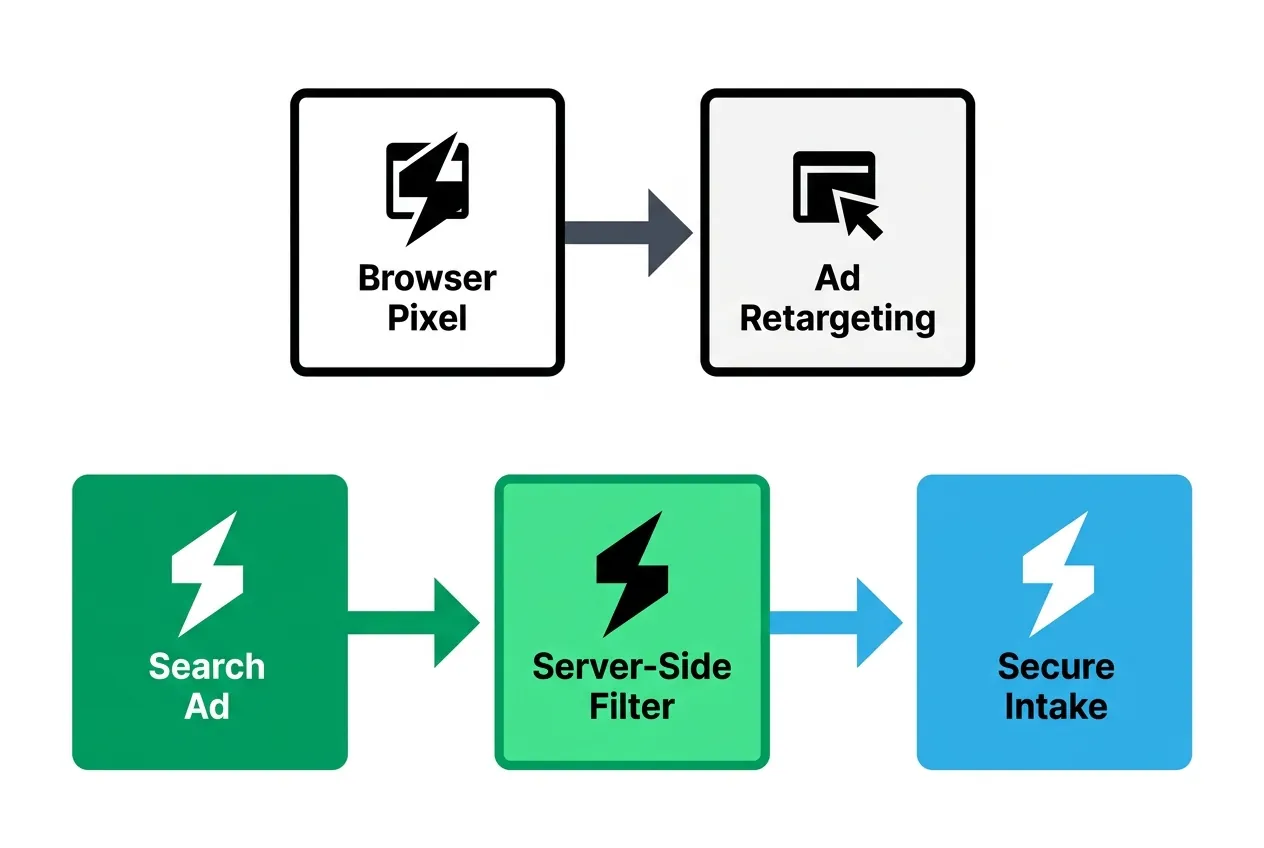
Under the Google Ads Personalized Advertising Policy, Google prohibits advertisers from creating remarketing lists, building audience segments, or targeting users based on sensitive health categories. This policy covers physical or mental health conditions, clinical treatments, addiction services, and any personal health struggles. Advertisers are prohibited from placing tracking pixels on medical pages to serve follow-up ads to individuals who visited those specific pages.
This operational constraint invalidates conventional multi-touch remarketing funnels. Healthcare marketers cannot rely on inexpensive retargeting campaigns to recapture lost web traffic. Instead, customer acquisition must succeed on the initial touchpoint.
This requires rigorous search intent capture, highly responsive mobile landing pages, and rapid intake routing. The marketing architecture must capture demand at the precise moment of commercial intent, converting prospects immediately into secure, first-party communication channels such as encrypted intake forms or compliant call systems.
How Marketing Powered Keeps Measurement and Privacy Aligned
Maintaining growth across hospitals, health systems, multi-location clinics, and regulated practices requires infrastructure that protects patient data while maintaining complete operational attribution. Marketing Powered approaches privacy compliance as an engineering discipline.
Our operating foundation is informed by executive healthcare experience. Our founder served as a healthcare Chief Marketing Officer, running marketing for a treatment network that grew from 3 to 24 locations, managed $1.5 to $2M per month in Google Ads across 11+ behavioral and mental health accounts, and serves as a court-certified expert witness in advertising strategy. We are LegitScript-aware and HIPAA-aware, with systems designed specifically around platform rules where retargeting is prohibited.
Rather than stripping out analytics and running campaigns blindly, our infrastructure isolates attribution signals before data crosses external boundaries. We deploy owned, local AI infrastructure for HIPAA-aware inference, keeping sensitive organizational intelligence within controlled environments rather than routing private data through shared commercial models.
By utilizing server-side data routing and strict ingestion boundaries, technical parameters like user IP addresses and detailed referral URLs are stripped before aggregated conversion pings are communicated to ad platforms. Our conversion architecture tracks marketing outcomes past the initial form fill or phone call directly to qualified admission, keeping growth accountable to verified revenue without compromising regulatory integrity.
Organizations seeking to structure their broader promotional strategy can explore our detailed guide on HIPAA compliant marketing: what the rules mean for campaigns and tracking. When evaluating external support, review our framework on HIPAA compliant marketing companies: what a specialist partner delivers and how to vet one. To understand the operational limits of common measurement platforms, consult our analysis on Google Analytics and HIPAA: what healthcare marketers can and cannot do.
Questions, Answered.
Marketing under HIPAA is any communication by a covered entity or its business associate that encourages the recipient to purchase or use a product or service. If protected health information is used to target or deliver that communication, it is prohibited unless the individual provides signed authorization or the communication falls strictly under statutory exceptions like direct treatment recommendations or care coordination.
Healthcare organizations can send appointment reminders, treatment updates, care instructions, and descriptions of their own health-related services to existing patients without separate authorization, provided the organization receives no third-party financial compensation for sending the message. However, the communications must still use secure transmission methods, honor opt-out requests, and follow minimum necessary data standards.
No. A Business Associate Agreement is a legal prerequisite, not an operational pass. A BAA establishes legal liability and data handling standards, but the marketing agency must still execute compliant data architecture. If an agency with a signed BAA places non-compliant third-party tracking pixels on patient intake pages, an impermissible disclosure under the Privacy Rule still occurs.
Uploading patient email lists, phone numbers, or intake records into ad platforms to generate "lookalike" or "similar" audiences constitutes an impermissible use of PHI for marketing. Doing so without explicit patient authorization violates federal regulations. Ad platforms process that data to train commercial algorithms, which does not qualify as a treatment or healthcare operations activity under the law. Request a privacy and tracking review of your marketing stack
Ready to see where your marketing can improve?
Request a free audit of your paid media, landing pages, attribution, and measurement setup. You'll get a straight assessment of where the opportunities are.
or email us at info@marketingpowered.ai