Guide
Discover the Power of Multimodal AI Search
How image, voice, and visual AI are reshaping search discovery for forward-thinking brands
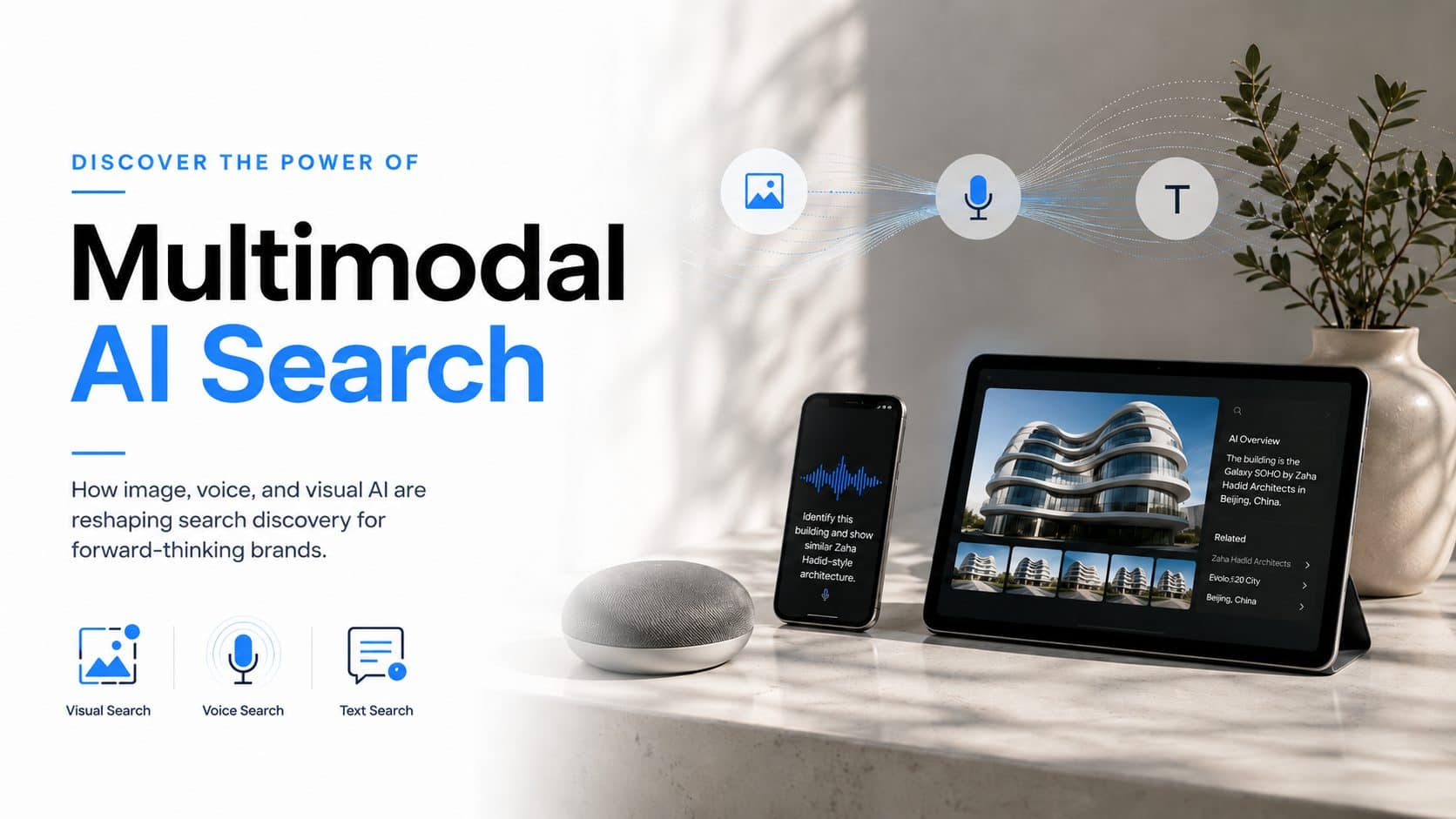
What is Multimodal AI Search?
Traditional search required users to translate their intent into text queries. Multimodal AI search removes that constraint. It processes inputs across multiple formats simultaneously: text, images, audio, and video. The result is a search experience that matches how humans actually think and communicate.
At its core, multimodal AI search combines several specialized AI models into a unified system. Natural language processing handles text. Computer vision interprets images. Speech recognition converts voice to actionable queries. Large language models (LLMs) tie these inputs together, understanding context and intent across formats to deliver relevant results.
The technical architecture differs significantly from traditional search engines. Where conventional search relies primarily on keyword matching and link analysis, multimodal systems use embedding models to create vector representations of content across all formats. A product image, its description, and a video review all exist in the same semantic space, making cross-format retrieval possible.
For marketers and strategists, this shift carries concrete implications. Content optimization now extends beyond text. Images need descriptive metadata that aligns with how visual search AI interprets them. Voice queries require understanding conversational patterns. Structured data markup becomes more important as search engines work to understand content across formats.
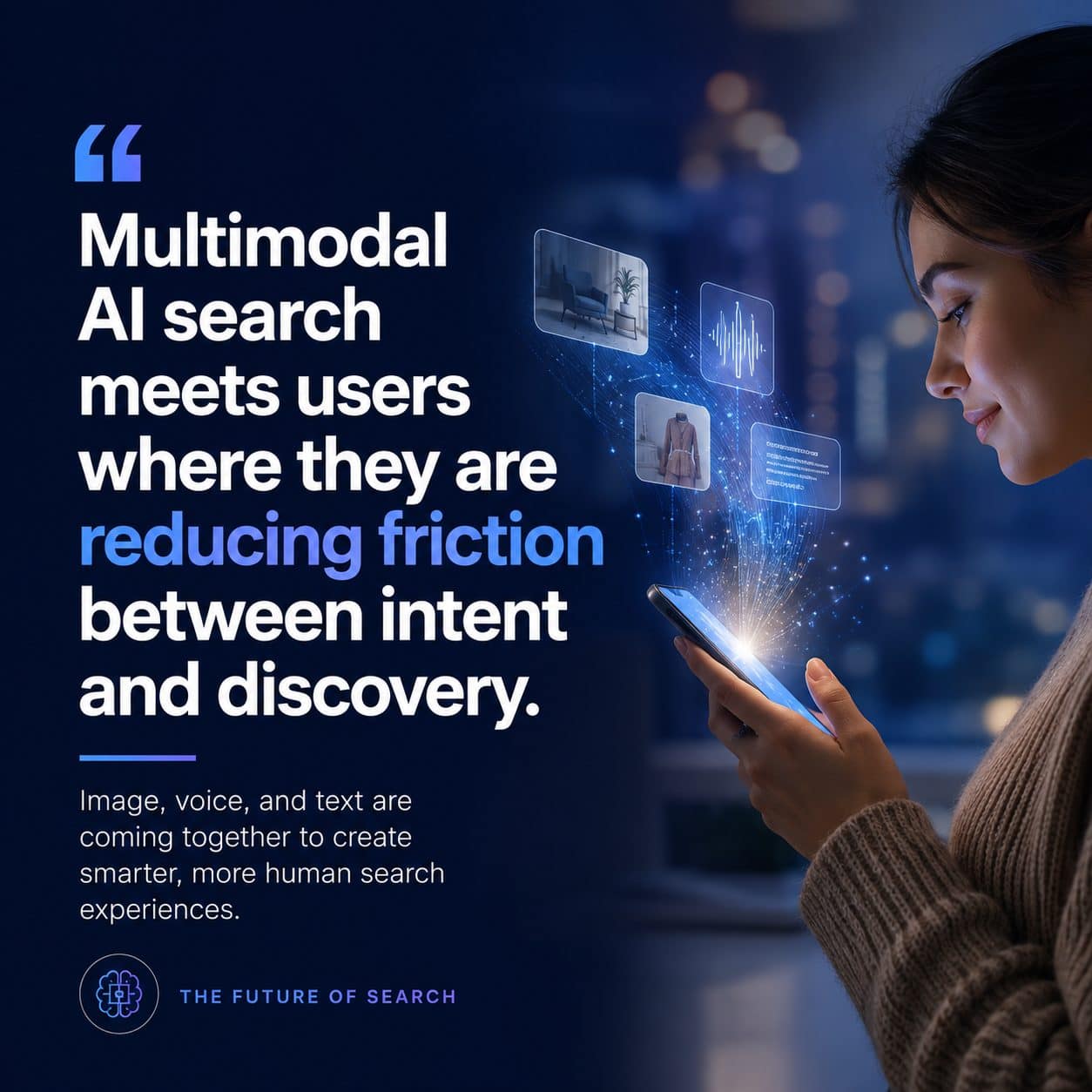
The business case is straightforward: users increasingly expect to search the way they communicate. A shopper photographs a product to find similar items. A driver asks their phone for directions. A researcher uploads a chart to find related data. Multimodal AI search meets users where they are, reducing friction between intent and discovery.
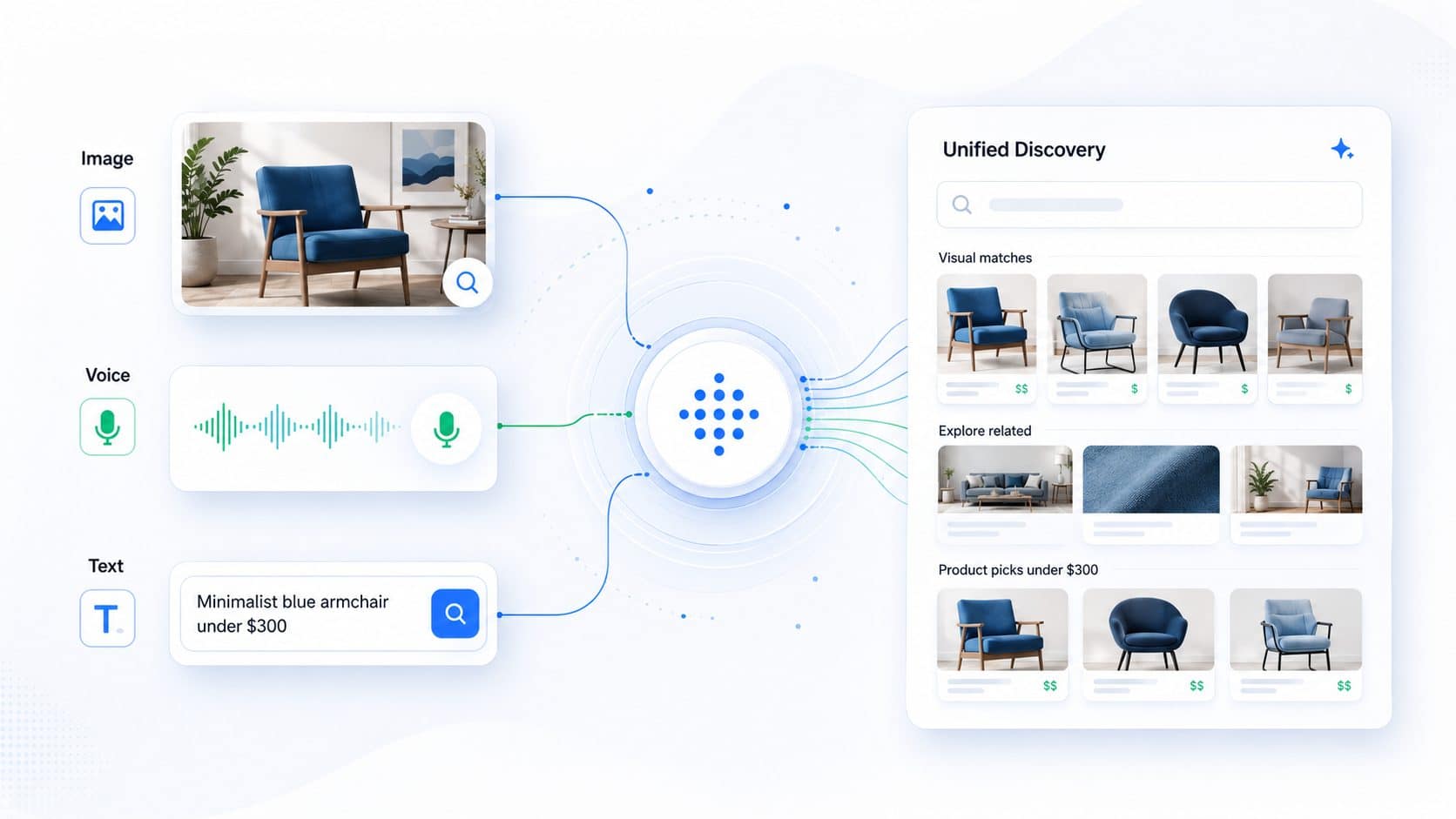
Key Technologies: Visual and Image Search
Image search AI represents one of the fastest-growing segments in multimodal search. The technology has moved from novelty to practical application. Users can now photograph a plant to identify the species, capture a screenshot to find a product, or upload a design to discover similar styles.
The underlying technology relies on convolutional neural networks and, increasingly, transformer-based vision models. These systems analyze pixel patterns, identify objects, extract features, and match them against indexed visual content. Google Lens processes over 12 billion visual searches monthly, demonstrating the scale of adoption.
Visual search LLM integration adds another layer. Modern systems do not just match images; they understand them contextually. Upload a photo of a living room, and the system identifies the couch, the lamp, the rug, and can surface products matching each item. This capability transforms how e-commerce and retail approach product discovery.
For brands, the opportunity lies in visual content optimization. Product images need clean backgrounds and multiple angles. Lifestyle photography should include recognizable contexts. Technical specifications embedded in image metadata help search systems categorize and retrieve content accurately.
The competitive advantage here is measurable. Brands that optimize for image search AI capture traffic that text-only optimization misses. A potential customer who photographs a competitor's product can be served your alternative. The intent signal from a visual search often indicates higher purchase readiness than a generic text query.
Enhancing Search with Voice Optimization
Voice search optimization operates on different principles than traditional SEO. Users speak in complete sentences. They ask questions. They expect direct answers. Optimizing for voice means understanding conversational query patterns and structuring content to match.
The technology stack includes automatic speech recognition, natural language understanding, and increasingly sophisticated dialogue management. Voice assistant users continue to grow globally, with smart speaker adoption driving significant search volume through voice interfaces.
Query patterns differ substantially from typed searches. Voice queries average 29 words compared to 3 to 4 words for text queries. They include more question words such as who, what, where, when, how, and why. They often include local intent or action intent such as call, book, or order.
Practical voice search optimization includes several technical considerations. Featured snippet optimization becomes critical because voice assistants often read the featured snippet as the answer. FAQ schema markup helps search engines identify question-and-answer pairs. Page speed matters more because voice users expect immediate responses.
The integration with multimodal search creates compound opportunities. A user might begin with a voice query, refine with a visual filter selecting a preferred style, and complete the journey with a text search for reviews. Brands optimized across all three formats capture the full journey.
Free Audit
Want a straight read on where your budget is leaking?
Real-World Applications and Industry Case Studies
Retail has emerged as the proving ground for multimodal search applications. Pinterest's visual search tool drives significant product discovery, with users uploading inspiration images to find purchasable items. Visual searches on Pinterest have increased substantially as users adopted visual discovery patterns.
The fashion industry demonstrates clear ROI from visual search investment. ASOS implemented Style Match, allowing users to photograph clothing items and find similar products in their catalog. The feature addresses a persistent e-commerce challenge: helping users find products they cannot describe in words.
Home goods and furniture present another strong use case. Wayfair and Houzz both offer visual search for home products. A user photographs a chair at a friend's house and surfaces similar options. The technology bridges the gap between inspiration and purchase.
Beyond retail, healthcare applications show promise within appropriate compliance boundaries. Medical imaging analysis uses similar underlying technology to assist diagnostic workflows. Research institutions apply multimodal search to scientific literature, matching diagrams and charts across publications.
The pattern across industries is consistent. Multimodal search reduces friction in discovery workflows. Users spend less time translating their intent into search terms. Conversion rates improve because intent signals are clearer. At Marketing Powered, we have tracked AI-native approaches since 2022, watching these patterns emerge across verticals where we operate.
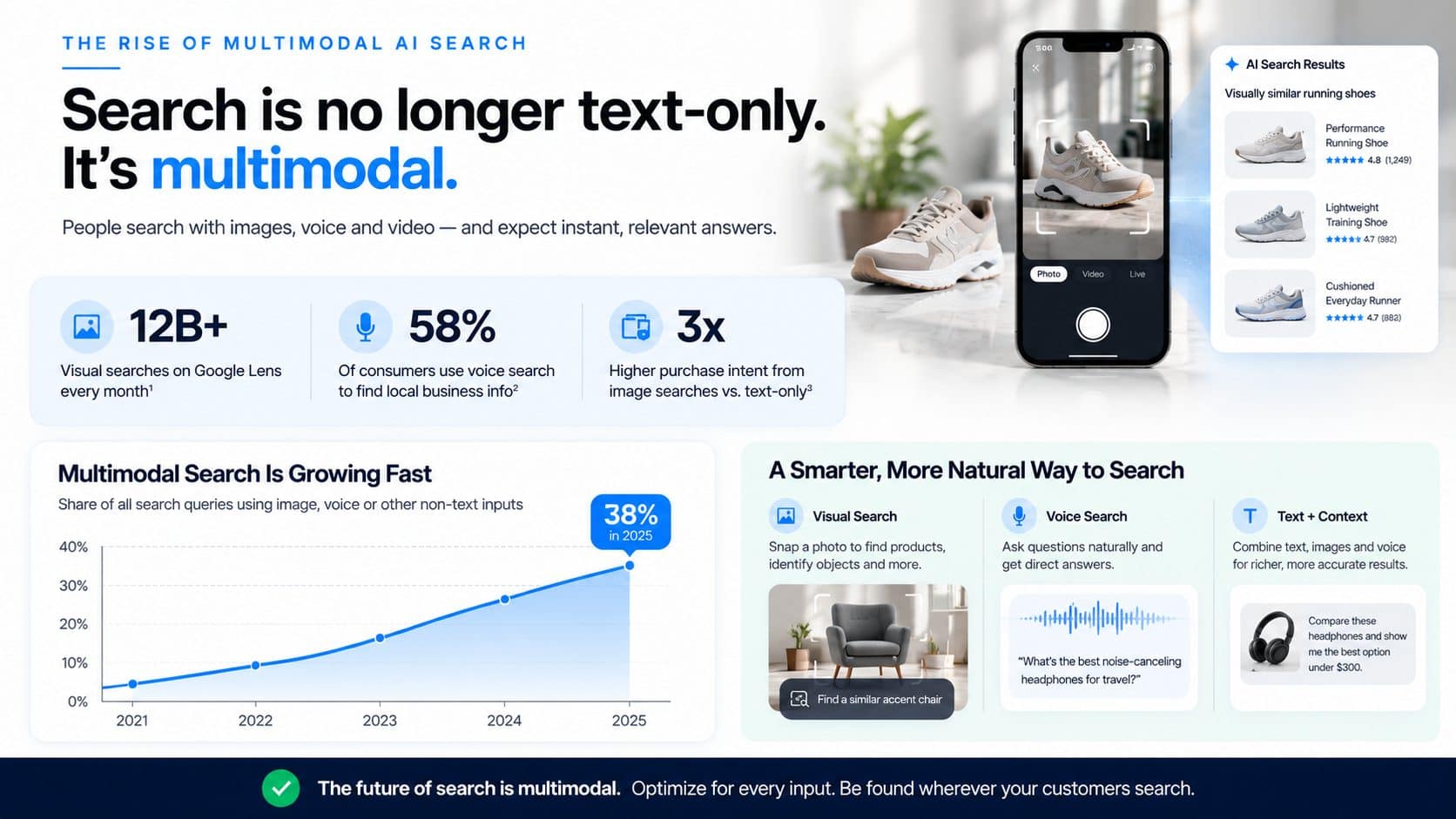
The Future of Multimodal AI Search
The trajectory points toward deeper integration. Generative AI models like GPT-4V and Google's Gemini already process text and images in unified workflows. The next generation will handle video, audio, and real-time sensor data with the same fluency.
Real-time multimodal search represents one frontier. Imagine pointing a phone camera at a street scene and receiving contextual information about businesses, transit options, and points of interest overlaid on the view. Augmented reality search applications are already in development at major technology companies.
Research published by leading AI labs suggests that multimodal understanding improves as models scale. Larger models show emergent capabilities in cross-format reasoning that smaller models lack. This points to continued rapid improvement in search relevance and overall capability.
For strategists and marketers, the practical implication is clear: multimodal optimization is not optional. Content strategies need to account for how AI systems interpret images, process voice, and connect formats. Brands that treat this as a future concern will find themselves catching up to competitors who invested earlier.
Ready to Build Your Multimodal Search Strategy?
The shift toward multimodal AI search is accelerating. Brands that optimize across image, voice, and text formats capture traffic and conversions that single-format strategies miss. Marketing Powered brings AI-native expertise developed since 2022, with practical implementation experience across complex verticals. Let's discuss how multimodal optimization fits your broader digital strategy, what technical requirements apply to your content, and where the highest-impact opportunities exist for your business.
Questions, Answered.
Image search AI uses computer vision and machine learning to analyze visual content and return relevant results based on image inputs rather than text queries. The technology identifies objects, patterns, colors, and contextual elements within images, then matches them against indexed visual databases. This enables users to search by photographing products, uploading screenshots, or selecting images to find visually similar content.
Visual search removes the translation step between what users see and what they can find. Users no longer need to describe an item in words; they simply share the image. This reduces search friction, increases accuracy for visually complex queries, and delivers more relevant results. For product discovery, visual search often captures purchase intent more effectively than text queries.
Voice search optimization improves accessibility for users who prefer speaking to typing, captures longer conversational queries, and positions content for featured snippet selection. Voice queries often indicate stronger intent signals because users typically speak more specific requests. Optimizing for voice also prepares content for smart speaker and voice assistant ecosystems.
Retailers deploy multimodal search to enable product discovery through photos, voice commands, and combined inputs. A customer might photograph a friend's outfit to find similar items, ask a voice assistant to reorder a product, or combine visual and text filters to narrow results. This approach increases conversion by meeting customers in their preferred interaction mode.
Technology industries benefit from multimodal search through improved internal knowledge retrieval, enhanced customer support interfaces, and more intuitive product experiences. Development teams use visual search to find similar code patterns or UI components. Support systems process screenshots alongside text descriptions. Product teams analyze user-generated images alongside feedback text for more complete insights.
Ready to see what AI-native marketing can do for your treatment center?
Request a free audit of your paid media, landing pages, attribution, and compliance posture. You'll get a straight assessment of where the opportunities are.
or email us at info@marketingpowered.ai