Capabilities
Technical SEO and Site Performance Optimization
Site architecture, Core Web Vitals, and performance optimization built on the discipline behind $50M+ in managed media spend.
Why Technical SEO Determines Whether Your Content Gets Found
Technical SEO is the infrastructure layer that determines whether search engines can find, crawl, and index your content. Without it, even the strongest content strategy fails to surface in search results. For enterprises and agencies managing complex sites, technical SEO is not optional; it is the foundation on which every other channel depends.
Search engines prioritize sites that load quickly, render correctly across devices, and communicate their structure through markup and metadata. When that foundation is weak, crawlers waste budget on low-value pages, miss critical content, and fail to understand topical relationships across your domain. The result is diminished visibility precisely where your business needs it most.
According to Google's Search Central documentation, technical accessibility is a prerequisite for ranking consideration. No amount of content investment compensates for pages that cannot be indexed. This is why technical SEO audits consistently surface the highest-impact opportunities: the fixes are structural, and the gains compound across every page on your domain.
Core Components of a Technical SEO Audit
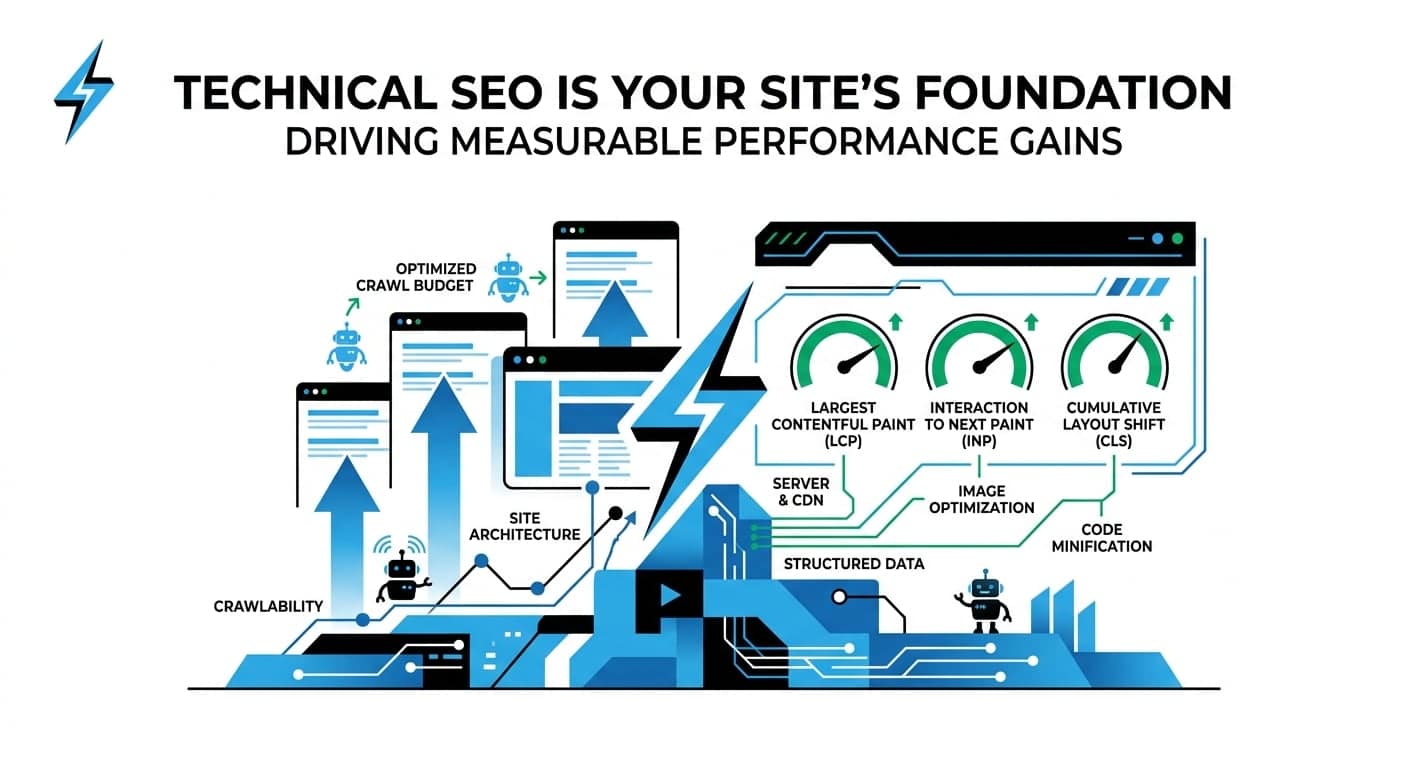
A comprehensive technical SEO audit examines the systems that govern how search engines interact with your site. These components work together, so a weakness in one area creates friction across the entire crawl and index process.
- XML sitemaps provide search engines with a roadmap of your most important URLs. A properly configured sitemap prioritizes high-value pages, excludes thin or duplicate content, and updates automatically as your site evolves.
- Robots.txt directives control which areas of your site crawlers can access. Misconfigured robots.txt files are among the most common technical SEO errors — often blocking critical pages from indexing entirely or wasting crawl budget on low-priority resources.
- Structured data (schema markup) helps search engines understand the meaning of your content, not just the words on the page. Proper schema implementation enables rich results, improves click-through rates, and strengthens topical signals.
- Canonical tags prevent duplicate content issues by signaling which version of a page should be indexed when multiple URLs serve similar content — critical for e-commerce sites, filtered navigation, and content syndication.
- Internal linking architecture distributes authority across your site and establishes topical relationships between pages. A well-structured internal linking strategy ensures your most important pages receive adequate crawl attention and link equity.
- HTTPS and security configuration signal trustworthiness to both search engines and users. Sites without valid SSL certificates face ranking penalties and browser warnings that erode conversion rates.
Core Web Vitals: Google's Quantified Measure of User Experience
Core Web Vitals are Google's standardized metrics for measuring real-world user experience, and they directly influence ranking positions. These metrics assess how quickly your page loads visible content, how soon users can interact with it, and how stable the layout remains during loading.
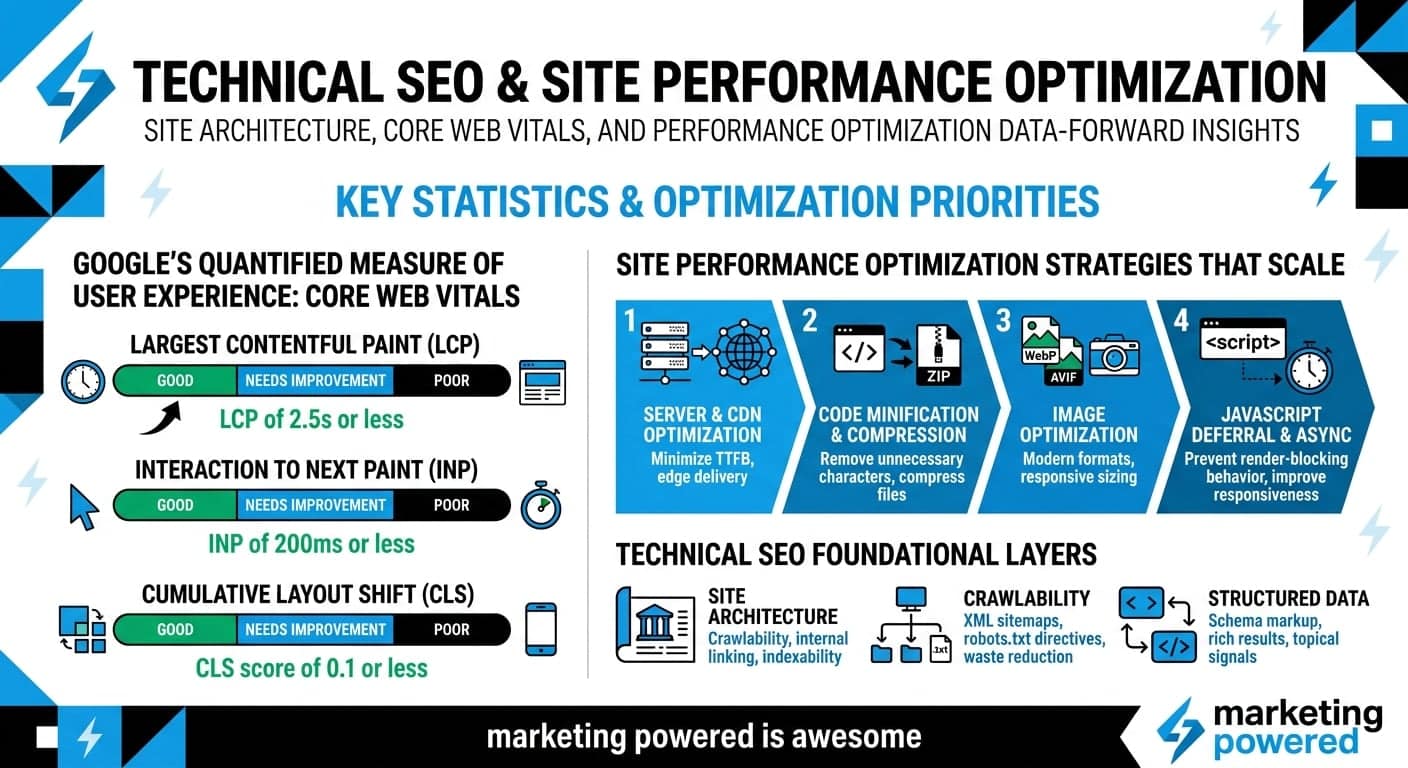
Largest Contentful Paint (LCP) measures loading performance. Google recommends an LCP of 2.5 seconds or less. Sites that exceed this threshold signal poor user experience, and rankings reflect that assessment. Common LCP issues include unoptimized images, slow server response times, and render-blocking resources.
Interaction to Next Paint (INP) replaced First Input Delay in March 2024 as the core responsiveness metric. INP measures the latency of all user interactions throughout a page visit, not just the first click. Google's threshold for a good INP score is 200 milliseconds or less. Heavy JavaScript execution and long tasks are the primary culprits when INP scores suffer.
Cumulative Layout Shift (CLS) quantifies visual stability. A CLS score of 0.1 or less indicates that page elements stay where users expect them. Layout shifts frustrate users and erode trust, particularly on mobile devices where accidental taps on shifted elements are common.
Addressing Core Web Vitals requires coordination between development, design, and performance strategy. The fixes are often interdependent: compressing images improves LCP, but lazy loading those images incorrectly can worsen CLS. We approach these optimizations systematically, measuring impact at each stage and prioritizing changes that move the metrics most relevant to your ranking positions.
Free Audit
Want a straight read on where your budget is leaking?
Site Performance Optimization Strategies That Scale
Site performance optimization extends beyond Core Web Vitals scores. A fast, stable site reduces bounce rates, increases time on page, and improves conversion rates across every traffic source. The strategies below address the infrastructure layer that determines how quickly your content reaches users.
- Server and CDN optimization: Time to First Byte (TTFB) measures how quickly your server responds to requests. Slow TTFB cascades into poor LCP scores. Optimization strategies include upgrading hosting infrastructure, implementing server-side caching, and configuring Content Delivery Networks (CDNs) to serve static assets from edge locations closer to your users.
- Code minification and compression: Removing unnecessary characters from CSS, JavaScript, and HTML files, combined with Gzip or Brotli compression, reduces file sizes significantly and accelerates download times without changing functionality.
- Critical CSS extraction: Identifying the styles needed for above-the-fold content and inlining them directly in the HTML allows the initial render to complete before external stylesheets finish loading, dramatically improving perceived performance.
- Image optimization: Modern formats like WebP and AVIF provide superior compression compared to JPEG and PNG. Responsive images served at appropriate sizes for each device prevent mobile users from downloading desktop-sized assets.
- JavaScript deferral and async loading: Preventing render-blocking behavior ensures that visible content reaches users before scripts finish executing, improving both LCP and INP scores.
- Continuous monitoring: Performance is not a one-time project. Code deployments, content additions, and third-party script changes can degrade performance over time. Real-user monitoring (RUM) and synthetic testing catch regressions before they impact rankings or conversions.
What to Look for in a Technical SEO Partner
Technical SEO requires both strategic vision and implementation capability. Many agencies can identify issues in an audit report. Fewer can fix them without breaking other systems in the process, and fewer still can connect technical improvements to business outcomes.
Marketing Powered has managed over $50M in media spend across behavioral health and mental health verticals, where technical SEO directly influenced Quality Score, landing page experience ratings, and cost per acquisition. Our founder has served as a court-certified expert witness in advertising strategy, which is a distinction that reflects the documentation discipline and analytical rigor we bring to every engagement.
We have helped clients improve search rankings while maintaining compliance with LegitScript certification requirements and HIPAA-conscious data handling standards. For healthcare-adjacent businesses, this combination of technical depth and compliance awareness is not a differentiator; it is a requirement.
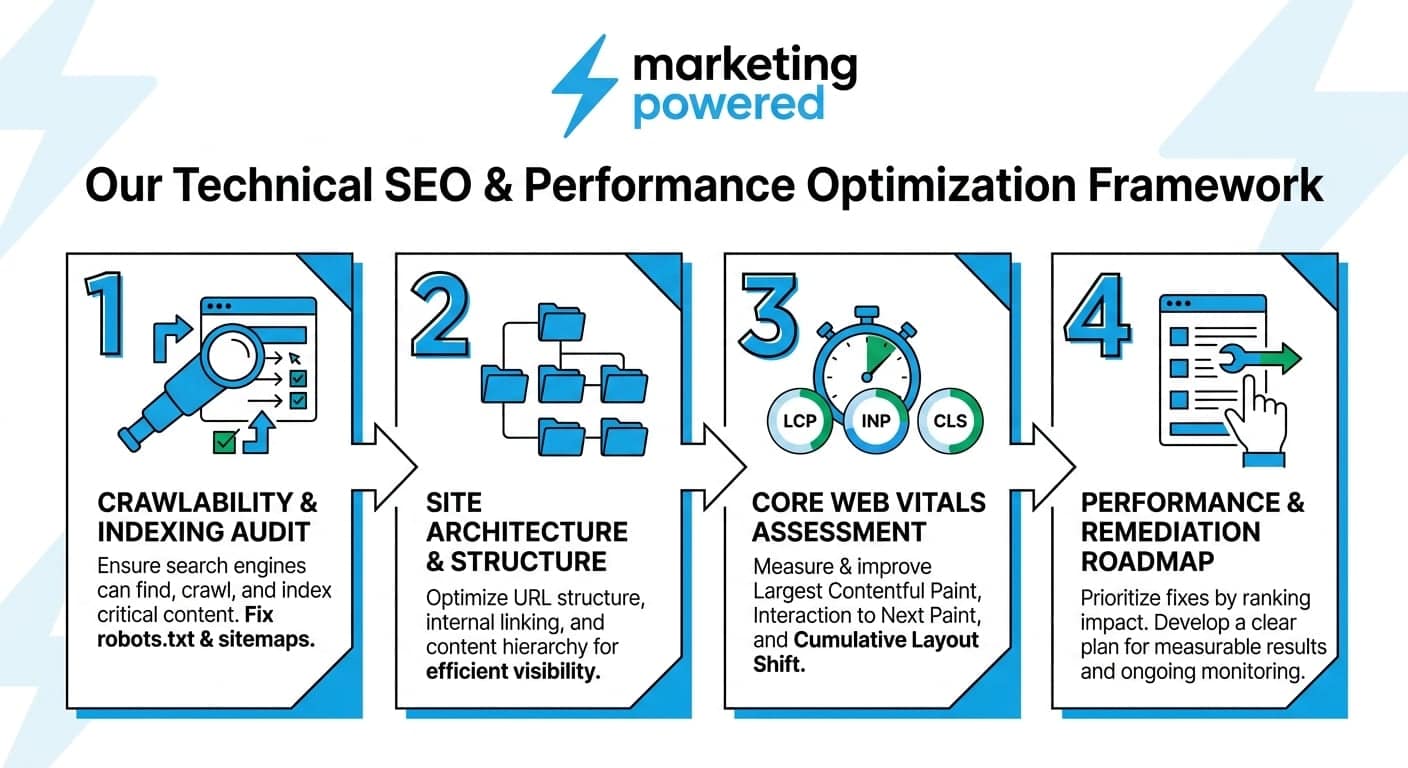
If your site's technical foundation is holding back your visibility, an audit is the starting point. We will identify the issues, prioritize them by ranking impact, and give you a clear remediation roadmap with timelines and ownership assignments.
Ready to Fix What's Holding Your Site Back?
A technical SEO audit identifies the infrastructure issues limiting your visibility and prioritizes fixes by impact. We will examine your site architecture, Core Web Vitals, structured data, and crawlability, then deliver a clear remediation roadmap.
Questions, Answered.
Technical SEO encompasses the infrastructure elements that enable search engines to crawl, index, and rank your content, including site architecture, XML sitemaps, robots.txt configuration, structured data markup, and page speed optimization. Without a sound technical foundation, even high-quality content cannot surface in search results. Technical audits often reveal the highest-impact opportunities because the fixes compound across every page on your domain.
Core Web Vitals are Google's quantified measures of user experience: Largest Contentful Paint (loading performance), Interaction to Next Paint (responsiveness), and Cumulative Layout Shift (visual stability). These metrics directly influence ranking positions. Sites that meet Google's recommended thresholds signal a strong user experience and receive preferential treatment in search results. Poor scores can suppress rankings even when content quality and backlink profiles are strong.
A comprehensive technical SEO audit examines crawlability (robots.txt, XML sitemaps, internal linking), indexability (canonical tags, duplicate content, pagination), site architecture (URL structure, navigation depth), structured data implementation, Core Web Vitals performance, mobile usability, and HTTPS security. The audit surfaces issues, prioritizes them by ranking impact, and provides actionable remediation steps with clear ownership.
Timeline varies depending on issue severity and how quickly Google recrawls your site. Critical fixes like resolving indexing blocks or eliminating crawl errors can show results within days to weeks once Googlebot revisits affected pages. Core Web Vitals improvements may reflect in ranking data within one to three months as Google incorporates field data from real users. Structural changes like internal linking restructuring typically show compounding gains over three to six months.
Technical SEO focuses on crawlability, indexability, and structured data — ensuring search engines can access and understand your content. Site performance optimization focuses on speed and stability metrics like Core Web Vitals, TTFB, and page weight. The two disciplines overlap significantly: performance directly influences Core Web Vitals scores, which are a Google ranking factor. A comprehensive technical program addresses both layers together rather than treating them as separate workstreams.
Ready to see what AI-native marketing can do for your treatment center?
Request a free audit of your paid media, landing pages, attribution, and compliance posture. You'll get a straight assessment of where the opportunities are.
or email us at info@marketingpowered.ai