Guide
Explore B2B Marketing Attribution Models
Understand which touchpoints drive revenue so you can allocate budget with precision across complex B2B sales cycles.

Introduction to Marketing Attribution
Marketing attribution models determine how credit for conversions gets assigned across the touchpoints a prospect encounters before becoming a customer. In B2B environments, where sales cycles stretch from weeks to months and buying committees include multiple stakeholders, accurate attribution becomes the difference between informed budget decisions and expensive guesswork.
What is marketing attribution at its core? It is the discipline of connecting marketing activities to business outcomes. Every whitepaper download, webinar attendance, sales call, and retargeting impression plays a role in moving a prospect toward a decision. Attribution methodology gives you a framework for measuring that role.
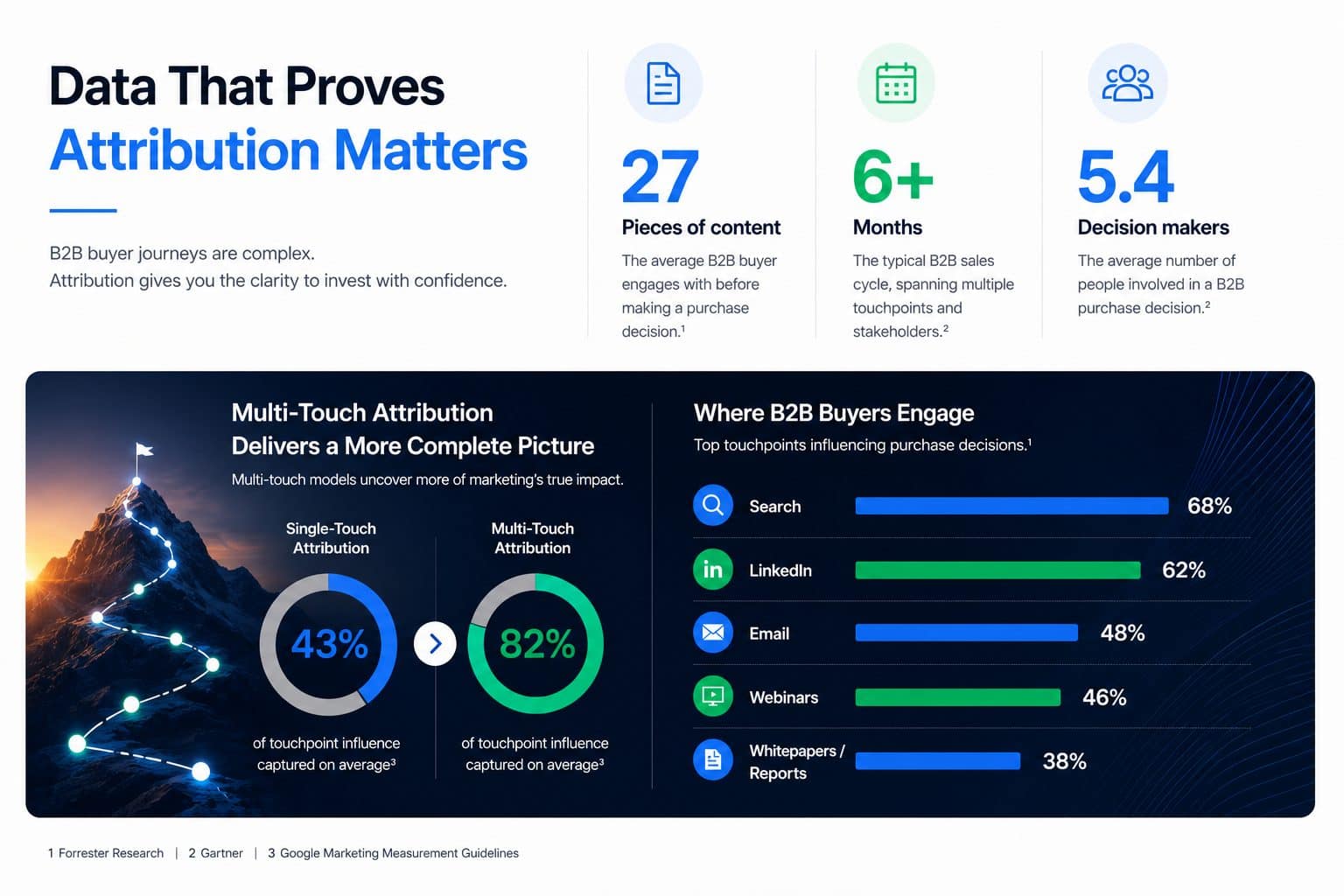
The challenge in B2B is complexity. A single deal might involve 20+ touchpoints across six months, with three different decision-makers consuming content independently. According to Forrester Research, the average B2B buyer engages with 27 pieces of content before making a purchase decision. Without a clear attribution framework, you cannot answer basic questions: Which channels generate pipeline? Which content assets influence closed-won revenue? Where should next quarter's budget go?
Understanding marketing attribution models is not optional for B2B marketers operating at scale. It is the foundation of accountable marketing spend. The model you choose shapes every downstream decision about channel mix, content investment, and campaign optimization.
Types of Marketing Attribution Models
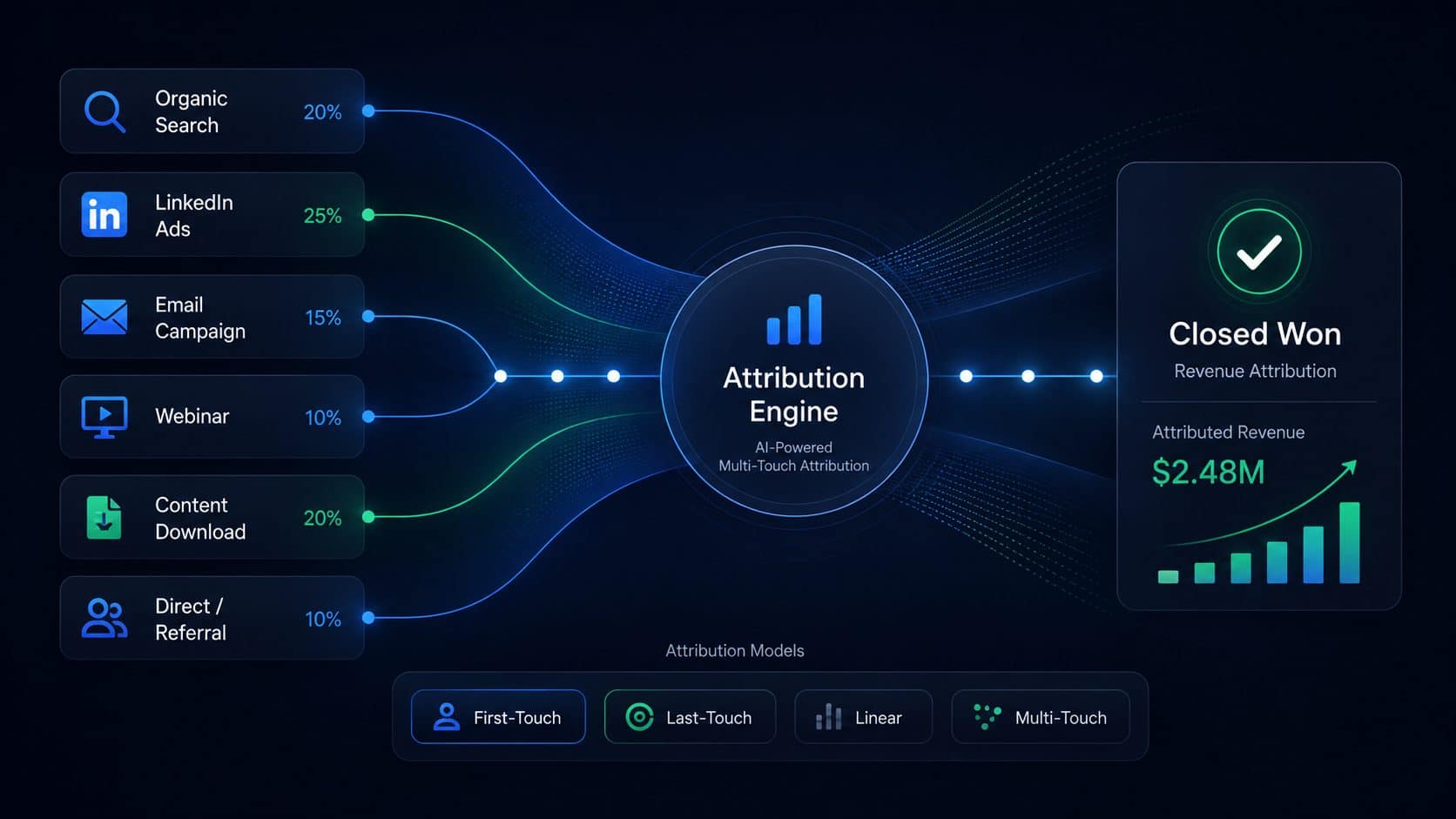
Attribution models fall into two broad categories: single-touch and multi-touch. Each has trade-offs, and the right choice depends on your sales cycle, data infrastructure, and organizational maturity.
Single-touch attribution assigns 100% of conversion credit to one touchpoint. The two most common variants are first-touch and last-touch attribution.
First-touch attribution credits the initial interaction that brought a prospect into your funnel. If a prospect first discovered your company through a LinkedIn ad, that ad receives full credit for any eventual conversion. This model favors top-of-funnel awareness channels and is useful for understanding demand generation effectiveness. The limitation: it ignores every touchpoint that nurtured the prospect afterward.
Last-touch attribution credits the final interaction before conversion. If a prospect converted after clicking a Google search ad, that ad gets full credit. This model favors bottom-of-funnel channels and is simpler to implement. The limitation: it ignores the months of awareness and consideration activity that made that final click possible.
Multi-touch attribution distributes credit across multiple touchpoints. Common variants include linear (equal credit to all touchpoints), time-decay (more credit to recent touchpoints), U-shaped (more credit to first and last touch), and W-shaped (credit weighted toward first touch, lead creation, and opportunity creation).
For B2B organizations with longer sales cycles, multi-touch attribution provides a more complete picture of marketing influence. According to Google's marketing measurement guidelines, multi-touch models help marketers understand the full customer journey rather than optimizing for isolated touchpoints. However, multi-touch models require more sophisticated data collection and analysis capabilities.
- First-touch: Best for measuring awareness and demand generation effectiveness
- Last-touch: Best for understanding final conversion triggers and bottom-funnel performance
- Linear: Equal credit across all touchpoints; simple but may undervalue high-impact moments
- Time-decay: Weights recent touchpoints more heavily; useful for shorter consideration cycles
- U-shaped: 40% to first and last touch, 20% distributed across middle; balances awareness and conversion
- W-shaped: Adds weight to lead creation moment; better for complex B2B funnels with defined stages
Choosing the Right Attribution Model for B2B
Selecting an attribution model is not about finding the theoretically correct answer. It is about matching the model to your business reality: your sales cycle length, your data infrastructure, and your organizational decision-making needs.
Sales cycle length matters. If your average deal closes in under 30 days with fewer than five touchpoints, single-touch attribution may provide sufficient insight. If your sales cycle spans six months with dozens of touchpoints across multiple stakeholders, single-touch models will systematically mislead you about channel performance.
Data availability shapes your options. Multi-touch attribution requires comprehensive tracking across channels, clean CRM data, and integration between marketing automation and sales systems. If your data infrastructure cannot reliably connect touchpoints to opportunities and closed revenue, even the most sophisticated model will produce unreliable outputs. Start with your data foundation before selecting your model.
Organizational goals determine the frame. If your marketing team is primarily measured on lead volume, a first-touch model aligns incentives with measurement. If you are accountable for pipeline and revenue, multi-touch models that track influence through the full funnel become necessary.
Assess your current state honestly. What data do you actually have? What questions do you need to answer? What decisions will change based on attribution insights? The best attribution model is the one your organization will actually use to make better decisions, not the one that looks most sophisticated on paper.
For most B2B organizations with sales cycles exceeding 60 days and marketing budgets above $100K annually, some form of multi-touch attribution is worth the implementation investment. The question becomes which multi-touch model fits your specific funnel shape and data capabilities.
Free Audit
Want a straight read on where your budget is leaking?
Implementing Multi-Touch Attribution in B2B
Moving from single-touch to multi-touch attribution is a significant operational shift. Done well, it transforms how you allocate budget and measure marketing contribution. Done poorly, it creates a false sense of precision that leads to worse decisions than simple last-touch reporting.
Start with data hygiene. Before implementing any multi-touch model, audit your tracking coverage. Can you reliably capture touchpoints across all channels? Are UTM parameters consistent? Does your CRM accurately reflect the buying journey? Gaps in data collection will create blind spots in attribution, and those blind spots will bias your model toward channels you happen to track well.
Define your touchpoint taxonomy. Decide what counts as a touchpoint and how granular you need to be. A whitepaper download and a pricing page visit may both be touchpoints, but they signal different intent. Your taxonomy should reflect the distinctions that matter for your business decisions.
Choose your attribution window. How far back should the model look for touchpoints that influenced a conversion? A 90-day window will produce different results than a 30-day window. Your attribution window should roughly match your typical sales cycle length. According to HubSpot's attribution research, mismatched attribution windows are one of the most common implementation errors.
Implement incrementally. Run your multi-touch model alongside your existing reporting for at least one quarter before making budget decisions based on it. Compare the outputs. Understand where and why they differ. Build organizational confidence in the new data before changing how you allocate spend.
Plan for ongoing maintenance. Attribution models are not set-and-forget. As your channel mix evolves, as your sales process changes, and as new touchpoints emerge, your model will need updates. Assign ownership for model maintenance and schedule quarterly reviews of attribution logic and data quality.
Measuring Success and ROI with Attribution Models
An attribution model is only valuable if it improves decisions. Measure your model's effectiveness by the quality of insights it produces and the confidence you have in acting on them.
Track whether attribution data is actually influencing budget allocation. If your quarterly budget reviews do not reference attribution outputs, the model is not delivering value. The goal is not perfect measurement; it is better decision-making.
Compare model outputs against known business realities. If your attribution model says paid search drives 5% of pipeline, but your sales team consistently cites search traffic as a top lead source, investigate the discrepancy. Either your model is missing data, or your sales team's perception is skewed. Both are fixable, but only if you surface the conflict.
Build feedback loops between attribution insights and campaign optimization. When the model shows a channel underperforming, test reducing spend. When it shows strong performance, test increasing investment. Measure whether acting on attribution data produces the expected results. Over time, this feedback loop validates or challenges your model's accuracy.
Revisit your attribution methodology at least annually. As Marketing Evolution's research notes, B2B buying behavior shifts, channel effectiveness changes, and your data infrastructure evolves. The attribution model that served you well last year may need adjustment to remain accurate.
Conclusion and Next Steps
Marketing attribution models are the foundation of accountable B2B marketing. The right model, implemented with clean data and organizational buy-in, enables confident budget allocation and clearer ROI measurement. The wrong model, or no model at all, leaves you optimizing on incomplete information.
Start by assessing your current state: your sales cycle length, your data infrastructure, and the decisions you need attribution to inform. For most B2B organizations, multi-touch attribution is worth the investment, but only if you commit to the data hygiene and ongoing maintenance it requires.
If you are unsure which attribution model fits your business, or if your current approach is leaving blind spots in your marketing measurement, an outside perspective can accelerate your path to clarity. Marketing Powered brings AI-native solutions and attribution discipline to organizations ready to move beyond guesswork. Review our paid media services to see how we approach multi-touch attribution strategies and analyze marketing ROI across complex funnels.
Email Us
Prefer to send the context directly?
Ready to Optimize Your Attribution Strategy?
If your current attribution approach leaves gaps in your marketing measurement, or if you are unsure which model fits your business, an audit can surface opportunities you are missing. Marketing Powered brings attribution discipline and AI-native methodology to B2B organizations ready for accountable marketing spend.
Questions, Answered.
Marketing attribution is the practice of assigning credit to marketing touchpoints that contribute to a conversion or sale. It tracks how prospects interact with your marketing across channels and campaigns, then assigns value to each interaction based on its influence on the outcome. For B2B companies, attribution connects marketing activity to pipeline and revenue.
Attribution models enable B2B marketers to allocate budget based on actual channel performance rather than assumptions. In complex buying cycles with multiple stakeholders and extended timelines, attribution reveals which touchpoints influence deals and which consume budget without impact. This visibility is the foundation of efficient marketing spend.
Common models include first-touch (credits the initial interaction), last-touch (credits the final interaction before conversion), linear (equal credit across all touchpoints), time-decay (more credit to recent touchpoints), U-shaped (weighted toward first and last touch), and W-shaped (adds weight to lead creation). Each model suits different sales cycles and organizational needs.
Evaluate three factors: your sales cycle length, your data infrastructure, and the decisions you need attribution to inform. Shorter cycles with fewer touchpoints may work with single-touch models. Longer cycles with complex buying committees typically require multi-touch models. Choose the most sophisticated model your data can actually support.
The primary challenges are data integration across systems, incomplete tracking coverage, inconsistent UTM implementation, and organizational adoption. Multi-touch models require clean data flowing from marketing platforms into CRM and accurate opportunity-to-touchpoint mapping. Many organizations underestimate the data foundation work required before implementation.
Ready to see what AI-native marketing can do for your treatment center?
Request a free audit of your paid media, landing pages, attribution, and compliance posture. You'll get a straight assessment of where the opportunities are.
or email us at info@marketingpowered.ai