Guide
How to Evaluate AI Marketing Agency Capabilities
A practical framework for behavioral health operators selecting an AI-native agency partner.

Why AI Capabilities Matter for Behavioral Health Marketing
The gap between AI claims and AI results is costing treatment centers real money
Every marketing agency claims AI capabilities today. Few can demonstrate what those capabilities actually produce. For behavioral health center operators, this gap between claim and outcome creates compounding risk: wasted media budget, compliance exposure, and leads that never convert to admissions.
An AI marketing agency worth serious consideration should show you exactly how its systems improve targeting precision, reduce cost per admission, and maintain compliance with Google's sensitive healthcare vertical restrictions and LegitScript certification requirements. Mentioning machine learning in a pitch deck is not a demonstration.
For treatment centers, the cost of choosing the wrong partner is higher than in most verticals. You operate under advertising restrictions that prohibit retargeting. Your cost per click often exceeds fifty to one hundred dollars for competitive terms. Your intake team has limited bandwidth, and every unqualified call costs real time and real opportunity.
The right AI advertising agency has managed campaigns at scale inside your vertical. The wrong one applies generic performance marketing tactics that produce compliance violations and budget burn. This guide gives you a structured framework for telling the difference before you sign a contract.
Core AI Marketing Capabilities to Evaluate
Five capability areas that determine whether AI actually improves your results
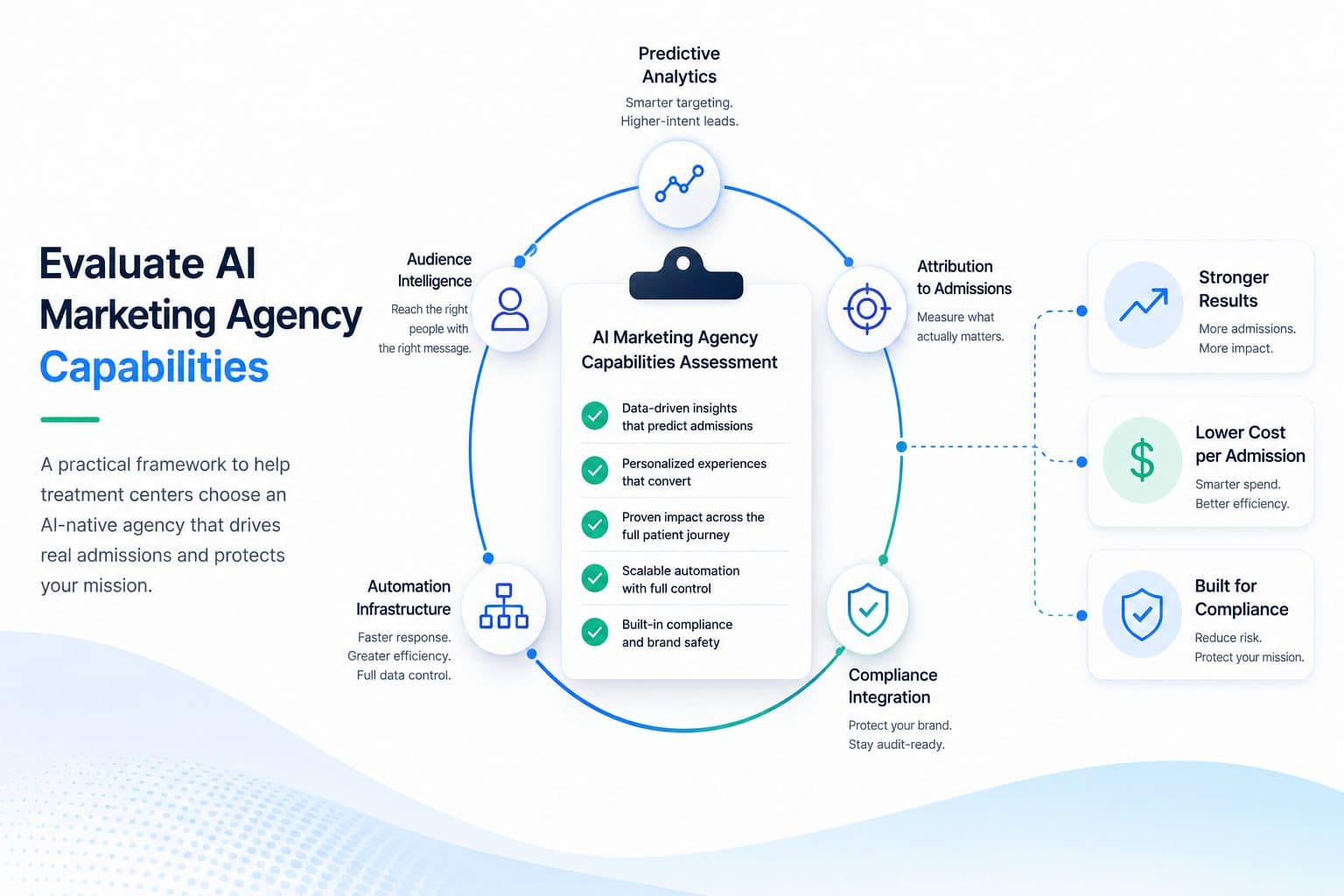
When assessing AI marketing capabilities, focus on five areas with direct impact on your admissions funnel: predictive analytics, multivariant optimization, attribution modeling, automation infrastructure, and compliance integration.
Predictive analytics should identify which audience segments convert to admissions, not just clicks or form fills. Ask how agency models incorporate downstream conversion data. If the agency cannot explain how admission outcomes feed back into targeting, their AI is optimizing for the wrong metric, and your budget is paying for it.
Multivariant optimization means routing each visitor to the landing page variation most likely to convert based on that person's characteristics. This is not A/B testing. It is machine learning applied to conversion rate optimization in real time, at the individual visitor level.
Attribution modeling matters in behavioral health because consideration cycles are long and touchpoints are multiple. An agency should track attribution through to admission, not just lead submission. Without admission-level attribution, you cannot calculate true cost per admission or allocate budget with any accuracy.
Automation infrastructure determines how quickly an agency can respond to market changes. Agencies relying entirely on third-party APIs face rate limits, data sharing constraints, and capability changes outside their control. Agencies with owned infrastructure can customize models for your vertical and maintain data sovereignty.
Compliance integration should be built into campaign architecture, not reviewed after the fact. In behavioral health, compliance failures produce account suspensions that can interrupt lead flow for days or weeks. Ask how the agency handles this at the infrastructure level.
- Predictive analytics tied to admission outcomes, not vanity metrics
- Multivariate optimization at the individual visitor level for landing pages
- Attribution modeling that tracks through to actual admissions
- Owned automation infrastructure with data sovereignty controls
- Compliance integration is built into campaign setup, not added after launch
Free Audit
Want a straight read on where your budget is leaking?
What AI-Powered Marketing Results Look Like in Practice
Case evidence that demonstrates real capability versus marketing language
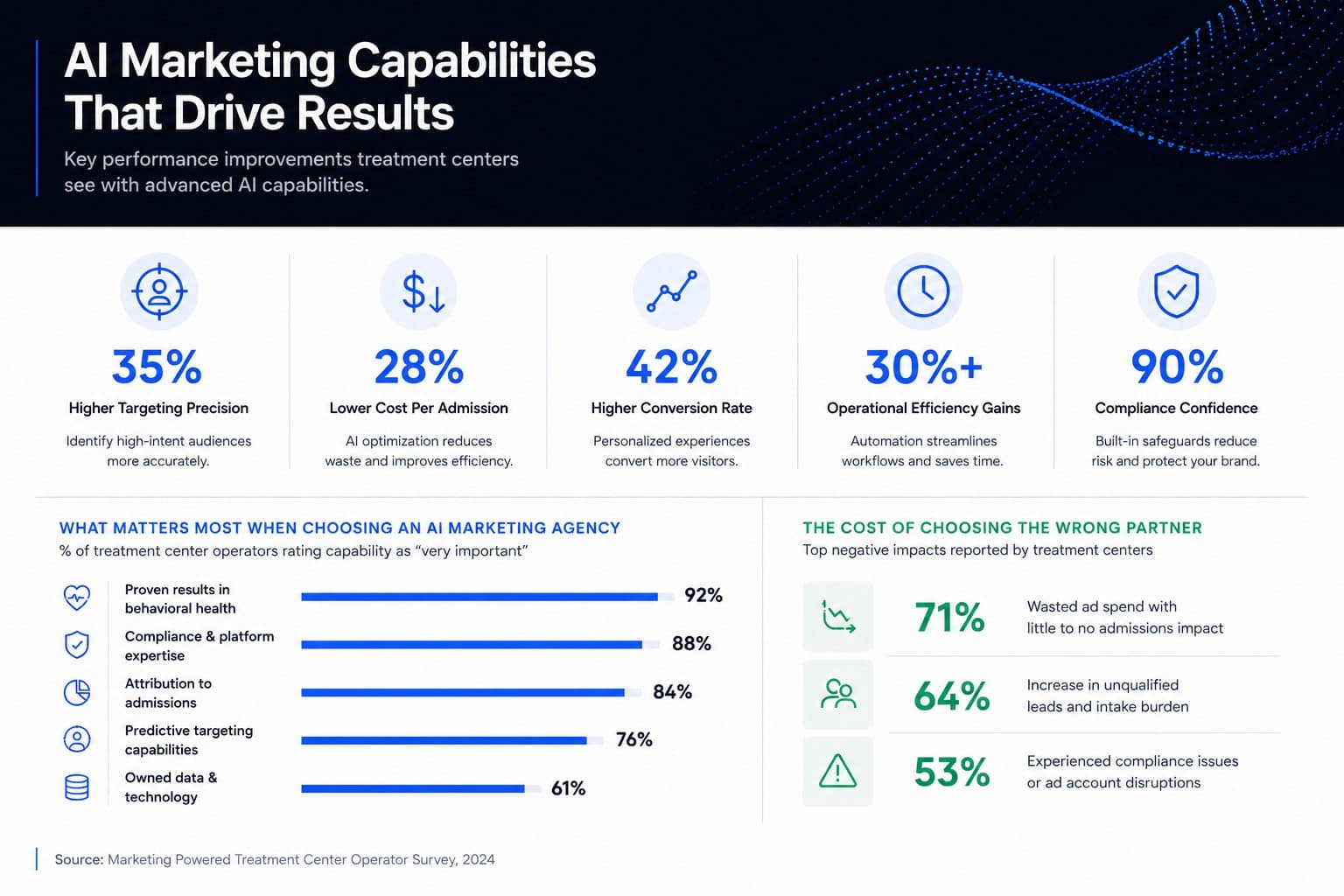
Real AI-powered marketing services produce measurable outcomes you can verify. When evaluating agencies, ask for case studies with specific numbers attached to results you care about. Impressions and click-through rates are not the numbers that matter.
Scale in this vertical provides a meaningful signal. Managing over fifty million dollars in behavioral health and mental health media spend produces the data density needed to train models that actually work. An agency managing fifty thousand dollars monthly across all clients does not have the sample size to build effective predictive models for treatment center campaigns.
Operator-level growth trajectories demonstrate that an agency can maintain efficiency as volume increases. Scaling a multi-location treatment organization from three to twenty-four locations requires a paid media infrastructure sophisticated enough to handle geographic expansion, census fluctuations, and varying competitive intensity across markets simultaneously.
At the campaign level, managing one and a half to two million dollars monthly in Google Ads across more than eleven behavioral health accounts means encountering every edge case, policy challenge, and market condition the platform produces. That operational depth translates to faster problem resolution and fewer costly mistakes for clients.
When agencies present case studies, ask them to explain exactly how AI contributed to the outcome. If they cannot articulate the mechanism, the AI claim may be positioning rather than methodology.
Evaluation criteria that move past jargon to operational specifics
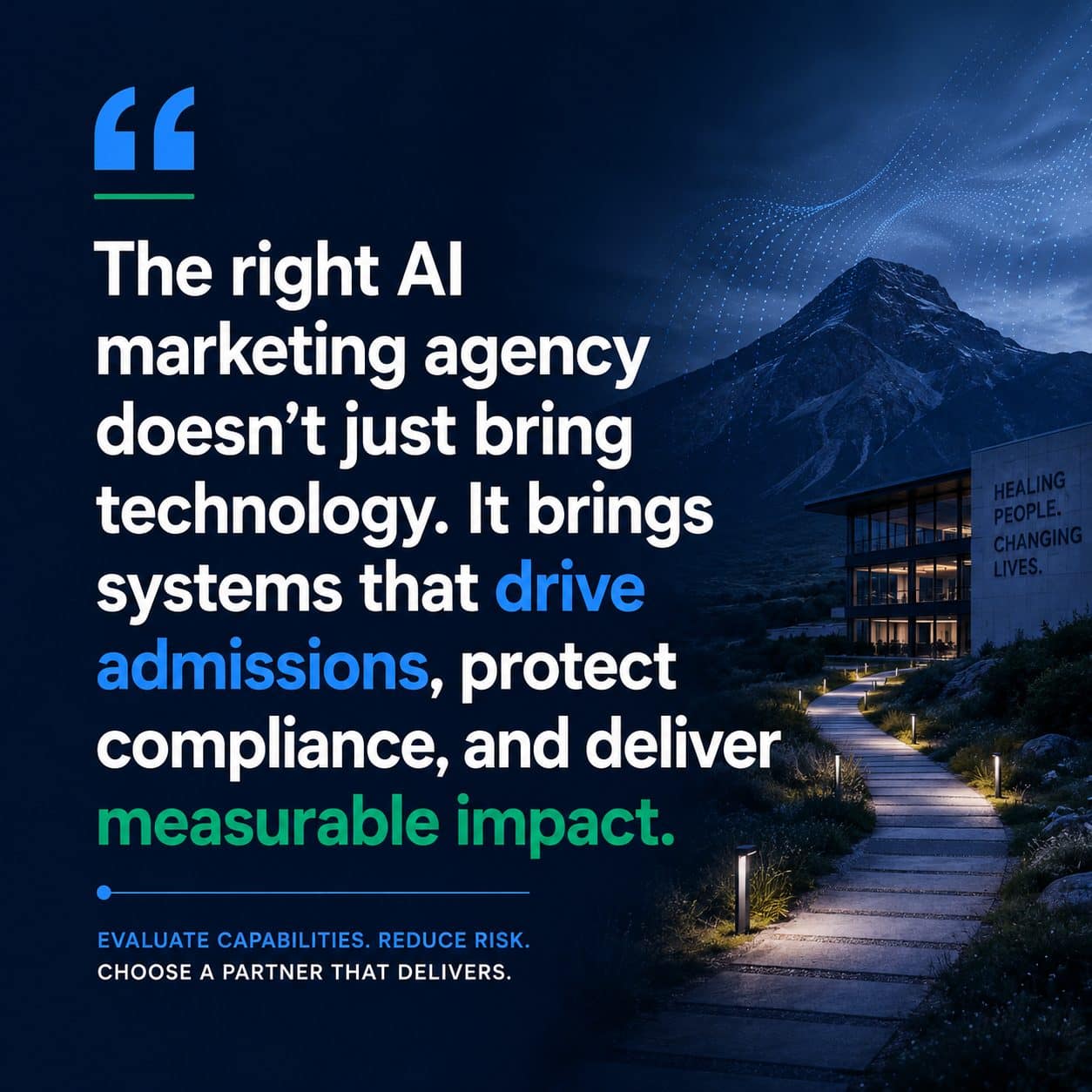
Comparing AI marketing agencies requires moving past capability language to operational evidence. Use these criteria to evaluate potential partners against each other on dimensions that predict actual performance.
Vertical specialization is the first filter. Ask what percentage of an agency's revenue comes from behavioral health or mental health clients. Ask how many campaigns they have had flagged or suspended by Google for policy violations in the past twelve months. Ask whether they have worked with inpatient programs specifically, since inpatient economics differ significantly from outpatient programs.
Technology ownership matters for data sovereignty and customization. An AI-native marketing agency with owned infrastructure can build models specific to your vertical and keep your data within controlled systems. Agencies wrapping commercial AI APIs have limited flexibility and limited control over where your data flows or what happens when those APIs change.
Compliance posture should be demonstrable. Ask whether the agency has LegitScript certification awareness integrated into campaign setup. Ask how they handle HIPAA considerations in their data practices. Ask for their Google Ads policy compliance record. Compliance integration at the infrastructure level is the standard that a sophisticated agency should meet.
Founder and team credentials provide a useful signal about depth. Court-certified expert witness status in marketing indicates peer-recognized expertise. Direct operator experience at treatment centers indicates an understanding of your business model beyond the marketing function. These backgrounds matter when you need an agency that can advise on strategy, not just execute tactics.
- What percentage of revenue comes from behavioral health clients?
- How many Google Ads policy violations or suspensions in the past 12 months?
- Does the agency own its AI infrastructure or wrap third-party APIs?
- Can they demonstrate LegitScript and HIPAA awareness in their process?
- Does agency leadership have direct operator experience in healthcare?
Next Steps: Moving from Evaluation to Engagement
How to structure the conversation once you have a short list
Once you have narrowed your list of potential AI marketing agency partners, a structured discovery conversation covers four areas: current performance baseline, compliance history, lead quality issues, and growth objectives.
Come prepared with your current cost per lead and cost per admission if you have them. If you do not have admission-level attribution, that gap is itself diagnostic. The right agency will help you build that tracking infrastructure. An agency that does not ask about it is optimizing for metrics that do not reflect your actual business.
Discuss your compliance history directly. Have you had ads disapproved, accounts suspended, or policy warnings? An agency with deep behavioral health experience will recognize these patterns immediately and have established approaches to remediation. Google's advertising policies for healthcare are specific and frequently updated, and an experienced agency maintains active awareness.
Define what lead quality means for your intake team in concrete terms. Are you receiving calls from people who cannot verify insurance? Wrong geography? Wrong level of care needed? These specifics shape the targeting strategy and audience definitions that the agency should build. Generic audience parameters waste budget on leads that your intake team cannot convert.
The best agency relationships begin with mutual assessment. You are evaluating the agency, and a serious agency should be evaluating whether it can produce results for your specific situation. An agency that accepts every prospective client without qualification is optimizing for its own revenue, not your outcomes.
Strategy
Want to start with a quick message?
Ready to Evaluate Your AI Marketing Options?
Schedule a discovery call to discuss your current performance baseline, compliance history, lead quality challenges, and growth objectives. We will give you an honest assessment of whether our approach fits your situation and answer your questions about AI-native behavioral health marketing without the pitch deck language.
Questions, Answered.
Paid search on Google Ads remains the highest-intent channel for behavioral health, though it requires navigating sensitive vertical restrictions and a prohibition on retargeting. SEO builds sustainable traffic for informational queries during the consideration phase. AI-powered multivariant optimization on landing pages improves conversion rates by matching page content to visitor characteristics in real time. Attribution modeling that tracks through to admission, not just form fill, enables accurate budget allocation across all channels.
Ask for case studies with admission-level outcomes rather than click or lead metrics. Request details on their AI infrastructure: do they own their systems or wrap third-party APIs? Ask how their models incorporate downstream conversion data and what feedback loops connect admission outcomes to targeting. Evaluate whether they have managed meaningful scale in behavioral health, specifically, since vertical-specific data density is what makes predictive models accurate.
LegitScript certification awareness is a baseline requirement for addiction treatment advertising on major platforms. Google Ads classifies behavioral health as a sensitive healthcare vertical, which prohibits retargeting and requires careful ad copy review before launch. HIPAA considerations apply to any agency handling data that could identify patients or inform targeting based on health status. An agency should demonstrate compliance integration at the infrastructure level, not as a post-launch review step.
Agencies with owned AI infrastructure can customize models for your specific vertical, maintain data sovereignty over your campaign data, and respond to platform changes without waiting for third-party API updates. Agencies wrapping commercial AI APIs have limited flexibility and less control over where your data flows or what happens when those APIs change their terms, pricing, or capabilities. For behavioral health specifically, data sovereignty has both competitive and compliance implications.
AI enables multivariant optimization that routes each visitor to the landing page variation most likely to convert based on that person's characteristics, operating faster and at greater scale than manual testing. Predictive analytics identify which audience segments convert to admissions rather than just generating clicks, improving targeting efficiency and reducing wasted spend. Attribution modeling connects media spend to actual admissions, enabling accurate ROI calculation. Automated bid management responds to market conditions in real time, maintaining efficiency during census fluctuations and competitive shifts.
Ready to see what AI-native marketing can do for your treatment center?
Request a free audit of your paid media, landing pages, attribution, and compliance posture. You'll get a straight assessment of where the opportunities are.
or email us at info@marketingpowered.ai