Guide
Optimize Your Google Ads Quality Score with Proven Strategies
A practical guide to improving ad performance, reducing CPC, and maximizing ROI in behavioral health advertising.
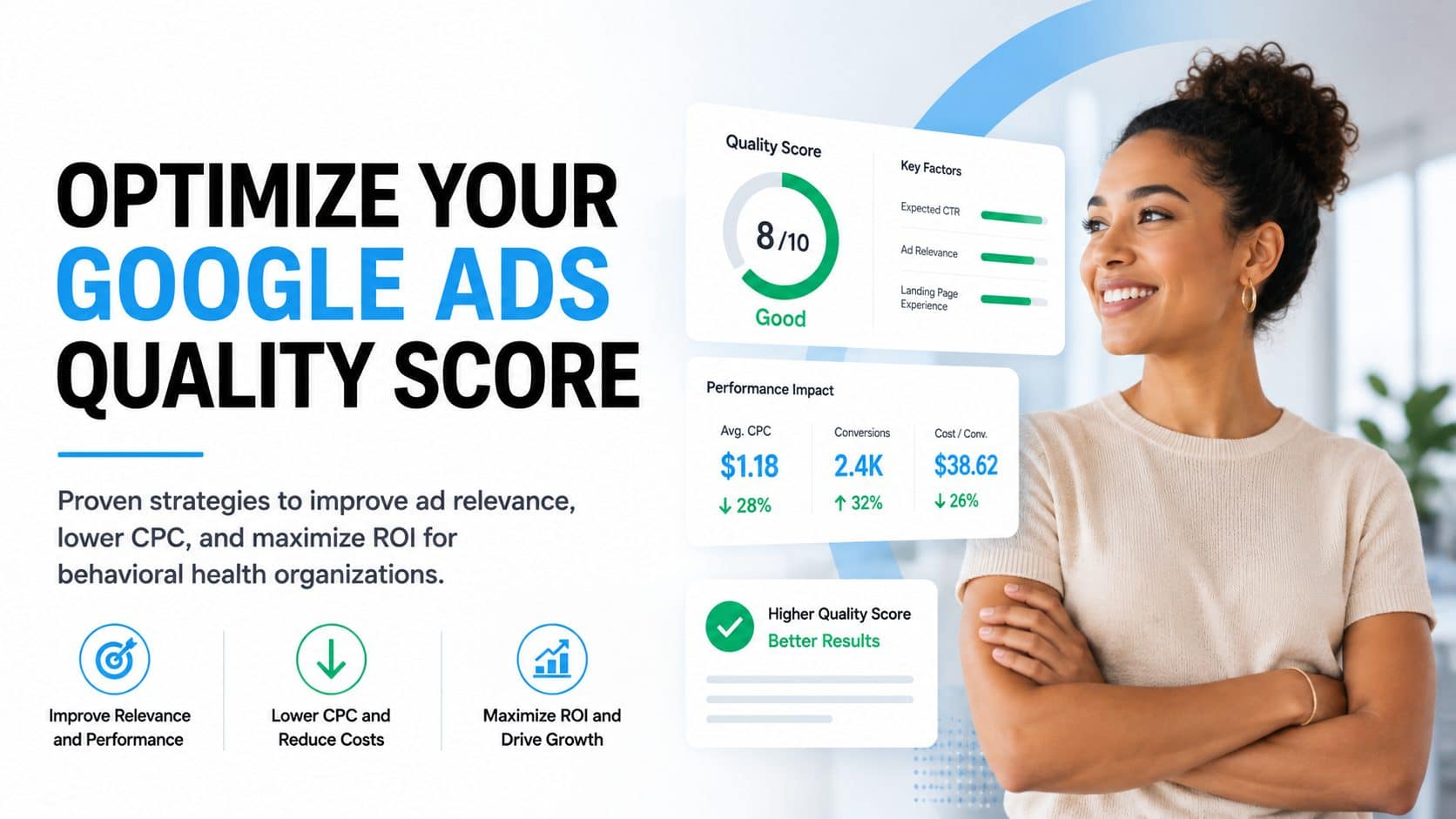
Understanding Quality Score in Google Ads
Quality score in Google Ads is a diagnostic metric that Google assigns to each keyword in your account on a scale of 1 to 10. It reflects how relevant your ads, keywords, and landing pages are to users who see your advertisements. For behavioral health advertisers managing significant media budgets, understanding this metric is foundational to campaign efficiency.
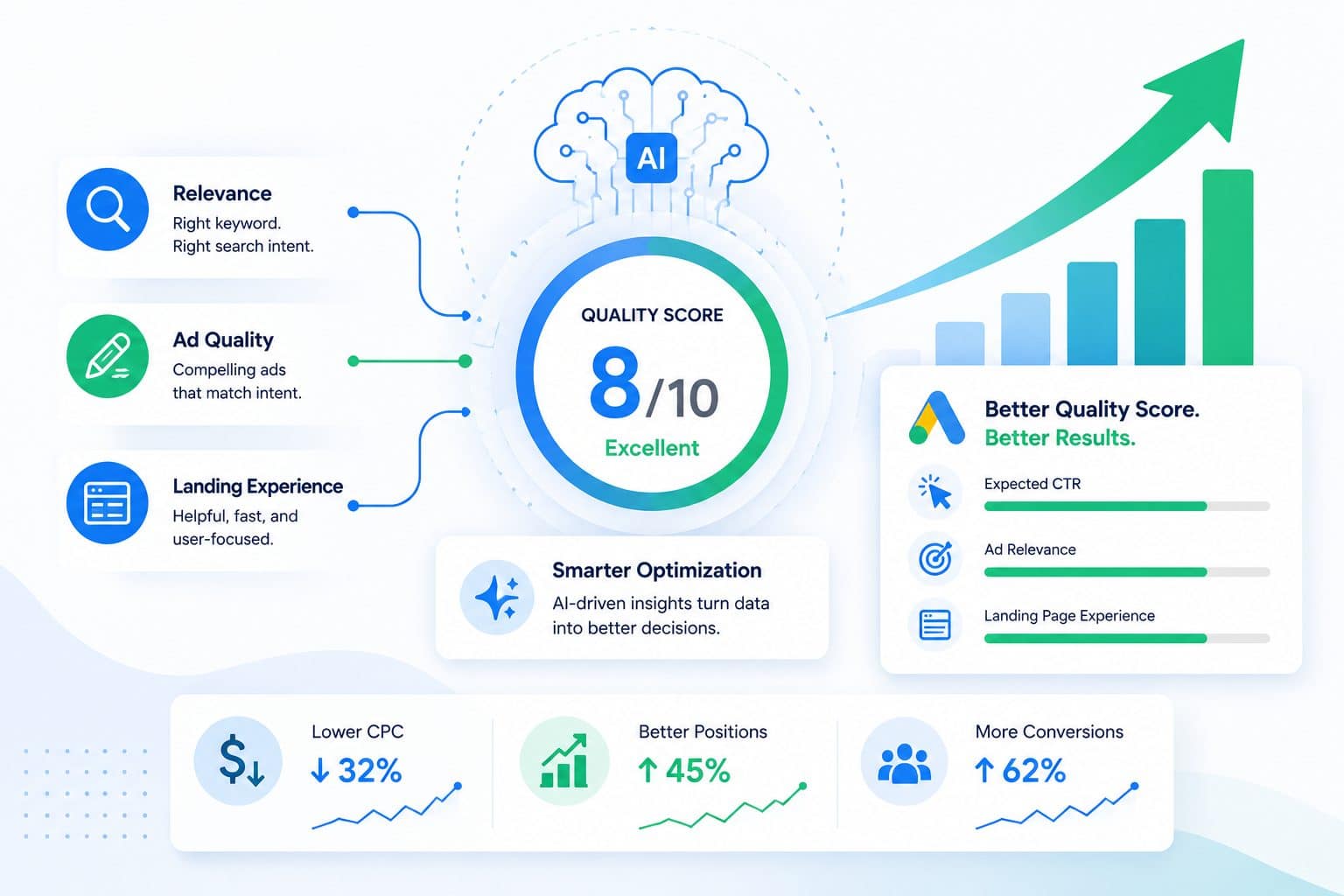
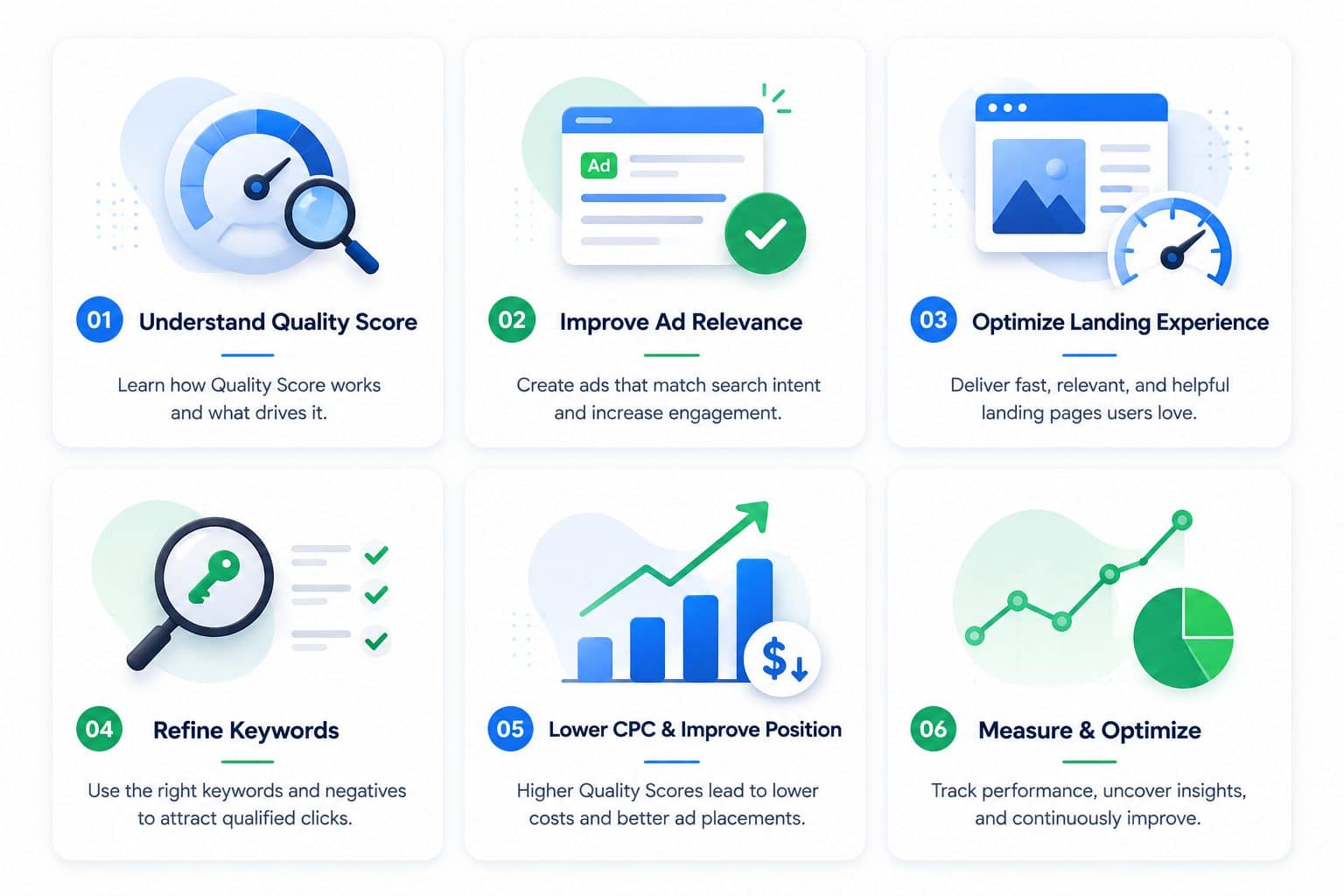
Google calculates quality score based on three primary components. Expected clickthrough rate (CTR) predicts how likely users are to click your ad when it appears. Ad relevance measures how closely your ad copy matches the intent behind a user's search query. Landing page experience evaluates whether your destination page delivers on what the ad promises, including factors like load speed, mobile responsiveness, and content relevance.
These components are assessed relative to other advertisers competing for the same keywords. A score of 5 indicates average performance compared to competitors. Scores above 7 signal strong alignment between your ads and user expectations. Scores below 4 indicate significant room for improvement that is likely costing you money.
According to Google's official quality score documentation, the metric serves as an aggregate estimate of your overall performance in ad auctions. Google uses real-time calculations during each auction that may differ from the reported score, but the diagnostic number provides directional guidance for optimization efforts.
Why Quality Score Matters for Your Ad Budget
Quality score directly influences two outcomes that impact your bottom line: cost per click (CPC) and ad position. Google rewards advertisers who deliver relevant experiences to users. Higher quality scores translate to lower CPCs and better placement, sometimes dramatically.
The math works in your favor when you invest in relevance. An advertiser with a quality score of 8 might pay 30% to 50% less per click than a competitor with a score of 4, while achieving comparable or better ad positions. For organizations managing substantial Google Ads budgets, even small improvements in quality score compound into significant savings. We have managed $1.5M to $2M monthly in Google Ads across behavioral health accounts.
Beyond cost efficiency, quality score affects your ability to compete. In behavioral health advertising, where sensitive vertical restrictions already limit targeting options, strong quality scores ensure your ads appear when they matter most. Low scores may result in ads not showing at all for competitive queries, regardless of your bid.
Refine Keyword Relevance and Ad Group Structure
Free Audit
Want a straight read on where your budget is leaking?
Foundation: Tight theming drives quality score improvement
Tightly themed ad groups are the foundation of quality score optimization. Group keywords by specific intent rather than broad categories. An ad group targeting 'outpatient addiction treatment' should not include keywords for 'residential detox programs.' Each ad group should contain 10 to 20 closely related keywords that can all be served by the same ad copy without awkward fits.
Negative keywords are equally important. Exclude search terms that drive irrelevant clicks. Review your search terms report weekly and add negatives aggressively. This improves CTR by ensuring your ads only appear for searches where they genuinely match user intent.
- Use single-theme ad groups with 10 to 20 tightly related keywords
- Review the search terms report weekly and add negatives proactively
- Separate branded and non-branded keywords into distinct campaigns
- Audit existing ad groups quarterly to collapse or split based on performance data
Write Ad Copy That Matches Search Intent
Ad relevance: Speak the language your audience uses
Ad relevance improves when your headlines and descriptions directly address what users are searching for. Include the primary keyword in at least one headline. Mirror the language your audience uses. If someone searches for 'alcohol rehab near me,' your ad should acknowledge that specific need rather than defaulting to generic treatment messaging.
Use responsive search ads with multiple headline and description variations. Google's machine learning will test combinations and surface the versions that resonate with different queries. Provide at least 8 to 10 headline options and 3 to 4 descriptions to give the algorithm enough material to optimize.
Behavioral health advertisers face an additional layer of complexity: ad copy must comply with LegitScript certification standards and Google's sensitive vertical policies. This means certain claims, testimonials, and urgency tactics that work in other industries are not available to you. Invest in creative that is both compliant and compelling — the two are not mutually exclusive.
Email Us
Prefer to send the context directly?
Optimize Landing Page Experience
Landing page experience: Where most behavioral health campaigns fall short
Landing page experience is where many behavioral health marketing campaigns fall short. Google evaluates whether your page delivers on the ad's promise, loads quickly, works well on mobile devices, and provides a clear path to the user's goal.
Ensure message match between ad copy and landing page headline. If your ad promotes 'evidence-based depression treatment,' the landing page should lead with that exact topic, not a generic homepage. Page load speed matters: Google's Web Vitals guidelines recommend a Largest Contentful Paint under 2.5 seconds. Compress images, minimize code, and use a content delivery network.
For behavioral health advertisers, compliance requirements add complexity. Your landing pages must satisfy both Google's quality standards and LegitScript certification requirements. This dual mandate requires careful attention to claims, disclosures, and user experience design. Pages that try to satisfy compliance by adding lengthy disclaimers without addressing user needs will score poorly on landing page experience.
- Match landing page headline to ad copy promises (message match)
- Achieve Largest Contentful Paint under 2.5 seconds
- Ensure mobile responsiveness across all device types
- Include clear, single calls to action that guide users toward conversion
- Satisfy LegitScript certification requirements without sacrificing usability
Common Pitfalls That Undermine Quality Score
Several mistakes consistently undermine quality score improvement efforts. Recognizing these patterns helps you avoid wasted optimization cycles.
Keyword stuffing in ad copy forces keywords into every headline and description, which degrades readability and can actually hurt ad relevance scores. Write for humans first and include keywords where they fit naturally.
Neglecting mobile experience is a costly error. Over 60% of searches occur on mobile devices. If your landing pages are slow or difficult to navigate on phones, your landing page experience score will suffer regardless of desktop performance.
Ignoring negative keywords allows irrelevant clicks to accumulate, damaging your CTR and wasting budget. Behavioral health advertisers face particular challenges here because broad match keywords can trigger ads for informational searches with no treatment intent.
Failing to test systematically is perhaps the most common mistake at scale. Quality score optimization requires ongoing experimentation with ad copy, landing page elements, and keyword groupings. Track changes over time and document what works. Attribution discipline matters: we track attribution through to admission because that is the only way to know which optimizations actually drove business results.
Strategy
Want to start with a quick message?
Future Trends in Google Ads Quality Score
Google continuously refines how it evaluates ad quality. Several trends are shaping the future of quality score optimization.
Machine learning integration is accelerating. Google's algorithms increasingly use machine learning to predict ad performance and user satisfaction. Responsive search ads, automated bidding strategies, and Performance Max campaigns all rely on AI to optimize in ways that static campaigns cannot. Advertisers who provide high-quality inputs, including strong creative assets, clean conversion data, and well-structured accounts, will see better algorithmic outcomes.
User experience signals are gaining weight. Google is placing more emphasis on post-click behavior. Bounce rates, time on page, and conversion actions all inform how the platform evaluates landing page experience. Pages that deliver genuine value will outperform thin content, even if both technically meet relevance criteria.
Privacy and first-party data are becoming decisive advantages. As third-party cookies phase out and privacy regulations tighten, advertisers with strong first-party data strategies will outperform those relying on third-party audiences. In behavioral health, where retargeting is already prohibited by Google's sensitive vertical policies, this shift reinforces the importance of quality over quantity in paid acquisition.
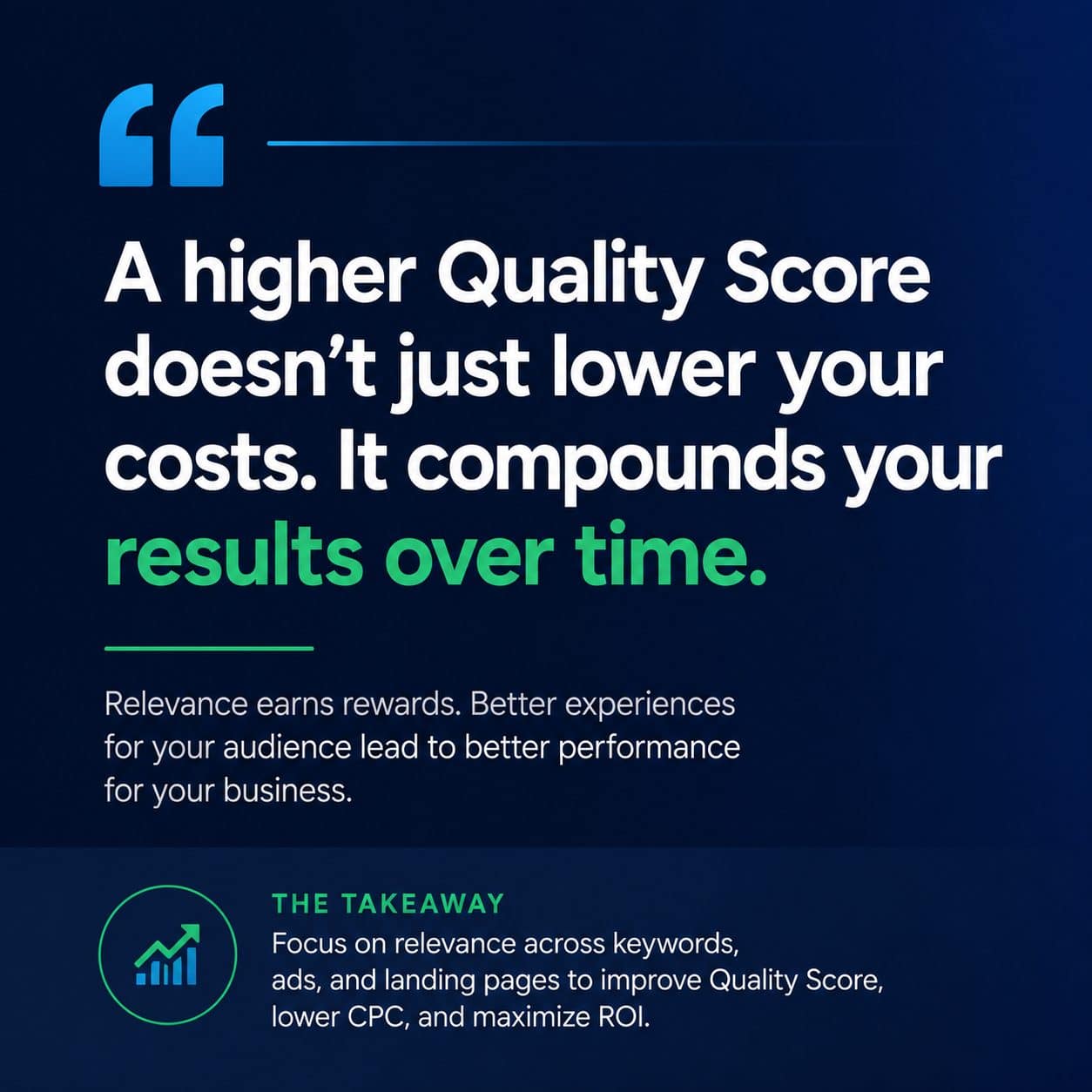
AI-powered creative optimization is changing iteration speed. We have operated AI-native infrastructure since 2022, and the capabilities available today for ad copy testing, landing page personalization, and multivariate optimization were not possible even two years ago. Advertisers who integrate AI thoughtfully into their workflows will iterate faster and improve quality scores more efficiently. The fundamentals, however, remain constant: relevant keywords, compelling ads, and landing pages that deliver on user expectations.
Get a Quality Score Audit from Specialists Who Manage $50M+ in Behavioral Health Media
Quality score optimization requires both technical expertise and vertical knowledge. Our team has managed $1.5M to $2M monthly in Google Ads across behavioral health accounts, with attribution tracked through to admission. We understand the compliance constraints, the sensitive vertical restrictions, and the real economics of treatment center marketing. If your quality scores are holding back your campaigns, we can identify the gaps and build a plan to fix them.
Questions, Answered.
Quality score has a direct inverse relationship with cost per click. Google rewards advertisers who deliver relevant experiences by charging them less per click and giving them better ad positions. An advertiser with a quality score of 8 might pay 30% to 50% less than a competitor with a score of 4 for the same keyword. This relationship compounds over time: lower CPCs mean more clicks for the same budget, which generates more conversion data, which enables better optimization.
Google calculates quality score based on three components. Expected clickthrough rate predicts how likely users are to click your ad compared to competitors. Ad relevance measures how closely your ad copy aligns with the user's search intent. Landing page experience evaluates whether your destination page delivers relevant content, loads quickly, and provides a good user experience. Each factor is rated as below average, average, or above average relative to other advertisers.
Improve ad relevance by structuring ad groups tightly around specific keyword themes, including primary keywords in your headlines, and writing copy that directly addresses user intent. Use responsive search ads with multiple headline and description variations so Google can match the most relevant combination to each query. Review which ads are performing and pause underperformers. Ensure the language in your ads mirrors how your target audience actually searches.
Landing page experience measures whether your page delivers on the promise your ad makes. Google evaluates relevance (does the page content match the ad and keyword), usability (is the page easy to navigate on all devices), and load speed (does the page render quickly). For behavioral health advertisers, landing pages must also satisfy compliance requirements, including LegitScript standards. Pages with strong message match, fast load times, and clear calls to action score highest.
A quality score of 7 or higher is generally considered good and indicates your ads, keywords, and landing pages are well-aligned with user intent. A score of 5 is average relative to competitors. Scores below 4 signal significant problems with relevance or landing page experience that are likely increasing your CPCs and limiting your ad delivery. For competitive keywords in behavioral health, aiming for scores of 7 to 9 is a reasonable performance target.
Ready to see what AI-native marketing can do for your treatment center?
Request a free audit of your paid media, landing pages, attribution, and compliance posture. You'll get a straight assessment of where the opportunities are.
or email us at info@marketingpowered.ai