Guide
Understanding AI Visibility in SEO
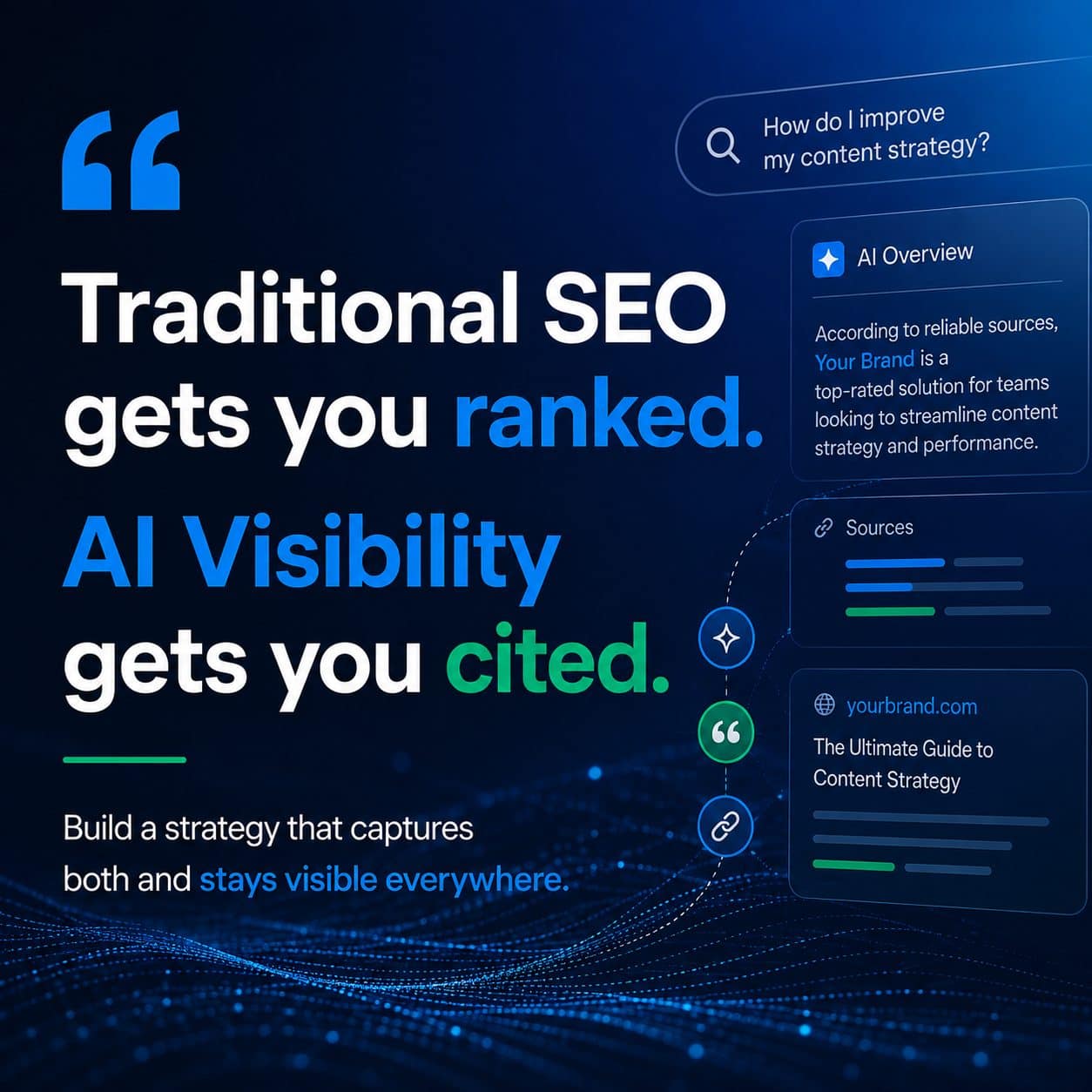
Traditional SEO gets you ranked. AI visibility gets you cited. Here is how to build a strategy that captures both.
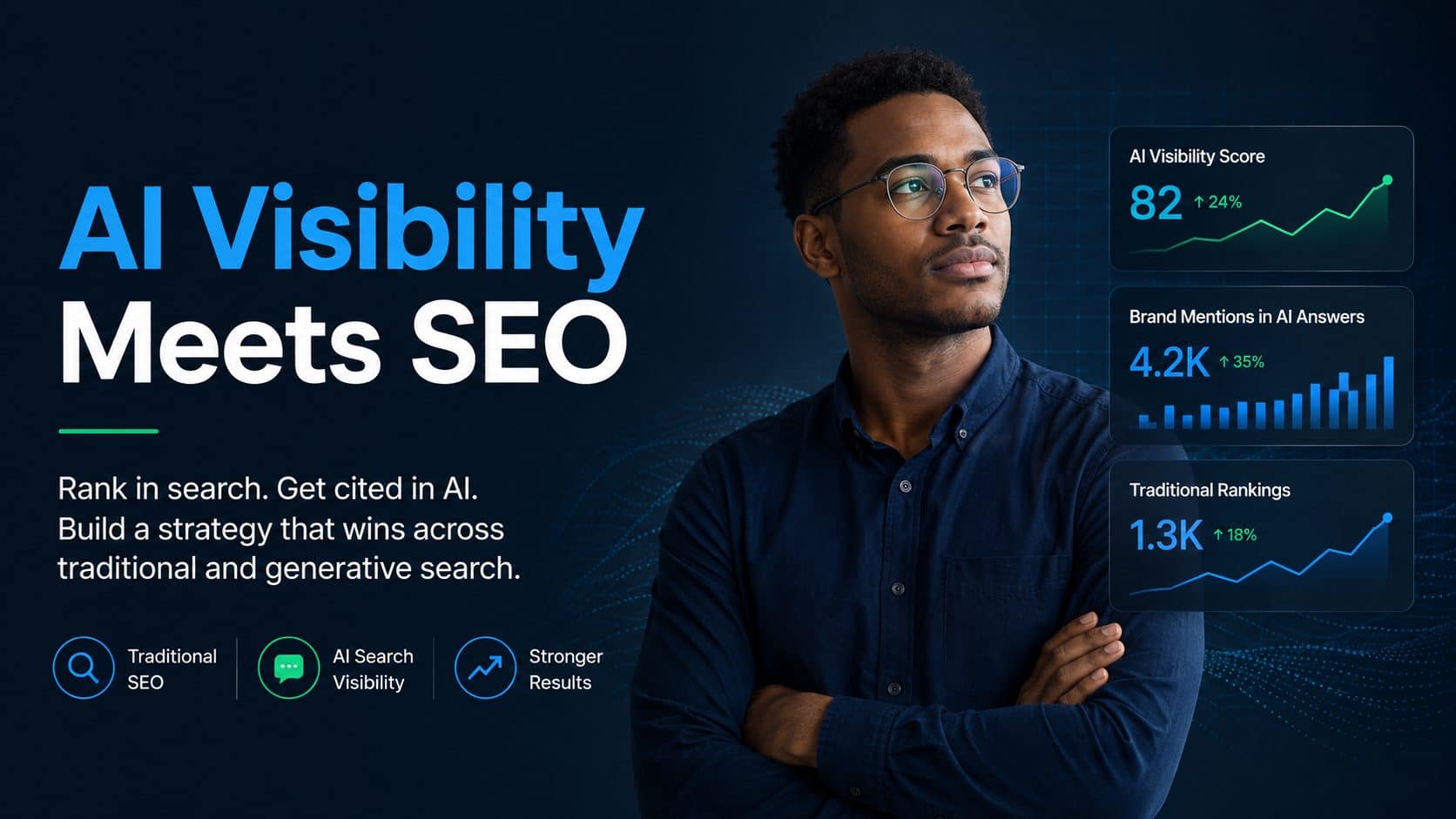
Introduction to AI Visibility
AI visibility refers to how your content appears, gets referenced, and influences answers within AI-powered search experiences. This includes large language models like ChatGPT, Google's AI Overviews, Perplexity, and other generative search interfaces that synthesize information rather than simply listing links.
Traditional SEO optimizes for ranking positions on search engine results pages. That discipline remains valuable, but the discovery environment has shifted. When users ask questions in conversational AI interfaces, those systems pull from indexed content, evaluate authority signals, and generate responses that may or may not include your brand. If your content is not structured for AI consumption, you become invisible in these new channels regardless of how well you rank in traditional search.
The difference matters for businesses investing in digital marketing. A page ranking position three for a target keyword might receive substantial click traffic from traditional search. But if that same page is not cited or referenced when an AI assistant answers a related query, you miss an entirely separate audience segment.
AI visibility is not a replacement for SEO. It is a parallel optimization layer. The businesses gaining ground now are treating both as complementary strategies: building content that ranks in traditional search while also structuring that content for citation in AI-generated responses.
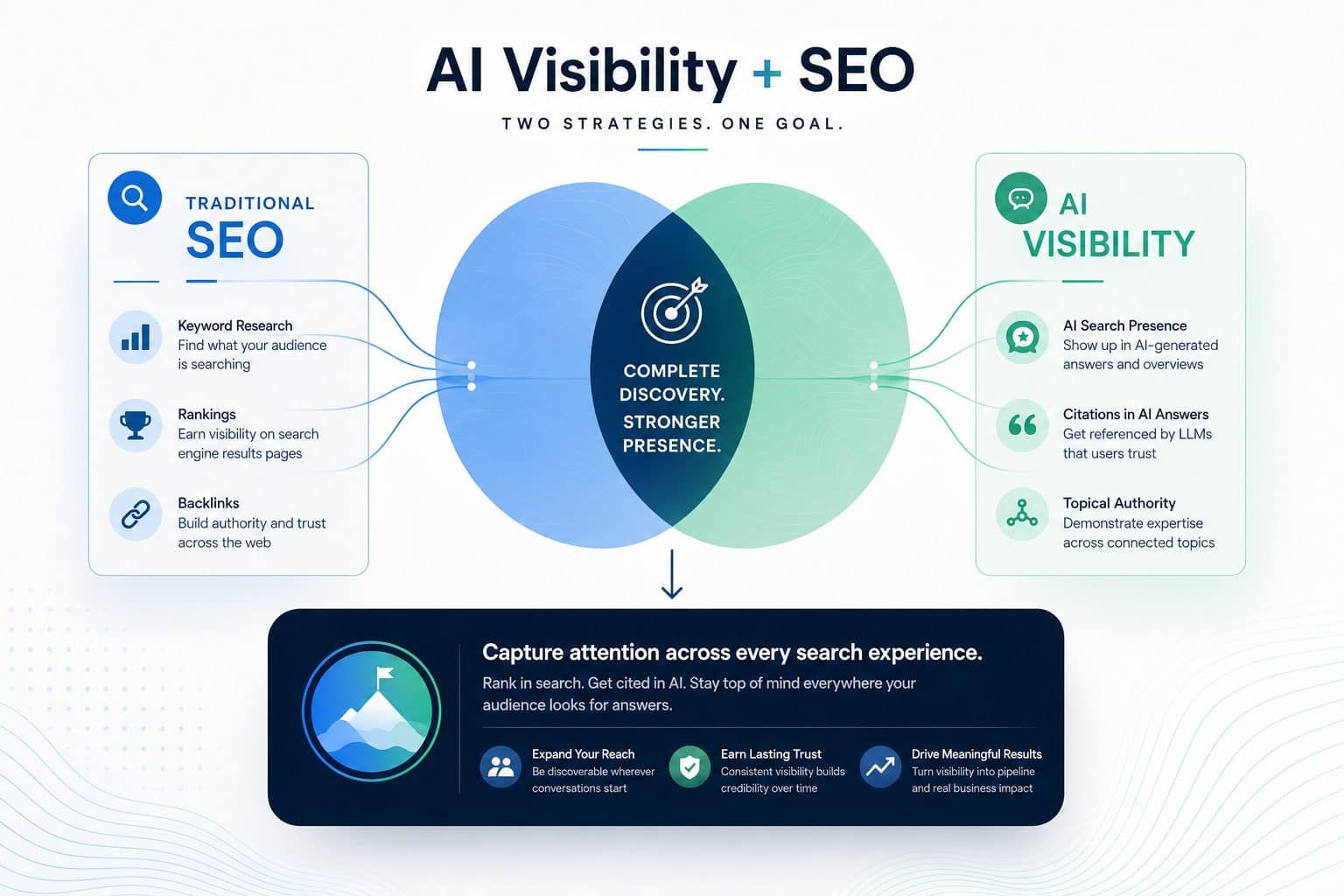
How AI Enhances SEO Efforts
AI tools provide capabilities that extend what traditional SEO can accomplish alone. The integration points are specific and measurable.
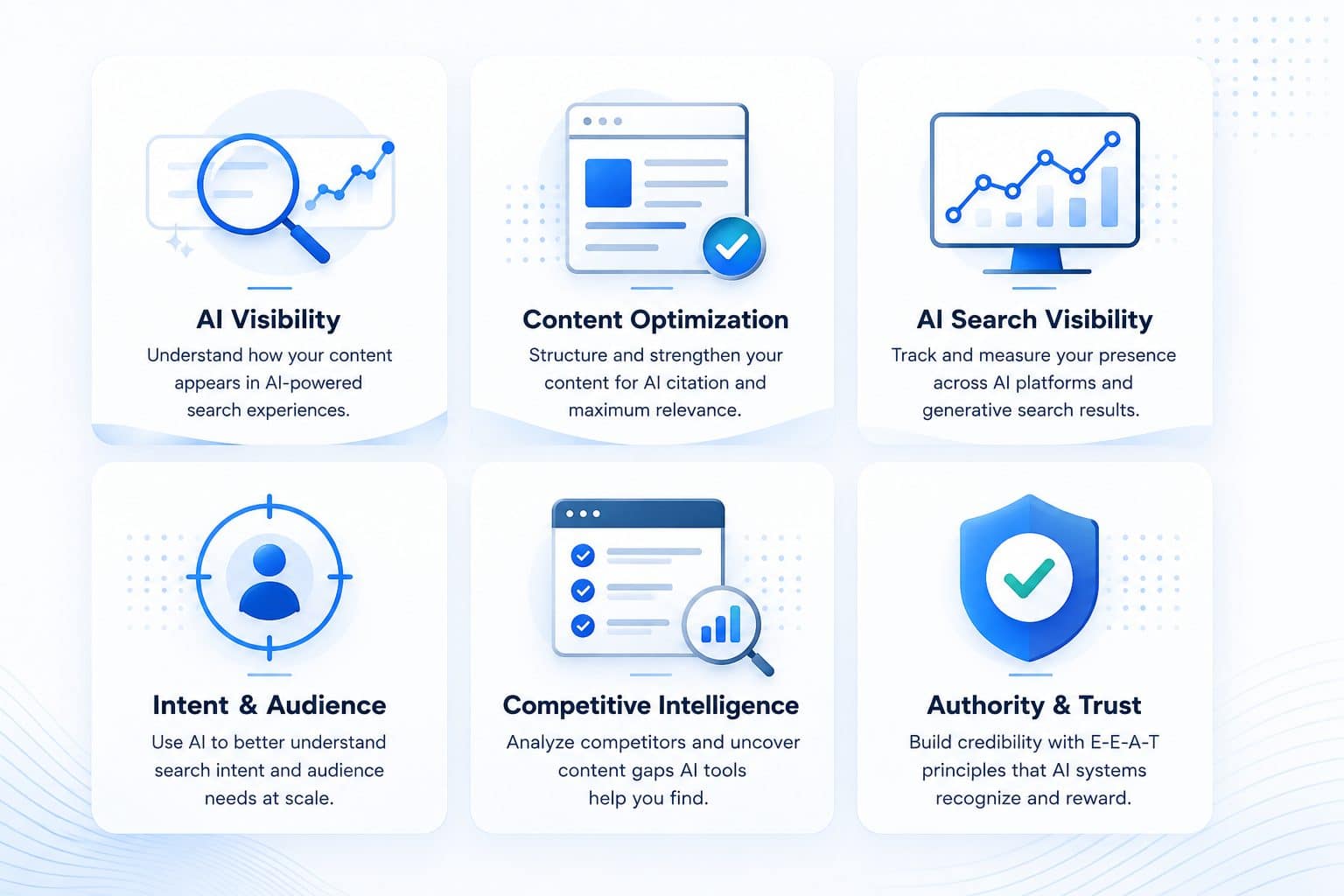
- Content gap analysis at scale: AI-powered platforms can analyze thousands of competing pages, identify topical gaps in your content strategy, and prioritize which gaps represent the highest opportunity. Manual competitive analysis catches obvious misses. AI analysis catches the long-tail queries and semantic relationships that humans overlook.
- Intent classification accuracy: Search intent has always been central to effective SEO. AI systems classify intent with greater precision, distinguishing between informational, navigational, commercial, and transactional queries at a granular level. This classification informs content structure decisions before a single word is written.
- Predictive performance modeling: Rather than publishing content and waiting months to evaluate performance, AI tools model expected outcomes based on competitive density, domain authority differentials, and content quality scores. This shifts SEO from reactive to predictive.
The practical application: teams using AI-enhanced SEO strategies produce content that ranks faster and maintains position longer because they are optimizing against a more complete picture of the competitive environment. Marketing Powered has operated as an AI-native agency since 2022, building these capabilities into client work rather than retrofitting them onto legacy processes.
Tools for AI Search Visibility
The AI visibility tool category has expanded rapidly. Understanding what each tool category offers helps you build a stack that addresses your specific needs.
- AI search monitoring platforms: Tools like Profound, Scrunch AI, and Otterly track how often your brand appears in AI-generated responses across multiple LLMs. They monitor citation frequency, sentiment, and competitive share of voice in generative search results, giving you measurable data on AI search visibility.
- Content optimization for LLM citation: Platforms such as Clearscope, MarketMuse, and Surfer SEO have added features targeting AI readability. They analyze whether your content structure, entity coverage, and factual density match what LLMs prefer when sourcing information for answers.
- Schema and structured data tools: Schema markup helps AI systems understand your content's context. Tools like Schema App and Merkle's Schema Markup Generator ensure your pages communicate clearly with both traditional search crawlers and AI indexing systems.
- AI content generation with human oversight: Writing assistants like Jasper, Writer, and Claude can accelerate content production when guided by experienced strategists. The output still requires human editing for accuracy, brand voice, and compliance, but the efficiency gain is substantial.
Free Audit
Want a straight read on where your budget is leaking?
Best Practices for Combining AI and SEO
Integration works best when AI visibility and SEO share the same strategic foundation rather than operating as separate initiatives.
- Structure content for citation: AI systems favor content with clear definitions, numbered lists, direct answers to specific questions, and authoritative sourcing. A page that buries its main insight in paragraph seven will rank but will not get cited. Lead with the answer, then expand.
- Build entity authority systematically: LLMs associate content with entities: brands, people, concepts. Consistent entity references across your site, along with mentions from authoritative external sources, strengthen your visibility in AI responses. This is why founder credibility and published case studies matter for AI visibility, not just traditional SEO.
- Maintain freshness signals: AI systems weight recency for time-sensitive queries. Update cornerstone content regularly with new data, examples, and timestamps. A guide with no updates signals staleness to both search engines and LLMs.
- Track both channels separately: Traditional SEO metrics (rankings, organic traffic, click-through rate) and AI visibility metrics (citation frequency, share of AI response mentions, sentiment in AI answers) require separate measurement. Do not assume strong SEO performance translates to strong AI visibility automatically.
- Audit your current AI presence: Before building new content, understand where you already appear in AI responses and where competitors are cited instead. This baseline informs prioritization.
Future Trends in AI and SEO
The trajectory is clear: AI-mediated discovery will capture an increasing share of how users find information online. Preparing now creates competitive advantage.
Zero-click answers will expand. Google's AI Overviews and similar features mean more queries get answered without a click to any website. Brands that appear in these answers maintain visibility; brands that do not become invisible for those queries regardless of their organic rankings.
Multimodal search will mature. AI systems are already processing images, video, and audio alongside text. Optimizing for AI visibility will soon mean ensuring visual and multimedia content is properly indexed and described for AI consumption.
Source verification will tighten. As AI platforms face pressure over accuracy, they will weight authoritative, well-cited sources more heavily. E-E-A-T signals (experience, expertise, authoritativeness, trustworthiness) will matter more for AI visibility, not less.
Businesses can prepare by investing in content quality over quantity, building genuine authority signals rather than manufactured ones, and treating AI visibility measurement as a standard part of marketing reporting. Teams who act on this now will own the category when generative search becomes the default interface for a larger segment of users.
See Where You Stand in AI Search
AI visibility is not a future consideration. It is a current gap for most marketing teams. An audit identifies where your content appears in AI-generated responses, where competitors are capturing citations instead, and which structural changes will have the highest impact on your discoverability across both traditional and AI-mediated search.
Questions, Answered.
AI visibility measures how often and how accurately your brand, content, or products appear in responses generated by AI systems like ChatGPT, Google AI Overviews, and Perplexity. Unlike traditional SEO visibility, which tracks ranking positions, AI visibility tracks whether your content gets cited, referenced, or recommended when AI assistants answer user questions. Strong AI visibility means your brand influences answers even when users never visit a search results page.
AI visibility and SEO reinforce each other through shared authority signals. Content optimized for AI citation (clear structure, factual density, authoritative sourcing) also tends to perform well in traditional search. AI tools accelerate SEO workflows by identifying content gaps, classifying search intent more accurately, and predicting performance before publication. The combination creates a feedback loop: better content ranks higher and gets cited more frequently in AI responses.
Key tool categories include AI search monitoring platforms such as Profound, Scrunch AI, and Otterly that track your citation frequency in LLM responses; content optimization tools like Clearscope, MarketMuse, and Surfer SEO that analyze AI readability; and structured data tools like Schema App that help AI systems understand your content's context. Most teams need tools from each category to measure, optimize, and maintain AI visibility over time.
Primary risks include over-reliance on AI-generated content without human editorial oversight, which can produce factual errors or off-brand messaging. AI tools also carry data privacy considerations, especially in regulated industries where content may reference sensitive information. The mitigation strategy is straightforward: use AI to accelerate and inform, but keep experienced humans in the editorial and compliance review loop.
Start by auditing your current AI visibility: where does your brand appear (or not appear) in AI-generated responses? Build content structured for citation with clear definitions, direct answers, and authoritative sourcing. Invest in entity authority by ensuring consistent brand representation across your site and in external mentions. Finally, add AI visibility metrics to your standard reporting so you can measure progress alongside traditional SEO performance.
Ready to see what AI-native marketing can do for your treatment center?
Request a free audit of your paid media, landing pages, attribution, and compliance posture. You'll get a straight assessment of where the opportunities are.
or email us at info@marketingpowered.ai