Guide
Understanding Generative Engine Optimization
A practical framework for optimizing content visibility in AI-powered search environments

What is Generative Engine Optimization?
Generative engine optimization is the practice of structuring content so AI-powered search systems can accurately interpret, summarize, and cite it. Unlike traditional SEO, which focuses primarily on ranking in a list of blue links, this approach targets the summarized responses that tools like Google's AI Overviews, Bing Copilot, and standalone AI assistants deliver directly to users.
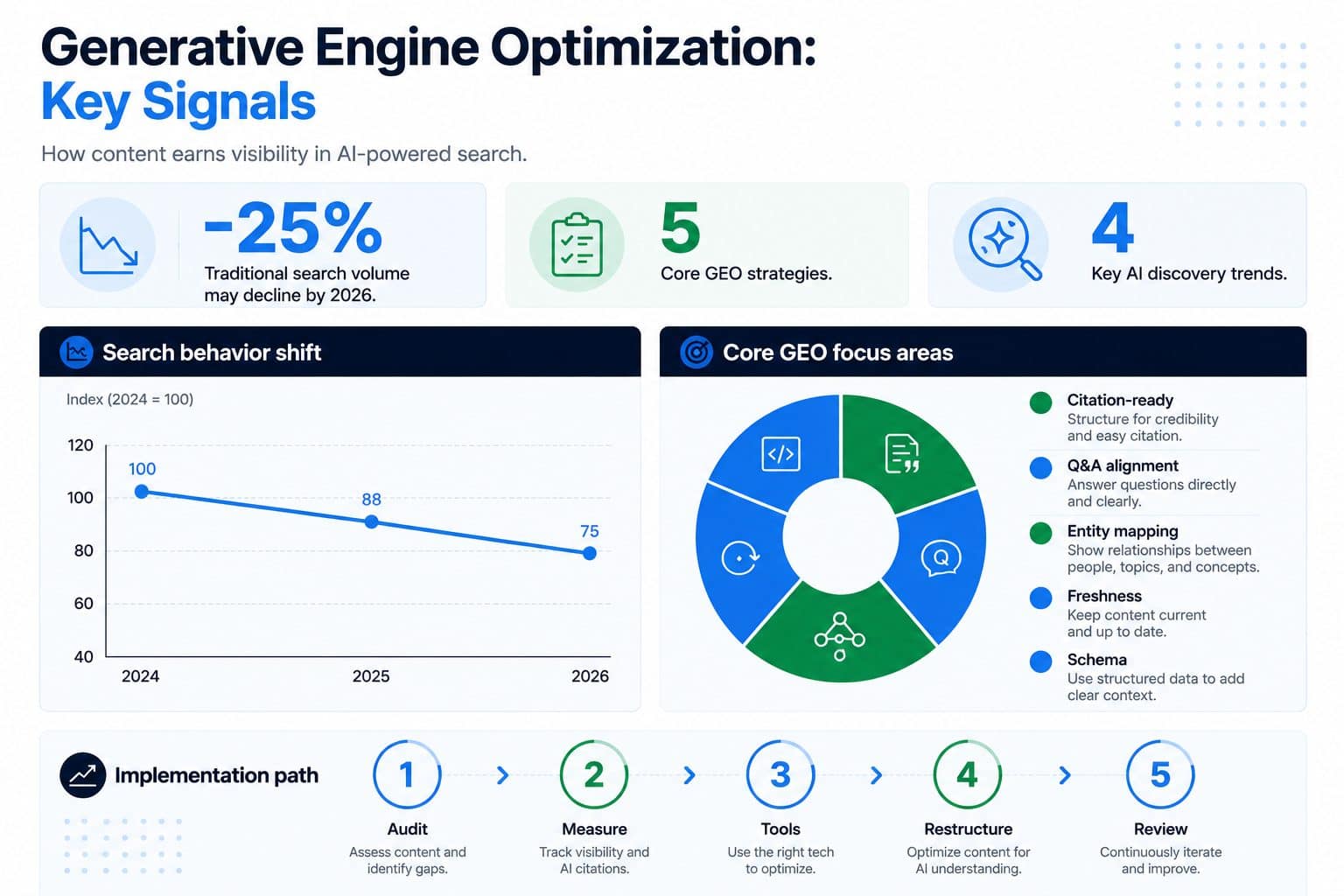
The distinction matters because user behavior is shifting. According to Gartner's 2024 predictions, traditional search engine volume could decline by 25% by 2026 as users migrate to AI chat interfaces and virtual agents. For behavioral health organizations competing for visibility, this shift demands a new content architecture.
Traditional SEO optimizes for crawlers that index pages and rank them by signals like backlinks, keyword density, and page authority. Generative engine optimization goes further. It optimizes for large language models that parse content semantically, extract factual claims, and synthesize answers from multiple sources. The goal is not just to rank but to be cited, quoted, or surfaced as the authoritative source within an AI-generated response.
For behavioral health solutions providers, this creates both opportunity and complexity. AI systems favor content that is structured, factually grounded, and contextually complete. Organizations that adapt their content strategy now position themselves to capture visibility as search interfaces continue to evolve.
Key Strategies for Generative Engine Optimization
Effective generative engine optimization requires deliberate structural and semantic decisions. The following strategies form the foundation of a content approach built for AI discovery.
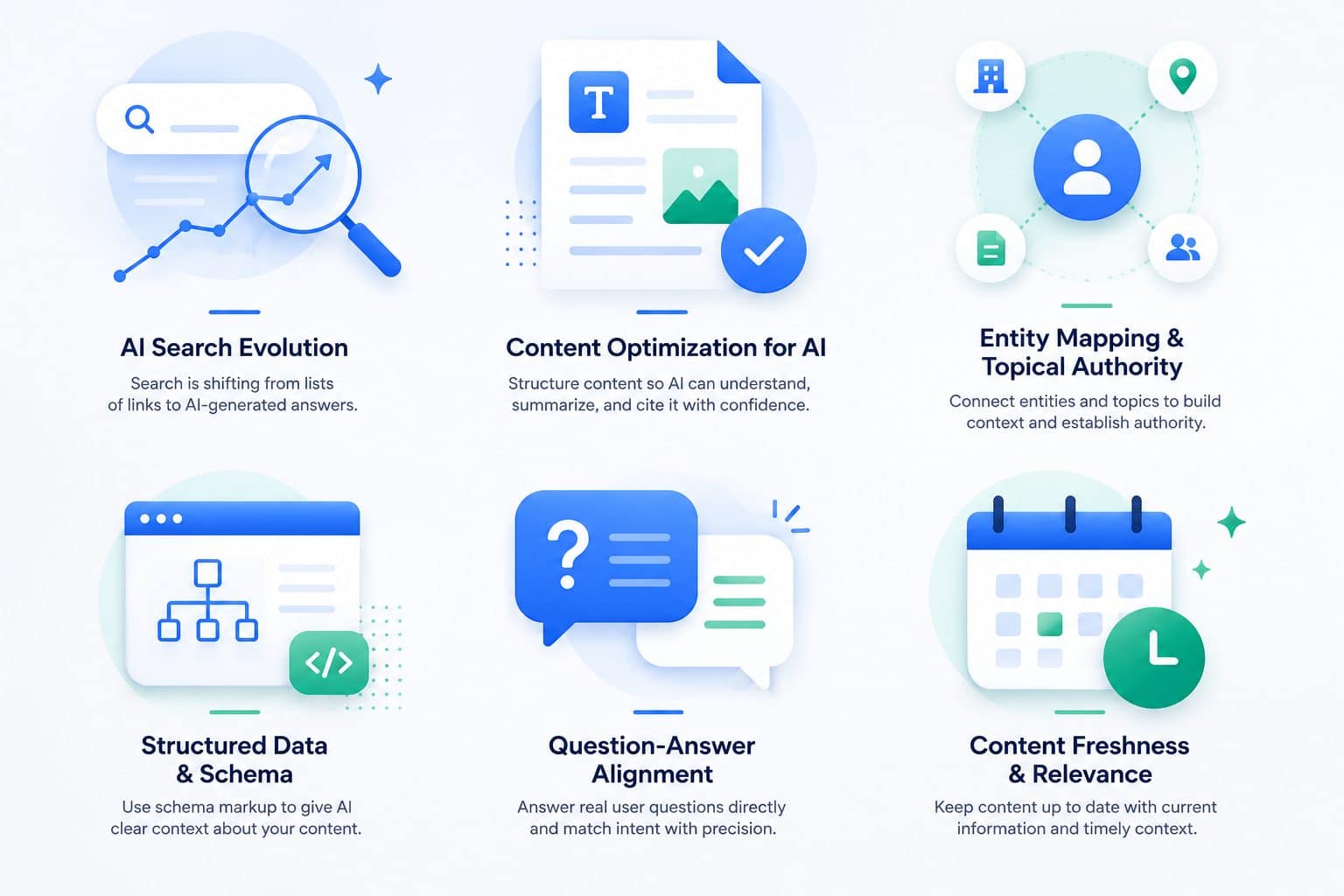
- Keyword clustering and entity mapping: Group related terms into semantic clusters rather than targeting isolated keywords. AI models understand topic relationships, so content that demonstrates topical depth through interconnected concepts signals authority. Map entities (people, organizations, concepts, locations) and their relationships explicitly in your content.
- Structured data and schema markup: Implement schema.org markup to give AI systems explicit context about your content. FAQPage, HowTo, Article, and Organization schemas help models parse content accurately. For healthcare organizations, this also supports compliance by clearly delineating informational content from promotional claims.
- Citation-ready formatting: Structure content with clear claims, numbered steps, and source attributions. AI systems prioritize content they can cite confidently. Use declarative sentences, place key facts early in paragraphs, and provide inline citations to authoritative sources.
- Question-answer alignment: Anticipate the exact questions users ask and answer them directly within your content. AI systems extract answers that match query intent precisely. FAQ sections, clear definitions, and direct response patterns increase citation likelihood.
- Content freshness signals: Maintain updated publication dates, revise statistics regularly, and include temporal context ("as of Q1 2026") where relevant. AI models factor recency into source selection, particularly for fast-moving topics.
LLM SEO and Its Role in Optimization
LLM SEO refers specifically to optimizing content for large language model interpretation. While generative engine optimization is the broader discipline, LLM SEO focuses on how models like GPT-4, Claude, and Gemini process and retrieve information.
Large language models do not read content the way humans do. They tokenize text, identify semantic relationships, and weight information based on training patterns and retrieval signals. Content optimized for LLM SEO is structured to align with these processing patterns.
Practical LLM SEO implementation includes using consistent terminology throughout a piece (models track semantic coherence), placing definitions near first mentions of technical terms, and avoiding ambiguity in pronoun references. These adjustments help models extract accurate information without misinterpretation.
The relationship between LLMs and traditional search engines is increasingly intertwined. Google's Search Generative Experience layers AI-generated summaries over organic results, meaning content must satisfy both ranking algorithms and language model retrieval. Organizations investing in marketing strategies that address both layers gain compounding visibility advantages.
Free Audit
Want a straight read on where your budget is leaking?
AI Discovery Optimization: Future Trends
AI discovery optimization extends beyond search engines to include AI assistants, voice interfaces, and specialized vertical agents. The trajectory points toward more fragmented discovery surfaces and more sophisticated content evaluation.
Several trends are shaping this space:
- Multimodal search integration: AI systems increasingly process images, video, and audio alongside text. Content strategies that include optimized visual assets, transcripts, and alt text descriptions will capture visibility across modalities.
- Vertical-specific AI agents: Specialized AI tools for healthcare, finance, and legal sectors are emerging. For behavioral health organizations, this means content may be surfaced not just in general search but through dedicated healthcare discovery tools that prioritize clinical accuracy and compliance signals.
- Real-time personalization: AI systems are moving toward personalized responses based on user context. Content that addresses multiple user segments with clear audience signals (job titles, use cases, experience levels) positions for broader retrieval.
- Attribution and source verification: As AI-generated misinformation concerns grow, models are placing higher weight on verifiable sources. Content from organizations with established authority signals, documented expertise, and traceable credentials gains preferential treatment.
Practical Implementation Steps
Implementing generative engine optimization within an existing content operation requires systematic assessment and phased integration. The following framework provides a structured approach.
- 1. Audit existing content for AI readability: Review top-performing pages through the lens of AI extraction. Are claims clearly stated? Are sources cited? Is structure scannable? Tools like Screaming Frog can identify schema gaps, while manual review assesses semantic clarity.
- 2. Establish baseline visibility metrics: Document current AI citation rates where measurable. Track brand mentions in AI-generated responses using tools like Perplexity or direct queries to major AI assistants. This baseline informs optimization priorities.
- 3. Select and integrate appropriate tools: Consider AI writing assistants for draft generation, schema generators for structured data, and analytics platforms that track AI surface visibility. Integration with existing CMS and AI discovery tools workflows ensures sustainable adoption.
- 4. Restructure priority content: Begin with high-value pages: service descriptions, cornerstone guides, and FAQ hubs. Apply citation-ready formatting, add schema markup, and ensure factual claims are sourced and current.
- 5. Establish governance and review cycles: AI optimization is not a one-time project. Build quarterly content audits into your best practices workflow. Monitor AI interface changes and adjust strategy as retrieval patterns evolve.
The Behavioral Health Context
For treatment centers and mental health focus organizations, generative engine optimization carries specific considerations. Compliance requirements under SAMHSA guidelines and LegitScript certification standards constrain certain content approaches, while HIPAA awareness shapes how patient-related information can be structured.
At Marketing Powered, we have operated in behavioral health marketing since the early days of AI-native strategy, beginning in 2022. Our team has managed over $50M in behavioral health and mental health media spend, with monthly Google Ads management ranging from $1.5M to $2M. That operational depth informs how we approach AI discovery optimization for treatment centers.
Attribution tracking through to admission, not just to lead form submission, gives us visibility into which content surfaces actually drive qualified admissions. This data shapes our recommendations for case studies and content optimization priorities.
The AI edge in marketing is not about chasing trends. It is about building content infrastructure that positions your organization for visibility as search interfaces evolve, while maintaining the compliance discipline that behavioral health requires.
Email Us
Prefer to send the context directly?
Ready to Optimize for AI Discovery?
Generative engine optimization requires both technical precision and strategic depth. If your behavioral health organization is evaluating how to position content for AI-powered search interfaces, we can help you build a framework grounded in compliance awareness and operational experience. Let's discuss your current visibility challenges, content infrastructure, and optimization priorities.
Questions, Answered.
Generative engine optimization is the practice of structuring content for accurate interpretation and citation by AI-powered search systems. It extends traditional SEO to address how large language models parse, summarize, and surface information in AI-generated responses. The discipline focuses on semantic structure, citation-ready formatting, and schema implementation to increase the likelihood that AI systems will reference your content as an authoritative source.
LLM SEO enhances visibility by aligning content structure with how large language models process information. Models tokenize text and identify semantic relationships, so content with consistent terminology, clear definitions, and unambiguous references gets extracted more accurately. When content matches model processing patterns, it is more likely to be cited in AI-generated summaries across search interfaces and AI assistants.
Essential tools include schema generators for structured data implementation, AI writing assistants for draft optimization, and visibility tracking platforms that monitor brand mentions in AI-generated responses. Analytics tools like Screaming Frog identify technical gaps, while direct querying of AI assistants (Perplexity, ChatGPT, Claude) provides qualitative insight into current citation patterns. CMS integrations that automate schema deployment streamline ongoing maintenance.
Answer engine optimization matters because AI interfaces increasingly deliver direct answers rather than link lists. Users asking questions receive synthesized responses, and content that directly answers those queries gets cited as the source. Organizations that optimize for answer extraction capture visibility in this zero-click environment, maintaining brand presence even when users do not navigate to the source page.
Integration starts with auditing current content through an AI readability lens, then restructuring priority pages with schema markup and citation-ready formatting. Rather than replacing existing SEO workflows, layer generative optimization into quarterly content reviews. Prioritize high-value service pages and cornerstone guides first, then expand systematically based on visibility data and resource availability.
Ready to see what AI-native marketing can do for your treatment center?
Request a free audit of your paid media, landing pages, attribution, and compliance posture. You'll get a straight assessment of where the opportunities are.
or email us at info@marketingpowered.ai