Guide
Server-Side Tracking: A Modern Setup Guide for Behavioral Health
Move beyond client-side limitations. Build a measurement foundation that survives browser restrictions, respects HIPAA guidance, and tracks admissions with accuracy.

Why Server-Side Tracking Matters Now
Client-side tags are losing ground. Here is what replaces them.
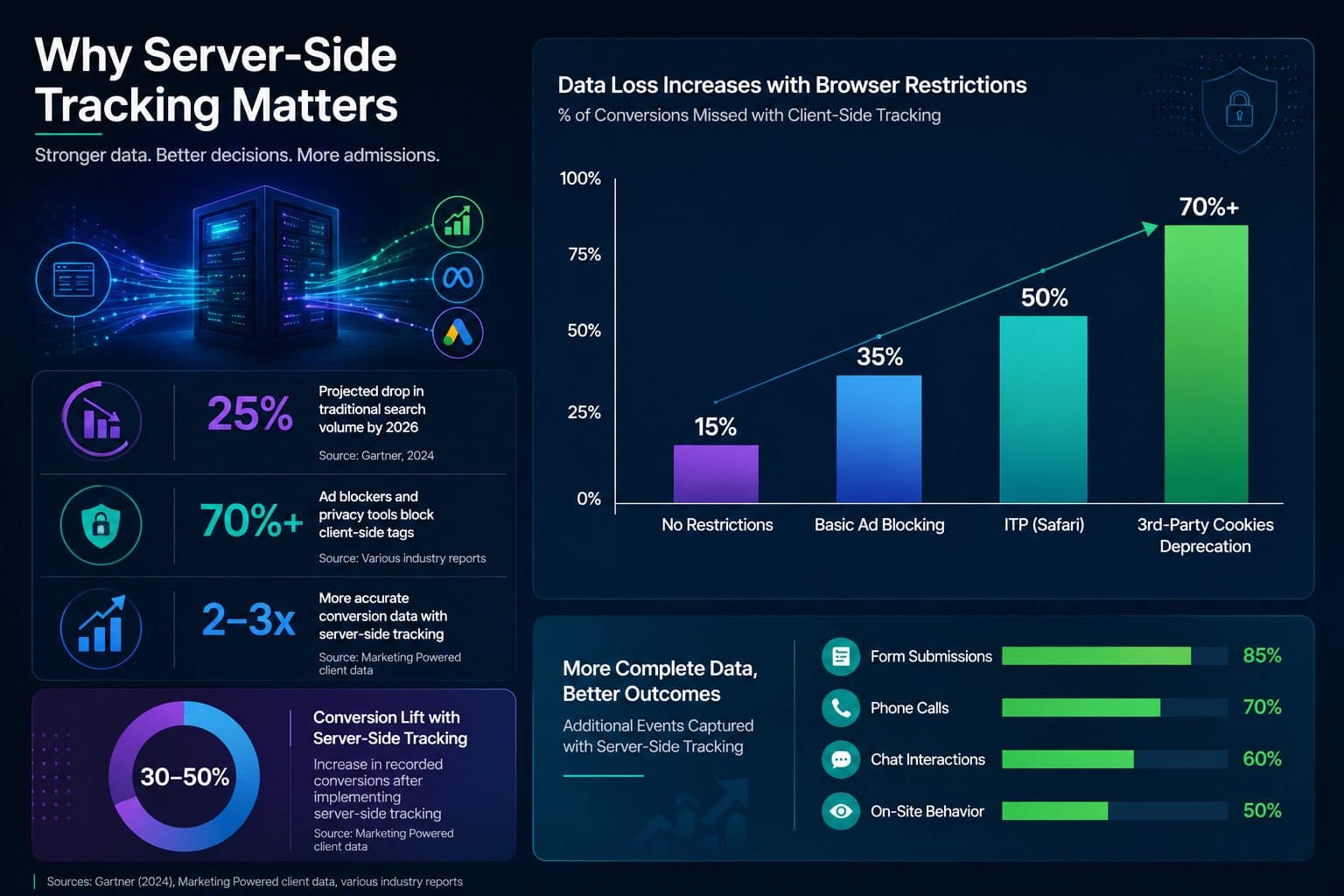
If your behavioral health organization still relies entirely on browser-based tags, your conversion data is incomplete. Ad blockers remove client-side pixels before they fire. Safari's Intelligent Tracking Prevention caps cookie lifespans at seven days. Chrome's ongoing deprecation of third-party cookies will narrow the gap further. The result is attribution built on partial data, inflated cost-per-admission figures, and budget decisions made from guesswork.
Server-side tracking shifts measurement from the visitor's browser to infrastructure you control. A first-party server receives event data directly from your website, processes it, and forwards it to advertising platforms and analytics tools. Because data never passes through third-party browser scripts, it bypasses most blocking mechanisms and extends cookie persistence under your own domain.
For behavioral health providers, this architecture delivers three outcomes that matter: improved data accuracy across long admission funnels, enhanced privacy posture that aligns with HHS guidance on online tracking, and better compliance with platform policies that govern sensitive health verticals.

How to Implement Server-Side Tracking with GTM
A practical path from concept to working container
Google Tag Manager's server-side container is the most accessible entry point for most organizations. The architecture adds a cloud-hosted container between your website and destination platforms. Your web container sends data to the server container via a first-party endpoint, and the server container forwards that data to Google Analytics 4, Google Ads, Meta, and other platforms.
The setup process follows a predictable sequence. First, provision a server container in GTM. Google offers App Engine hosting, but most behavioral health organizations benefit from a custom Cloud Run deployment that allows tighter access controls. Second, configure a transport tag in your existing web container to send event data to your server endpoint. Third, build server-side tags in the new container for each destination.
Common challenges appear at predictable points. Cookie consent integration requires careful sequencing; consent mode signals must reach the server container before tags fire. Debugging is less intuitive than client-side preview mode, so build a staging environment before production deployment. Cost management also matters: a high-traffic site can generate meaningful Cloud Run charges if event volume is not controlled.
- Provision a GTM server container on Cloud Run for tighter access control
- Configure a transport tag in your web container pointing to your first-party endpoint
- Build server-side tags for GA4, Google Ads, and conversion APIs
- Integrate consent mode before tags fire to stay compliant
- Use live server container logs and a staging environment for debugging
Free Audit
Want a straight read on where your budget is leaking?
First-Party Data Tracking: Own Your Data
Durable, privacy-respecting measurement starts with first-party infrastructure
First-party data tracking means collecting information directly from your visitors through interactions on properties you control: form submissions, phone calls, chat conversations, and on-site behavior. Server-side infrastructure makes this data more durable and more useful.
When a visitor lands on your site, a first-party cookie set under your domain persists longer than third-party alternatives. That persistence matters when behavioral health admission cycles stretch across weeks or months. A prospect researching treatment options may return multiple times before converting, and first-party data tracking preserves that journey across sessions.
The benefits compound for behavioral health providers. You control what information is collected and where it travels, reducing exposure under HIPAA guidance on online tracking technologies. You build direct measurement relationships with prospects rather than depending on platform pixels that may be blocked or degraded. And you create a foundation for predictive modeling and AI-enhanced attribution that requires clean, consistent input data.
Server-Side Conversion APIs: Reliable Signals to Every Platform
Email Us
Prefer to send the context directly?
Direct server-to-server connections replace fragile browser pixels
A server-side conversion API is a direct connection between your server and an advertising platform's servers. Instead of relying on a JavaScript pixel in the browser to report conversions, you send event data through a secure API endpoint. Meta's Conversions API (CAPI), Google's Enhanced Conversions, and TikTok's Events API all follow this pattern.
The technical advantage is reliability. API calls from your server are not subject to ad blockers, browser privacy features, or network interruptions that affect client-side pixels. You control the payload, the timing, and the deduplication logic. For behavioral health advertisers operating under Google's healthcare-sensitive vertical restrictions, this control is essential for accurate measurement without policy violations.
Implementation requires mapping your conversion events to the API schema each platform expects. Meta CAPI accepts standard events such as Lead and Purchase along with custom events you define. The server container approach described earlier can handle this mapping, or you can build direct integrations if your tech stack supports it. Meta's published documentation shows that advertisers using Conversions API alongside the pixel see improved event match rates and more stable attribution.
- Meta Conversions API (CAPI): sends lead and admission events directly from your server to Meta
- Google Enhanced Conversions: improves match rates for Google Ads attribution without browser dependency
- TikTok Events API: extends reach into emerging channels with server-to-server reliability
- Deduplication logic prevents double-counting when pixel and API both fire
What Behavioral Health Organizations Have Achieved with Server-Side Tracking
Patterns observed across organizations that committed to this architecture
The pattern repeats across behavioral health organizations that implement server-side infrastructure: more complete data, better attribution, and clearer ROI visibility.
One multi-location treatment network had been operating with a significant gap between Google Ads reported conversions and actual admission calls. Their client-side pixel was being blocked by privacy extensions common among the demographic they served. After implementing a GTM server-side container with direct API connections to Google Ads and Meta, that gap narrowed substantially. Their cost-per-admission calculation shifted from an estimate to a reliable figure, which changed how they allocated budget across locations.
Another regional behavioral health provider scaling from 3 to 12 facilities needed attribution that tracked prospects from first click through to admission. Browser-based tracking broke down as users moved between devices over multi-week decision cycles. Server-side tracking with enhanced first-party data capture allowed them to build cohort analysis showing true time-to-admission by channel. That insight revealed that organic search visitors converted at lower cost but longer timelines than paid media, informing a patient acquisition strategy that balanced both.
These outcomes are not guaranteed. Every organization's data environment is different. But the pattern holds: server-side infrastructure produces cleaner data, and cleaner data produces better decisions.
Strategy
Want to start with a quick message?
Request a Server-Side Tracking Audit
If your behavioral health organization is ready to move beyond client-side limitations, the first step is understanding your current state. Our audits evaluate your existing tracking infrastructure, identify gaps in attribution accuracy, and map a path to server-side implementation that respects compliance requirements and budget constraints.
With more than $50M managed in behavioral health and mental health media spend, we have seen what works and what fails in this vertical. Our team has configured server-side containers for organizations managing millions monthly in paid media and maintained LegitScript and HIPAA-aware posture throughout.
Ready to Build a Measurement Foundation That Survives Browser Restrictions?
Our server-side tracking audits identify gaps in your current infrastructure and map a compliant path forward. We bring $50M+ in managed behavioral health media spend and attribution discipline that tracks through to admission.
Questions, Answered.
Server-side tracking moves data collection from the visitor's browser to a server you control. Instead of JavaScript tags firing in the browser and sending data directly to platforms like Google Analytics or Meta, your website sends event data to a first-party server endpoint. That server processes and forwards the data to its destinations. The approach improves data accuracy by bypassing ad blockers and browser privacy restrictions, while giving you control over what information leaves your infrastructure.
GTM server-side uses a cloud-hosted container that receives data from your website's web container via a first-party endpoint. The server container then fires tags that send data to analytics and advertising platforms. Setup involves provisioning the server container on Google Cloud, configuring transport from your web container, and building server-side tags for each destination. Common implementation challenges include consent mode integration, debugging complexity, and managing cloud hosting costs at scale.
A server-side conversion API creates a direct, reliable connection between your server and an advertising platform. Unlike browser-based pixels that can be blocked or degraded, API calls from your infrastructure reach their destination consistently. This improves event match rates, stabilizes attribution, and gives you control over the data payload. For behavioral health advertisers facing platform restrictions in sensitive verticals, API-based measurement is often the only path to accurate conversion tracking.
Server-side tracking extends the value of first-party data by preserving visitor identity across longer timeframes and multiple sessions. First-party cookies set under your domain persist longer than third-party alternatives, and server-side infrastructure protects that data from browser-level restrictions. For behavioral health providers with admission cycles spanning weeks, this persistence means you can track the full prospect journey and build attribution models that reflect actual behavior rather than partial data.
Meta CAPI, or Conversions API, is Meta's server-side solution for sending conversion events directly from your server to Meta's advertising systems. It operates alongside or instead of the Meta pixel, improving event reliability and match rates. Within a server-side tracking strategy, Meta CAPI typically receives data from your GTM server container or a direct integration, ensuring that conversion signals reach Meta even when browser-based tracking fails or is blocked.
Server-side tracking does not automatically make your measurement stack HIPAA compliant, but it gives you the controls needed to build a compliant implementation. Because you control the data payload before it leaves your server, you can strip protected health information before forwarding events to advertising platforms. This aligns with HHS guidance on tracking technologies in healthcare settings, which warns against transmitting PHI through third-party pixels without appropriate safeguards. Any implementation should be reviewed with your compliance team and legal counsel.
Ready to see what AI-native marketing can do for your treatment center?
Request a free audit of your paid media, landing pages, attribution, and compliance posture. You'll get a straight assessment of where the opportunities are.
or email us at info@marketingpowered.ai