Guide
How to Build an AI-Native Marketing Function
A practical framework for executives ready to move beyond AI experimentation to operational integration.
What AI-Native Marketing Actually Means
The marketing industry has spent the last three years talking about AI. Conference stages overflow with predictions. Vendor pitches promise automation that will solve everything. Yet most organizations remain stuck in pilot mode, running disconnected experiments that never scale into operational change.
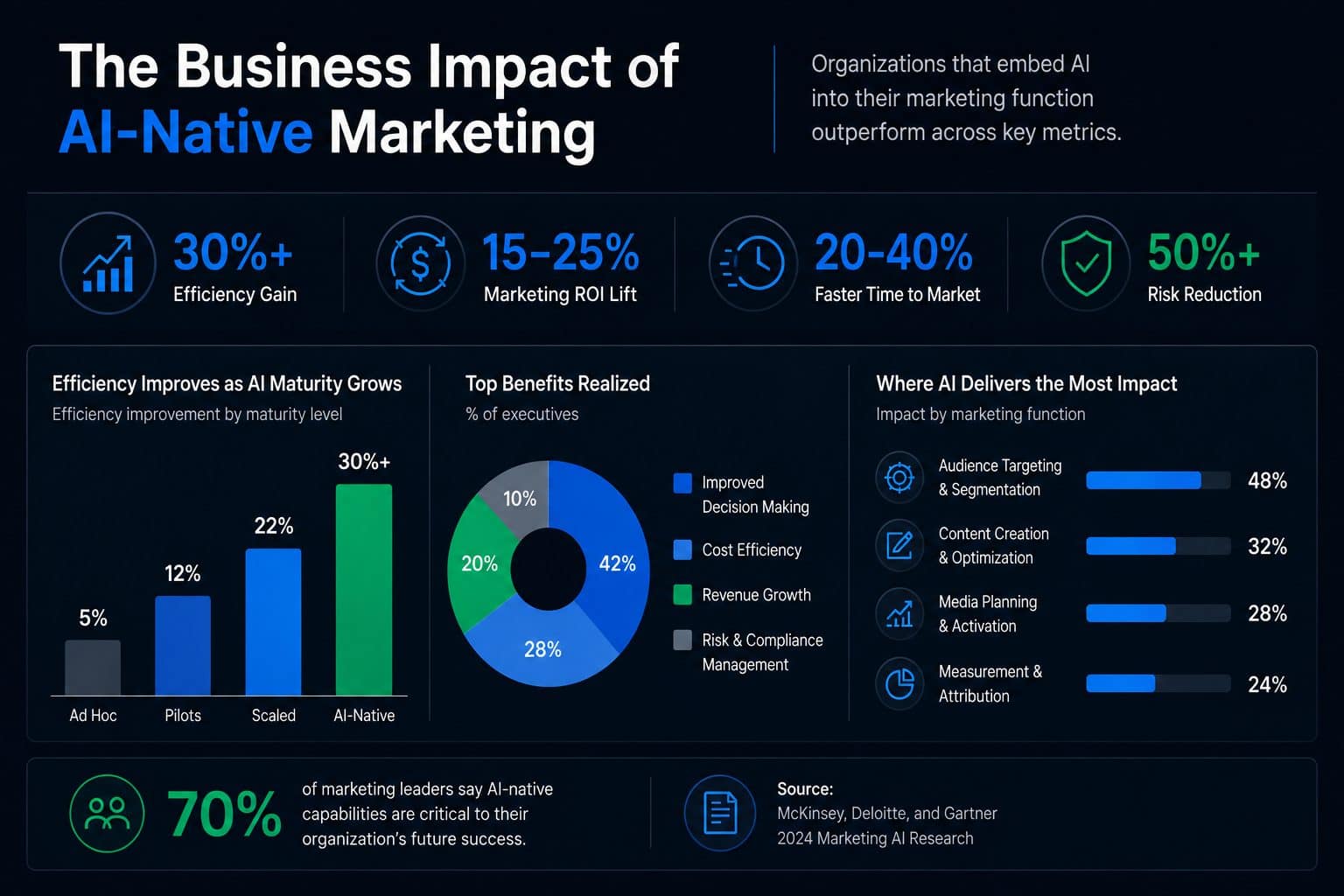
AI-native marketing is different from bolting AI tools onto existing workflows. It means designing your marketing function from the ground up with AI capabilities as foundational infrastructure, not optional add-ons. The distinction matters because retrofitting AI into legacy processes captures perhaps 10 to 15 percent of available efficiency gains. Building natively captures the full 30 percent or more that independent research on AI in marketing suggests is achievable.
The highest-value applications fall into three categories. First, predictive analytics that inform budget allocation and audience targeting before campaigns launch. Second, generative systems that produce and test creative variations at speeds impossible for human teams alone. Third, attribution modeling that connects marketing spend to actual business outcomes rather than proxy metrics.
For organizations in regulated industries like behavioral health or mental health services, AI-native approaches also enable compliance monitoring at scale. Models can flag policy violations, PHI exposure risks, and platform-specific restrictions before content goes live.
Setting Up AI Marketing Infrastructure
Infrastructure determines what is possible. Without the right foundation, AI initiatives stall at the proof-of-concept stage indefinitely.
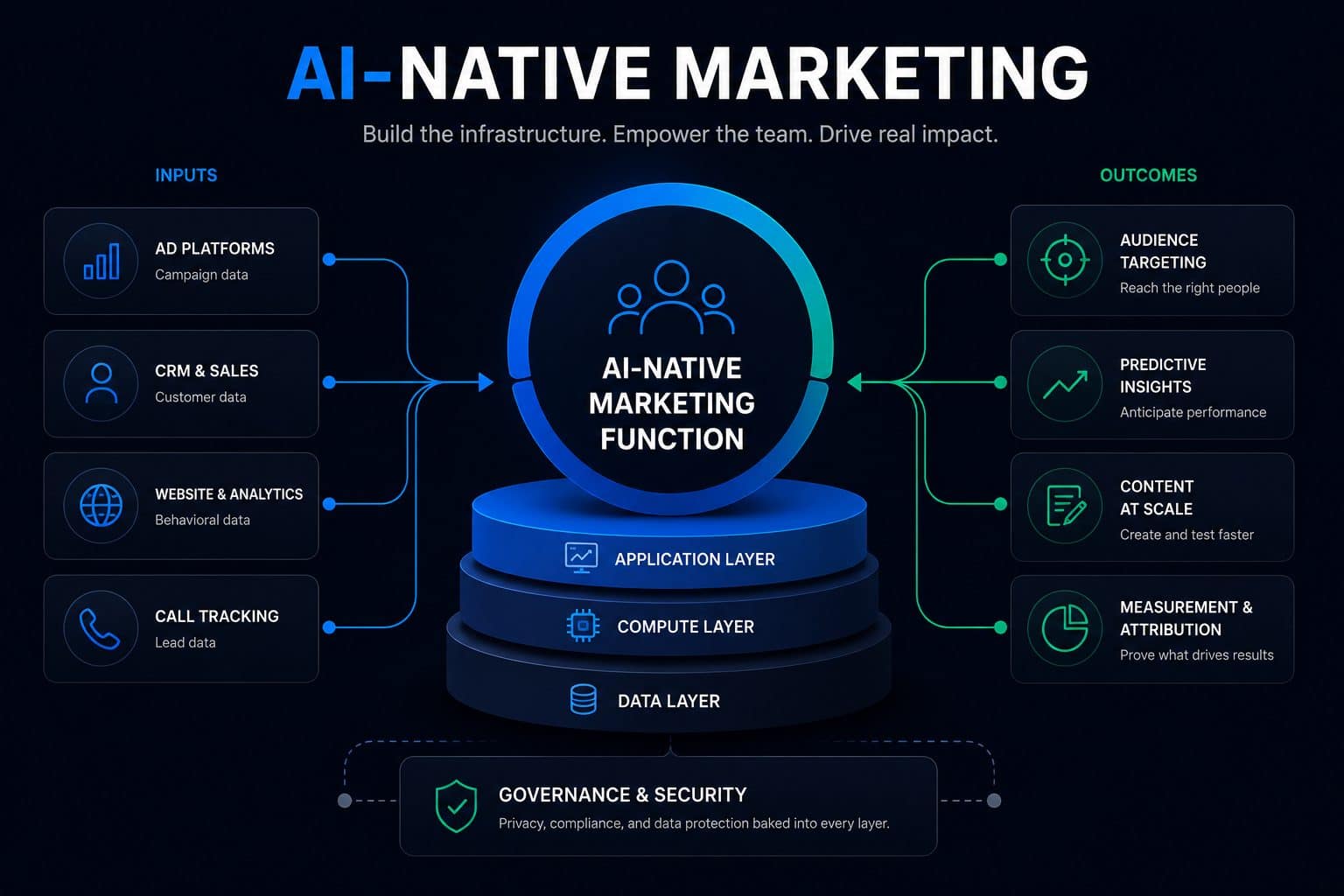
The core components of AI marketing infrastructure span three layers. The data layer encompasses collection pipelines, storage systems, and governance protocols that ensure your AI models train on clean, compliant, and representative data. The compute layer covers the processing power needed for model training, inference, and real-time decisioning. The application layer includes the tools, interfaces, and integrations that put AI capabilities into the hands of your marketing team.
- Data pipelines: Automated ingestion from ad platforms, CRM, website analytics, and call tracking. Schema standardization across sources. Real-time or near-real-time refresh cycles.
- AI platforms: Whether you build on open-source frameworks or commercial platforms, choose systems that allow model customization, not just pre-built workflows.
- Integration architecture: APIs connecting your AI layer to execution platforms including ad managers, email systems, CMS, and CRM. Bi-directional data flow is non-negotiable.
- Governance and security: For healthcare-adjacent organizations, this means HIPAA-conscious data handling, audit trails, and access controls. Data sovereignty matters when PHI is involved.
Vendor vs. In-House: The Real Tradeoffs
The vendor path offers faster deployment and lower upfront investment. The in-house path offers greater control, customization, and long-term cost efficiency. Most organizations benefit from a hybrid: vendor platforms for commodity capabilities such as basic automation and standard analytics, and in-house development for proprietary advantages including custom models, unique data assets, and competitive differentiation.
Behavioral health and mental health marketing require HIPAA-conscious data handling that most commercial AI platforms cannot guarantee. This is a clear example of where building in-house, or partnering with a specialist who has already built that infrastructure, is the only viable path.
Free Audit
Want a straight read on where your budget is leaking?
Building an AI Marketing Team
Technology without the right people produces expensive shelfware. An AI marketing team requires a blend of skills that rarely exists in traditional marketing departments.
- Data fluency: Team members who can interpret model outputs, spot data quality issues, and translate analytical findings into strategic decisions.
- Technical integration: At least one person or fractional resource who understands API connections, data pipelines, and platform architecture well enough to troubleshoot and extend your infrastructure.
- Marketing strategy: AI amplifies strategy; it does not replace it. You need marketers who understand customer psychology, competitive positioning, and channel dynamics.
- Compliance awareness: For regulated industries, someone who understands LegitScript requirements, Google Ads sensitive vertical policies, and HIPAA implications for marketing data.
Developing AI Capabilities: Three Paths
You have three options: train existing team members, hire specialists, or partner with an agency that already has the capability stack. Training works for data fluency and compliance awareness. Hiring works for deep technical roles. Partnering works when you need operational capability faster than internal development allows.
The hybrid model is common: retain strategic control in-house while partnering with specialists for execution. This pattern, where an agency handles paid media operations and attribution while client teams own brand strategy and content direction, allows organizations to move quickly without sacrificing strategic ownership.
AI Marketing Operations: What It Looks Like Day-to-Day
AI-native marketing in practice means AI handles volume, pattern recognition, and optimization while humans handle strategy, creativity, and judgment calls.
Content production: Generative AI drafts ad copy variations, email sequences, and landing page content. Human editors refine for brand voice, compliance, and strategic alignment. A single strategist can now produce what previously required a team of three to five writers.
Campaign optimization: Multi-variant optimization routes individual visitors to the landing page variant most likely to convert based on real-time signals. This is not A/B testing; it is per-visitor decisioning at scale.
Audience targeting: Predictive models score leads and identify high-value segments before budget is spent reaching them. For treatment center marketing, this means distinguishing between information-seekers and admission-ready prospects, then allocating spend accordingly.
Attribution and reporting: AI-powered attribution connects marketing touchpoints to actual admissions or conversions, not just clicks or form fills. Tracking attribution through to admission allows reporting on cost-per-admission rather than cost-per-lead, a fundamentally different and more useful metric.
Consider a mid-sized treatment center running $150,000 monthly in paid media. Traditional operations might test two to three ad variations per campaign, refresh creative quarterly, and report on leads without visibility into which leads are actually admitted. AI-native operations test dozens of variations continuously, refresh creative based on performance signals weekly, and report on cost-per-admission with full-funnel attribution. The efficiency gap compounds over time.
Email Us
Prefer to send the context directly?
Evaluating Success and ROI
AI initiatives fail when organizations measure the wrong things. Vanity metrics including impressions, clicks, and raw lead volume obscure whether AI investments are actually generating business value.
The metrics that matter for AI-native marketing ROI fall into three categories.
- Efficiency metrics: Time saved per campaign launch, cost per qualified lead, creative production velocity. These measure whether AI is reducing operational drag.
- Effectiveness metrics: Conversion rate improvements, cost-per-acquisition trends, revenue attribution. These measure whether AI is improving outcomes, not just speed.
- Learning metrics: Model accuracy over time, prediction quality, decision automation rate. These measure whether your AI capabilities are compounding or plateauing.
Making Strategic Adjustments Over Time
Quarterly reviews should examine whether AI-driven decisions are outperforming human-only baselines. If they are not, the issue is usually data quality, model tuning, or process integration rather than the underlying technology. Organizations that establish clear feedback loops between AI outputs and business outcomes consistently see stronger returns on their AI investments.
The organizations that succeed with AI-native marketing treat it as an ongoing capability development effort, not a one-time technology implementation. They invest in continuous learning, infrastructure refinement, and strategic adaptation as the field evolves.
Marketing Powered has operated as an AI-native agency since 2022, managing over $50 million in Google Ads across behavioral health and mental health accounts. The founder holds court-certified expert witness credentials in advertising strategy. If you are evaluating how to build AI capabilities into your marketing function, whether through internal development, agency partnership, or hybrid models, we can help you assess the options.
Ready to Build Your AI-Native Marketing Function?
Whether you are starting from scratch or transitioning existing operations, the path to AI-native marketing requires clear strategy, the right infrastructure, and experienced guidance. Marketing Powered has operated as an AI-native agency since 2022, with over $50 million managed in behavioral health and mental health media. Let's discuss your goals, compliance requirements, and the approach that fits your organization.
Questions, Answered.
AI-native marketing integrates artificial intelligence tools and principles into the foundational structure of marketing operations, not as add-ons to existing workflows. This means designing data pipelines, team structures, and decision processes around AI capabilities from the start. The result is significantly greater efficiency gains compared to retrofitting AI onto legacy marketing approaches.
An effective AI marketing team requires four core competencies: data fluency to interpret model outputs, technical integration skills to manage infrastructure, strategic marketing expertise to direct AI capabilities toward business goals, and compliance awareness for regulated industries. Most organizations use a hybrid approach, training existing staff on data fluency while hiring or partnering for deep technical capabilities.
AI marketing infrastructure has three layers. The data layer includes collection pipelines, storage, and governance protocols. The compute layer provides processing power for model training and real-time inference. The application layer encompasses tools, interfaces, and API integrations that connect AI capabilities to execution platforms like ad managers, CRM, and email systems.
In-house AI marketing provides greater control over data, customization of models for your specific use cases, and long-term cost efficiency compared to ongoing vendor fees. For organizations in regulated industries like behavioral health, in-house infrastructure also enables HIPAA-conscious data handling and data sovereignty that commercial platforms cannot always guarantee.
Measure AI marketing ROI across three categories: efficiency metrics such as cost per qualified lead and creative production velocity; effectiveness metrics such as conversion rate improvements and cost-per-acquisition trends; and learning metrics such as model accuracy over time and decision automation rate. Avoid relying on vanity metrics like impressions or raw lead volume, which obscure actual business impact.
Ready to see what AI-native marketing can do for your treatment center?
Request a free audit of your paid media, landing pages, attribution, and compliance posture. You'll get a straight assessment of where the opportunities are.
or email us at info@marketingpowered.ai