Guide
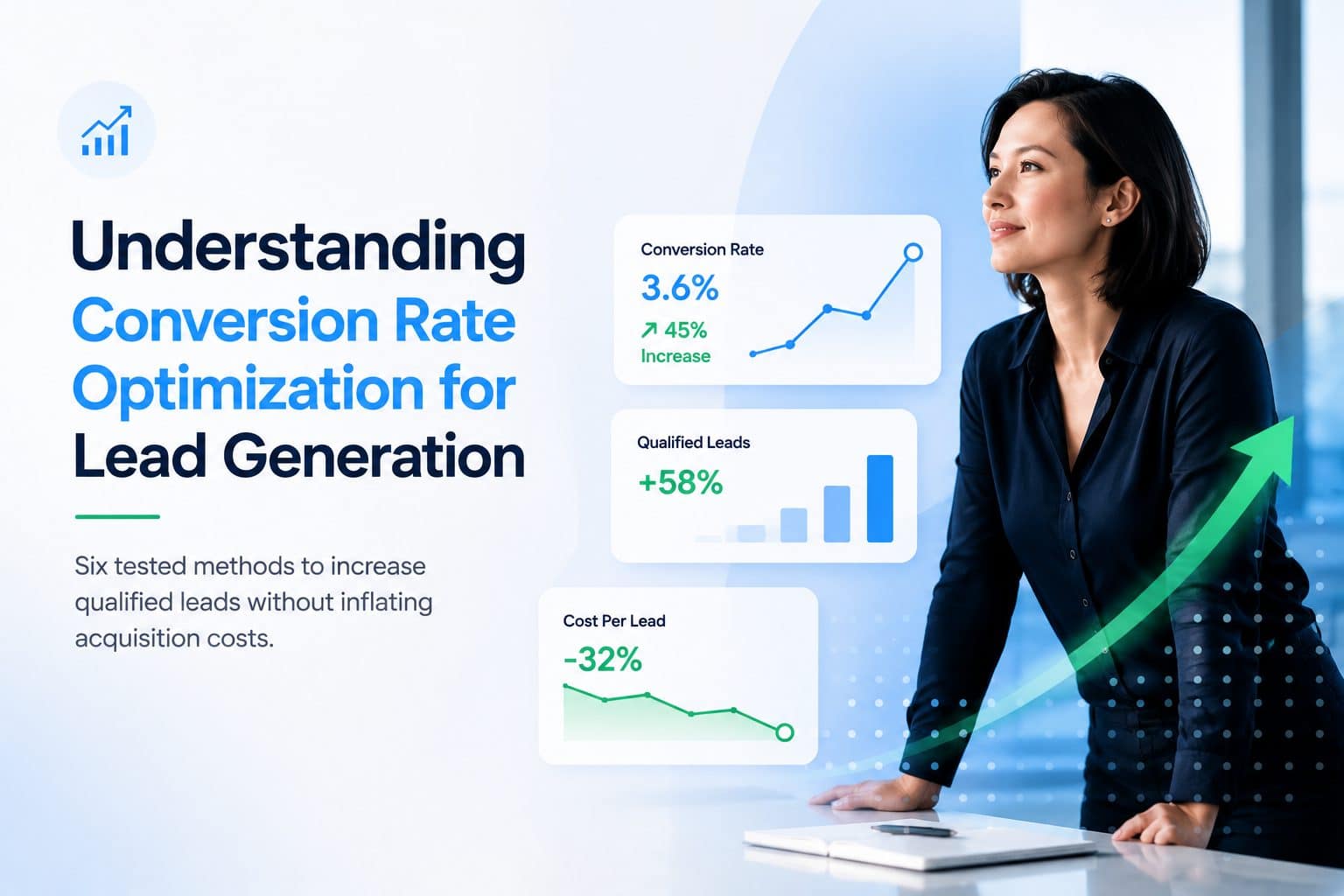
Understanding Conversion Rate Optimization for Lead Generation
Six tested methods to increase qualified leads without inflating acquisition costs
What is Conversion Rate Optimization?
Conversion rate optimization is the systematic process of increasing the percentage of website visitors who complete a desired action. For B2B companies, that action is typically a form submission, demo request, or sales call booking. The goal is straightforward: extract more value from existing traffic before spending more to acquire new visitors.
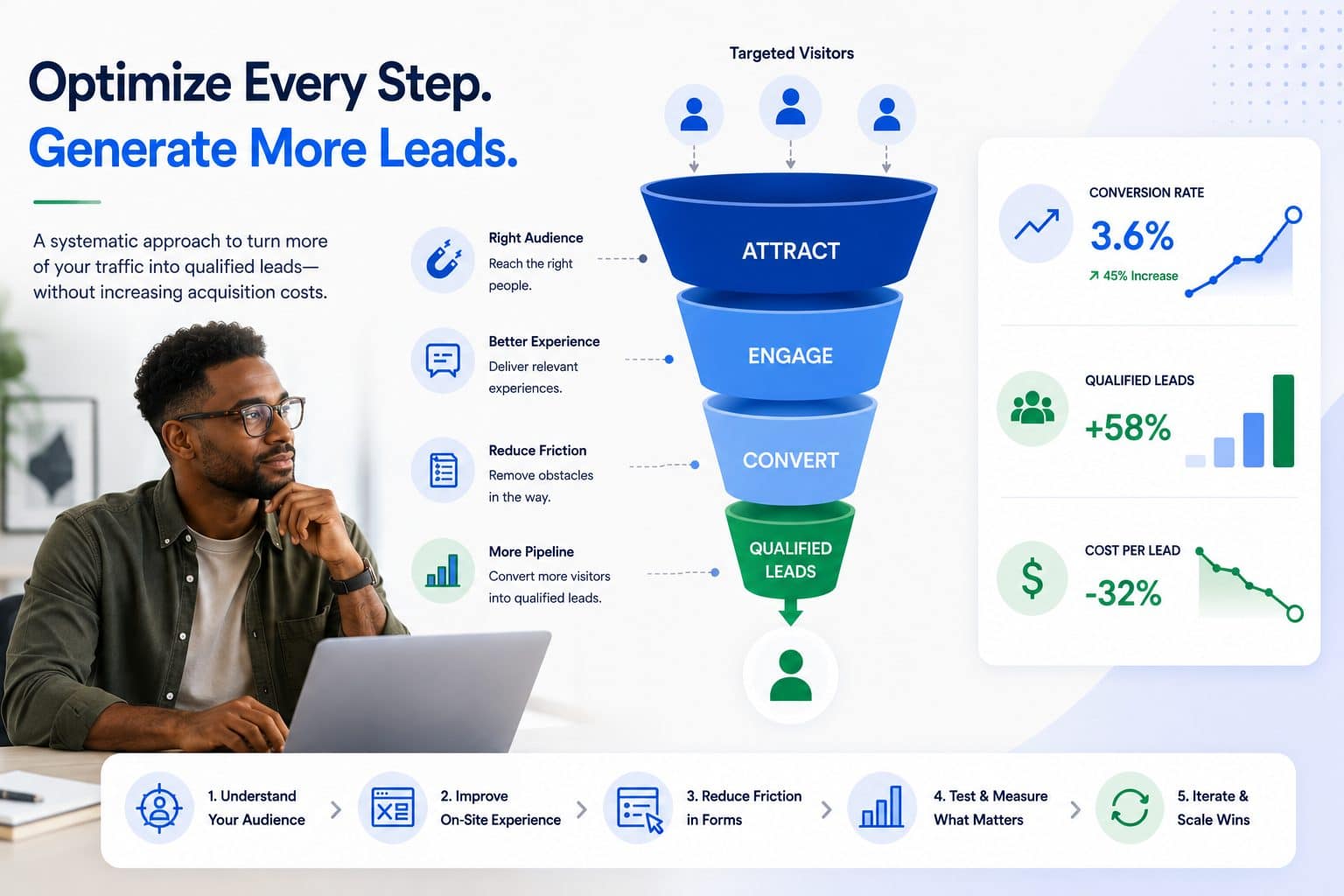
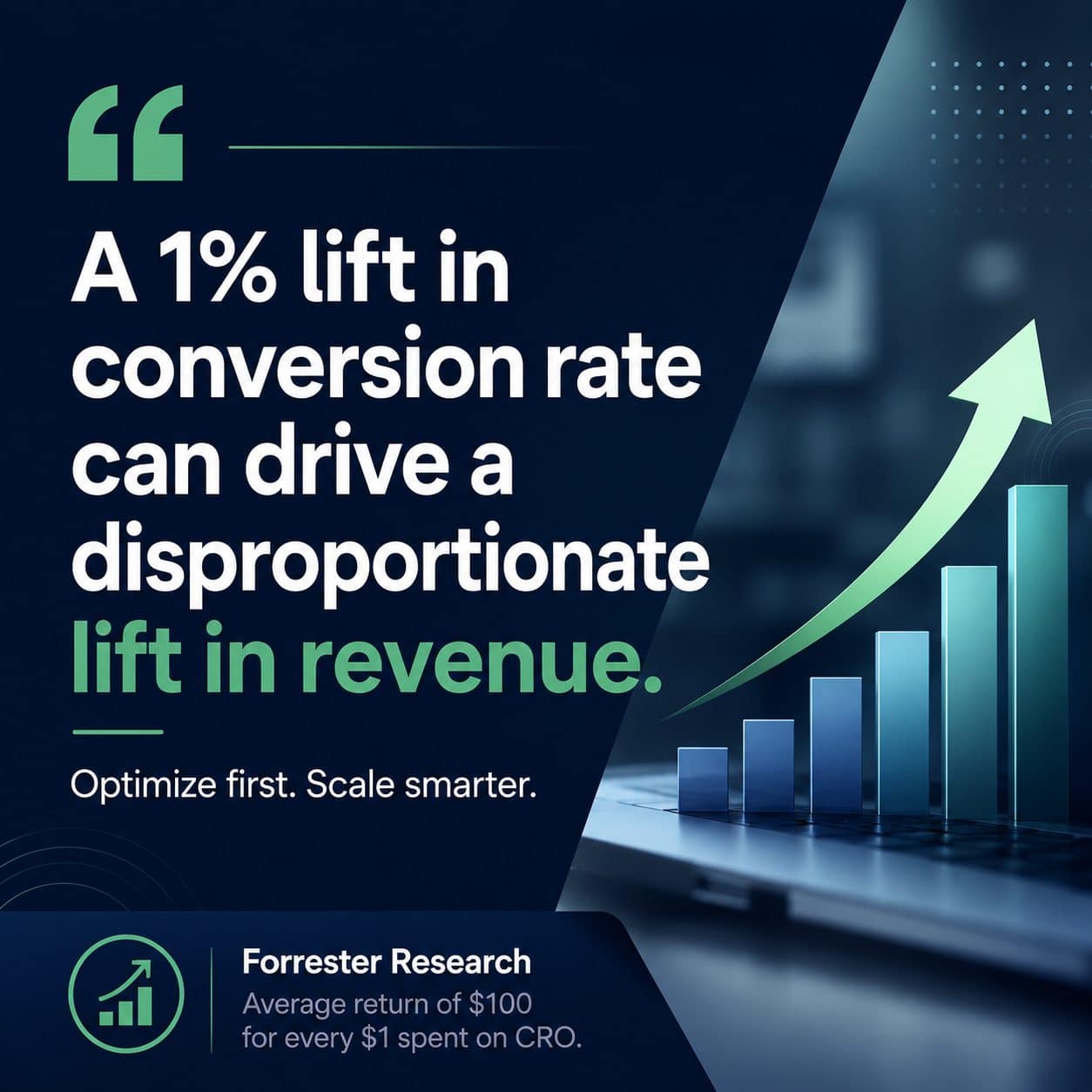
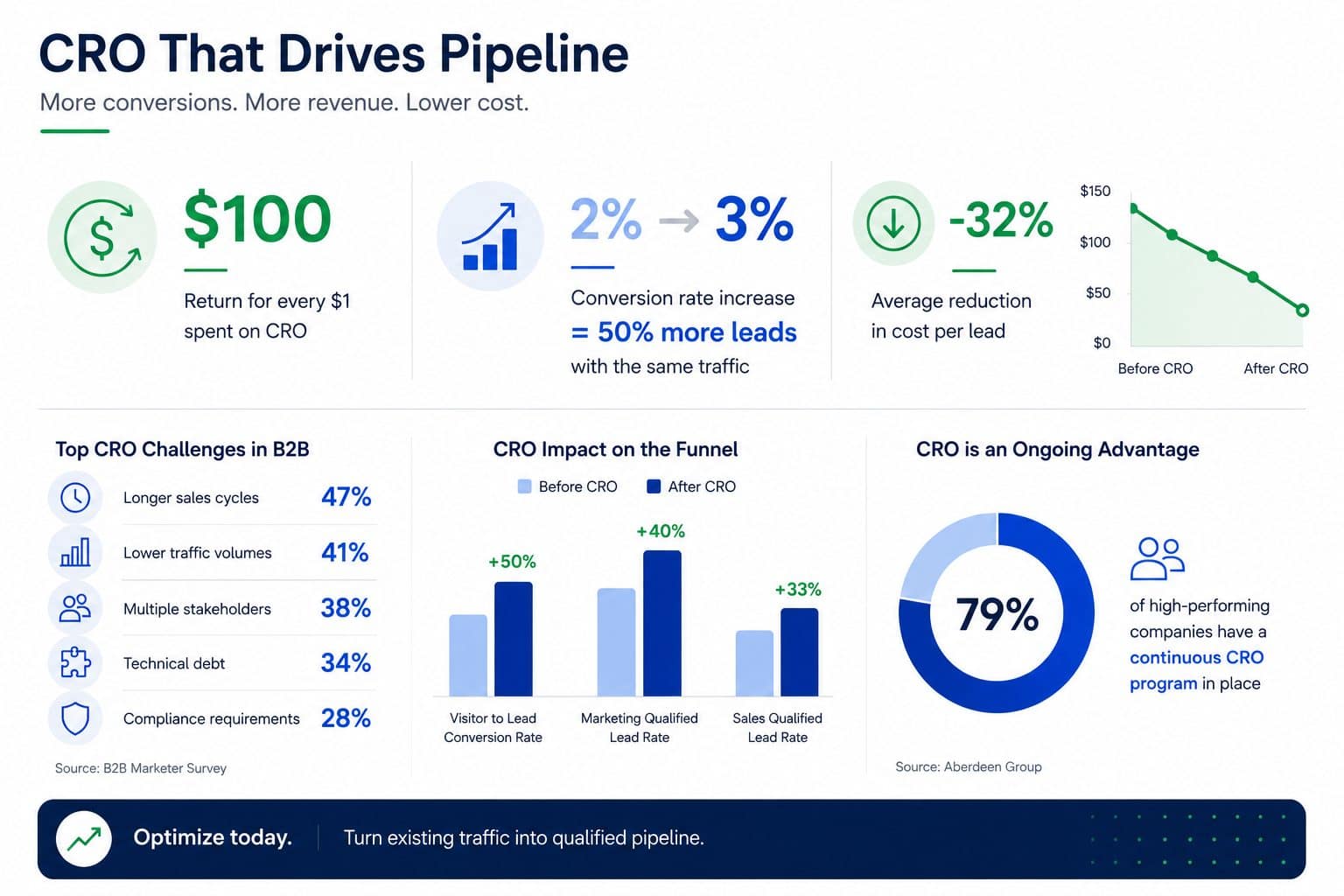
The math behind CRO makes the investment case clear. A site converting at 2% that improves to 3% has effectively increased lead volume by 50% without touching the media budget. According to Forrester research, companies that invest in CRO see an average return of $100 for every $1 spent on optimization efforts. That multiplier effect is why CRO sits at the center of any serious lead generation strategy.
For B2B organizations, where customer acquisition costs run significantly higher than B2C, the impact compounds. A single percentage-point improvement in conversion rate can translate into hundreds of thousands of dollars in pipeline value annually. The calculation depends on your average deal size, but the principle holds: fixing the conversion layer is often more efficient than adding top-of-funnel spend.
CRO is not a one-time project. It is an ongoing discipline that requires hypothesis formation, testing, measurement, and iteration. Companies that treat it as a continuous function rather than a quarterly initiative consistently outperform those that optimize sporadically.
Challenges in B2B CRO
B2B conversion optimization presents obstacles that consumer-focused marketers rarely encounter. Understanding these challenges before building your testing program prevents wasted cycles and misallocated resources.
- Longer sales cycles obscure attribution: When deals take 6 to 12 months to close, connecting a landing page test to revenue requires sophisticated tracking and patience. Many teams abandon tests before meaningful data accumulates.
- Lower traffic volumes limit statistical significance: B2B sites often see a fraction of the traffic that B2C properties generate. Running valid A/B tests requires either extended test durations or alternative methodologies like sequential testing.
- Multiple stakeholders complicate the conversion path: A single lead may involve a researcher, an evaluator, and a decision-maker, each with different information needs. Optimizing for one persona can inadvertently degrade the experience for another.
- Technical debt slows implementation: Enterprise CMS platforms, legacy form systems, and complex tag management setups make even simple tests difficult to deploy without engineering support.
- Compliance requirements constrain creative testing: Industries with regulatory oversight, including healthcare, finance, and legal services, face additional constraints on claims, data collection, and remarketing tactics.
Overcoming B2B CRO Obstacles
Overcoming these challenges requires a framework that accounts for B2B realities: longer measurement windows, multi-touch attribution, and cross-functional alignment between marketing, sales, and operations. Companies that have managed paid media at scale understand that optimization is as much about operational discipline as it is about creative ideas.
Free Audit
Want a straight read on where your budget is leaking?
Six Essential CRO Tests for Lead Generation
These six tests form the foundation of an effective lead gen optimization program. Each addresses a specific conversion lever and can be implemented regardless of your current technology stack.
1. Form Field Reduction Testing
Every additional form field introduces friction. Test removing non-essential fields and measure the impact on both submission rate and lead quality. According to HubSpot research, reducing form fields from four to three can increase conversions by up to 50%. The tradeoff is data richness, so track downstream qualification rates alongside top-of-funnel metrics.
2. Headline and Value Proposition Testing
Your headline is the first filter. Test variations that emphasize different benefits: cost savings, time reduction, risk mitigation, or competitive advantage. Specificity outperforms vagueness. "Reduce procurement cycle time by 40%" will typically beat "Streamline your procurement process."
3. Social Proof Placement and Format
Testimonials, client logos, and case study links reduce perceived risk. Test their placement (above fold vs. below), format (video vs. text), and specificity (named clients vs. anonymous). For examples of how proof points can be structured, review our case studies to see attribution tracked through to measurable outcomes.
4. CTA Copy and Design Variations
Button text matters more than most teams assume. Test action-oriented copy ("Get Your Free Assessment") against softer alternatives ("Learn More"). Test button color, size, and surrounding white space. Small changes here often produce statistically significant lifts.
5. Page Load Speed Optimization
According to Google's Web Vitals research, pages that load within 2.5 seconds see significantly higher engagement than slower pages. Test image compression, script deferral, and CDN implementation. Speed improvements often deliver conversion gains that exceed what creative testing produces. Teams focused on web development understand that performance is a conversion lever, not just a technical concern.
6. Mobile Experience Testing
Even in B2B, mobile traffic now represents a significant share of initial research sessions. Test mobile-specific layouts, tap target sizes, and simplified navigation. A prospect who encounters friction on mobile may never return on desktop.
How to Implement a Conversion Optimization Framework
A conversion optimization framework organizes testing activity into a repeatable process. Without a framework, optimization becomes reactive and inconsistent. With one, it becomes a systematic growth function.
Planning Phase
Start with a quantitative audit. Identify pages with high traffic but low conversion rates, as these represent the largest optimization opportunities. Map the user journey from first touch to form submission. Document hypotheses based on analytics data, heatmaps, session recordings, and user feedback. Prioritize tests using an ICE framework (Impact, Confidence, Ease) or a similar scoring method.
Execution Phase
Build tests with clear success criteria defined before launch. Document the hypothesis, the metric being measured, the minimum detectable effect, and the required sample size. Use proper A/B testing methodology: randomized traffic allocation, adequate sample sizes, and sufficient test duration. According to VWO's statistical significance guidelines, most B2B tests require 2 to 4 weeks of runtime to reach valid conclusions.
Measurement and Iteration
Analyze results against pre-defined success criteria. Winners get implemented; losers generate learning. Document everything in a centralized testing repository so institutional knowledge accumulates. The organizations that benefit most from CRO treat it as a discipline supported by AI-driven tools and data infrastructure, not as an occasional project.
Measuring Success in CRO Efforts
Effective measurement requires tracking both leading and lagging indicators. Leading indicators show whether tests are performing; lagging indicators confirm whether improvements translate to business outcomes.
- Conversion rate by page and by traffic source: Segment performance to identify which channels and pages warrant additional optimization investment.
- Cost per lead and cost per qualified lead: Conversion rate improvements should reduce acquisition costs. If they do not, the test may be capturing lower-quality submissions.
- Lead-to-opportunity rate: Track what percentage of form fills become sales-qualified opportunities. This metric catches optimizations that inflate volume without improving quality.
- Pipeline velocity: Measure how quickly leads move through your funnel. CRO improvements should accelerate, not slow, the sales cycle.
- Revenue attribution: Connect the testing activity to the closed revenue. This requires multi-touch attribution and patience, but it is the only metric that truly validates CRO investment.
Email Us
Prefer to send the context directly?
Start Optimizing Your Conversion Funnel
Consistent tracking and analysis are the difference between teams that improve quarter over quarter and teams that run tests without compounding gains. Build dashboards that surface these metrics automatically, and review them in regular optimization cadences.
Effective CRO requires more than tools and tactics. It requires a framework, measurement discipline, and operational consistency. The six tests outlined in this guide provide a starting point, but sustainable improvement comes from treating optimization as an ongoing function rather than a one-time initiative.
Marketing Powered brings operator-level experience to conversion optimization. Our team has managed over $50M in media spend and tracked attribution through to measurable business outcomes for clients across multiple verticals. We understand the compliance constraints, longer sales cycles, and technical complexity that B2B organizations face.
If you are ready to identify the highest-impact optimization opportunities in your funnel, request a free CRO audit. We will analyze your current conversion performance and outline specific tests worth running.
Ready to improve your conversion rates?
Request a free CRO audit and get a data-driven analysis of your highest-impact optimization opportunities.
Questions, Answered.
The six essential tests are form field reduction, headline and value proposition testing, social proof placement and format, CTA copy and design variations, page load speed optimization, and mobile experience testing. Each addresses a specific conversion lever and can produce measurable improvements in lead volume and quality when implemented systematically.
B2B companies should extend measurement windows to account for longer sales cycles, use multi-touch attribution to connect tests to revenue, and align marketing with sales and operations on success criteria. Lower traffic volumes may require sequential testing methodologies or longer test durations to achieve statistical significance.
Track conversion rate by page and traffic source, cost per lead and cost per qualified lead, lead-to-opportunity rate, pipeline velocity, and revenue attribution. Leading indicators show test performance; lagging indicators confirm business impact. Consistent tracking and regular analysis are essential for compounding gains over time.
A framework organizes testing activity into a repeatable process that includes planning, execution, and measurement phases. Without a framework, optimization becomes reactive and inconsistent. With one, teams can prioritize high-impact tests, document learnings, and build institutional knowledge that compounds over time.
Ready to see what AI-native marketing can do for your treatment center?
Request a free audit of your paid media, landing pages, attribution, and compliance posture. You'll get a straight assessment of where the opportunities are.
or email us at info@marketingpowered.ai