Guide
Why Treatment Center CEOs Fire Their Behavioral Health Marketing Agency
What drives treatment center executives to end agency partnerships, and how to recognize when your marketing needs a fundamentally different approach.

The Pattern Behind Most Agency Breakdowns
Most treatment center executives have fired at least one marketing agency. The reasons follow a predictable pattern: promises that sounded reasonable in the pitch meeting collapse under the weight of actual execution. Understanding these failure modes helps you recognize them before they drain your budget and stall your census.
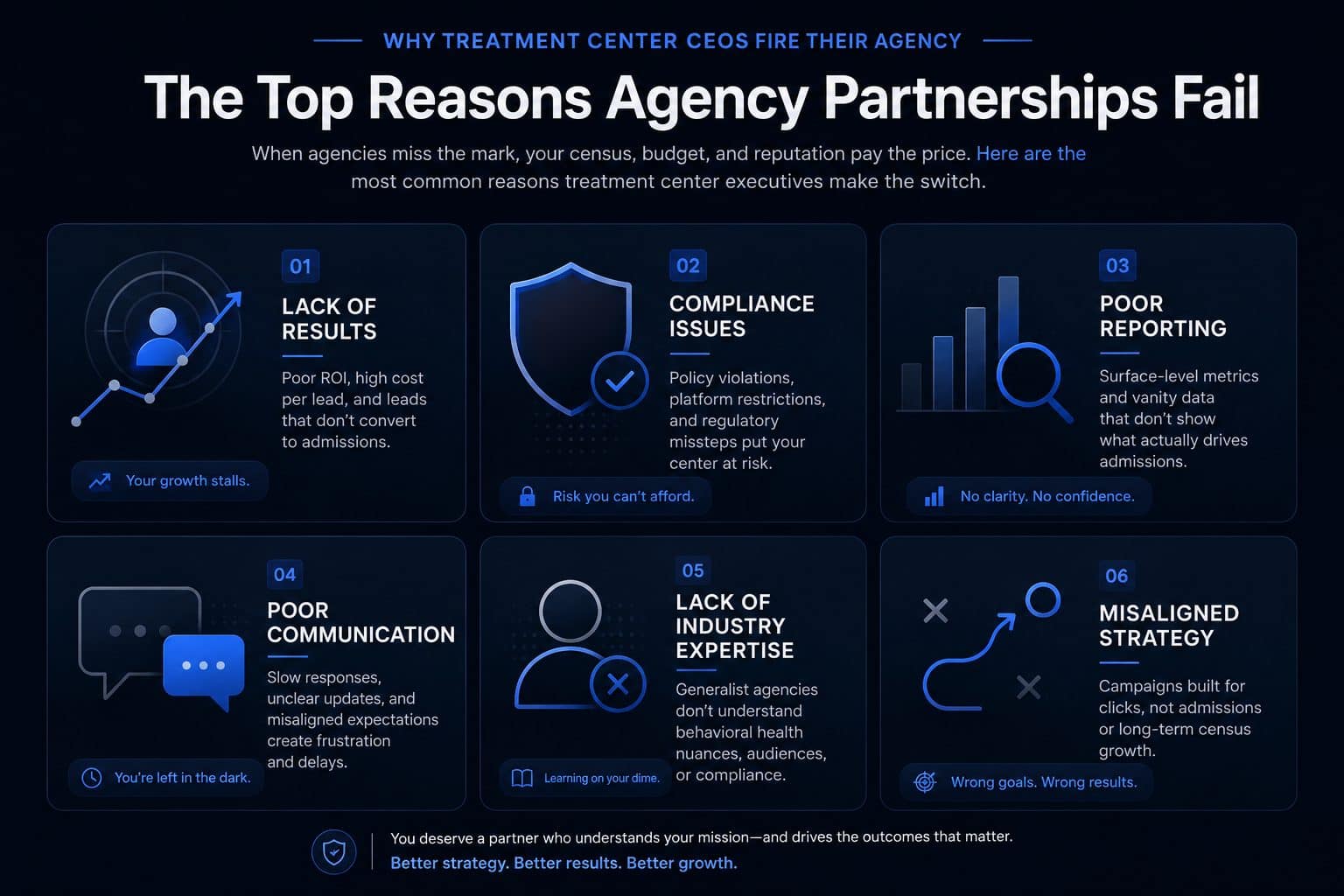
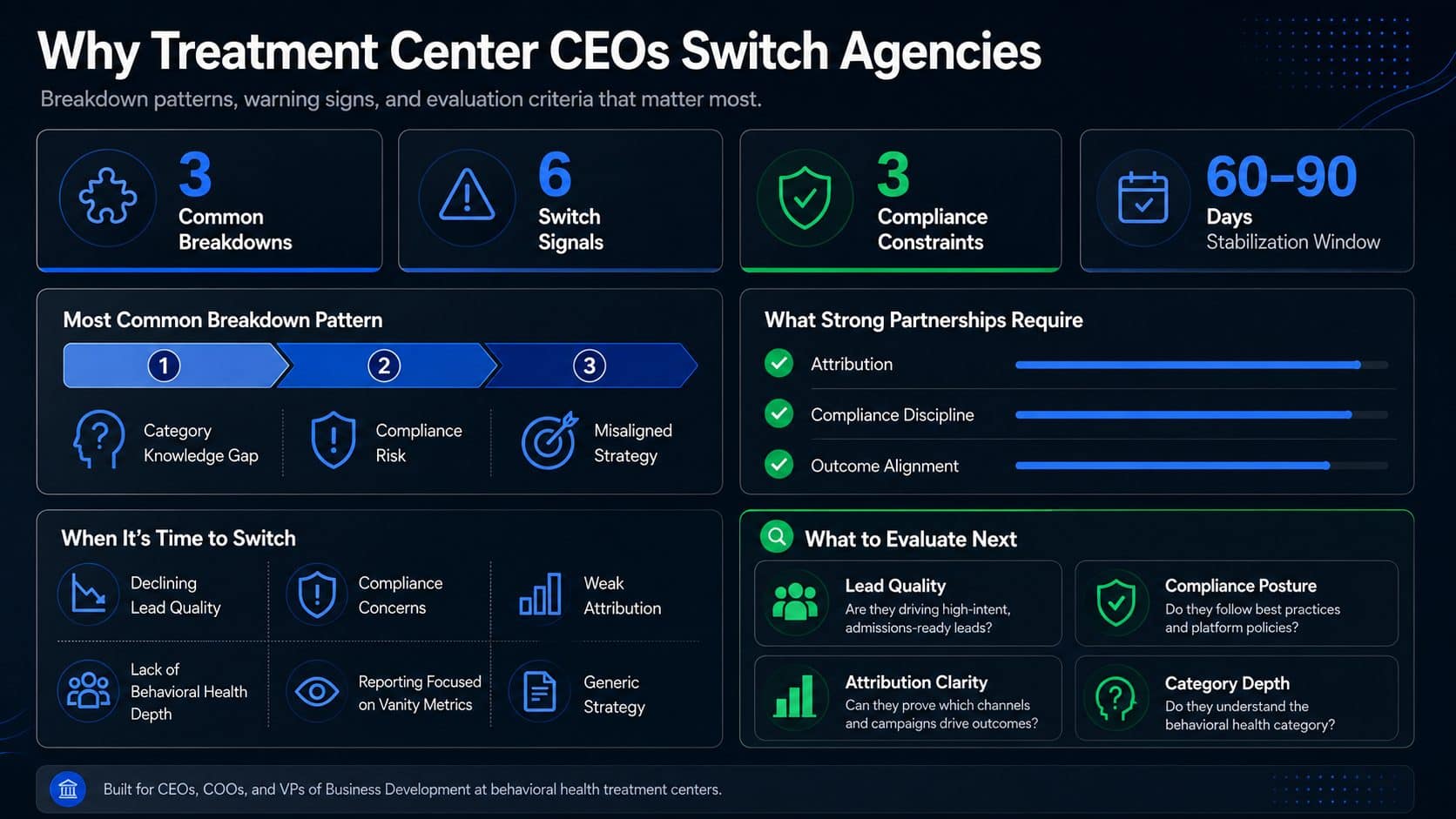
The first breakdown happens when agencies lack category knowledge. A generalist agency treating your treatment center like a dental practice or med spa will produce campaigns that miss the mark. They write ad copy that violates platform policies. They target audiences that cannot convert. They measure vanity metrics while your intake team fields calls from people who were never qualified prospects.
Compliance failures compound the problem. Behavioral health marketing operates under restrictions that most agencies have never encountered. Google Ads healthcare vertical policies prohibit retargeting for addiction treatment. LegitScript certification requirements add another layer of scrutiny. Agencies unfamiliar with these constraints either ignore them, which creates legal exposure, or over-correct so aggressively that campaigns cannot scale.
Misaligned strategy rounds out the pattern. Your agency optimizes for clicks while you need admissions. They celebrate impression volume while your intake team sits idle. They report on cost per lead while your CFO asks about cost per admission. Without attribution that tracks through to the outcome that matters, you are making budget decisions without the data you need.

Why Industry-Specific Expertise Changes Everything
A behavioral health marketing agency brings more than familiarity with your vertical. It brings pattern recognition built from managing campaigns at scale across dozens of treatment centers, understanding what works at different census levels, and knowing which compliance tripwires to avoid before they become problems.
Generalist agencies learn from your budget. They discover that Meta restricts health-related custom audiences after your campaign gets flagged. They realize that certain keyword strategies trigger LegitScript review only after your ads get paused. Every lesson they learn costs you time, money, and momentum.
Specialized experience compounds differently. An agency that has managed $50M or more in behavioral health and mental health media spend has already made those mistakes on someone else's account. They know which landing page structures convert for inpatient treatment centers versus outpatient services. They understand the difference between a lead that will show up for intake and one that will ghost your admissions team.
The benefits extend beyond campaign execution. A treatment center marketing agency with deep vertical experience can advise on market positioning, competitive dynamics, and payer mix considerations that generalists simply cannot see. They speak your language because they have spent years inside your category.
How Compliance Gaps Undermine Your Marketing Investment
Compliance in behavioral health marketing is not optional complexity. It is a filter that separates agencies capable of scaling your census from those that will create legal and operational risk.
HIPAA regulations govern how patient information flows through your marketing systems. An agency that integrates tracking pixels without understanding PHI implications exposes you to enforcement action. The Office for Civil Rights has made clear that marketing technology does not receive a carve-out from privacy requirements. Your agency needs a documented approach to HIPAA-conscious tracking infrastructure before they touch your campaigns.
LegitScript certification adds another dimension. Treatment centers must maintain certification to advertise on major platforms. Your agency needs to understand what triggers review, what language to avoid, and how to structure campaigns that remain compliant at scale. Agencies without this expertise learn these lessons at your expense, and the cost includes paused campaigns, policy strikes, and potential removal from platforms.
Platform-specific restrictions layer on top of regulatory requirements. Google prohibits behavioral health retargeting. Meta restricts health-related targeting options. Microsoft Advertising has its own set of healthcare policies. An addiction treatment marketing agency that understands these constraints builds campaigns within them from the start, rather than discovering limitations after launch and asking for more time to rebuild.
Free Audit
Want a straight read on where your budget is leaking?
What Successful Agency Partnerships Actually Look Like
Successful agency partnerships share common characteristics: clear attribution, compliance discipline, and alignment on what success actually means. The following patterns illustrate what separates partnerships that scale census from those that generate reports but not results.
Treatment centers that grow from single locations to multi-site operations do so when marketing scales alongside operational capacity. That requires attribution that tracks through to admission, not just lead volume. It requires paid media campaigns that can be spent at meaningful levels without triggering compliance flags. And it requires an agency that understands capacity planning: generating leads your intake team cannot process creates waste, not growth.
The attribution discipline matters more than most executives realize. Knowing that a lead came from Google is not the same as knowing which campaign, keyword, and landing page combination produced an admission. Treatment centers that work with agencies capable of tracking attribution through to admission can make informed decisions about budget allocation. Those working with agencies that stop at the lead level are optimizing the wrong metric.
Compliance safety compounds over time. Treatment centers that have maintained LegitScript certification and clean platform histories can scale campaigns that competitors cannot. One compliance violation can pause your entire advertising operation during a period when you need census growth. The agencies that understand these stakes build compliance review into their workflow rather than treating it as a constraint to work around.
How to Know When It Is Time to Make the Switch
Switching agencies carries real costs: transition time, learning curves, and the risk that the next partner will repeat the same mistakes. The decision requires clear criteria, not frustration alone.
Start with lead quality. If your intake team consistently reports that leads are unqualified, that is a strategy problem. Ask your agency how they define a qualified lead and compare that definition to your intake team's experience. Misalignment here indicates either poor targeting or inadequate feedback loops between marketing and admissions.
Evaluate compliance posture. Has your agency triggered platform policy reviews? Have they recommended tactics that made your compliance officer uncomfortable? Do they understand the difference between what platforms technically allow and what LegitScript will flag? Agencies that push compliance boundaries create risk that accumulates until it becomes a crisis.
Assess attribution clarity. Can your agency tell you the cost per admission, not just the cost per lead? Do they track which campaigns produce patients who complete treatment? Attribution that stops at the lead level hides the information you need to allocate budget toward what actually drives census.
Consider category depth. How many behavioral health accounts does your agency actively manage? What is their total managed spend in the vertical? Agencies that manage significant behavioral health media spend have seen patterns that smaller operators have not encountered. They know which strategies work at different census levels and which tactics produce diminishing returns.
If your current agency fails on multiple criteria, the transition cost is likely worth paying. Document what went wrong, define success in specific measurable terms, and evaluate new partners against those criteria before signing.
- Lead quality has stagnated or declined over multiple quarters
- Compliance incidents have occurred, or your compliance team has raised concerns
- Attribution cannot track beyond the lead to admission outcomes
- Your agency lacks demonstrated depth in behavioral health or addiction treatment marketing
- Reporting focuses on impressions and clicks rather than census-driving outcomes
- Strategic recommendations feel generic rather than tailored to your market position and payer mix
What to Look for in Your Next Rehab Marketing Agency
The criteria that predict agency success in behavioral health are specific and measurable. Evaluate potential partners against these benchmarks before signing an agreement.
Vertical concentration matters. An agency that derives the majority of its revenue from behavioral health and mental health clients has aligned incentives. They invest in understanding platform policy changes that affect your vertical. They build technology and processes optimized for your compliance environment. They cannot afford to lose expertise in your category because it is their core business.
Technology posture indicates future capability. Agencies that have adopted AI-native approaches, working with local inference, vector databases, and retrieval-augmented generation, are better positioned to capture efficiency gains that generalist agencies will miss. Ask about their technology stack and how they apply it to campaign optimization, creative testing, and attribution modeling.
Proof of scale demonstrates execution capability. An agency that has managed significant monthly budgets in behavioral health paid media, scaled treatment centers from single locations to multi-state operations, and maintained clean compliance records has proven it can execute at the level your growth requires. Ask for specific examples, not general claims.
Request a performance audit before committing. A serious agency will analyze your current performance, identify specific opportunities, and explain its methodology before asking for a long-term commitment. The audit itself demonstrates their diagnostic capability and gives you a preview of how they communicate. If the audit is vague or relies on generic recommendations, treat that as a signal.
Email Us
Prefer to send the context directly?
Ready to Evaluate Your Current Marketing Performance?
If the patterns in this guide sound familiar, a structured audit can identify specific opportunities in your current campaigns. We will review your attribution setup, compliance posture, lead quality trends, and channel mix, then explain exactly what we would do differently and why.
Questions, Answered.
A qualified behavioral health marketing agency will provide strategies built specifically for treatment center economics, compliance expertise that keeps your campaigns running without policy violations, and attribution that tracks through to admission rather than stopping at the lead. They should demonstrate experience managing meaningful media spend in your vertical and a clear understanding of the difference between lead volume and census growth.
HIPAA requirements govern how patient information flows through marketing systems, creating restrictions on tracking and data sharing that most agencies do not understand. LegitScript certification requirements add scrutiny to ad content and landing pages. Platform policies from Google, Meta, and Microsoft prohibit retargeting and restrict targeting options for addiction treatment. An experienced agency navigates these constraints without creating legal exposure for your organization.
Clear signals include declining lead quality over multiple quarters, compliance incidents or near-misses your team has raised concerns about, attribution that cannot be tracked to admission outcomes, and strategic recommendations that feel generic rather than specific to your market. If your agency cannot explain the cost per admission or lacks depth in behavioral health accounts, the transition cost to a specialized partner is likely worth paying.
Some improvements appear quickly, particularly if your current campaigns have obvious compliance or targeting problems that can be corrected immediately. Meaningful and stable results in behavioral health marketing typically require 60 to 90 days as new campaigns are built, attribution is properly configured, and optimization cycles accumulate data. Expect continued improvement beyond that window as attribution data informs budget allocation decisions.
A treatment center marketing agency brings category-specific expertise that a generalist cannot replicate without learning on your budget. This includes knowledge of HIPAA-compliant tracking infrastructure, LegitScript certification requirements, platform-specific restrictions on behavioral health advertising, and the attribution models needed to connect campaigns to admissions rather than just leads. Generalist agencies encounter these requirements for the first time on your account.
Ready to see what AI-native marketing can do for your treatment center?
Request a free audit of your paid media, landing pages, attribution, and compliance posture. You'll get a straight assessment of where the opportunities are.
or email us at info@marketingpowered.ai