Guide
Optimizing the Intake Process for Treatment Centers
How to close the gap between marketing leads and actual admissions through systematic intake optimization.

Understanding Intake Optimization
Intake optimization for treatment centers represents the systematic improvement of every touchpoint between a marketing-generated lead and a confirmed admission. Most treatment center operators have experienced the frustration of watching qualified leads evaporate somewhere between the first call and the intake paperwork. The problem is rarely the marketing. The problem is the handoff.
When a prospective patient or family member calls your admissions line, you have roughly 90 seconds to establish trust, assess fit, and move them toward the next step. If your intake team is undertrained, understaffed, or working with incomplete information from your marketing channels, those leads become lost revenue. At scale, the cost compounds quickly.
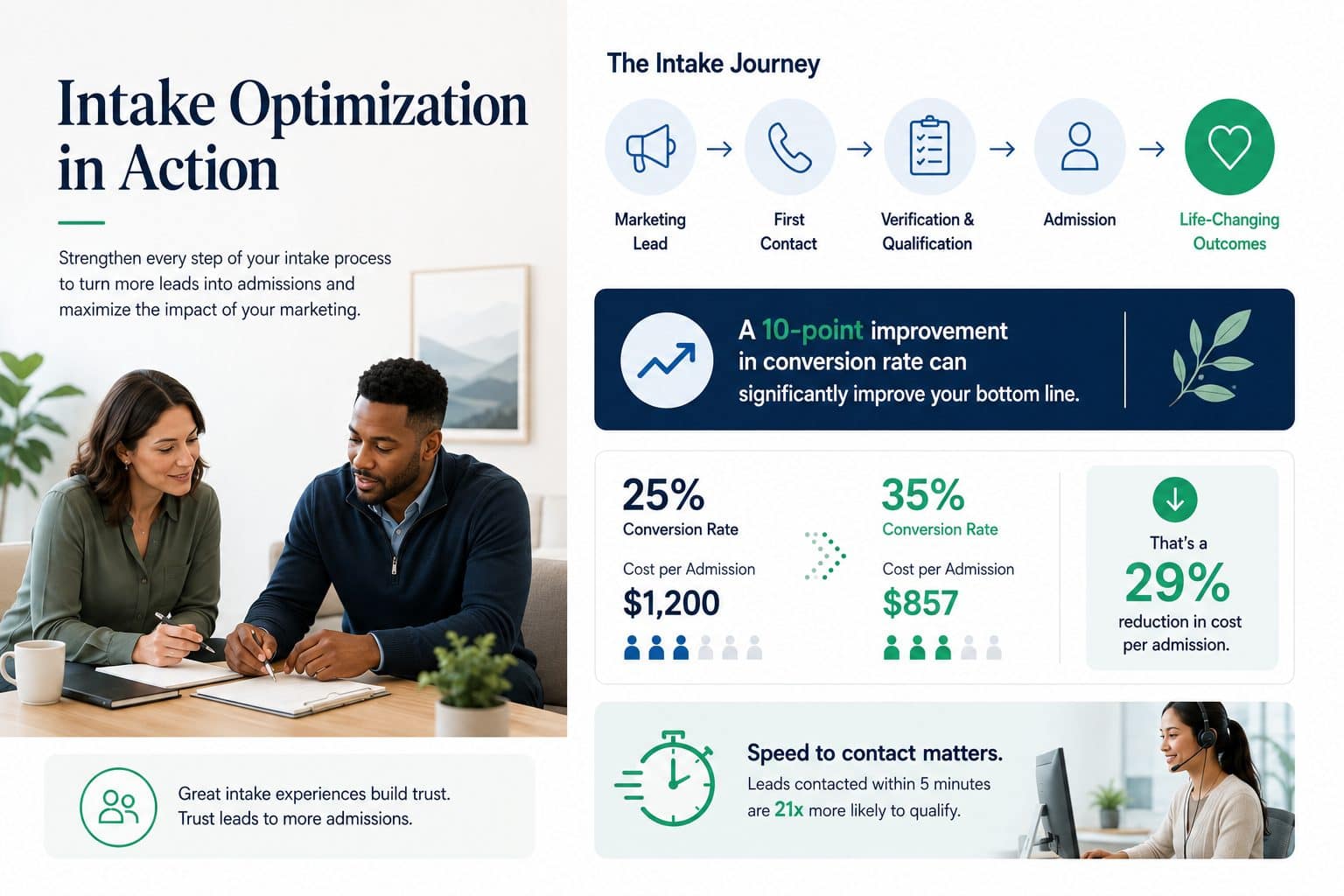
Consider the math. If your average cost per lead is $300 and your intake team converts 25% of calls to admissions, your effective cost per admission is $1,200. Improve that conversion rate to 35% through better intake processes, and your cost per admission drops to approximately $857. That 10-point improvement represents significant margin recovery without spending an additional dollar on media.
The connection between intake performance and marketing ROI is direct. Every percentage point of improvement in your lead-to-admission conversion rate amplifies the return on your media spend. This is why operators who manage $50M+ in behavioral health marketing budgets track intake metrics with the same rigor they apply to cost per click and impression share.
Intake optimization is not about answering phones faster. It is about building a systematic process that captures, qualifies, and converts leads with consistency. This guide breaks down the specific steps, technology considerations, and compliance requirements that separate high-performing intake operations from the industry average.
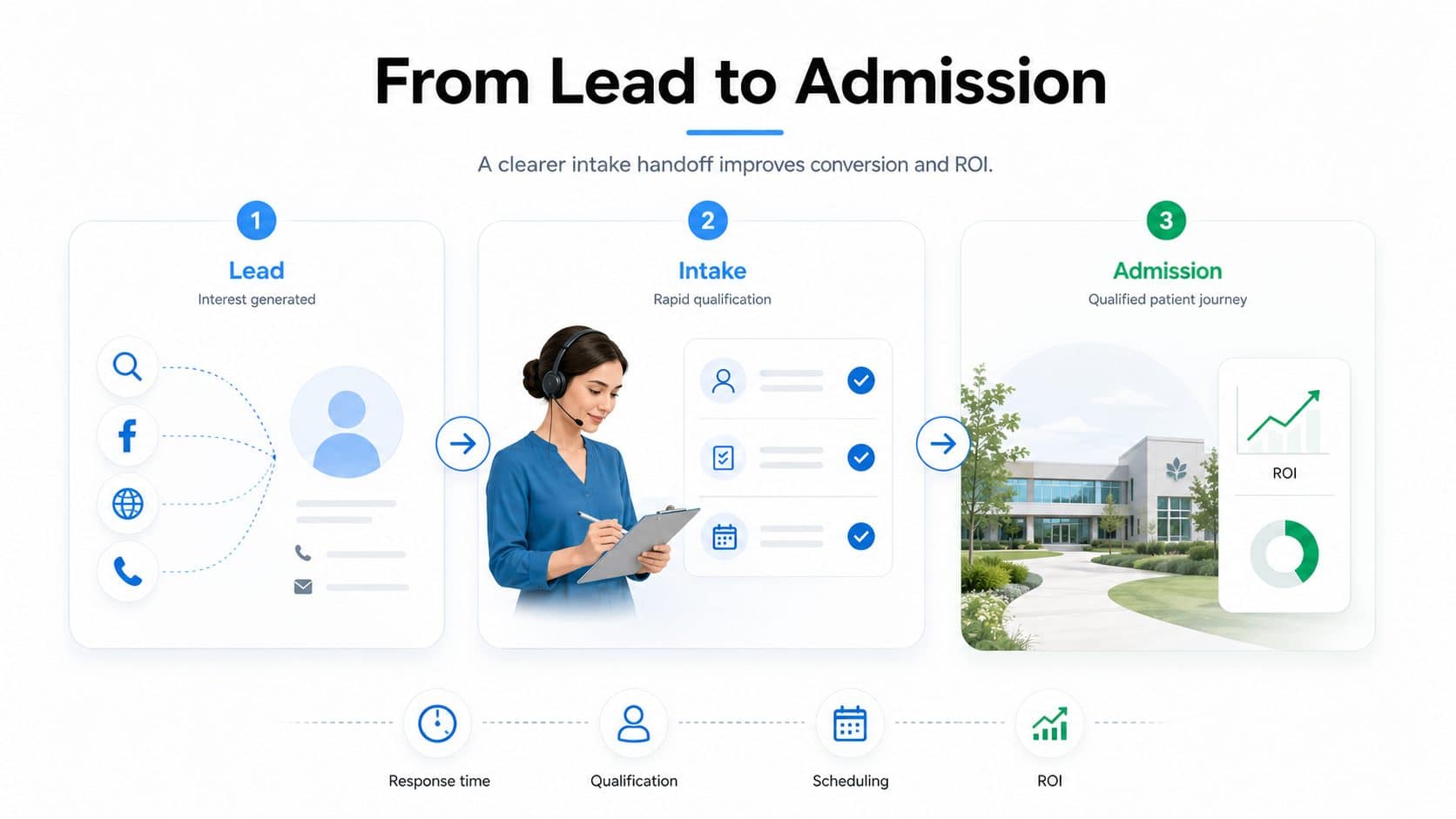
Steps to Optimize Your Intake Process
Optimization begins with measurement. Before implementing changes, establish baseline metrics for your current intake operation: call answer rate, average speed to answer, call-to-verification rate, verification-to-admission rate, and time from first contact to admission. Without these numbers, you cannot quantify improvement.
Step 1: Audit your current call flow. Listen to recorded intake calls (with appropriate consent protocols) and document where conversations break down. Common failure points include unclear insurance verification processes, inconsistent responses to family questions, and poor handoff between the first responder and clinical staff. Identify the three most frequent drop-off points and prioritize those first.
Step 2: Standardize your intake scripts. Your intake team needs a consistent framework for handling calls without sounding robotic. Build scripts that cover insurance questions, clinical fit assessment, family concerns, and next-step clarity. Train your team to use the framework while adapting to each caller's emotional state. The goal is consistency of information, not uniformity of tone.
Step 3: Implement technology solutions for intake that connect your marketing data to your intake team. When a lead calls, your intake coordinator should see the source, the landing page they visited, and any form data they submitted. This context allows for more relevant conversations and reduces the time spent asking questions that the caller already answered online.
Step 4: Reduce response time. According to research from the Harvard Business Review, leads contacted within five minutes are 21 times more likely to qualify than leads contacted after 30 minutes. For behavioral health, where emotional readiness fluctuates, this window may be even tighter. Staff your intake team to answer calls live during peak hours and return missed calls within minutes, not hours.
Step 5: Build verification capacity. Insurance verification bottlenecks kill conversions. If your team cannot verify benefits quickly, callers shop while they wait. Either build internal VOB capacity or partner with a verification service that can return results within hours. Every day of delay increases the likelihood of losing the admission to a competitor or to the caller's ambivalence.
Step 6: Train continuously. Intake optimization is not a one-time project. Schedule monthly call reviews, track individual coordinator metrics, and provide coaching based on actual performance data. The best intake teams operate like sales teams: measured, coached, and accountable to conversion targets.
Impact of Intake Optimization on Conversion
The relationship between intake performance and treatment center intake conversion rates is measurable and significant. Centers that implement systematic intake optimization typically see conversion improvements of 15% to 40% within the first 90 days. The variance depends on how far below best practices the starting point was.
Consider a mid-sized residential treatment center generating 200 inquiry calls per month with a 20% conversion rate. That produces 40 admissions monthly. If intake optimization lifts conversion to 28%, the same lead volume now produces 56 admissions. At an average revenue of $15,000 per admission, that eight-point improvement represents $240,000 in additional monthly revenue from the same marketing spend.
These gains compound over time. As your intake team becomes more skilled, your marketing team can provide better lead intelligence, and your clinical team can improve their intake handoff processes; each improvement amplifies the others. This is why operators who have scaled treatment centers from three to 24 locations treat intake optimization as a core operational discipline, not a marketing afterthought.
The impact extends beyond revenue. Higher conversion rates mean lower cost per admission, which creates room to improve treatment center ROI through either margin expansion or reinvestment in growth channels. Better intake processes also improve patient experience during the most vulnerable moment of their treatment journey.
Attribution discipline matters here. You cannot optimize what you do not measure. Tracking attribution through to admission, not just to lead or call, reveals which marketing channels produce patients who actually complete intake. This data allows you to reallocate budget toward higher-converting sources and away from channels that generate calls but not admissions.
Free Audit
Want a straight read on where your budget is leaking?
Building an Effective Lead to Admission Funnel
The lead to the admission funnel in behavioral health is distinct from standard sales funnels. Callers are often in crisis, emotionally volatile, and making decisions under pressure. Family members may be calling on behalf of a loved one who is not yet willing to enter treatment. The funnel must accommodate these complexities while still moving qualified leads toward admission.
Align marketing and intake teams around shared definitions. What constitutes a qualified lead? If marketing defines it as any form of submission and intake defines it as a caller with verified insurance and clinical fit, you will have constant friction. Establish shared criteria: insurance coverage, clinical appropriateness, geographic fit, and willingness to engage. Track these criteria at each funnel stage.
Map the funnel stages explicitly. A typical behavioral health funnel includes: inquiry (call, form, or chat), qualification (insurance and clinical screening), verification (benefits confirmation), clinical assessment, and admission. Define the exit criteria for each stage and measure conversion between stages. This granularity reveals where leads are dropping off.
Common pitfalls in the lead-to-admission funnel include misaligned handoffs between marketing and intake, slow verification processes, and poor follow-up on leads who did not convert on the first call. Solutions include unified CRM systems that track leads from first touch through admission, automated follow-up sequences for unconverted leads, and clear ownership at each funnel stage.
The lead to admission funnel design should integrate with your paid media strategy. Campaigns should be optimized toward admission-qualified leads, not just call volume. This requires closed-loop reporting that feeds admission data back to your ad platforms. Without this feedback loop, your campaigns optimize toward the wrong goal.
Operators who treat the funnel as a single system, rather than separate marketing and intake functions, consistently outperform those who do not. The handoff between marketing and intake is where most treatment centers lose the highest percentage of potential admissions.
Compliance and Quality Assurance in Intake
Intake optimization must operate within strict compliance boundaries. Behavioral health marketing is subject to SAMHSA guidelines, LegitScript certification requirements, Google Ads sensitive vertical policies, and HIPAA regulations. Any optimization effort that compromises compliance creates regulatory risk that far exceeds the revenue benefit.
HIPAA considerations in intake. Your intake team handles protected health information from the first call. Ensure your CRM, phone systems, and any technology solutions are HIPAA-compliant. Train intake staff on PHI handling, including what information can be discussed with family members and what requires patient consent. Document your compliance protocols and audit adherence regularly.
LegitScript and advertising compliance. If your intake process involves any re-engagement of unconverted leads, ensure those communications comply with LegitScript standards. Behavioral health retargeting is prohibited under Google Ads policies, so your follow-up sequences must use compliant channels like email and phone, not display advertising.
Compliance management in treatment centers extends to the claims your intake team makes during calls. Train staff to avoid outcome guarantees, cure language, or comparisons to other treatment centers. Focus conversations on your program's approach, the admissions process, and logistical next steps rather than promises about treatment results.
Quality assurance processes. Implement regular call monitoring, scoring against compliance criteria, and remediation for staff who deviate from protocols. Quality assurance protects both patients and your organization. It also produces data that informs training priorities and process improvements.
The operators who maintain clean compliance records while optimizing intake performance treat compliance as a design constraint, not an obstacle. Building compliance into your intake process from the beginning is far easier than retrofitting it after a violation.
Ready to Optimize Your Intake Process?
If your intake conversion rate is below where it should be, or if you are unsure how your performance compares to industry benchmarks, a focused conversation can identify your highest-impact opportunities. We bring operator-level experience from scaling treatment centers from 3 to 24 locations, managing $1.5M to $2M monthly in behavioral health media, and tracking attribution through to admission. Let us discuss your current intake performance, compliance posture, and growth goals.
Questions, Answered.
Intake optimization directly impacts your marketing ROI by improving the percentage of leads that convert to admissions. A 10-point improvement in conversion rate can reduce your effective cost per admission by 25% or more without additional media spend. For operators managing significant ad budgets, this translates to hundreds of thousands in recovered revenue annually. Beyond financial performance, optimized intake processes improve patient experience during the critical first contact.
Start by measuring your current baseline: call answer rate, speed to answer, and conversion rate at each funnel stage. Then implement systematic improvements, including standardized call scripts, technology that connects marketing data to intake staff, faster response times, and streamlined insurance verification. Continuous training based on call review data accelerates improvement. For centers seeking tailored guidance, external consultation with specialists who have tracked attribution through to admission across $50M+ in managed behavioral health spend can identify optimization opportunities specific to your operation.
The most frequent issues include misalignment between marketing and intake teams on lead definitions, slow insurance verification that causes callers to shop competitors, poor follow-up on leads who did not convert on the first call, and a lack of attribution tracking that connects marketing spend to actual admissions. Solutions include unified CRM systems, clear handoff protocols, automated follow-up sequences, and closed-loop reporting that feeds admission data back to your media platforms.
Compliance constrains how you can optimize intake, but it also protects your organization. HIPAA governs PHI handling throughout the intake process. LegitScript and Google Ads policies prohibit behavioral health retargeting, limiting your re-engagement options to compliant channels. Your intake staff must avoid outcome guarantees or cure language during calls. Building compliance into your intake process from the beginning is easier than correcting violations after the fact.
Technology enables faster response times, better lead intelligence, and more consistent processes. HIPAA-compliant CRMs track leads from first touch through admission. Call tracking systems connect marketing source data to intake conversations. Automated verification tools reduce benefits confirmation delays. AI-native tools can assist with lead scoring and follow-up prioritization. The key is selecting technology that integrates across your marketing and intake systems rather than creating additional data silos.
Ready to see what AI-native marketing can do for your treatment center?
Request a free audit of your paid media, landing pages, attribution, and compliance posture. You'll get a straight assessment of where the opportunities are.
or email us at info@marketingpowered.ai