Guide
Understanding the Private Equity Rollup Threat in Behavioral Health
What independent treatment center operators need to know about consolidation, competition, and strategic positioning in a changing market.
The Rise of Private Equity in Behavioral Health
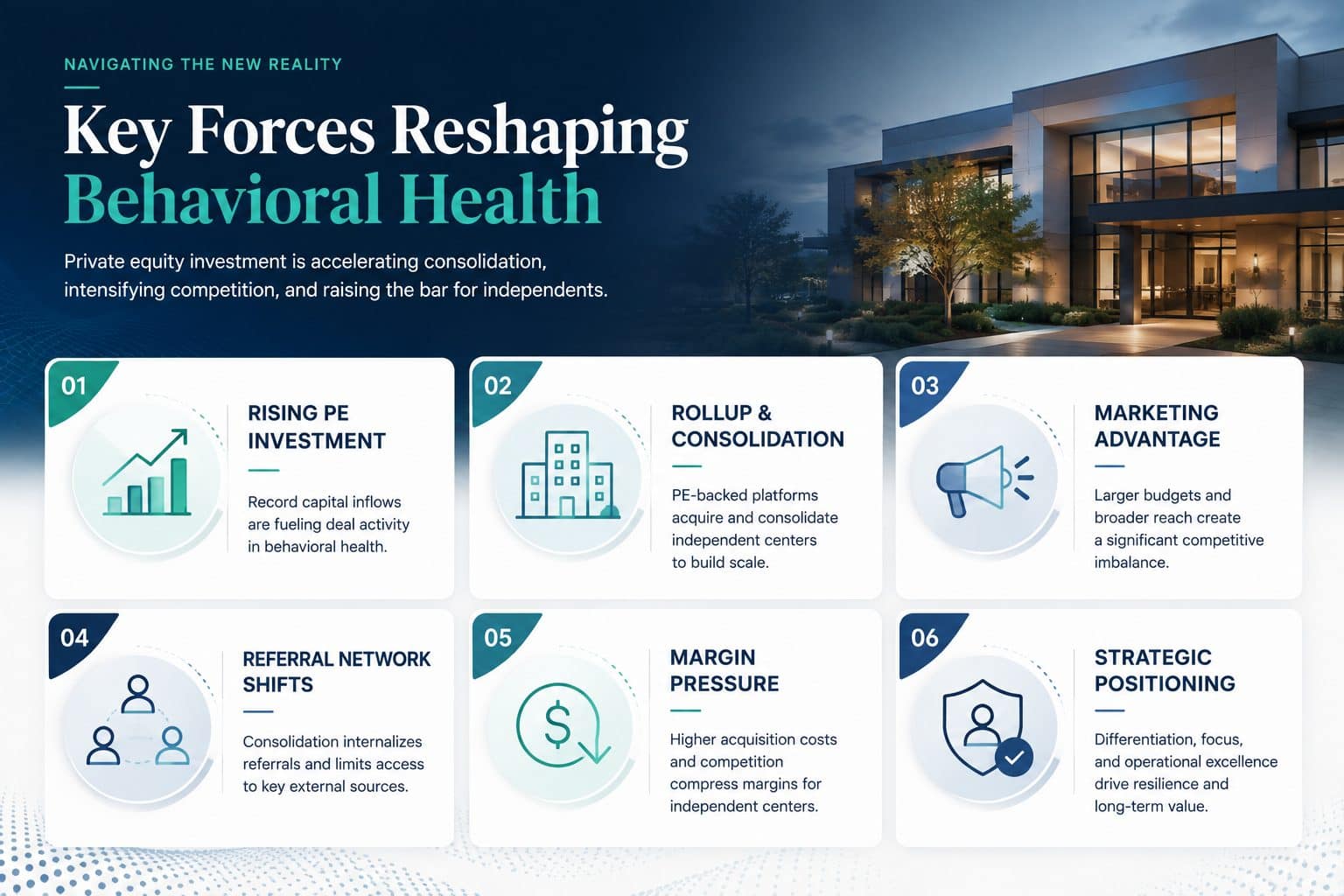
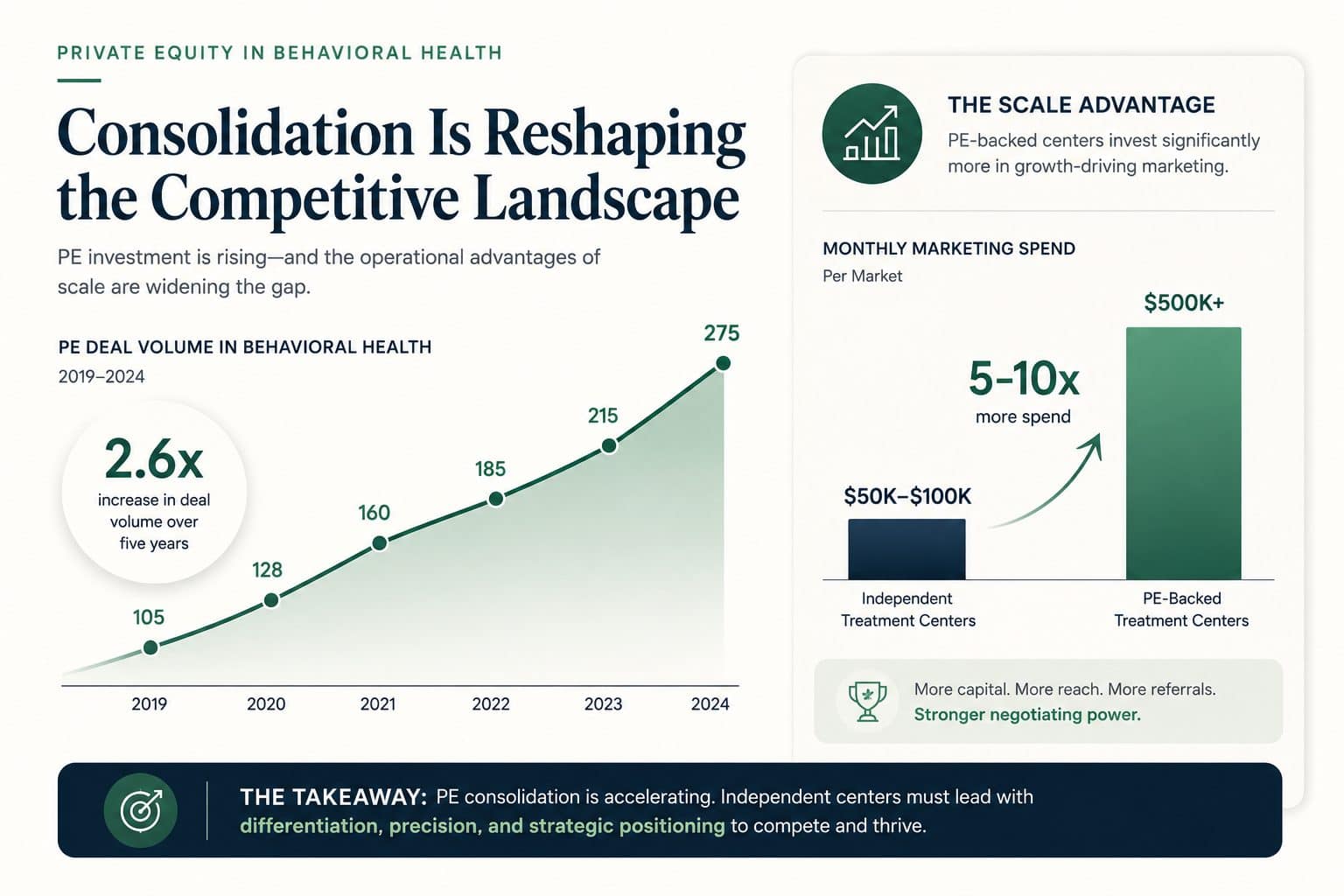
Private equity behavioral health investment has accelerated dramatically over the past decade. According to PitchBook data, behavioral health represented one of the fastest-growing healthcare subsectors for PE investment between 2019 and 2024, with deal volume increasing year over year even as broader healthcare M&A faced headwinds. For independent operators, this shift represents both a competitive threat and a fundamental change in market dynamics.
The motivations driving this capital influx are straightforward. Behavioral health offers stable, recurring revenue streams, fragmented ownership structures ripe for consolidation, and growing demand fueled by increased awareness of mental health and substance use disorders. SAMHSA's National Survey on Drug Use and Health consistently documents rising treatment needs, creating a demand curve that attracts institutional capital.
PE-backed platforms typically pursue a rollup strategy: acquire multiple independent centers, consolidate back-office operations, standardize clinical protocols, and build regional or national scale. The resulting entities command negotiating leverage with payers, access to cheaper capital, and marketing budgets that dwarf what most independent operators can deploy. Centers that were once local competitors become components of multi-state platforms with centralized intake, shared technology infrastructure, and aggressive growth mandates.
Understanding this shift is not optional. It is the baseline context for every strategic decision an independent treatment center makes, from marketing spend allocation to exit planning.
Implications for Independent Treatment Centers
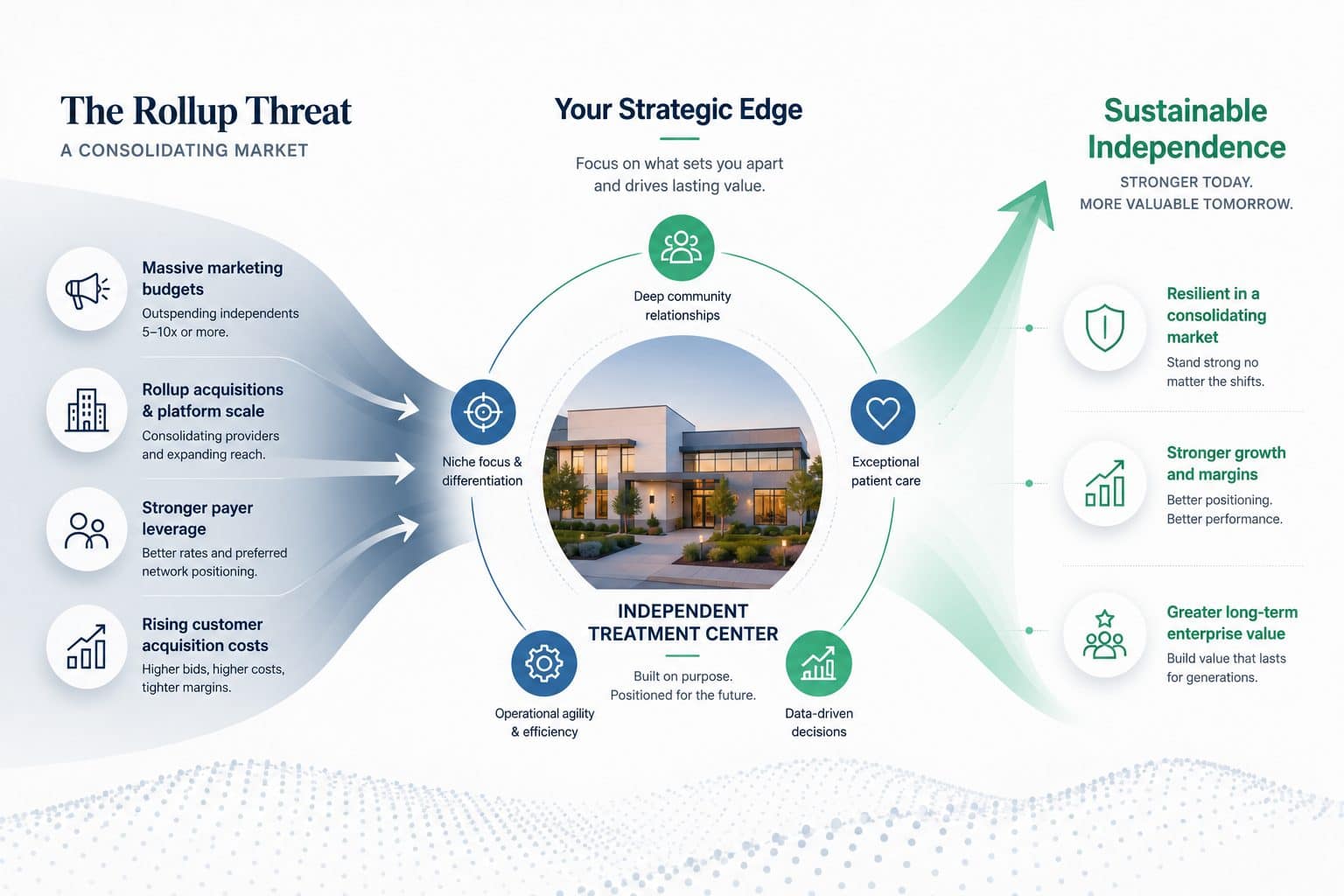
The most immediate implication of private equity consolidation is intensified competition. PE-backed centers typically operate with marketing budgets five to ten times larger than independent competitors in the same market. They bid aggressively on high-intent keywords, dominate local service directories, and fund referral network development at scale. For an independent center running $50K to $100K monthly in paid media, competing against a platform spending $500K or more in the same geography requires precision that brute force cannot match.
Competitive Pressure on Cost Per Admission
PE-backed treatment centers can absorb higher cost-per-lead and cost-per-admission figures because their patient lifetime value calculations account for cross-facility referrals, longer retention across the care continuum, and negotiated payer rates unavailable to smaller operators. An independent center paying $1,200 per admission lead in a competitive market may be bidding against a platform that views the same lead as a $3,000 acceptable cost because their economics work differently.
This dynamic compresses margins for independents and forces difficult choices: increase marketing spend to maintain census, accept lower occupancy, or find differentiated positioning that justifies premium pricing.
Free Audit
Want a straight read on where your budget is leaking?
Referral Network Disruption
Consolidation also reshapes referral networks. When PE platforms acquire interventionists, sober living operators, or outpatient groups, those referral relationships become internal. A hospital system that once referred to multiple independent centers may sign an exclusive agreement with a PE-backed platform offering a full continuum of care. The referral sources you have cultivated over the years can shift overnight following a single acquisition in your market.
Staffing and Talent Competition
PE-backed centers often offer competitive compensation packages, equity participation, and clearer career paths. Clinical staff and admissions professionals who might have stayed at an independent center for years now receive recruiting outreach from platforms with more resources. Maintaining team stability requires intentional culture-building and compensation strategies that independents must fund from tighter margins.
The cumulative effect is an operating environment where independent treatment centers must be more strategic, more efficient, and more differentiated than they were five years ago. The margin for error has narrowed.
Strategies for Competing Against PE-Backed Centers
Competing effectively does not require matching PE budgets. It requires precision, differentiation, and disciplined execution across the channels that matter most to your specific patient population.
Email Us
Prefer to send the context directly?
Specialize Where Platforms Generalize
PE-backed platforms optimize for scale, which often means standardized programming designed for broad patient populations. Independent centers can compete by developing genuine clinical specialization: dual diagnosis expertise, trauma-informed care, specific populations such as adolescents, professionals, or first responders, or modalities that require specialized training. Specialization creates defensible positioning that generic marketing cannot replicate.
When your clinical programming genuinely differs from the PE playbook, your marketing can communicate that difference effectively. Attribution tracking through to admission confirms which messages resonate with which patient segments.
Own Your Local Market Presence
PE platforms operate regionally or nationally. They struggle to replicate the community relationships an independent operator builds over the years. Local SEO, community partnerships, alumni engagement, and physician relationship development create acquisition channels that paid media alone cannot displace.
An independent center with strong local organic presence, established referral relationships, and genuine community ties has defensible positioning against a platform that entered the market through acquisition.
Deploy Marketing Capital with Precision
With over $50M managed in behavioral health media spend, we have seen independent centers outperform PE-backed competitors in specific markets by focusing on channel efficiency rather than channel volume. This means rigorous attribution tracked through to admission rather than just to form fill, aggressive negative keyword management, landing page testing, and intake process optimization.
The goal is not to outspend the platform. It is to convert at a rate that makes your smaller budget work harder. Case studies from behavioral health clients demonstrate what disciplined execution looks like in practice.
Strategy
Want to start with a quick message?
Build Operational Resilience
Centers that survive PE competition typically have strong unit economics, diversified payer mixes, and intake processes that convert leads efficiently. If your cost per admission is $1,500 and your competitor's is $1,000, no amount of marketing sophistication closes that gap entirely. Operational discipline is marketing's prerequisite.
For independent operators competing in consolidating markets, the playbook starts with understanding your true cost to acquire and serve each patient segment.
Positioning for Acquisition: Pros and Cons
Not every independent operator wants to remain independent indefinitely. For some, positioning for acquisition by a PE-backed platform represents a logical exit strategy. Understanding the trade-offs helps clarify your own strategic direction.
Arguments for Positioning Toward Acquisition
PE acquirers pay premium multiples for centers with strong financials, scalable operations, and defensible market positions. If you have built a center with clean books, stable census, diversified payer mix, and documented clinical outcomes, you may command attractive EBITDA multiples in the current market.
Acquisition also provides liquidity for founders who have invested years building their organizations. For operators approaching retirement or seeking capital for new ventures, a PE exit can fund the next chapter while ensuring continuity for staff and patients.
Additionally, joining a larger platform can provide resources your center could not access independently: technology infrastructure, payer negotiating leverage, and growth capital for expansion.
Free Audit
Want a straight read on where your budget is leaking?
Arguments Against Acquisition Positioning
PE ownership typically comes with growth mandates, standardization requirements, and reduced operational autonomy. Clinical decisions that were once yours become subject to platform protocols. Staff who joined your culture may leave when ownership changes.
The behavioral health M&A environment also carries risk. PE platforms facing their own financial pressures may cut costs in ways that affect care quality, staff retention, or community reputation. Your legacy becomes their asset to optimize.
Founders who sell often discover that the earnout structure ties them to performance targets they no longer fully control. The payday on paper may look different than the payday in practice.
Making the Decision
The acquisition question ultimately comes down to personal goals and market position. Centers with genuine competitive advantages may generate more long-term value through continued independence. Centers facing intense competition with limited differentiation may find acquisition attractive before market conditions erode their valuation.
Either path benefits from clarity. If you intend to sell, optimize for the metrics acquirers value. If you intend to compete, invest in the differentiation and operational discipline that sustains independence.
The Future Landscape of Behavioral Health M&A
Predicting M&A cycles with precision is impossible, but several trends suggest what independent operators should anticipate over the next three to five years.
Email Us
Prefer to send the context directly?
Continued Consolidation with Selective Pressure
PE capital committed to behavioral health platforms must be deployed. According to Behavioral Health Business, PE dry powder allocated to healthcare services remains substantial, and behavioral health continues to attract deal flow. Expect continued acquisition activity, particularly for centers with strong financials, specialized programming, or strategic geographic positioning.
However, rising interest rates have increased the cost of acquisition financing, compressing the multiples some platforms can pay. Centers with weaker fundamentals may receive less attractive offers than they would have in 2021 or 2022.
Regulatory and Policy Uncertainty
Federal and state scrutiny of PE ownership in healthcare has increased. The FTC and state attorneys general have examined consolidation patterns across healthcare subsectors, though behavioral health has received less attention than primary care or hospital systems to date. Future regulatory changes could affect deal structures, reporting requirements, or antitrust review thresholds.
Parity enforcement under the Mental Health Parity and Addiction Equity Act continues to evolve. Changes in parity compliance requirements could affect revenue models for both independent and PE-backed centers, though the direction of impact remains uncertain.
Technology as a Differentiator
Centers that adopt AI-native marketing infrastructure, sophisticated attribution, and data-driven intake optimization will outperform those relying on legacy approaches. PE platforms have resources to deploy technology at scale, but independent operators who move early on AI-powered marketing, predictive analytics, and multivariate optimization can achieve disproportionate results.
Marketing Powered has been AI-native since 2022, building infrastructure purpose-designed for behavioral health marketing compliance and performance. This investment in technology serves the specific needs of treatment center operators competing in a consolidating market.
Strategy
Want to start with a quick message?
The Independent Operator's Strategic Imperative
The behavioral health consolidation trend is not reversing. Independent operators who thrive will be those who make deliberate strategic choices: specialize clinically, optimize operationally, market with precision, and build defensible local positioning.
Waiting to see how the market evolves is itself a strategic choice, and rarely a winning one. The centers we have worked with share a common trait: they made decisions before market pressure forced their hand.
For resilient growth in a consolidating market, the path forward requires clarity about your competitive position and disciplined execution against a defined plan.
Navigate the Consolidation Landscape with Strategic Clarity
Whether you are positioning to compete independently or evaluating acquisition options, the decisions you make now shape your center's future. Marketing Powered brings operator-level experience, over $50M in managed behavioral health media spend, and AI-native infrastructure built for this specific market. Let's discuss your strategic position, competitive dynamics, and the marketing approach that fits your goals.
Questions, Answered.
PE ownership typically brings operational standardization, increased marketing investment, and pressure for census growth and margin expansion. This can improve efficiency and fund expansion, but it also creates tension between financial return requirements and clinical decision-making. Centers under PE ownership often face pressure to optimize length of stay, payer mix, and staffing ratios in ways that prioritize financial metrics. The impact on care quality varies by platform and operator, but the structural incentive to prioritize returns is inherent to the model.
Independent centers compete most effectively through genuine clinical specialization, strong local market presence, and disciplined marketing execution. Specialization creates positioning that generic PE playbooks cannot replicate. Local relationships with physicians, hospitals, and community organizations build referral channels that national platforms struggle to develop. Precision marketing with rigorous attribution tracking, optimized intake processes, and efficient spend allocation allows smaller budgets to compete against larger competitors. Operational discipline in cost-per-admission and conversion rates is the foundation that makes marketing investment productive.
Behavioral health attracts PE investment for several reasons: fragmented ownership structures create acquisition opportunities, demand continues to grow as treatment-seeking increases, recurring revenue models provide predictable cash flows, and the sector historically traded at lower multiples than other healthcare subsectors. SAMHSA data consistently documents treatment needs that outpace capacity in many markets, creating favorable supply-demand dynamics. The combination of growth potential and consolidation opportunity makes behavioral health attractive to financial sponsors seeking healthcare exposure.
Acquirers evaluate several factors: strong and stable financial performance, diversified payer mix reducing concentration risk, documented clinical outcomes and accreditation, scalable operational processes, experienced leadership willing to stay through transition, and strategic geographic positioning. Centers with clean financials, specialized programming, and defensible market positions command premium multiples. Those with operational challenges, single-payer dependence, or compliance concerns face discounted valuations or may not attract offers at all.
Ready to see what AI-native marketing can do for your treatment center?
Request a free audit of your paid media, landing pages, attribution, and compliance posture. You'll get a straight assessment of where the opportunities are.
or email us at info@marketingpowered.ai