Resources
Google Ads Best Practices for High-Intent Lead Generation
Applying modern google ads best practices requires shifting your account focus from raw lead volume to verified downstream pipeline. When search campaigns optimize solely for top-of-funnel web form submissions, automated bidding systems inevitably purchase cheap, unqualified inquiries. Building a defensible lead generation engine demands strict conversion signal integrity, structured query intent, and rigorous offline conversion tracking.
By Mike Hulick, Founder, Marketing Powered

Feed Offline Conversions to Protect Bidding Signal Integrity

What Are Google Ad Best Practices for Lead Generation?
In high-value lead generation, standard advertising metrics often disguise operational failure. Marketing dashboards frequently display declining cost-per-click (CPC) and falling cost-per-lead (CPL) figures while intake coordinators, admissions directors, and sales teams manage an influx of disconnected phone numbers, spam inquiries, and out-of-area prospects. When performance is measured exclusively at the point of initial contact submission, search engines optimize toward users who submit forms casually rather than prospects who possess commercial intent and purchasing authority.
Qualified lead acquisition begins by restructuring the conversion feedback loop. Rather than treating every form submission or phone call as an identical success event, high-performance accounts evaluate campaigns on downstream economics: cost per qualified sales opportunity, cost per clinical intake, and customer acquisition cost. In high-stakes service categories, including healthcare networks and enterprise professional services, generating fifty unqualified phone calls costs an organization administrative payroll and delays response times for legitimate inquiries.
To establish genuine efficiency, media managers must align account mechanics with business reality. This process involves establishing precise technical tracking, segmenting intent into discrete ad groups, isolating transactional search queries from exploratory research, and feeding verified outcome data back to the ad platform. Every technical adjustment, from match-type governance to negative keyword exclusions, serves to direct capital toward searchers prepared to take commercial action.
Google Ads bidding algorithms optimize strictly for the data they receive. If an account designates an unverified web form completion as its primary conversion goal, automated systems such as Target CPA (Cost Per Acquisition) and Target ROAS (Return on Ad Spend) locate users who exhibit high propensities to complete online forms. These users frequently include job seekers, current customers seeking support logins, researchers seeking academic information, and low-intent consumers submitting inaccurate contact details.
Resolving this disconnect requires implementing Google Ads Offline Conversion Imports. By capturing the Google Click Identifier (GCLID) or utilizing Enhanced Conversions for Leads with hashed first-party user data, your customer relationship management (CRM) software or intake database records which specific click generated an inquiry. As your internal team evaluates the lead, downstream qualification milestones are transmitted back into Google Ads via secure webhooks or automated batch uploads.
In an accountable conversion hierarchy, front-end submissions are configured as secondary conversion actions, which monitor operational volume without steering algorithmic bidding. Only validated business milestones function as primary conversion actions. In a multi-location clinic, this milestone might represent a verified clinical assessment or scheduled intake. In a professional advisory firm, it represents an accepted discovery meeting with an economic decision-maker.
Attribution must track directly to final revenue or patient admission rather than terminating at the initial form fill. Feeding qualified milestones back to Google Ads forces Smart Bidding models to abandon search queries that generate superficial clicks, reallocating media budget toward keyword clusters and auction environments that yield contracted revenue.
Google Ads Best Practices 2026: Match Types and Bidding Maturity
Managing search query expansion in modern ad auctions requires a disciplined transition between keyword match types and automated bidding strategies. Deploying broad match keywords inside an unseasoned account or pairing broad match with manual bidding introduces severe budget waste. Broad match relies on deep historical conversion data to interpret semantic intent. Without strong offline conversion signals, broad match searches match aggressively against adjacent, irrelevant queries.
Building an account following google ads best practices 2026 involves executing a staged maturation sequence:
- Phase One: Exact Match Foundation. Launch new campaigns using exact match keywords and tightly themed phrase match variations. Utilize Target Impression Share or Manual CPC with Enhanced CPC disabled to establish precise baseline query intent and control initial search term delivery.
- Phase Two: Controlled Expansion. Once ad groups generate consistent, clean search term histories and record verified conversion volume, selectively introduce phrase match variations paired with Target CPA bidding.
- Phase Three: Signal-Backed Broad Match. Introduce broad match keywords only within campaigns possessing robust offline conversion imports and historical volume exceeding 30 to 50 verified qualified conversions per month. Ensure Target CPA or Target ROAS safeguards are firmly applied.
Account managers must avoid treating broad match as a universal setting. In regulated fields, clinical services, and competitive B2B sectors, query variations can easily breach compliance or draw individuals in acute crisis to non-urgent services. Maintain strict control over keyword expansion until your bidding infrastructure reliably separates qualified commercial intent from casual research.
Free Audit
Want a straight read on where your budget is leaking?
Real Google Ads Examples and Campaign Architectures
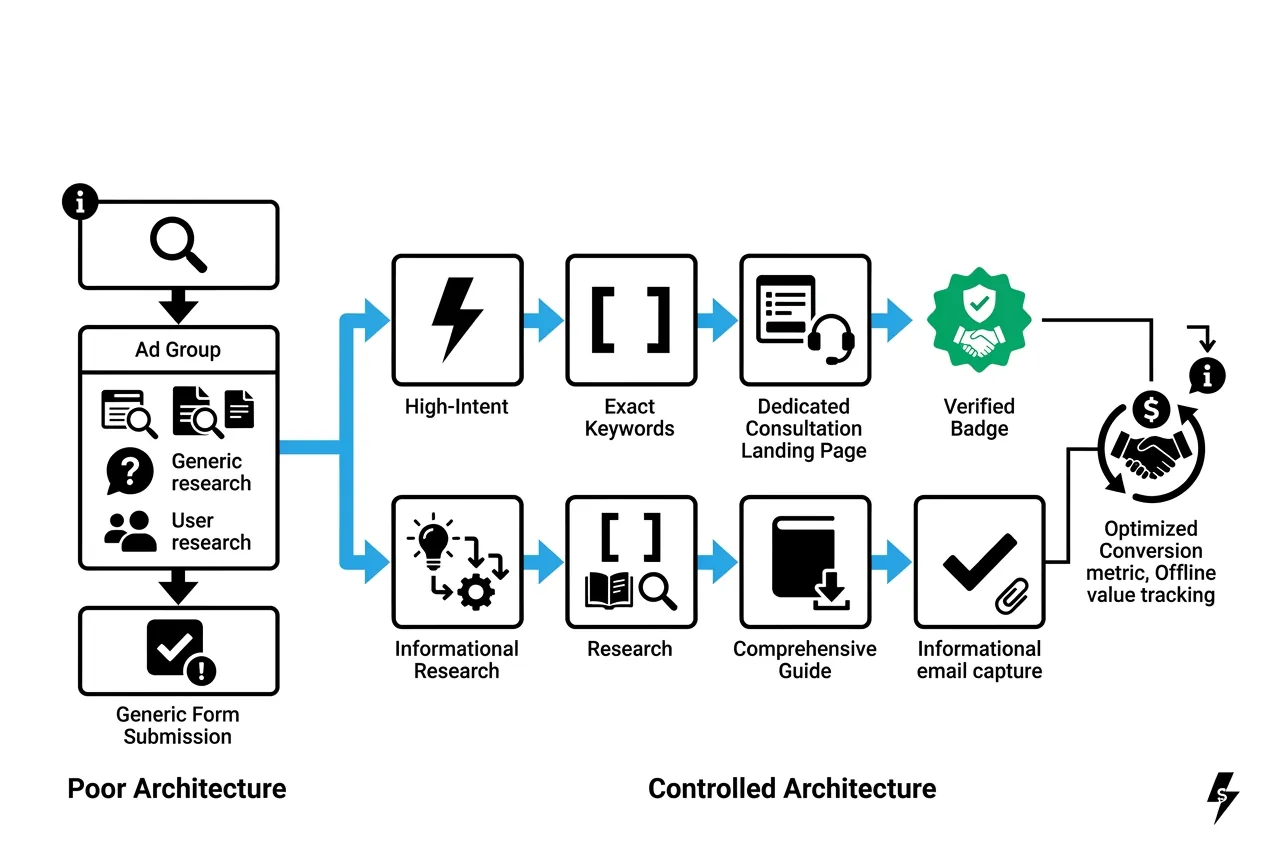
Examining actual account structures illustrates the practical application of intent segmentation. Many advertisers organize campaigns around generic service taxonomies, grouping informational research queries with commercial buying queries inside the same campaign. This structure spreads media spend unevenly, allowing exploratory research terms with high search volumes to exhaust the daily budget before high-intent transactional searchers enter the auction.
Consider the structural difference between well-segmented and consolidated Google Ads accounts.
High-performing accounts enforce distinct campaign separations between geographic locations, core practice specialties, and levels of query intent. In multi-location organizations, isolating campaigns by specific physical markets prevents higher-density metropolitan areas from draining resources allocated to smaller regional sites.
To explore specialized campaign frameworks tailored for patient acquisition and clinical operations, review the pillar analysis on Healthcare PPC: structuring paid search for qualified patient demand. Establishing granular structural boundaries ensures every dollar spent serves a designated operational objective.
Google Ads for Small Business and Regulated Verticals
Executing google ads for small business operators and regulated organizations presents unique operating parameters. Independent practices and regional firms cannot absorb the algorithmic learning waste common to enterprise advertising budgets. Simultaneously, operating within sensitive markets such as healthcare introduces strict legal and platform limitations.
Under the Google Ads Policy for Personalized Advertising, advertisers promoting products or services related to personal hardships, health conditions, or medical treatments cannot deploy remarketing lists, customer match audiences, or personalized targeting. In sensitive healthcare verticals, including addiction treatment and mental health, retargeting is strictly prohibited. Marketers who rely on standard e-commerce funnels to recapture abandoned web visits through remarketing display ads find their accounts restricted or banned.
Furthermore, advertisers running campaigns in addiction treatment must complete mandatory third-party vetting under the Google Ads Healthcare and Medicines Policy, which requires verification from LegitScript prior to ad serving.
Because retargeting is unavailable across sensitive healthcare categories, first-touch conversion mechanics determine campaign survival. Small businesses and multi-location clinics must convert qualified search intent on the initial visit. This reality elevates the necessity of exact search intent matching, precise ad relevance, clear professional credential display, and friction-free direct phone routing.
Tactical Google Ads Tips for High-Value Lead Intake
Optimizing account performance requires continuous operational maintenance. Reviewing search terms once a month or trusting automated recommendations inside Google Ads inevitably degrades lead qualification. Implementing proven google ads tips focused on lead intake protection isolates ad spend from commercial waste.
- Build Negative Keyword Tiering. Implement a three-level negative keyword structure: account-level lists, campaign-level thematic negatives, and ad-group-level cross-negatives. Account-level lists should immediately filter universal non-commercial terms (such as careers, jobs, salaries, glassdoor, login, portal, courses, free, and pro bono). Campaign-level negatives prevent semantic overlap between distinct service lines.
- Filter Lead Form Assets. When deploying native form capture through Google Ads Lead Form Assets, enable qualification questions rather than accepting single-click auto-fill submissions. Requiring users to specify location, budget, timeframe, or insurance status introduces productive friction that eliminates casual click-throughs.
- Audit Search Terms Daily During Scaling. The search terms report reveals exact user queries. Review search terms consistently, extracting irrelevant semantic variants and adding them as exact match negative keywords before automated bidding systems latch onto false intent signals.
- Enforce Local Address Verification. Multi-location firms must verify that Google Business Profiles are linked accurately within Google Ads location assets. Restrict location targeting strictly to "Presence: People in or regularly in your targeted locations" rather than the platform default "Presence or interest," which serves ads to international users searching about your territory.
- Implement Dynamic Call Tracking with CRM Webhooks. Ensure every inbound phone call generated by paid search dynamically captures campaign, ad group, keyword, and click data. Route calls directly to knowledgeable intake professionals capable of logging consultation status immediately into your patient management or CRM software.

Email Us
Prefer to send the context directly?
How Marketing Powered Delivers Accountable Paid Media Management
Marketing Powered provides operator-led paid search management built for high-accountability sectors. Our methodologies were forged in large-scale marketing leadership, informed by a founder background as a former healthcare CMO who ran marketing for a treatment network that grew from 3 to 24 locations, managing $1.5 to $2M per month in Google Ads across 11+ behavioral and mental health accounts. We approach advertising strategy with forensic precision, bringing experience as a court-certified expert witness in advertising strategy directly into account governance.
Our media management systems reject vanity metrics. We deploy custom offline conversion pipelines that track attribution directly to customer revenue or clinical admission, bypassing shallow lead counters. Operating as an AI-native organization since 2022, we maintain owned, local AI infrastructure for HIPAA-aware inference, enabling sophisticated natural language analysis of search terms and intake workflows without exporting sensitive data to public third-party models.
We align your search media directly with qualified demand across complex, regulated environments. For teams assessing external partners, reviewing our analyses on Healthcare ppc services: what a specialist partner delivers and how to vet one and our guide to selecting a Google ads agency: what a specialist partner delivers and how to vet one provides clear evaluation benchmarks for technical capability, compliance awareness, and reporting accountability.
Questions, Answered.
This problem almost always stems from an unvetted conversion signal. If your bidding strategy optimizes for generic website form fills or button clicks, Google's machine learning targets searchers who submit forms easily, including automated bots, job seekers, and consumers who do not meet your intake criteria. To fix this, implement offline conversion tracking to send validated commercial milestones back to Google Ads, designating low-intent form fills as secondary conversion actions.
Broad match should only be used in mature campaigns that have accumulated significant conversion history and are paired with Target CPA or Target ROAS bidding tied to offline, qualified conversions. In newly launched accounts or accounts with limited conversion volume, broad match captures vast amounts of non-commercial search intent. Start with exact and phrase match keywords to build a clean baseline of search query data before testing broad match.
No. Under Google's personalized advertising policies, remarketing lists and audience targeting based on sensitive personal health interests or medical conditions are strictly prohibited. Healthcare, behavioral health, and addiction treatment providers must capture and convert demand on the first click through exceptional keyword precision, high-intent landing page messaging, and direct intake phone accessibility.
The most critical metric is cost per qualified opportunity or customer acquisition cost (CAC), calculated from verified CRM revenue or admissions data. While metrics like click-through rate (CTR), cost-per-click (CPC), and cost-per-lead (CPL) provide diagnostic context, optimizing for a low CPL often leads to purchasing low-intent traffic. Success is measured by the media cost required to generate a verified, paying customer. Request a paid media audit from Marketing Powered
Ready to see where your marketing can improve?
Request a free audit of your paid media, landing pages, attribution, and measurement setup. You'll get a straight assessment of where the opportunities are.
or email us at info@marketingpowered.ai