Resources
Facebook Ads for Healthcare: Compliant Paid Social Systems That Convert
Healthcare providers frequently struggle with ad disapprovals, rising acquisition costs, and compliance risks across social platforms. Running facebook ads for healthcare requires understanding platform rules, privacy boundaries, and clinical positioning systems that turn passive social audiences into booked consultations. By shifting from aggressive tracking tactics to value-first education and robust first-party intake systems, medical practices and hospital networks can build predictable, privacy-safe patient acquisition channels.
By Mike Hulick, Founder, Marketing Powered

The Regulatory Landscape: Why Healthcare Social Media Advertising Changed
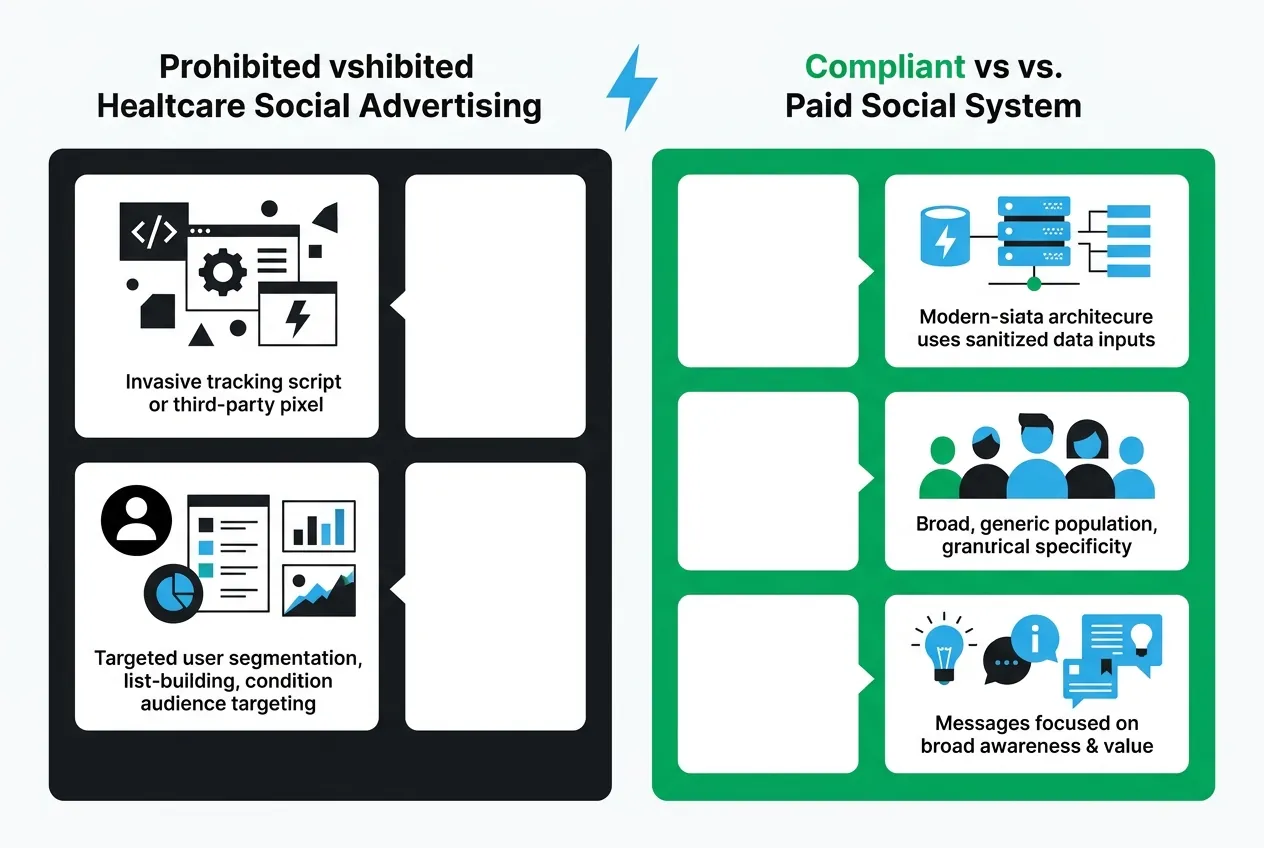
Healthcare organizations face a fundamentally different advertising environment than standard commercial brands. For years, digital agencies relied on invasive tracking scripts, third-party data broker segments, and aggressive retargeting lists to follow prospective patients across the web. That playbook is no longer viable. Federal regulators, platform policy teams, and consumer privacy laws have systematically dismantled traditional digital tracking methods in medicine.
The primary catalyst for this shift was regulatory enforcement regarding web trackers on medical websites. The HHS Office for Civil Rights Guidance on Online Tracking Technologies clarified that standard third-party tracking pixels placed on patient portals, telehealth platforms, or condition-specific booking workflows can impermissibly disclose protected health information. When an IP address, device identifier, or browser fingerprint is transmitted alongside URL parameters that reveal a specific medical condition or appointment request, covered entities face substantial HIPAA liability.
Simultaneously, Meta tightened internal enforcement across its advertising ecosystem. Under Meta Advertising Standards on Personal Attributes, ad copy and creative assets cannot assert or imply that a user possesses a specific medical condition, disability, mental health diagnosis, or physical ailment. Framing an ad around phrases such as "Do you struggle with depression?" or "Struggling with joint pain?" triggers automated account flags, ad rejections, and potential business manager restrictions. Furthermore, Meta Advertising Standards on Health and Wellness prohibit before-and-after imagery showing dramatic bodily transformations, unrealistic treatment outcomes, or negative self-perception hooks.
For specialized sectors such as addiction recovery, digital pharmacy, and specific medical devices, platforms also enforce third-party credentialing. Advertisers in these verticals must obtain mandatory certification under the LegitScript Healthcare Merchant Certification Program before their accounts can publish ad units.
These converging restrictions transformed healthcare social media advertising. Marketing teams that relied on technical surveillance and hyper-specific interest hacking saw their campaigns collapse. Successful patient acquisition now demands clean conversion architecture, transparent clinical positioning, and creative structures that invite patients to identify themselves voluntarily.
Compliant Targeting: Reaching Patients Without Violating Privacy
When Meta eliminated detailed targeting categories related to health conditions, medical treatments, and sensitive personal topics, many healthcare advertisers assumed paid social had lost its utility. In practice, stripping away narrow clinical targeting forced healthcare organizations to adopt broader, more resilient media structures that rely on native algorithmic optimization.
Modern campaign architecture starts with geographic and demographic precision. For multi-location practices, regional health systems, and specialty clinics, geographic boundaries represent the most reliable initial filter. Setting radius-based parameters around physical clinic locations prevents wasted spend in zip codes where prospective patients are statistically unlikely to travel for care. Demographic filters, such as broad age brackets and gender parameters, align ad delivery with the typical clinical profile of a given service line without running afoul of anti-bias or privacy rules.
Instead of building fragile custom audiences using scraped contact lists or unauthenticated site visitors, top-performing healthcare campaigns rely on contextual relevance. Contextual targeting uses top-of-funnel creative assets to let prospective patients self-select. When an ad addresses general health education, preventative measures, or structural information about how a specialized procedure works, users who stop, watch, and engage indicate inherent interest in that medical topic.
The platform delivery algorithm then identifies demographic and behavioral commonalities among users who engage with that educational content, dynamically serving subsequent creative to similar profiles within the chosen geographic area. This process operates without accessing individual medical records or collecting protected health information. The patient retains full autonomy, choosing to interact based on clinical value rather than invasive tracking.
Creative Strategy: What Still Converts on Meta Ads for Healthcare
Creative execution is the single most powerful targeting variable remaining on social platforms. When running meta ads healthcare campaigns, your creative assets must accomplish two distinct goals simultaneously: satisfy strict platform compliance algorithms and persuade a skeptical user to consider your medical practice.
Compliant copywriting requires shifting perspective from the user's personal identity to the provider's institutional capability. Direct assertions of personal vulnerability trigger automated ad rejection. Neutral, credential-led statements about service availability and clinical excellence pass review while establishing authority.
Consider how compliant messaging reframes common healthcare offerings:
- Non-compliant approach: "Are you suffering from chronic lower back pain? Get rid of your sciatica today." This asserts a personal health condition and implies a clinical outcome.
- Compliant approach: "Our fellowship-trained spine specialists offer minimally invasive evaluations for persistent lumbar discomfort. Explore non-surgical treatment options at our regional orthopedic center."
- Non-compliant approach: "Depressed or anxious? Find professional therapy before it ruins your relationships." This exploits personal emotional distress and assumes a mental health diagnosis.
- Compliant approach: "Access evidence-based outpatient therapy and psychiatric evaluations. Appointments available this week with licensed clinical providers."
Visual assets must adhere to identical standards of professionalism and restraint. Dramatic before-and-after photos, graphic depictions of surgical incisions, and exaggerated close-ups of body parts invite immediate disapproval. High-performing visual creative instead highlights clinical settings, diagnostic technology, and real care teams. Video walk-throughs of modern facilities, doctor-led explanations using anatomical models, and clear infographics explaining what to expect during an initial consultation generate high engagement while projecting clinical competence.
Effective facebook ad headline examples that consistently pass platform policy while maintaining high click-through rates include:
- "Board-Certified Cardiologists Serving Metro Atlanta: Schedule a Comprehensive Screening"
- "Minimally Invasive Joint Solutions: How Modern Outpatient Procedures Work"
- "Pediatric Urgent Care With Zero Wait Time: Open Seven Days a Week"
- "Understanding Your Treatment Options: A Guide to Outpatient Physical Therapy"
These headlines focus on provider credentials, clinical operational advantages, and educational clarity rather than patient vulnerability.
Free Audit
Want a straight read on where your budget is leaking?
Building Trust with Facebook Ads for Doctors and Specialty Providers
Specialty medical practices require a fundamentally different acquisition funnel than retail e-commerce or local consumer services. When people research medical care, they are evaluating clinical risk, professional competence, and personal trust. Deploying facebook ads for doctors demands positioning that respects the gravity of medical decisions.
Physician-specific campaigns perform best when centered on credential-led thought leadership. Video assets featuring the lead physician addressing common clinical questions break down the intimidation barrier that often delays patient outreach. When a fellowship-trained surgeon spends sixty seconds explaining the difference between conservative physical therapy and arthroscopic intervention, prospective patients perceive a trusted clinical counselor rather than an aggressive commercial advertiser.
Multi-location practices and specialty groups should structure doctor-led campaigns around three sequential touchpoints:
- Provider Introductions: Professional video introductions highlighting the physician's education, board certifications, philosophy of care, and specific sub-specialty interests.
- Clinical Demystification: Short-form educational answers to the exact questions patients ask during their first ten minutes in an exam room, such as preparation steps, recovery timelines, and insurance acceptance.
- Access and Next Steps: Clear, neutral descriptions of how the scheduling process works, including direct phone numbers, facility parking details, and self-scheduling software walk-throughs.
Managing patient social proof requires careful governance. In healthcare, soliciting public testimonials or featuring patient stories without explicit, documented HIPAA marketing releases creates severe legal exposure. Furthermore, federal regulators scrutinize deceptive online reviews and paid endorsements across consumer channels.
Rather than relying on unvetted patient testimonials, showcase verified institutional milestones: years serving the regional community, verified hospital affiliations, academic appointments, and aggregate patient satisfaction metrics compiled through standardized clinical surveys. Medical authority is established through professional transparency, not emotional hyperbole.

Expanding Service Reach with Instagram Ads for Healthcare
While Facebook remains an exceptional channel for reaching older demographics, adult caregivers, and family decision-makers, Instagram provides an essential platform for specialty care, preventative wellness, sports medicine, pediatrics, and elective medical procedures. Reaching prospective patients through instagram ads healthcare campaigns requires a visual-first approach tailored to mobile consumption patterns.
Mobile users on Instagram process visual media rapidly. Complex medical concepts must be distilled into digestible, clean creative units that communicate instantly without sound. Carousels perform exceptionally well for service lines that require multi-stage explanations. A five-card carousel can methodically walk a patient through an intake journey:
- Card 1: The clinical problem defined objectively using medical terminology.
- Card 2: Diagnostic methods used by the clinic to identify root causes.
- Card 3: Non-surgical and conservative therapeutic options.
- Card 4: Insurance networks accepted and financing options.
- Card 5: How to request a consultation with the clinic's care navigation team.
Video content on Instagram Stories and Reels demands high production standards without feeling staged. Clean lighting, crisp audio, clear on-screen closed captioning, and professional attire reinforce clinical authority. Filming in clinical exam rooms, surgical consultation suites, or diagnostic imaging suites establishes authenticity. Avoid using generic stock photography of actors wearing stethoscopes; modern health consumers recognize artificial marketing instantly and react with skepticism.
The transition from visual engagement to your clinic's landing page must be frictionless. When an Instagram user taps your ad, the destination page must load in under two seconds on mobile networks, present the exact physician or service referenced in the creative, and offer immediate, privacy-safe contact options, such as click-to-call buttons and simplified preliminary inquiry forms.
Data Architecture and Tracking: Attribution Beyond the Lead Form
The single greatest operational challenge in regulated paid social is measuring true commercial return without violating federal privacy statutes. In standard e-commerce, advertisers place third-party browser pixels that track every action a consumer takes across a website, feeding individual purchase values directly back into the ad platform. In healthcare, executing this configuration on condition-specific pages or booking workflows risks regulatory violation under federal tracking guidance.
Healthcare organizations must implement robust server-side conversion architecture and zero-party data handling. Rather than allowing third-party client-side pixels to scrape user interactions directly from the browser, modern healthcare conversion pipelines route web events through secure, HIPAA-aware server infrastructure. Sensitive URL query parameters, condition identifiers, and personal contact details are completely sanitized before any aggregated, non-sensitive signal is transmitted to advertising platforms.
Furthermore, superficial cost-per-click and raw lead counts are misleading indicators of financial performance. An agency that generates hundreds of cheap contact form submissions often delivers nothing more than non-viable inquiries, unverified insurance types, or out-of-market consumers. Clinical operations cannot run efficiently on vanity metrics.
Real commercial performance requires linking initial social engagement to downstream operational outcomes:
- Completed clinical intake assessments
- Verified commercial insurance or payment eligibility
- Attended specialist consultations
- Documented clinical admissions or scheduled surgical procedures
To achieve this without compromising patient privacy, healthcare organizations deploy offline conversion imports using hashed identifiers and privacy-safe transaction codes. By matching randomized operational identifiers from the practice management or electronic health records system back to anonymized ad click identifiers at the server level, marketing leaders can evaluate which ad creative and campaign structures drive actual patient volume.
This data sovereignty ensures your organization maintains complete control over sensitive records while providing paid social algorithms with the downstream conversion data necessary to optimize campaign bidding effectively.

Email Us
Prefer to send the context directly?
How Marketing Powered Manages Regulated Paid Social Campaigns
Marketing Powered approaches paid media as an operational business discipline rather than a superficial creative exercise. We design, deploy, and manage Google and Meta advertising programs specifically engineered for hospitals, medical groups, behavioral health networks, and regulated service providers who cannot afford compliance missteps.
Our operating perspective is rooted in enterprise-scale leadership. Our founder is a former healthcare CMO who ran marketing for a treatment network that grew from 3 to 24 locations, personally overseeing marketing systems in environments where regulatory scrutiny is paramount. Our background includes managing $1.5 to $2M per month in Google Ads across 11+ behavioral and mental health accounts, as well as serving as a court-certified expert witness in advertising strategy.
We operate as an AI-native firm, developing custom systems since 2022. Because patient confidentiality and data sovereignty are central to regulated marketing, we utilize owned, local AI infrastructure for HIPAA-aware inference, ensuring sensitive data processing never touches public cloud models.
Our media deployment reflects the operational realities of healthcare:
- Regulatory Alignment: We maintain strict adherence to platform standards, operating as a LegitScript-aware and HIPAA-aware partner. In verticals like behavioral health where retargeting is not permitted, we build native acquisition funnels designed to convert on initial intent.
- Downstream Attribution: We reject vanity lead counts. We build attribution architecture tracked to admission or booked consultation, linking ad spend directly to verified patient arrivals.
- Cross-Channel Media Architecture: Social advertising cannot operate in isolation. We coordinate Meta paid social campaigns with search demand capture. For organizations evaluating paid search alongside social channels, our guides on Healthcare PPC: structuring paid search for qualified patient demand and Google ads agency: what a specialist partner delivers and how to vet one provide detailed frameworks for capturing active patient intent. When evaluating outside support, our breakdown of Healthcare ppc services: what a specialist partner delivers and how to vet one outlines critical technical and governance standards.
We help healthcare leaders replace speculative digital tactics with defensible, privacy-first patient acquisition systems that perform under sustained regulatory inspection.
Questions, Answered.
A healthcare Facebook ads specialist is a paid social media practitioner who understands how to build and optimize Meta ad campaigns within the boundaries of federal patient privacy laws and platform advertising policies. Unlike general consumer marketers, a healthcare specialist knows how to structure broad-audience targeting, craft non-stigmatizing educational copy that passes personal attribute reviews, and deploy server-side tracking architecture that protects sensitive patient data while measuring real clinical appointments.
Medical practices can use the Meta pixel only on fully public, unauthenticated web pages that contain purely general educational content, provided no user-specific medical condition or health status is revealed. Under federal tracking guidance, deploying standard third-party pixels on patient portals, telehealth access points, appointment booking workflows, or pages addressing specific medical conditions creates significant compliance liability. Healthcare providers should transition to privacy-safe server-side conversion architecture and zero-party intake mechanisms.
Facebook ads for physicians are most commonly rejected for violating Meta Advertising Standards on Personal Attributes or Health and Wellness. Automated platform scanners flag copy that asks direct questions about a viewer's physical or mental health conditions, creative that features before-and-after treatment comparisons, or language that implies a specific medical diagnosis. To prevent rejections, ad copy must focus objectively on provider credentials, clinical service availability, and general health education rather than the prospective patient's condition.
LegitScript certification is a mandatory merchant verification process required by major advertising platforms, including Meta and Google, for specific regulated healthcare categories such as addiction treatment centers, online pharmacies, and certain medical device manufacturers. Without active LegitScript certification, businesses in these sensitive sectors cannot publish advertising campaigns on Facebook or Instagram. The certification validates facility licensing, clinical credentials, and operational compliance to prevent fraudulent or predatory advertising. Request a paid media audit from Marketing Powered
Ready to see where your marketing can improve?
Request a free audit of your paid media, landing pages, attribution, and measurement setup. You'll get a straight assessment of where the opportunities are.
or email us at info@marketingpowered.ai