Resources
AI Ownership: Why We Chose to Own Our Marketing AI Stack
Marketing operations face a structural ceiling when built entirely on rented cloud subscriptions and commercial web wrappers. True operational leverage requires treating artificial intelligence as a durable balance sheet asset rather than an escalating monthly operational expense. Embracing ai ownership transforms how leadership controls unit economics, protects sensitive business data, and insulates core workflows from third-party volatility.
By Mike Hulick, Founder, Marketing Powered

The Rented Stack Trap: Accumulating SaaS Debt and Operational Risk
Between 2023 and 2025, enterprise marketing departments adopted artificial intelligence primarily through software-as-a-service subscriptions. Growth teams licensed specialized tools for copywriting, creative variations, search optimization, workflow automation, and intake transcription. Each individual seat license appeared modest on a departmental corporate card, but the cumulative outcome was fragmented tooling, unmetered recurring commitments, and zero enterprise equity.
This configuration creates compounding operational debt. When a marketing department runs its core analytical and creative processes through commercial wrappers, every prompt, prompt chain, and workflow runs across public infrastructure. The organization pays for every token consumed while training third-party systems on its operational patterns. If leadership cancels those subscriptions during an operational review or budget contraction, the underlying marketing capability vanishes overnight.
The physical reality of this model is visible inside modern marketing departments: growth directors staring at sprawling software invoices, teams manually copying outputs between disconnected browser tabs, and analysts troubleshooting integrations broken by silent platform updates. The software vendors capture the margin, while the enterprise assumes the structural risk.

What Is AI Ownership in Modern Marketing Operations?
Understanding ai ownership begins by clarifying what ownership actually means in an enterprise software context. In commercial law and business finance, ownership denotes clear title, exclusive rights of use, and the legal ability to capture the long-term utility of a capital asset without ongoing permission from a landlord.
In corporate practice, business ownership structures typically establish who controls the assets and who absorbs the operational downside. When applied to machine intelligence, ai ownership does not mean that an organization must spend hundreds of millions of dollars pre-training massive foundation models from scratch. Instead, it means establishing direct control over the computing hardware, deploying open-weights models behind your private firewall, maintaining proprietary fine-tuning pipelines, and retaining total custody of execution logic.
- Financial Accounting. Rented AI Stack (SaaS / Public Cloud): Perpetual Operating Expense (OpEx) with variable token tolls. Owned AI Infrastructure (Local & Open-Weights): Depreciable Capital Expense (CapEx) amortized over 3 to 5 years.
- Model Stability. Rented AI Stack (SaaS / Public Cloud): Subject to forced cloud provider model deprecations and safety drift. Owned AI Infrastructure (Local & Open-Weights): Pinned model weights deployed on dedicated hardware without forced updates.
- Data Governance. Rented AI Stack (SaaS / Public Cloud): Operational telemetry and inputs transmitted to external APIs. Owned AI Infrastructure (Local & Open-Weights): Air-gapped or ring-fenced internal inference behind the corporate perimeter.
- Workflow Moat. Rented AI Stack (SaaS / Public Cloud): Generic point-and-click tools accessible to every direct competitor. Owned AI Infrastructure (Local & Open-Weights): Custom-orchestrated agent pipelines and proprietary operational intelligence.
Renting public models keeps a business dependent on external access rules. Owning your infrastructure establishes an operational asset that compounds in utility as your internal knowledge base expands.
Breaking AI Platform Dependency and Surviving Silent Model Deprecation
Building growth systems on third-party commercial APIs introduces severe ai platform dependency. Commercial AI providers operate on aggressive commercial cycles. They regularly adjust system prompts, alter internal reward models, update safety filters, and deprecate earlier model checkpoints to optimize their own server utilization. Major cloud providers maintain explicit model retirement schedules, such as the Google Cloud Vertex AI model deprecation policy, which systematically discontinues older model versions and requires recurring software engineering overhauls.
When a public platform deprecates a model version, complex marketing operations break down. A prompt sequence designed to extract precise search themes, classify campaign intent, or draft technical copy under rigid brand constraints may suddenly return altered formats, unexpected refusals, or degraded reasoning quality. Marketing engineering teams must then scramble to rewrite system instructions and test downstream integrations.
The operational risk extends beyond planned retirements. Commercial cloud providers face regional outages, capacity throttling, and sudden policy revisions that restrict permissible content categories without appeal. When core marketing workflows run on owned infrastructure with frozen, open-weights model weights, deprecation ceases to be an external threat. The system performs predictably today, next quarter, and three years from now.
Free Audit
Want a straight read on where your budget is leaking?
The Balance Sheet Case: Economics of Owned AI Infrastructure
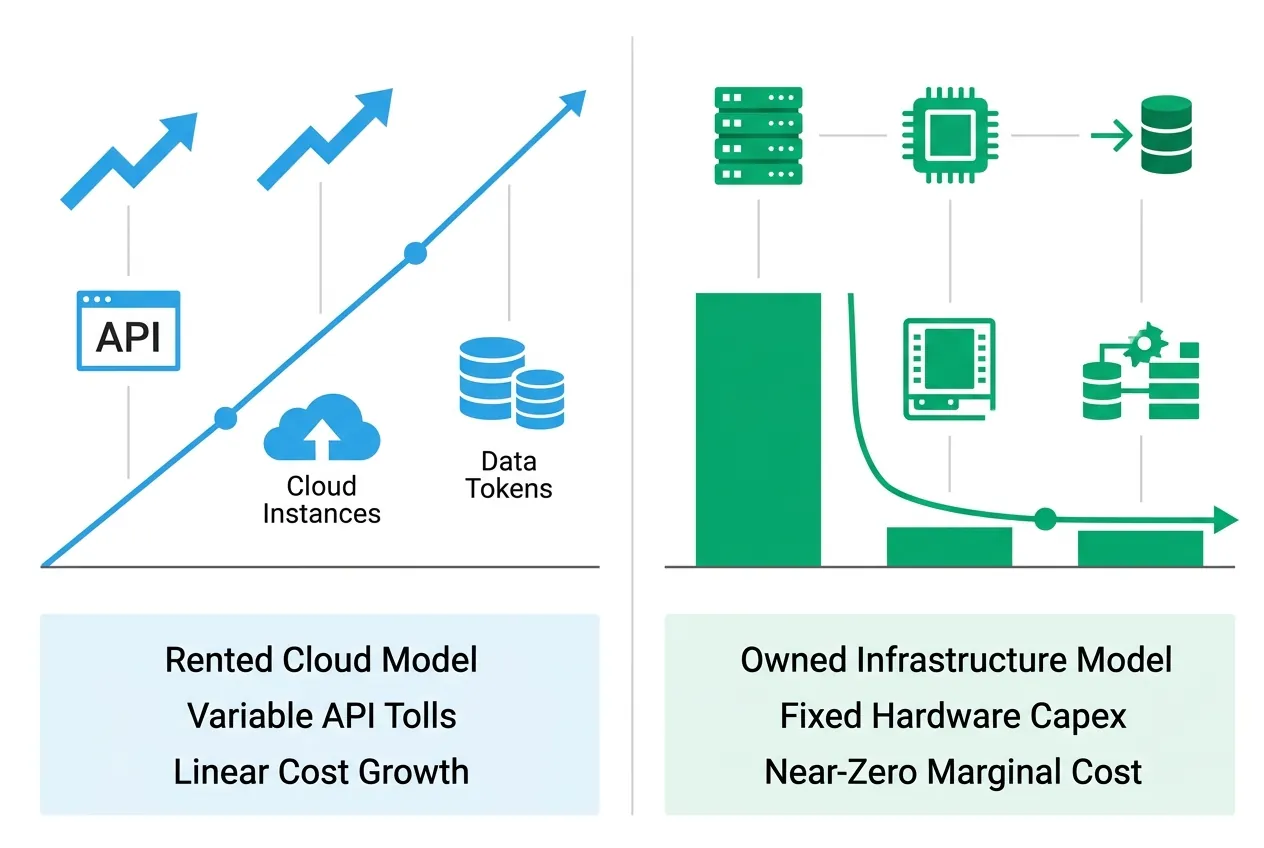
The financial argument for owned ai infrastructure centers on corporate accounting principles: amortizing fixed capital investments versus absorbing open-ended operating expenses. Commercial cloud inference meters every interaction. In high-velocity marketing environments, teams process vast arrays of search query logs, perform automated SERP audits, generate tens of thousands of dynamic creative variations, and conduct detailed synthetic customer research. Under an API pricing model, every iterative refinement incurs a marginal cost.
This metering creates perverse operational incentives. Content teams ration their testing, reduce the scope of audience segmentation, or skip comprehensive quality checks to avoid blowing past departmental API budgets.
Transitioning high-volume workloads to dedicated, self-managed local compute fundamentally shifts this math. Once hardware is procured, configured, and placed into service, the marginal cost of running another inference run drops near zero. Analysts can run multi-agent workflows, process massive datasets, and test hundreds of copy angles across millions of tokens without generating an unpredictable monthly cloud bill. The investment shifts from an uncontrollable monthly drain into a depreciable corporate asset.
Data Sovereignty and the Reality of Regulated Advertising
Data control becomes a board-level priority when marketing in heavily monitored, highly regulated sectors. In behavioral healthcare and specialized clinical services, privacy standards are absolute. Advertising platforms enforce strict rules around user privacy; for instance, the Google Ads Policy on Personalized Advertising explicitly prohibits targeting or building audience remarketing lists based on sensitive health conditions or personal personal hardships.
As a former healthcare CMO who ran marketing for a treatment network that grew from 3 to 24 locations and managed $1.5 to $2M per month in Google Ads across 11+ behavioral and mental health accounts, I observed firsthand how fragile public platform connections can be. In high-compliance environments, attribution must be tracked to admission, not just lead. LegitScript-aware and HIPAA-aware architectures cannot afford casual data leaks.
Piping sensitive intake notes, conversion telemetry, or strategic positioning data across shared commercial web interfaces creates unacceptable compliance exposure. Owned, local AI infrastructure for HIPAA-aware inference provides an isolated processing boundary. Proprietary data stays strictly inside the organization's physical or dedicated perimeter, eliminating third-party data collection risks while preserving advanced automation capabilities.
The Operator Model: Deploying Specialized AI Systems at Marketing Powered
At Marketing Powered, we operate as an AI-native marketing organization, a commitment maintained since 2022. We do not view artificial intelligence as a collection of novelty web tools or consumer plugins. We treat it as an industrial execution capability that strengthens fundamental digital marketing, high-intent search acquisition, and strategic operations.
Our approach integrates dedicated, self-hosted hardware environments with specialized multi-agent architectures. We isolate high-volume, sensitive tasks on our owned infrastructure, including deep search pattern discovery, creative structuring, competitive market research, and multi-location performance modeling. By combining local, private inference for internal workflows with deliberate use of commercial foundation models when broader exploratory reasoning is advantageous, we balance absolute data governance with state-of-the-art output quality.
To learn more about how we structure, deploy, and govern these custom marketing environments for enterprise growth, explore our work with specialized AI systems and AI-native marketing operations. We build technical systems designed to deliver measurable commercial returns rather than fashionable software novelty.

Email Us
Prefer to send the context directly?
A Strategic Blueprint: Practical Steps to Own Your AI Architecture
Transitioning from rented subscriptions to an owned infrastructure model requires a phased, disciplined deployment plan. CMOs and enterprise technical leaders can implement this transition through three structured phases:
- Audit Workflows and SaaS Redundancies: Catalog every external generative AI tool currently licensed across your growth, content, and media teams. Identify repetitive, high-volume workloads such as competitive intelligence parsing, initial draft structuring, and performance reporting. Measure both direct seat costs and time lost to fragmented data handoffs.
- Deploy Dedicated On-Premises or Private Hardware: Procure dedicated computing nodes equipped with sufficient unified memory and compute bandwidth to run modern open-weights models. Stand up isolated execution environments running open-source frameworks behind your corporate security perimeter.
- Pin Production Weights and Orchestrate Specialized Agents: Select high-performance open models tuned for coding, analysis, and writing. Freeze the model weights to eliminate deprecation risks. Build modular agent chains that execute specific operational responsibilities with deterministic validation checks at each stage.
When you own your ai stack, your marketing department stops functioning as a testing ground for external software platforms. It becomes a self-contained operational engine with a proprietary moat that competitors cannot replicate by purchasing the same subscriptions.
Questions, Answered.
An ownership interest represents legal title, operational control, and financial custody over a designated asset. In enterprise AI, ownership interest does not refer to claiming intellectual property over foundational open-source models. It means owning the dedicated physical or private compute hardware, the stored model weights, the fine-tuning datasets, and the proprietary orchestration software that directs your business workflows.
No. Training a foundational large language model from scratch requires tens of millions of dollars in compute and vast corpus data. AI ownership focuses on deploying high-capability open-weights models on owned or dedicated hardware. You control the inference environment, system prompt architectures, internal vector databases, and execution agents, avoiding perpetual software subscriptions while capturing enterprise-grade intelligence.
Ownership structure in machine learning refers to how the hardware, software, and data layers are partitioned across legal and operational boundaries. In a rented model, a public vendor controls the servers, system weights, and runtime logs, granting you temporary access via API. In an owned model, your business maintains physical or single-tenant administrative custody over the server infrastructure and local storage, ensuring complete authority over data retention and process execution.
When an organization relies on external cloud APIs, changes to a vendor's terms of service, acceptable use policies, or internal content filters can halt live marketing workflows without notice. Owning your infrastructure and running open-weights models creates an autonomous runtime environment. Your production capabilities operate independently of external vendor shifts, policy changes, or sudden platform deprecation cycles. Talk with Marketing Powered about owning your marketing AI stack.
Ready to see where your marketing can improve?
Request a free audit of your paid media, landing pages, attribution, and measurement setup. You'll get a straight assessment of where the opportunities are.
or email us at info@marketingpowered.ai